The Fleury Cross

IMG_0177

TIS A HARSH WORLD

IN WHICH AFFECTION KNOWS

NO PLACE TO TREASURE

UP ITS LOVED AND LOST

BUT THE LONE GRAVE.

The cross is one of the most common symbols found in cemeteries. It is a Christian symbol that comes in many different designs with separate meanings often with ancient origins. The cross on this white marble gravestone in the Laurel Hill Cemetery at Philadelphia, Pennsylvania, is called a fleury or floriated cross. What distinguishes this cross are the three-petaled tips at the end of the arms of the cross representing the petals of the lily.

The number three also has significance in Christianity and represents the Holy Trinity—the Father, the Son, and the Holy Ghost. This type of cross was also used in the symbolism of heraldry to represent the virtues of wisdom, faith, and chivalry.

This elaborate version of the fleury cross also has ivy leaves twinning around the gravestone. The ivy traditionally represents friendship. The epitaph coupled with the symbolism of the ivy on this tombstone speaks to the loss of a loved one in word and art.

Posted in Symbolism, Uncategorized | Leave a comment

Soldier Restored

IMG_9817

On top of one of the rolling hills in Unionville Township in Monroe County, Indiana, there was a tiny rural church, the Pleasant View Baptist Church, long since abandoned by the congregation and torn down. But, next to where the small church stood remains the Pleasant View Cemetery where the family members of the church were laid to rest.

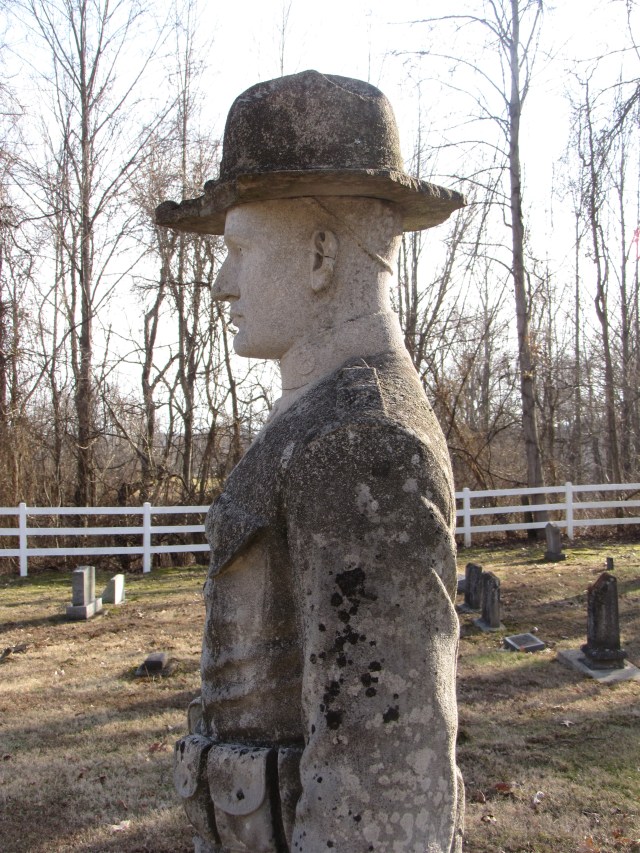
Toward the back of the cemetery nearly in the center stands a proud statue of a World War I soldier, tall and straight, looking forward at parade rest. The doughboy is carved from Bedford limestone, paid for by the boy’s grandmother as a tribute to Thomas Forrest Riddle, the fallen hero. The statue carved by one of the expert Owen County stone carvers stands next to a solid block of granite that has two names carved into the face of the polished red stone:

THOMAS F.

RIDDLE

1895-1919

RAYMOND R.

RIDDLE

1897-1919

IMG_9821

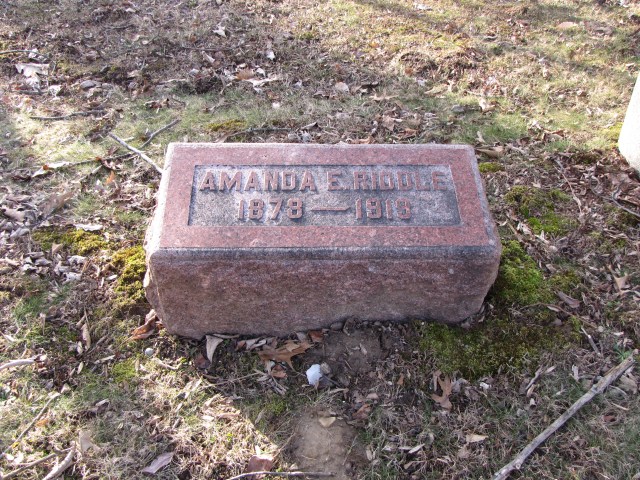
Next to that monument is a small red granite polished stone with the simple inscription:

AMANDA RIDDLE

1897-1919
IMG_9850

These three gravestone are the outline of a family tragedy for the Riddles who farmed and lived in this rural area. Thomas Andrew Riddle and his wife, Elizabeth Angeline, had a big brood of children as farm families did in those days but within one month the Spanish Influenza struck the family killing 3 of their 13 children.

The Saturday February 22, 1919, Bloomington Evening World, ran an headline that tells the story: THREE INFLUENZA DEATHS IN ONE FAMILY ONE MONTH.

The story goes on, “Influenza-pneumonia has already resulted in the death during the present month of their members of the family of Mrs. James Riddle, eleven miles northeast of the city, and two more are still sick with the malady.

Forrest, the 21-year-old son, who returned from service overseas only last Sunday, fell victim last night. His brother Raymond, 21, was buried yesterday. A sister, Miss Amanda, died the first day of February.”

The young soldier came back from the war in apparent good health only to find every member of the family in bed with the plague. He contracted the disease the same say and was so bad from the start that little hope was held out for him. He and his brother Raymond were delirious most of the week and the nurses did not know which one of the boys would be the first to go. The funeral of Forrest will be held at Pleasant View church tomorrow at 10:30 in charge of the Rev. Bayless. Forrest went to war with eight other boys of the same neighborhood, all of whom have returned. The others will set as pall bearers at his funeral. His comrades say he was in two or three big battles and was gassed, being in one of the hospitals in France two months.

The Sunday September 7, 2003 Hoosier Times article by Bette Nunn reported that Thomas Forrest Riddle “enlisted in the Army June 4, 1918. He was assigned to Co. D., 12th Machine Gun Battalion, 4th Division. He saw battle at Chateau Thierry and Argonne forest and became a casualty of war from poison gas.”

IMG_9847

IMG_9846

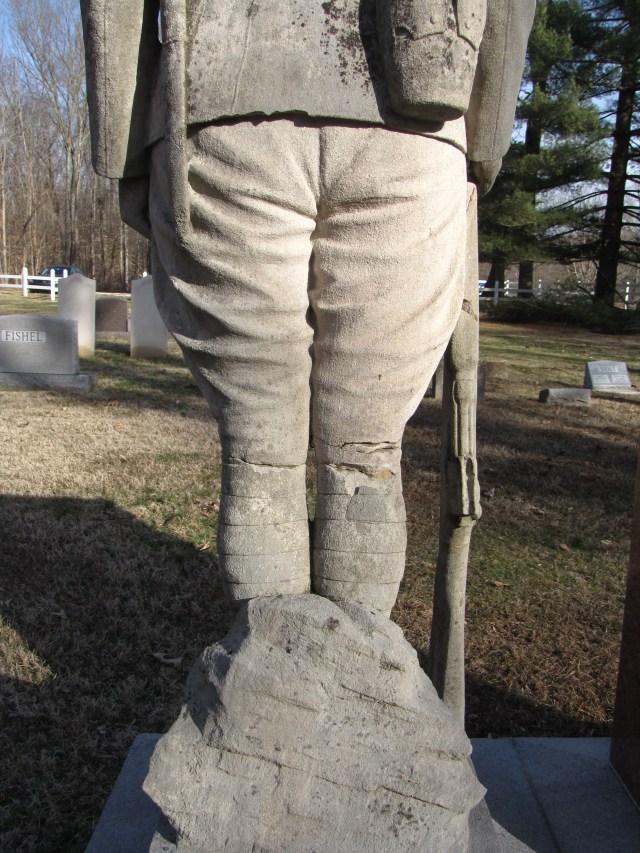
The article also reported that on August 12, 2003, the heroic statue of Thomas Forrest Riddle was vandalized—and badly damaged, smashed into several pieces, his head separated from the body, and broken below his knees. Rightfully the community around the area was outraged and went to action. The statue was mended and the soldier once again stands guard over the graves of Amanda, Raymond, and Thomas Forrest Riddle.
IMG_9844

Posted in Uncategorized | 3 Comments

The Flint Granite Company

IMG_4353

IN MEMORY OF

A FOND FATHER

JOHN LUDIN

DEVOTED HUSBAND OF

AGNES DEMANGEAT LUDIN

BORN SEPT. 24TH, 1827. DIED DEC 13TH, 1903

IN MEMORY OF

A

LOVING MOTHER

AGNES DEMANGEAT LUDIN

WIFE OF

JOHN LUDIN

BORN DEC. 11TH 1821; DIED AUG. 5TH, 1877

IMG_4355

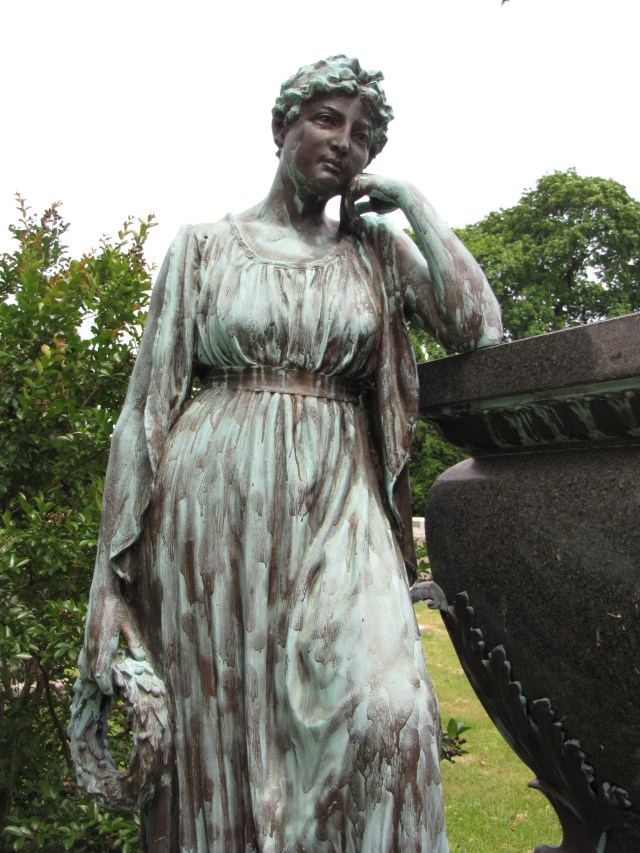
The Ludin family monument in the Green-Wood Cemetery at Brooklyn, New York, features a sarcophagus adorned with a bronze mourning figure.  Sarcophagus tombs are designed to look like coffins.  Most often they are set on a platform or a base.  The tomb is often embellished with ornamentation and nearly always has feet, though this one does not–but the “coffin” is empty–just an empty symbol of the receptacle.  This style of burial monument is ancient. The mourning figure’s head is bent in sorrow. Her head leans against one hand as the other clasps a laurel wreath in the other.   The laurel wreath dates back to Roman times when soldiers wore them as triumphal signs of glory.  The laurel was also believed to wash away the soldier’s guilt from injuring or killing any of his opponents.  In funerary art the laurel wreath is often seen as a symbol of victory over death.

IMG_4354

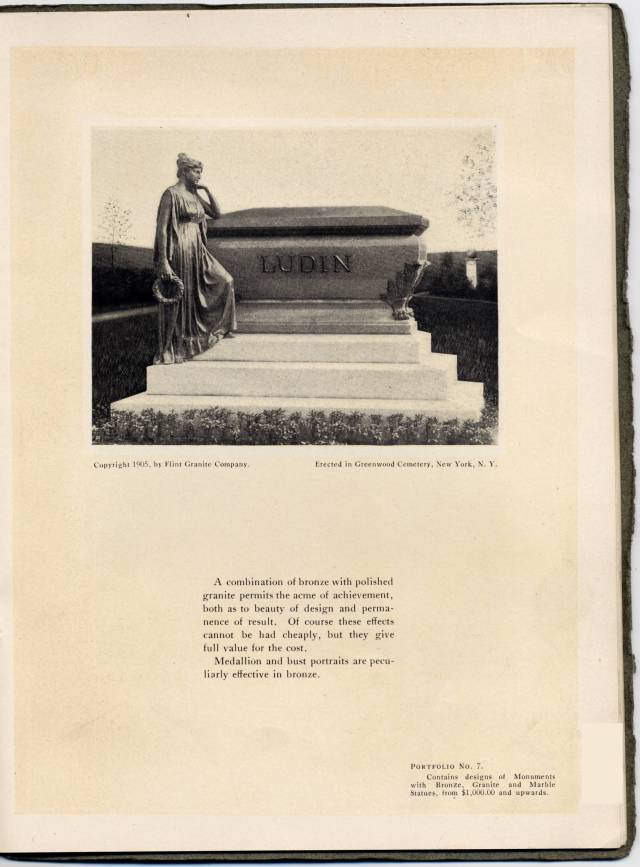
The monument was pictured in the Flint Granite Company brochure. The brochure describes the monument this way, “A combination of bronze with polished granite permits the acme of achievement, both as to beauty of design and permanence of result. Of course these effects cannot be had cheaply, but they give full value for the cost.”

IMG_4361

The brochure was prepared as an advertisement with pictures of magnificent monuments designed by the Flint Granite Company that highlighted specific monuments from their portfolio of designs.

flint_granite_co_bklet_p17

This Flint Granite Company catalog and many other gravestone and monument company brochures can be found at the Stone Quarries and Beyond Website: http://quarriesandbeyond.org/cemeteries_and_monumental_art/cemetery_stones.html.

The Stone Quarries and Beyond Website was created by Peggy B. and Patrick Perazzo. It focuses on historic stone quarries, stone workers and companies, and related subjects such as geology. Whenever possible links of finished products are provided on the Website. There is a “Quarry Articles” section that presents articles, booklets, and links from the late 1800s to early 1900s, including the 1856 “The Marble-Workers’ Manual.” The “Cemetery Stones and Monuments” section provides references and resources, including many old monument magazines, catalogs, price lists, and a photographic tour “From Quarry to Cemetery Monuments.”

Posted in Saving Graces, Symbolism | Leave a comment

Three revolutions around the statue saying his name

Bethel Cemetery, Hymera, Indiana

Bethel Cemetery, Hymera, Indiana

NATHAN HINKLE

BORN JUNE 7, 1749

DIED DEC. 25, 1848

NATHAN HINKLE

REVOLUTINARY SOLDIER

ENLISTED IN LANCASTER CO.

PENN APR. 1776 AND SERVED

2YS 9MS UNDER CAPT. HENRY

CRISP — COL. MILES REG AS A PRI-

VATE PARTICIPATED IN THE

BATTLES OF LONG ISLAND

BRANDYWINE AND PAOLI

Facing the highway at the Bethel Cemetery in the little town of Hymera, Indiana, is the statue of Revolutionary solider Nathan Hinkle. The local legend that has grown up around this proud monument is that you can evoke his spirit by walking around his statue three times saying his name with each revolution—then, Nathan comes alive and speaks back.

The limestone statue depicts a Revolutionary War soldier at parade rest, holding his rifle butt down, but unfortunately, most of the rifle is missing, save for the piece he clutches with his hands. The statue to honor Nathan Hinkle was unveiled on a Fall day in October in 1904, with a cluster of local dignitaries, a Knights of Pythias band, and a crowd estimated at seven thousand. Hymera, at the last Census, had 801 residents—it is hard to imagine that many people assembling for the unveiling today.

As the Sullivan County History details. “The ceremonies of the day centered about the unveiling of a monument to Nathan Hinkle, the Revolutionary soldier who was buried in the Hymera cemetery. About a year before the movement had been started to raise funds for such a memorial, and the subscriptions had been gathered and the monument set in place for this occasion. Hon. James S. Barcus, a great-grandson of the patriot, delivered an address, and Miss Mamie Asbury, a great-granddaughter, assisted in the unveiling. The monument is fifteen feet high, representing a Revolutionary soldier at “parade rest.”

IMG_6341


Posted in Uncategorized | Leave a comment

Salute to the Gray and the Blue

The Gray

IMG_5518

During the Civil War Americans were fighting against Americans. Brothers against brothers—cousins against cousins, every casualty and every fatality was an American. The war tore the country apart and threatened the very existence of the Republic itself.  The war left an edible mark on all who lived through those times. Rightly, town squares, parks, battle sites, and cemeteries throughout the United States pay tribute with monuments to the soldiers that fought to preserve the Union and those who fought to preserve the South and the Confederacy.  Cemeteries often have special sections where the soldiers themselves are buried.  Most of the monuments across the country, whether they be in the North or the South, were funded either by the soldiers themselves or associations created to honor the service of those who wore a uniform—gray or blue.

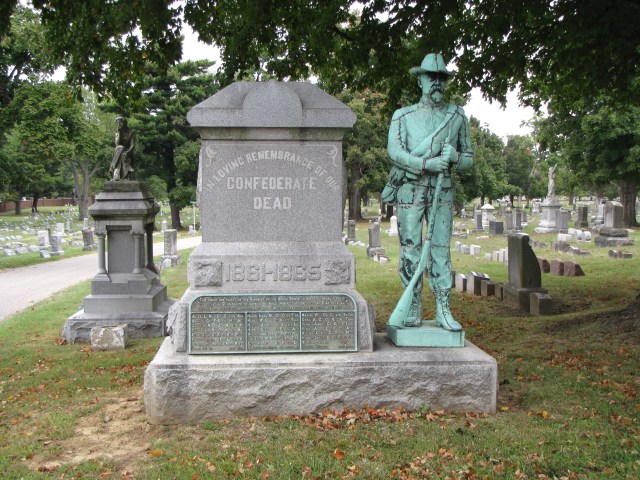
To honor the 24 Confederate war dead buried in unmarked graves in the Oak Hill Cemetery at Evansville, Indiana, the Fitzhugh Lee Chapter of the Daughters of the Confederacy had erected a monument in 1904. The monument is comprised of two elements—a large polished and matte granite block and a sculpture of Confederate soldier on a large gray granite base.  The granite block has carved on the face:

IN LOVING REMEMBRANCE OF OUR

CONFEDERATE DEAD

1861-1865

On the base of the large granite block is a bronze plaque that reads:

THIS TABLET WAS PLACED ON THIS MONUMENT BY THE UNITED STATES TO MARK THE BURIAL PLACE OF 24 CONFEDERATE SOLDIERS, WHO, WHILE PRISONERS OF WAR, DIED AT EVANSVILLE AND WERE BURIED IN THIS CEMETERY, WHERE THE INDIVIDUAL GRAVES CANNOT BE IDENTIFIED NOW.

IMG_5520

Below that are the names of the 24 soldiers buried in Oak Hill. The statue beside the block a life size replica of a Confederate soldier holding a rifle, butt down.  The soldier is in full uniform and gazes forward in a direct and respectful manner.

The Blue

IMG_5420

Not to be outdone by the Confederate ladies, in 1909, the auxiliary organization to the G.A.R., the Woman’s Relief Corp embarked on a campaign to raise a monument to salute the Union soldiers buried in the Oak Hill Cemetery. There are nearly 600 Union war soldiers buried in Oak Hill Cemetery, many of whom died after the bloody and hard-fought Battle of Shiloh and in the Evansville area hospitals.  The monument honoring the Union soldiers is comprised of a large gray granite marker with a Union soldier standing atop.  The soldier holds his rifle, butt down, as he gazes forward over the graves of the fallen.

IMG_5421

Inscribed on the plinth:

ERECTED

BY THE

WOMAN’S RELIEF CORPS

A. D. 1909

IN MEMORY OF

THE COMRADES OF

FARRAGUT POST NO. 27

DEPARTMENT OF INDIANA

GRAND ARMY OF THE REPUBLIC

1861 — 1865

LOYALTY

IMG_5535

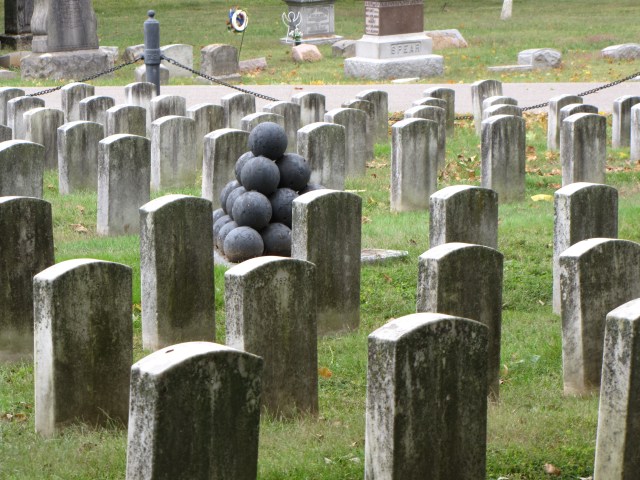
The large section of Civil War soldiers resembles a military cemetery—576 soldiers from 13 states—whose headstones are lined up in rows—are also honored with restored cannons and stacks of cannonballs as part of the tribute paid to their service.

IMG_5537

Posted in Uncategorized | Leave a comment

The Tree of Life

IMG_4682

A bright highly-polished white marble family tombstone in the Elmwood Cemetery at Charlotte, North Carolina, depicts an intricately carved Tree of Life. In funerary art the Tree of Life represents earthly or heavenly spiritual life with its meaning coming from Christian origins. To Catholics the Tree of Life represents the purity of life free from sin before the Fall. According to Saint Albert the Great, if the Tree symbolized Life, the Blood and Body of Christ represented the “fruit”.

IMG_4685


Posted in Symbolism | Leave a comment

Expressing Beauty


harrison_gran_co_1918_bklet_p8_9

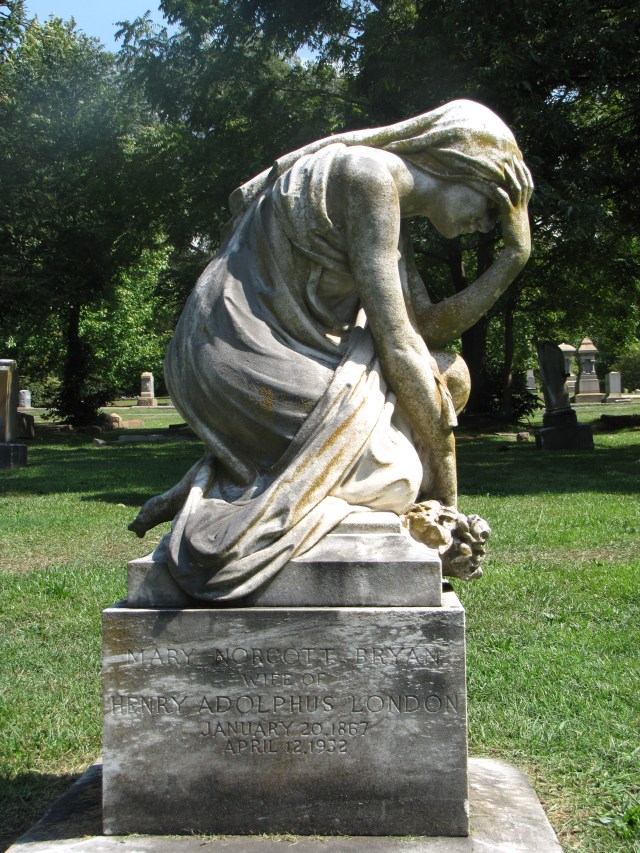
The Harrison Granite Company of New York City founded in 1845, had quarries and works at Barre, Vermont, mailed out brochures January of 1918, featured a sculpture of a kneeling woman with her head in her hand in grief. The brochure says, “Recommended for expressing beauty”. Several sources suggest that the sculpture is a representation of the Greek Goddess Niobe while another source says it is an expression of the “Morning Prayer”. The Harrison Granite Company brochure does not shed light on which is accurate. The mystery remains.

This sculpture has been found at least five time—the Gray Family Monument at the Oakland Cemetery at Atlanta, Georgia; the Haggard monument at the Mount Olivet Cemetery at Nashville, Tennessee; The Inez M. and James Dunn Family Monument at the Glendale Cemetery at Akron, Ohio; the Mary Norcott Bryan London Monument in the Elmwood Cemetery at Charlotte, North Carolina; and The Mary Salmen Monument at the St. Joseph Catholic Cemetery at Evansville, Indiana, are clearly look-a-likes.

Gray Family Monument at the Oakland Cemetery at Atlanta, Georgia

Gray Family Monument at the Oakland Cemetery at Atlanta, Georgia

The Haggard monument at the Mount Olivet Cemetery at Nashville, Tennessee

The Haggard monument at the Mount Olivet Cemetery at Nashville, Tennessee

The Mary Norcott Bryan London Monument in the Elmwood Cemetery at Charlotte, North Carolina

The Mary Norcott Bryan London Monument in the Elmwood Cemetery at Charlotte, North Carolina

The Mary Salmen Monument at the St. Joseph Catholic Cemetery at Evansville, Indiana

The Mary Salmen Monument at the St. Joseph Catholic Cemetery at Evansville, Indiana

The Inez M. and James Dunn Family Monument at the Glendale Cemetery at Akron, Ohio.

The Inez M. and James Dunn Family Monument at the Glendale Cemetery at Akron, Ohio.

This Harrison Granite Company catalog and many other gravestone and monument company brochures can be found at the Stone Quarries and Beyond Website: http://quarriesandbeyond.org/cemeteries_and_monumental_art/cemetery_stones.html.

The Stone Quarries and Beyond Website was created by Peggy B. and Patrick Perazzo. It focuses on historic stone quarries, stone workers and companies, and related subjects such as geology. Whenever possible links of finished products are provided on the Website. There is a “Quarry Articles” section that presents articles, booklets, and links from the late 1800s to early 1900s, including the 1856 “The Marble-Workers’ Manual.” The “Cemetery Stones and Monuments” section provides references and resources, including many old monument magazines, catalogs, price lists, and a photographic tour “From Quarry to Cemetery Monuments.”

Posted in Uncategorized | Leave a comment

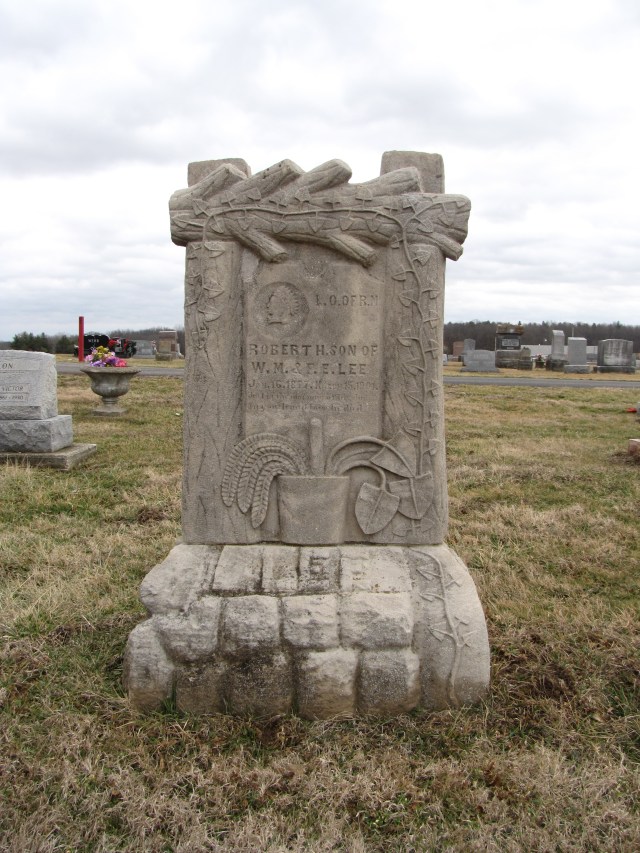
I. O. of R. M.

Fairview Cemetery, Linton, Indiana

Fairview Cemetery, Linton, Indiana


ROBERT H. SON OF

W. M. & F. E. LEE

JAN. 16, 1877. MARCH 15, 1901.

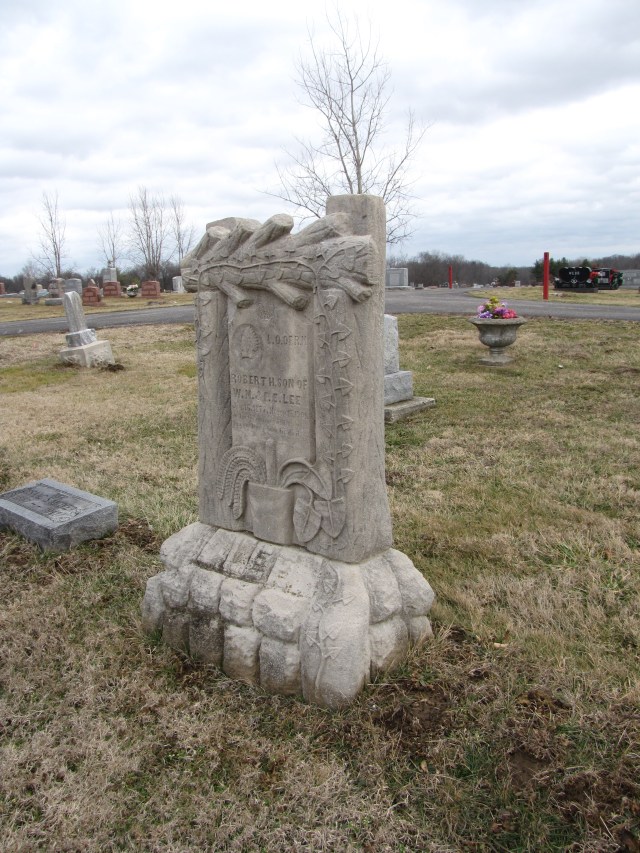
The gravestone of Robert H. Lee was carved in the rustic tradition. The gravestone is caved to like two logs on end are holding up a branch at the top. All of that sitting on a rock foundation. The rustic movement of the mid-nineteenth century was characterized by designs that were made to look like they were from the country. Elegant and slim curved lines in furniture gave way to bulkier and heavier forms made from pieces that came directly from the trees often with the bark still intact. In funerary art, tombstones took on the look of tree stumps. The gravestones were purposefully designed to look like trees that had been cut and left in the cemetery to mark a grave.
The rustic movement coincided with the rural cemetery movement. The rural cemeteries were often located on the outskirts of town and laid out as a park would be—with broad avenues and winding pathways, featuring picturesque landscaping such as ponds, abundant trees, and shrubs. The tree-stump tombstones were a funerary art contrivance mimicking the natural surroundings of the cemetery. The tree-stump tombstones were most popular for a twenty year-period from about 1885 until about 1905.

At the bottom of the gravestone, a flower pot sits in the middle with large stem without a bloom—a metaphor of an early death.

IMG_9693

Above Robert’s name and to the left is a circle with the silhouette of a Native American. The eroded bas-relief represents the symbol of the Improved Order of Redmen (I. O. of R. M.), which claims its beginnings with the patriots who were in the Sons of Liberty during the American Revolution.  The society models itself after the Iroquois Confederacy councils.  According to their Website, the I. O. of R. M. “promotes patriotism and the American Way of Life, provides social activities for the members, and supports various charitable programs.”  The different clubs or chapters are divided into “tribes”.

IMG_9694

Posted in Uncategorized | Leave a comment

In Service of His Country


IMG_9517

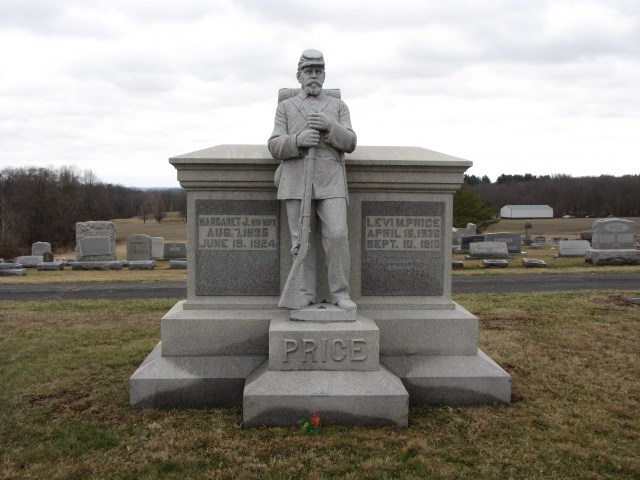
MARGARET J. HIS WIFE

AUG. 7, 1835

JUNE 19, 1924

LEVI M. PRICE

APRIL 15, 1836

SEPT. 10, 1910

59th IND. VOLUNTEERS

COMPAN Y E

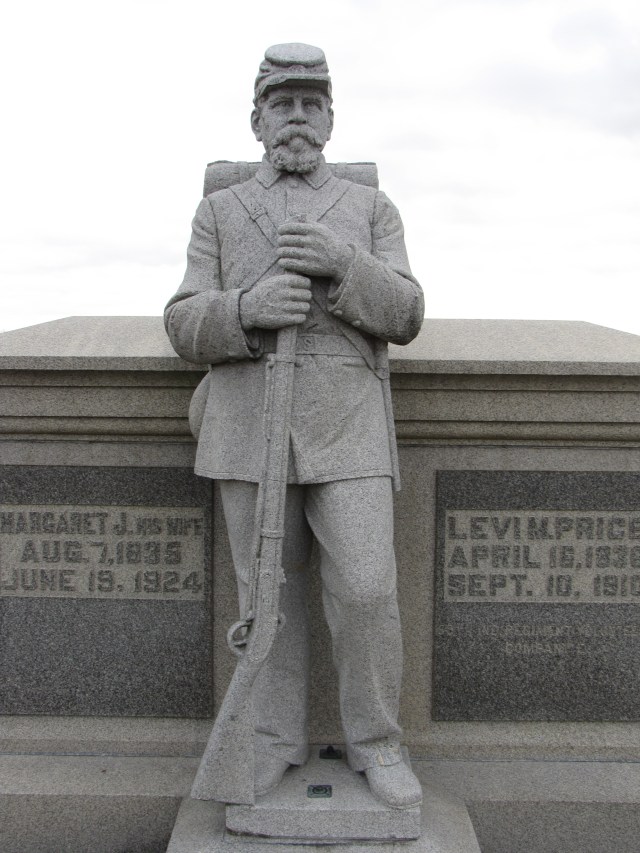
The monument in the Fairview Cemetery at Linton, Indiana, created for Levi Moss Price and his wife, Margaret Jane features a life-size granite statue of a Union soldier. According to Civil War Sites, Memorials, Museums and Library Collections: A State by State Guidebook to Places Open to the Public written by Doug Gelbert, the Union soldier is “standing at parade rest” and “was sculpted by Wilbur Wright Marbler”.

IMG_9521

The Green County, Indiana with Reminiscences of Pioneer Days, Volume III, published by B. F. Bowen & Company, Indianapolis, Indiana (1908), gives a brief but informative history of Levi Price:
Among the children of Aquilla Price was a son by the name of Levi M., whose birth occurred in Greene County, Indiana, in the year 1836, and who has been proud to call this section of the Hoosier state his home from that date to the present time. In his young manhood Levi Price married Margaret Hail, daughter of the Rev. Martin and Phoebe (Hickle) Hail, the father a popular minister of the Methodist Episcopal Church during the pioneer period in Greene County and a leader in religious affairs wherever his labors called him. He spent his declining years in Linton, where his death occurred at the advanced age of eighty-nine years, his faithful wife having also neared the century mark when summoned to the unseen world. Levi Price became one of the prominent farmers and stock raisers of Greene County, and after accumulating a handsome competency, retired from active life to enjoy the fruits of his labor and thrift. On the 27th day of October, 1907, he and his good wife celebrated the fiftieth anniversary of their marriage, on which occasion there assembled at their home in Linton, two hundred and fifty-five guests tow wish the worthy couple many returns of the memorable day and to rejoice with them in view of the many signal blessings by which their pathway has been best. Since retiring from active life Mr. and Mrs. Price has spent the winter seasons on the south Atlantic Coast and the rest of the year among the more familiar scenes of the home country, where many relatives and friends seem to vie with each other in doing them honor. Mrs. Price is a native of Clay County, Indiana, and the same age as her husband, having been born in 1836.”

[Chiseled into the granite is a different year of birth for Mrs. Price—1835]IMG_9525

From the THE BLOOMFIELD NEWS, Bloomfield, Greene County, Indiana, Thursday, September 15, 1910, Volume XXXIV, Number 14, Page 1, Column 2, “LINTON PIONEER DEAD. Levi M. Price, One of the First Mine Operators in Linton Field, Passes Away.”

Levi M. PRICE, one of the well-known business men and land owners of Greene County, died at the home of his daughter, Mrs. Clinton P. SHERWOOD, in Linton last Saturday night. He was seventy-four years old and was a pioneer of Stockton Township. Mr. PRICE had the distinction of being one of the first men to mine coal in this section of the country, sinking the old Summit mine on his farm west of Linton about thirty years ago. Through deals in coal lands he became a man of means and had wealth estimated at $60,000. Mr. PRICE was a civil war veteran having enlisted in COMPANY E, FIFTY-NINTH INDIANA {VOLUNTEER} INFANTRY and served until the close of the Civil War. He had been suffering with a fever which is thought to have caused his death. He was a member of the Methodist Episcopal Church where the funeral was held Monday afternoon. Besides his wife he left four children, namely Mrs. E. T. SHERWOOD, Mrs. Peter SCHLOOT, Mrs. C. T. SHERWOOD and I. O. PRICE. The funeral was largely attended. The services were conducted by Rev. F. A. STEELE, Rev. A. N. ELDROD and Rev. HENNINGER. Interment in the new cemetery. Burial under the ritual service of the G. A. R.”

IMG_9527

It is clear by the monument built in his honor that his service to his country in the Union Army was one of the seminal events of his life.

Posted in Uncategorized | Leave a comment

Bandwagon Advertising

harrison_gran_co_1918_bklet_p2_3

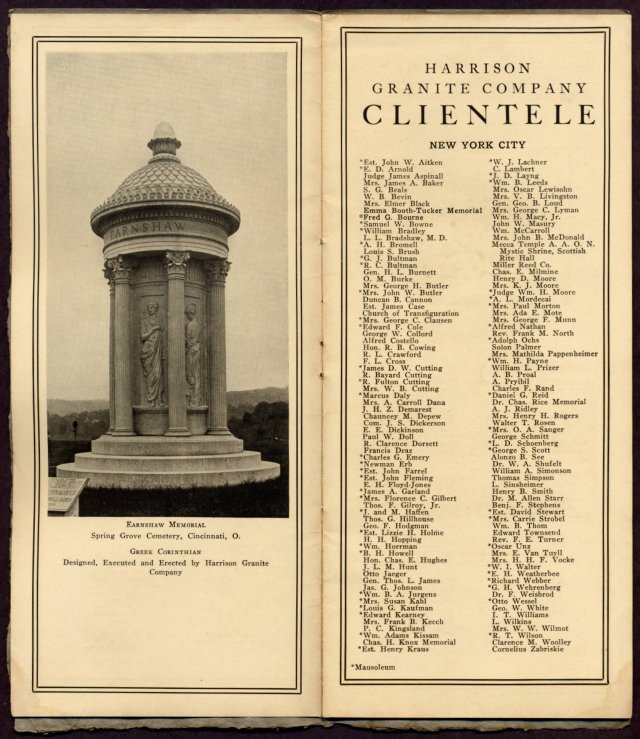
The Harrison Granite Company of New York City was founded in 1845.  It had quarries and works at Barre, Vermont.  The company mailed out brochures January of 1918, featuring the Earnshaw Memorial at the Spring Grove Cemetery at Cincinnati, Ohio.  the Earnshaw Monument was described as Greek Corinthian, and was “Designed, Executed and Erected by the Harrison Granite Company”.

The brochure states, “The interpretation of classic forms is the true expression of lasting tribute to the departed. Simplicity of treatment rather than ornateness has characterized the efforts of the company for the past 73 years. Ranging from monumental pieces of public interest to the simplest of private tributes this organization has achieved wonderful success in executing the conceptions of prominent sculptors and architects as well as the work of its own carefully selected staff of designers.” The Earnshaw Monument is a shining example of the interpretation of a “classic form for a lasting tribute.”

The brochure was prepared as an advertisement. Interspersed among pictures of magnificent monuments designed by Harrison Granite were lists of customers from across the United States as an inducement for others to purchase a monument from the company. This type of advertising is known as bandwagon advertising. That is, the advertisers use the fact that because many others like the product it is proof that you will like it, too.

 img_7564[1]

Joseph Earnshaw

September 16, 1831 – January 13, 1906

Neoclassical designed monuments can be found in many large urban cemeteries in the United States, including Spring Grove Cemetery at Cincinnati, Ohio.

img_7566[1]

The Joseph Earnshaw Grecian Corinthian-style monument was based on the Choragic Monument of Lysicrates which is located at the base of the Acropolis at Athens, Greece.  The Lysicrates monument was the first building to have Corinthian columns on its exterior.  The building was built by Lysicrates a wealthy patron of musical performances in the Theater of Dionysus.

img_2532[1]

This Harrison Granite Company catalog and many other gravestone and monument company brochures can be found at the Stone Quarries and Beyond Website: http://quarriesandbeyond.org/cemeteries_and_monumental_art/cemetery_stones.html.

The Stone Quarries and Beyond Website was created by Peggy B. and Patrick Perazzo. It focuses on historic stone quarries, stone workers and companies, and related subjects such as geology. Whenever possible links of finished products are provided on the Website. There is a “Quarry Articles” section that presents articles, booklets, and links from the late 1800s to early 1900s, including the 1856 “The Marble-Workers’ Manual.” The “Cemetery Stones and Monuments” section provides references and resources, including many old monument magazines, catalogs, price lists, and a photographic tour “From Quarry to Cemetery Monuments.”

Posted in Uncategorized | Leave a comment