The Lamb

Walk into nearly any American graveyard and you will find tiny little lambs marking the graves of children mostly. These lambs are often found on the tops of gravestones and comes in many sizes and positions—often curled up and sleeping, sometimes with a cross behind the lamb.

However, two examples show the lamb a bit differently—both of these sculptures are freestanding and not marking a specific grave but used as a work of art in each of the cemeteries.

The first is found in the Fairview Cemetery at Linton, Indiana. This little sculpture is found tucked in between two gravestones, neither of which is for an infant. The lamb in this small sculpture in this example, is being cradled by a child.

IMG_9644

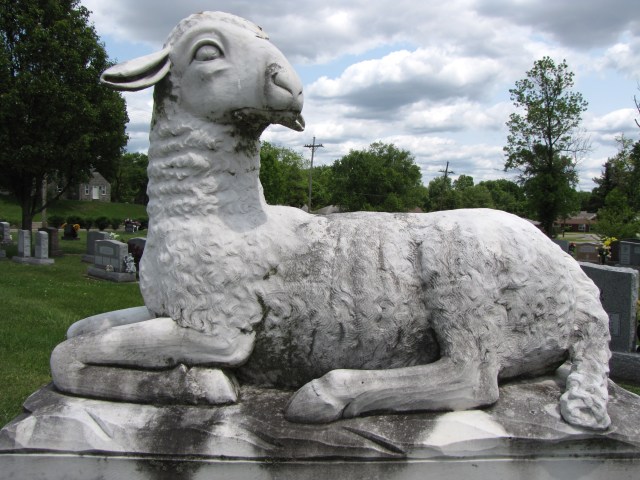
The lamb in St. Mary’s Catholic Cemetery at New Albany, Indiana is raising its head up, eyes wide open, as if it is looking at the passersby. The lamb, alert and bright eyed, looks like it could stand up at any moment and scamper away. This is also one of the biggest lambs I have come across in a cemetery—it is about the size of a full-grown Labrador.

IMG_3629

The lamb is the symbol of the Lord, the Good Shepherd. It also represents innocence, likely the reason why this motif usually adorns the tombstones of infants and young children.

Posted in Symbolism | Leave a comment

Allegory vs Realism; Female vs Male Depictions

IMG_3721

A few posts ago, I quoted June Hadden Hobbs, the editor of the Association for Gravestone Studies publication, Markers XXIX, who made an observation about nineteenth-century cemetery design (pages 4 and 5) writing that, “statues of men are historical while statues of women are usually allegorical.” Statues of men tend to be portraits while statues of females are nearly always not a representation of the deceased female but of an idea.

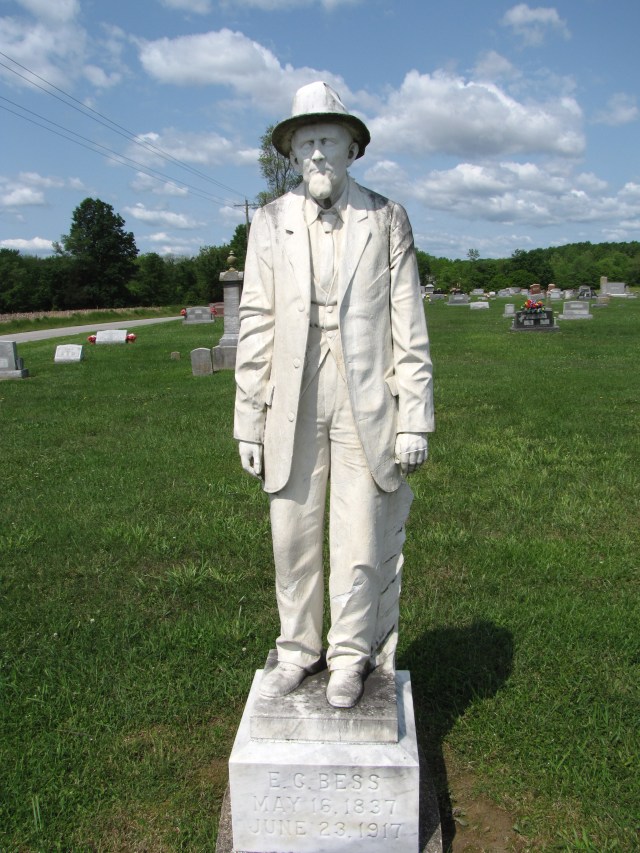
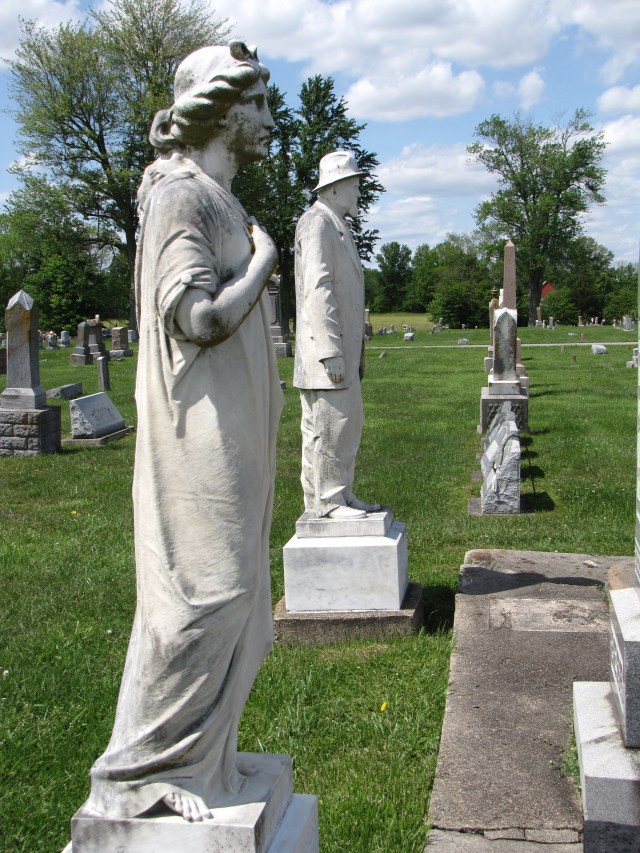
Another example of that can be found in the Crothersville Cemetery at Crothersville, Indiana. Two white marble statues mark the graves of Elisha Collins Bess, Sr., (May 16, 1837 – June 23, 1917) and Martha Jane Bess (April 13, 1840 – June 15, 1912). One statue features an aged slightly stooping bearded man in a suit and hat. Clearly a sculpture of the deceased Elisha.

IMG_3378

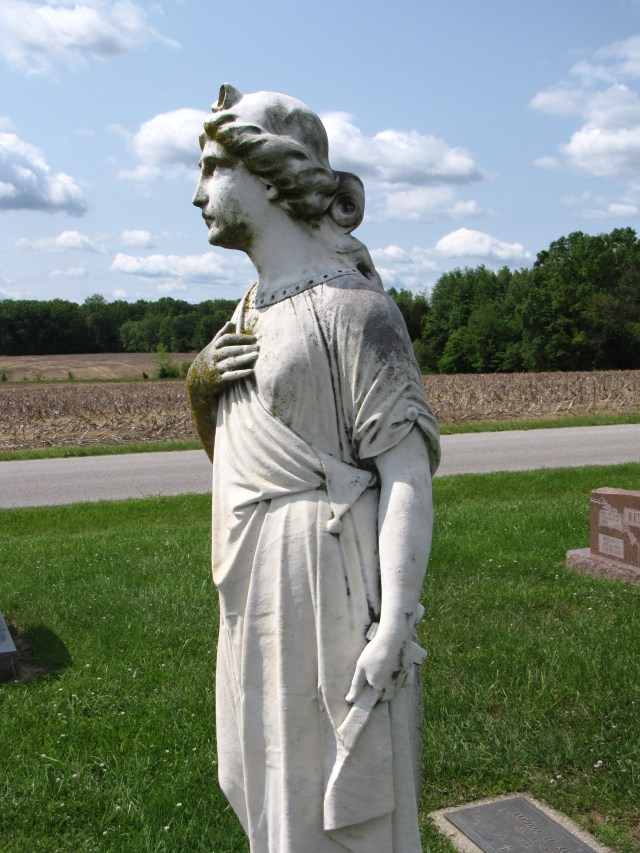
To the left of him is the statue that marks the grave of his wife, Martha Jane. She, however, is depicted as the allegorical figure of faith. The indication of that is that she holds a cross in her left hand. She is also portrayed in classical clothing, not the period dress that Martha Jane would have worn at the time of her death. Her statue is a young idealized portrayal of a virtue in the form of a woman, not the portrait sculpture of the 72-year old Martha Jane Bess buried beneath.

IMG_3391

The sculptures reflects the gendered response to death of the era. According to Laurie Stanley-Blackwell and Brenda Appleby in an article in Markers XXIX, “Romancing the Stone: Female Figural Monuments in Late-Nineteenth-Century Nova Scotia Cemeteries” page 37, “During this era. Prominent male statesmen, was heroes, prosperous businessmen, and religious leaders prevailed as the most deserving subjects for memorialization.” That is men were much more likely to have a realistic portrait in sculptural form than a woman—though, exceptions do exist.

IMG_3719

Women on the other hand were part of the romanticization of death during the Victorian era. Women were quite often portrayed in classical garb, often in mourning, depicted overcome by grief. As Stanley-Blackwell and Appleby describe, “These secular marble beauties were idealized, etherealized, and in some cases eroticized embodiments of ritual mourning. They represented a wide spectrum of mythologized female experiences, from classically austere and occasionally featureless to romantically voluptuous, barely clothed, in some cases starkly nude.”

IMG_3393
True to form, the statues marking the graves of Elisha and Martha Bess illustrate the point made in the article written by Laurie Stanley-Blackwell and Brenda Appleby.

Posted in Symbolism | Leave a comment

A Baby Saved

IMG_3449

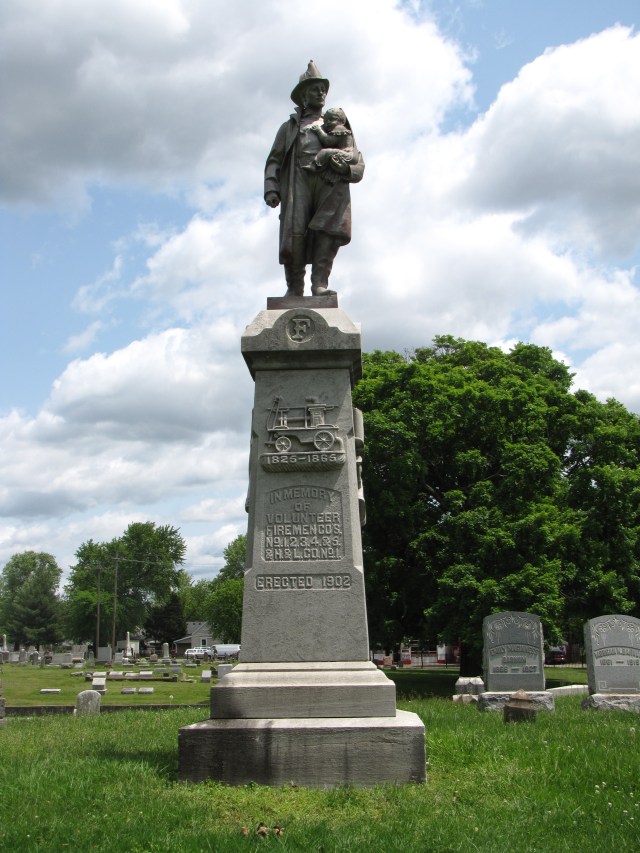
IN MEMORY

OF

VOLUNTEER

FIREMEN CO’S

No. 1,2,3,4, & 5.

& H & L. CO No. 1.

ERECTED 1902

IMG_3458

Firefighting Companies were vital to all communities which could be swept away by fire.  Entire communities could be lost to flame, so volunteer and professional firefighters were vital to save lives and citizens’ homes and businesses.  Firefighters had to be ready at a moment’s notice to fly into action and risk life and limb to battle an inferno.

Fire companies formed in communities all across the country. And, in many cemeteries in those villages, towns, and cities monuments have been dedicated to their fallen and valiant firefighters.

IMG_3459

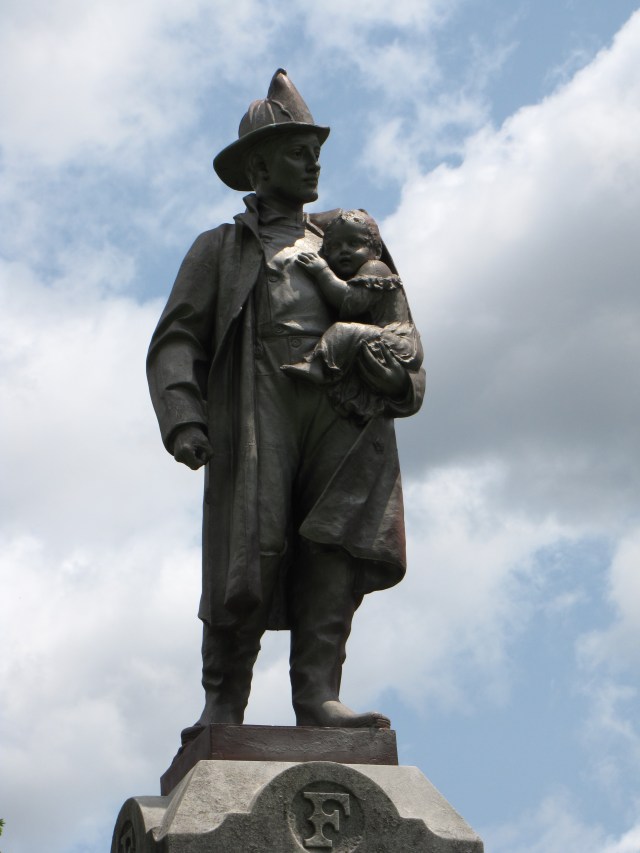
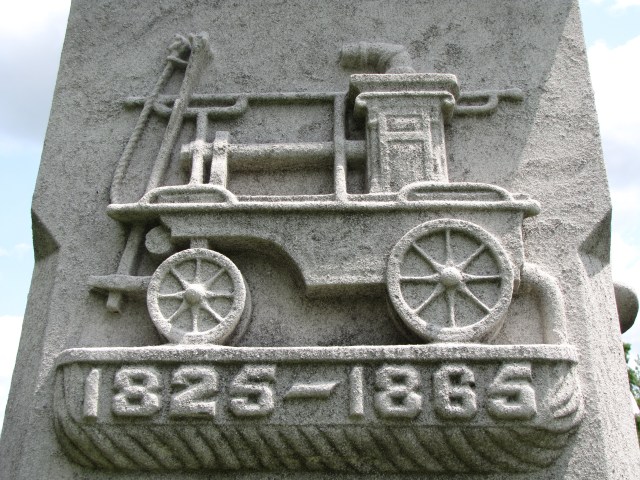
The monument in New Albany, Indiana, is dedicated to six fire companies. The monument was erected in the Fairview Cemetery on 1902, and dedicated September 7th of that same year. Charles Edwards sculpted the firefighter—in pewter. The New Albany firm of John Vernia & Son fabricated the monument.

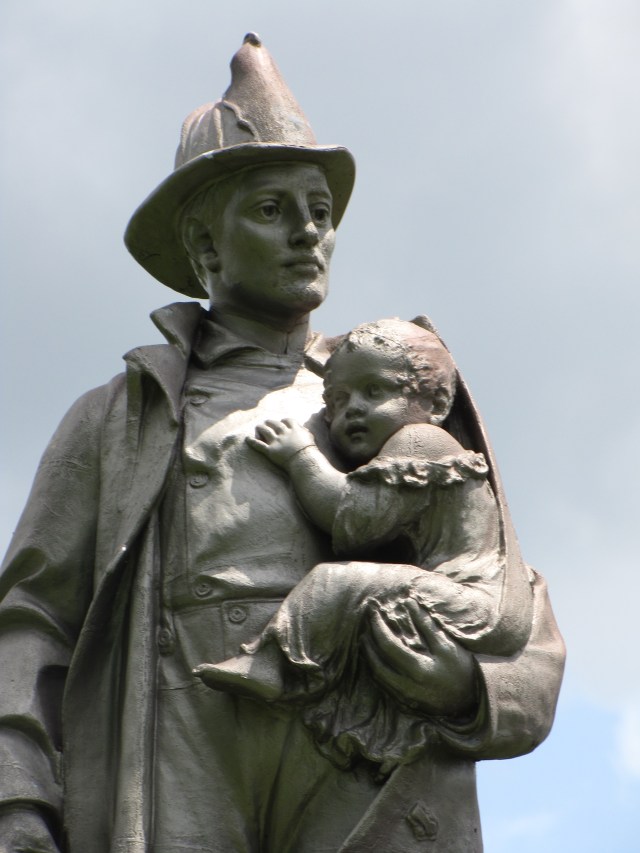
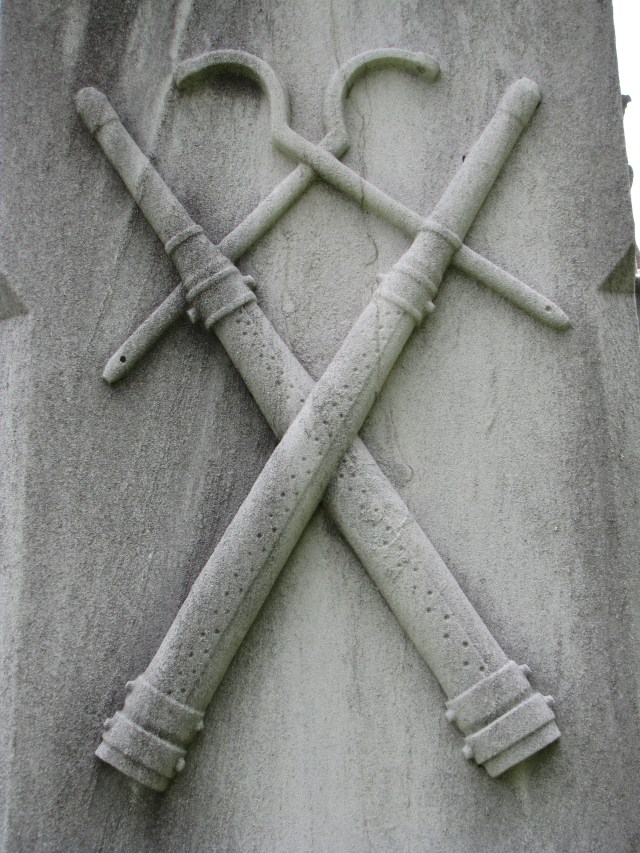
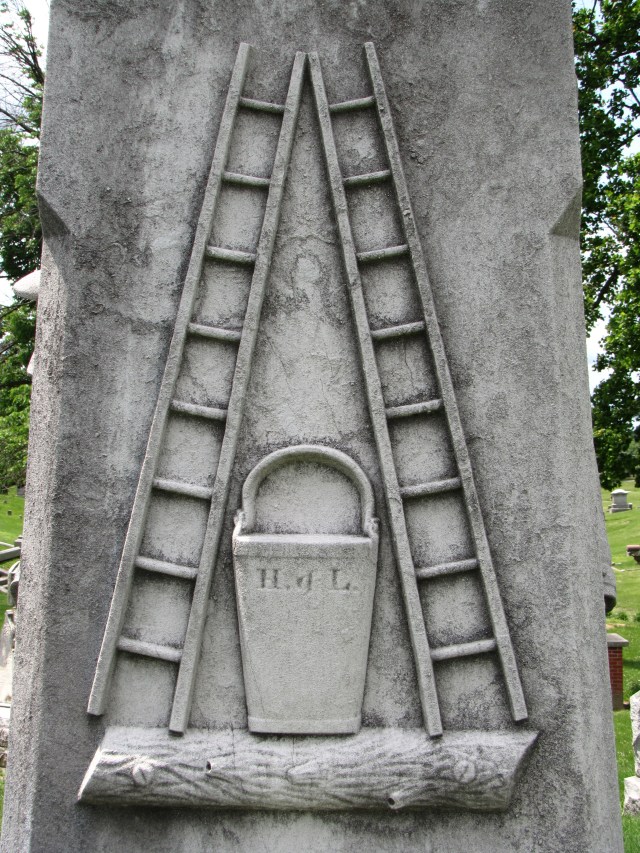
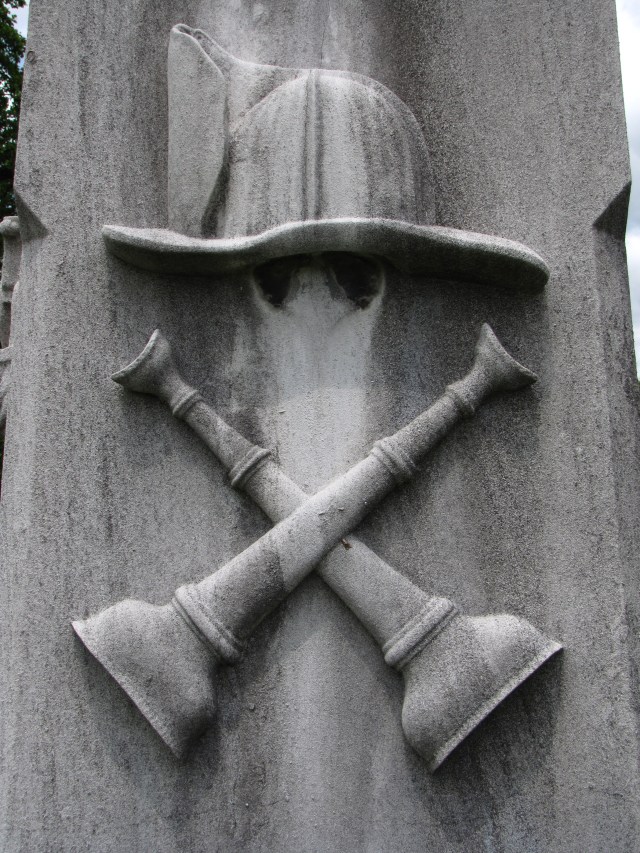
The fireman strikes a heroic pose holding a baby presumably that he rescued.  The firefighter has a clenched right hand to hold a lantern, but the lantern is now missing.  The statue of the firefighter stands atop a limestone plinth that has an engine on one side and the tools of the firefighter’s trade represented on the other three sides.

IMG_3452

IMG_3455

IMG_3456

IMG_3457

Posted in Symbolism | 2 Comments

The Plumed Warrior in Stained Glass

IMG_1906

The plumed warrior in stained glass in the Mount Carmel Cemetery at Hillsdale, Illinois, features an angel wearing armor, carrying a  shield, an wielding a sword indicate that the winged angel represented here is the Archangel Michael, one of three angels mentioned by name in the Bible.  The sword He carries represents a cross but also a weapon in his war against the devil’s warriors.  Archangel Michael is a Christian soldier fighting Satan’s hordes.   Archangel Michael is often represented standing on a worm, or a dragon.  The Archangel Michael is also considered the guardian of souls.

Posted in Symbolism | Leave a comment

HER CAT, HER ONLY FRIEND

IMG_9447

There has always been a debate between dog and cat lovers about which furry little friend makes the best companion. I have many friends who have cats galore and swear by them, while others like myself, have dogs and always have. We see dogs as the old bromide tells us, “as man’s best friend”. And it is true—you walk into the room and your dog’s eyes light up, tail wags. Walk out and back again, and he is just as happy, almost like he hadn’t seen you in hours! You just don’t get that reaction from a cat.

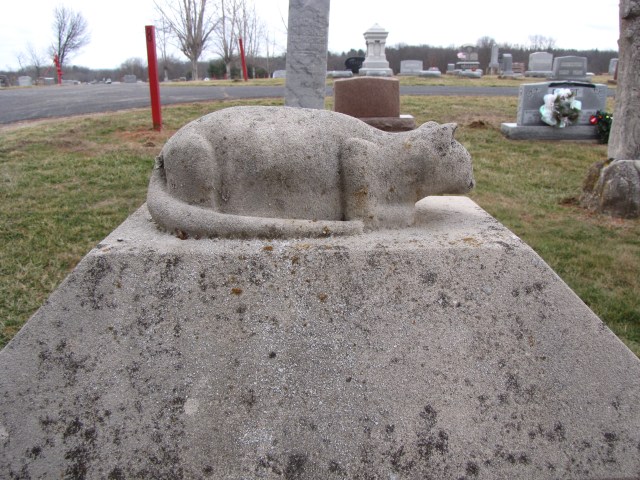
Whether dog and cat lovers can agree or not, graveyard aficionados can attest that many more dogs can be found on gravestones than cats. In fact, in my experience, I have seen very few cats adorning tombstones—so when I saw a gray marble cat perched atop the gravestone of Pollie Barnett in the Fairview Cemetery in Linton, Indiana, I was drawn to it. Then I was pulled in further by the following epitaph:

HERE POLLIE BARNETT IS AT REST,

FROM DEEPEST GRIEF AND TOILSOME QUEST,

HER CAT, HER ONLY FRIEND,

REMAINED WITH HER UNTIL LIFE’S END.

Surely, there was a mystery surrounding this gravestone. According to the area legend, Pollie (born September 23, 1836 – died February 27, 1900) had two daughters, one spirited girl named Sylvania. Her other daughter’s name has been lost to history, most likely because she wasn’t the focus of the sad tale. The book, Weird Indiana: Your Travel Guide to Indiana’s Local Legend’s and Best Kept Secrets, says that Sylvania disappeared without a trace. There were several reasons that could have explained the disappearance—she never came home from a quilting bee, she didn’t return to the house from gathering fire wood, or that she ran off with a local boy.

IMG_9445

Whatever happened, Pollie never recovered from the loss. She became despondent and made it her life’s mission to search for her absent daughter. For the rest of her life, Pollie traveled the roads in and around Linton, calling for her daughter. According to the book, Pollie kept the search wandering hither and yon for the next 32 years—never giving up her desperate search for Sylvania. Area storytellers recalled Pollie tired and bedraggled carrying her black cat with her wherever she went—often only stopping to sleep in a road ditch or a kind farmer’s barn.

Linton townspeople commissioned a tombstone tribute to Pollie and her best friend—a black cat, which rests with a watchful eye, on top of her gravestone forever looking after Pollie.

IMG_9452

Posted in Epitaphs, Symbolism | 2 Comments

Gender differences in Victorian funerary sculpture

IMG_8231

June Hadden Hobbs, the editor of the Association for Gravestone Studies publication, Markers XXIX, , made an observation about nineteenth-century cemetery design (pages 4 and 5) writing that, “statues of men are historical while statues of women are usually allegorical.” Statues of men tend to be portraits while statues of females are usually not a representation of the deceased female but of an idea or virtue, such as, grief, faith, or hope.

An unusual monument in the Rock Creek Cemetery at Washington, D.C., illustrates the point that Hobbs makes. It is unusual because it is a two-side monument; one side dedicated to one family—the Thompson Family; the other side dedicated to a different family—the Harding Family. There are statues on both sides of the rough-hewn cross that dominates the monument. While the two-sided monument is unusual, the statues on either side of the cross are typical Victorian statuary.

IMG_8217

One side features a full statue of N. Elbridge Thompson (1840-1904). Standing in front of the cross is a whiskered and distinguished looking man holding his jacket with one hand, his other resting on an open book. This statue was clearly carved to look like N. Elbridge Thompson and in line with contemporary Victorian funerary art to portray the deceased in statue, busts, and portraits. The advent of a process to adhere photographs to porcelain medallions and adhere them to tombstones became very popular. This was part of the Victorian views of sentimentality regarding death and burial practices.

The Thompson sculpture reflects the gendered response to death. According to Laurie Stanley-Blackwell and Brenda Appleby in an article in Markers XXIX, “Romancing the Stone: Female Figural Monuments in Late-Nineteenth-Century Nova Scotia Cemeteries” page 37, “During this era. Prominent male statesmen, war heroes, prosperous businessmen, and religious leaders prevailed as the most deserving subjects for memorialization.” That is, men were much more likely to have a realistic portrait in sculptural form than a woman—though, exceptions do exist.

IMG_8221

Women on the other hand were part of the romanticization of death during the Victorian era. Women were quite often portrayed in classical garb, often in mourning, depicted overcome by grief. As Stanley-Blackwell and Appleby describe, “These secular marble beauties were idealized, etherealized, and in some cases eroticized embodiments of ritual mourning. They represented a wide spectrum of mythologized female experiences, from classically austere and occasionally featureless to romantically voluptuous, barely clothed, in some cases starkly nude.”

IMG_8224

True to form, the young woman standing against the other side of the cross is a female figure depicted with her head looking down in reflection and sorrow, while holding an Easter lily in one hand and a lily bloom in the other. This is a common Victorian funerary motif. This mourning figure here is expressing the transitory nature of life and is an allegorical figure not meant to be a portrait of Lillie May Harding (1871-1897) the young 26-year old woman buried with her parents on that side of the monument. The statue represents an idealized form.

IMG_8223

Posted in Saving Graces, Symbolism | Leave a comment

Apparitions in gossamer gowns that fade into the murky night air

IMG_9665

One of my favorite episodes of the Andy Griffith Show, Three Wishes for Opie, came in the 5th season when Barney and Goober went to an auction. Barney came back from the auction holding a gypsy’s box that contained a magic lamp, tarot cards of a sort, a book, and the ability to conjure the spirit of a fortune-telling Count from the 18th Century.

In the back and forth with Sheriff Andy Taylor about whether or not the Count was real, Barney heatedly said, “I’m not saying there is such a thing as the supernatural but things have happened that have never been explained.”

Stories abound of the supernatural—apparitions that appear in gossamer gowns that fade into the murky night air. One such tale has been repeatedly told about the Stepp Cemetery in the Morgan Monroe State Forest near Bloomington, Indiana, reportedly the most haunted place in the state. The stories that swirl around the cemetery first started around a fallen tree that resembled a chair that became known as the Witch’s Throne. That throne, however, was not a royal seat but a place of mourning and sorrow from a distraught and inconsolable mother.

IMG_9683

The legend told and re-told is of a young family. The husband works long days at the quarry—the mother busy in the cabin with a newborn girl. Tragically the husband is cut down in his prime in a quarry blast leaving the young mother to raise their little girl alone. She pours herself into the little girl, thinking of her every waking moment—protecting her, over-protecting her. The little girl becomes a young woman and catches the eye of a young man. Reluctantly and fearfully the mother agrees to let the boy escort the girl to a dance.

In a race to get back to the girl’s home before the curfew, the couple drove too fast on the country road slick with a gentle rain sliding off the road. The young girl didn’t survive the accident—the Mother’s heart broken, her dreams shattered, her spirit sent adrift with anguish and heartbreak.

Many campers and hikers have reported that they have felt warmed air as if a hot breath was on their necks. They have reportedly seen a dark fluttering presence hovering over what must be the long-forgotten grave near the Witch’s Throne and heard a faint sobbing.

While pictures of the apparition don’t exist or what we would call empirical evidence there are those who swear it to be true—their senses alive by the touch of the warm air and the sight of figure in the dark night. Is it real or imagined? Or is it as Barney explained, “Things have happened that have never been explained.”

IMG_9666

Posted in Uncategorized | Leave a comment

The Mystery of the Hereafter AKA Grief

IMG_8290

Henry Brooks Adams

February 16, 1838 – March 27, 1918

—-

Marian “Clover” Hooper Adams

September 13, 1843 – December 6, 1885

Henry Adams, the scion of the great and influential Adams family was a journalist, an historian and a novelist. Born a Boston Brahmin, Adams graduated from Harvard and first worked as his father’s private secretary. His father, Charles Francis Adams, Sr., was in the House of Representatives, then was appointed by President Abraham Lincoln as the United States Ambassador to the United Kingdom. Henry accompanied his father to London and spent the Civil War years in the United Kingdom. In 1868, Henry Adams returned to the United States and began his career as a journalist and an historian, later a professor of Medieval History at Harvard.

In 1872, Henry and Marian “Clover” Hooper married at Beverly, Massachusetts, and set out on their European honeymoon. After Henry’s early retirement as a professor, the couple moved from Boston to Washington, D.C., where their home on Lafayette Square became a hub of entertainment for Capitol society. The Henry Adam’s happy home life was shattered on the morning of December 6, 1885. After breakfast, Adams, suffering from a tooth ache, was stepping out to see a dentist when he met a woman caller who had come to their house to visit Clover. Adams went upstairs to ask Clover, who had retired to her bedroom after breakfast, if she was well enough to receive a visitor. Clover was lying on the floor next to a vial of potassium cyanide.

There was speculation that Clover had committed suicide because she was distraught about her father’s recent death. Others believed that the mental illness in her family was the ultimate cause. Still other suggested darker theories; the truth, however, will never be known for sure.

Adams commissioned Stanford White, one of the most famous architects of his day, to design a memorial for his wife, Clover. Augustus Saint-Gaudens was chosen to create the statue that was to be the centerpiece of the memorial. Adams gave Saint-Gaudens specific instructions that he did not want a sentimental monument, but was looking to have the bronze be influenced by the Buddhist devotional art he had seen while traveling in Japan.

IMG_8292

Saint-Gaudens created the bronze titled, The Mystery of the Hereafter and the Peace of God that Passeth Understanding. The seated figure is a fusion of the male and female form with long flowing robes—contrasting the serene nature of the seated Buddhist figure with the waterfall-like clothing which creates a sense of moment and vitality. In spite of Adams’ admonition that this statue not be tagged with a saccharin and common name, the public came to call it simply, Grief, ignoring the lofty intellectual and exotic origins of its creation.

The Henry Adams Monument is one of the most sought out and visited in the Rock Creek Cemetery at Washington, D.C. Today the memorial is completely obscured by boxwoods which surround it. But, it provides a contemplative space to ponder life’s mysteries and the ultimate mystery of death itself.

IMG_8289

Posted in Uncategorized | Leave a comment

Eternal Disdain

Oak Ridge Cemetery, Springfield, Illinois

Oak Ridge Cemetery, Springfield, Illinois


MATTIE S. RAYBURN

WIFE OF

W. H. RAYBURN

1836 – 1891.

BISHOP AND MRS. RAYBURN

WHAT THEREFORE GOD HATH JOINED TOGETHER

LET NOT MAN PUT ASUNDER. MATT. 19 CHAPT. 6V.

IMG_0133

A few weeks ago, my son and I drove over to Springfield, Illinois, to visit the Lincoln Tomb in the Oak Ridge Cemetery. A cemetery docent told us about the highlights in the cemetery including a tip to make sure we visited the gravesite of Mattie Rayburn.

Her monument sets on the highest hillock in the cemetery with a white-marble sculpture of Mattie sculpted by the Springfield firm of Richter and Doland atop a polished granite column. The docent said, “Mattie wanted to be able to look down on all those who looked down on her during her lifetime.” Now for eternity she does just that from her perch.

But why did the citizens look down on Mattie, she was, after all, a wife of esteemed Bishop W. H. Rayburn? That is where the story begins to unfold. Rayburn had been a Methodist minister at Williamsville, Illinois, a small town just north of Springfield, before being elevated to Bishop by the Pilgrim Movement which advocated the doctrine of Free Love.

There seems to be some confusion as to whether Mattie was Bishop Rayburn’s wife at all or whether she was, in fact, his mistress. There is also confusion about whether the woman buried under the column is Mattie Rayburn, a Hannah Funk Rayburn, or a Mrs. Redfield or if they are all the same person. What is clear is that Reverend Rayburn’s views on Free Love and faith healing were too much for the sensibilities of the Williamsville Methodists—in 1869 Rayburn was relieved of his duties as a minister of the church. That is when he went on to form his own ministry. Rayburn was evidently charismatic and strikingly handsome—a bit of a dandy, building a flock that followed him.

He took his ministry on the road and on the seas—all the way to California and on trips overseas—always returning to the Springfield area. On one such trip back, Mattie died and was buried at the Oak Ridge Cemetery. The Bishop went to Europe. Some believe he is buried in a pauper’s grave in Ireland while others believe he was laid to rest in Paris. Whatever the truth about the prairie preacher, Mattie’s likeness stands watch over those who gave her a gaze of disdain. She faces Northeast toward the village of Williamsville, arms folded with a look of stoic disapproval.

IMG_0387

Posted in Famous graves | 2 Comments

Crucifix

IMG_8843

One of the things that I love about cemeteries, large and small, is the beautiful and moving artwork that you come across. The crucifix on the gravestone in the Rock Creek Cemetery at Washington, D.C., is not a traditional representation. But, the sculpture is expressive and moving demonstrating the pain and the suffering of Christ on the cross.

The symbol of Jesus Christ hanging on the cross is called a crucifix. This cross, which is not a part of the sculpture, though ever present, demonstrates the suffering of Christ.

The word crucifix is from Latin and is the combination of two words—cruci and fixus—which translates to one fixed to a cross.

IMG_8848

Posted in Symbolism | Leave a comment