Ruins

img_4303

CONRAD WINDISCH

1825 – 1887

SOPHIE WINDISCH

1827 – 1901

A passerby in the Spring Grove Cemetery strolling past the gravestone of Conrad Windisch might mistake it for a ruin—which was the whole idea. The white-marble marker carved to look like an English abbey ruin has a gothic pointed-arched window with a tree stump leaning across the face of the stone signifying a life cut short. Above the window is a winged hourglass. The soap opera, Days of Our Lives, has as their catchphrase, “Like sands through the hourglass, so are the days of our lives.”  The meaning of that catchphrase is clear–life passes by very quickly.  Life measured by the grains of sand slip through one side of the hourglass to the other in a flash.  The hourglass symbol on a gravestone, represents the same thought of time fleeting by quickly. All of this sits on a large base with a large oval convex cartouche with “Conrad Windisch” carved into it.

img_4307

The gravestone marks the graves of Conrad and Sophie Windisch. Conrad was a German immigrant from Munich who settled in the United States in the mid-19th Century. After working for several brewers Windisch founded his own brewery with his business partner and brother-in law, Gottlieb Mulhauser. The building that housed the enormous brewery had two large stone lions in the gables on top leading to the brewery’s unofficial name—Lion Brewery. Windisch and Mulhauser were very successful and became the largest brewer in Ohio.

img_4306

The Windisch gravestone harkens back to the 18th Century when English gardens were quite often landscaped to feature faux Roman temples and decaying English castles and abbeys. These became known as Victorian follies—that is a building or structure that was built first and foremost as decoration but suggested some other high purpose or former use.

img_25281

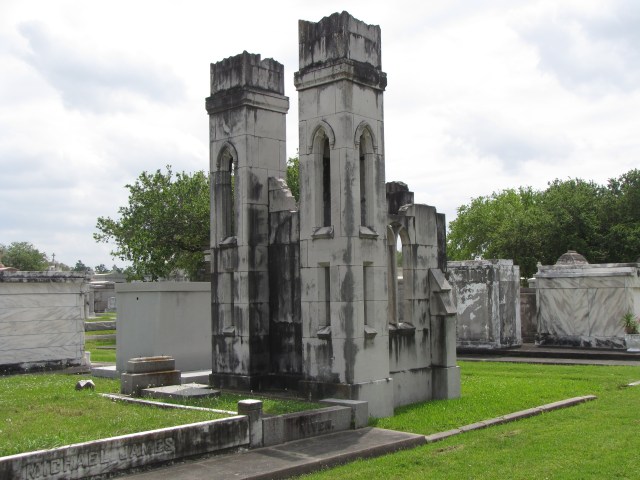
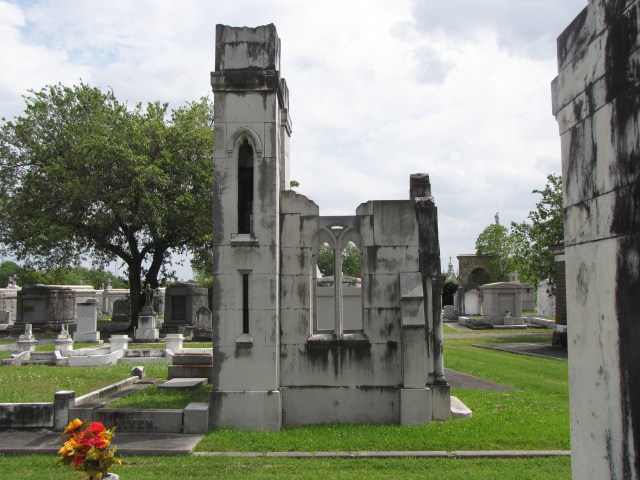
One of the most interesting monuments in the Metarie Cemetery in New Orleans, Louisiana, was built for Henry J. Egan, a Confederate Lieutenant Colonel, who was killed April 6, 1865, at Amelia Springs, Virginia, during General Robert E. Lee’s retreat. The monument was built to appear like a ramshackle Gothic Revival-style Church. It is a sham, however. The ruin was designed by Charles A. Orleans, one of the leading monument builders in New Orleans at the time, who was at the height of his fame when it was built in 1881. The Victorian folly, built to look like one thing when it is actually another, is a marble monument complete with mock cracks and crumbling stone to deceive the passerby. Carved above the arched doorway into the tomb are the words, “Sic itur ad astra” – Latin which translates to “Thus to the stars”.
img_25341

As author Phil Nuxhull writes in his book, Beauty in the Grove: Spring Grove Cemetery and Arboretum, the Windisch gravestone, like the Egan monument, conveys the “transitory nature of all earthly things.”
img_25321

(Inscription on the back wall of the church)

In Memory of

Bentinck Egan

Who died Dec. 27, 1881

And his brothers

Walter

Frederock

Yelverton

Henry

Augustus

The Good Sons of

Dr. J. S. Egan and I. M. Yelverton

Mother died 1884

Father died 1891

(on the floor )

Lieutenant Colonel Henry I. Egan

Killed at Amelia Springs, Va.

While in command of

Sharpshooters, Gordon’s Division,

Covering Retreat of Lee’s Army

April 6, 1865, Aged 24 years.

Dr. Yelverton B. Egan

Killed at the Battle of Sharpsburg

September 17, 1863, aged 24 years.


Letitia M. Yelverton Egan

Their mother

Died in London England 1884

Mary Louisa Egan

Only daughter of

James and Letitia Egan

Died Dec. 26, 1920

Buried with them in

Fulham Cemetery, London

Cecilia Maria Egan

Died Jan. 2, 1941

Frederick Egan and his wife

Julia Wilkinson Egan

(inscription on the back of the building)

 BENTINCK

Posted in Symbolism | Leave a comment

One into the Other

img_2842

The gravestone in the St. Adalbert Catholic Cemetery in Chicago depicts Christ on the cross. The gravestone is a moving and expressive representation demonstrating the pain and the suffering of Christ on the cross. The symbol of Jesus Christ hanging on the cross is called a crucifix. The word crucifix is from Latin and is the combination of two words—cruci and fixus—which translates to one fixed to a cross.

The Latin cross is universally recognized as the symbol of Christianity. Though it may look simple to the eye, the symbol is imbued with deep meaning to all Christians. William Henry Deacy in Memorials: To-Day for To-Morrow published by Georgia Marble Company of Tate, describes the symbolism of the Latin cross: “Faith had brought Him to Calvary. The Betrayal, the Trial, the piercing Crown of Thorns, the tortuous road to Golgotha, the cruel weight of the Cross, the hour of Crucifixion—through all these Faith had led Him on. …the Cross of Calvary, instrument of the Passion… a memorial of the Faith, the Chosen Symbol…

In the gravestone below from the St. Nicholas Ukrainian Catholic Cemetery in Chicago, the image of Jesus is depicted standing on a cloud as risen from the dead. On this gravestone the body of Christ forms the cross. In that way the figure of Christ becomes one with the most recognizable symbol of Christianity morphing one into the other.

img_2730

Posted in Symbolism | Leave a comment

Government Issue

img_3945

13615.

CAPT. DAN’L M.

KEYS

INDEPENDENT

WEST VA.

RANGERS.

In national military cemeteries across the United States standing tall and straight are rows of “Government Issue” white marble gravestones. Those gravestones are a third iteration. Not long after the start of the Civil War, Quartermaster General Montgomery Meigs was charged with burying the soldiers being lost in each successive battle of the war. The soldiers close to the front in Washington D.C. were being buried in military cemeteries around Arlington. By May of 1864, soldiers were buried on the grounds of Arlington House—the Ancestral home of Robert E. Lee.

img_3941

The first markers constructed for the fallen soldiers were made of wood but decayed at a very fast rate. It was clear very quickly that wood would not be a permanent solution. The second solution was to make the markers out of cast iron. To prevent rusting the outside of the marker was to be coated in a veneer of zinc. Only one of these markers remain in the Arlington national Cemetery, that for Captain Daniel Keys. The zinc coating gives the marker a faint blue cast. One side of the marker depicted a soldier, the other side had the fallen soldier’s information.

img_4098

img_4101

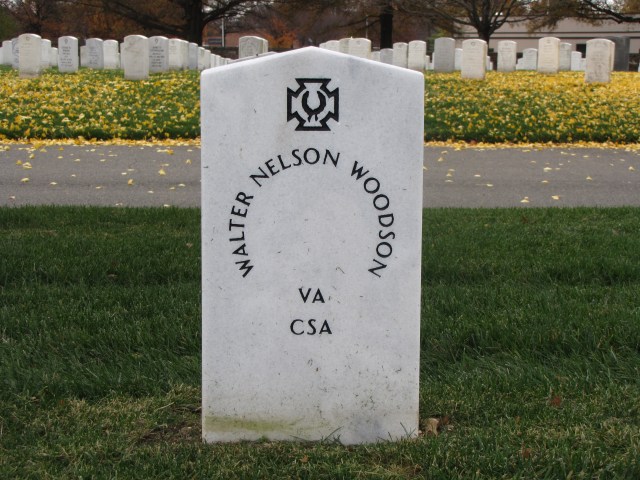
The military decided wood nor zinc-coated cast iron was the right material. White marble was chosen as more traditional and appropriate. Each white marble gravestone is to be 13 inches wide, 4 inches thick and 42 inches tall—with 24 inches to show above ground. Soldiers who fought for the North have segmented (or rounded tops) while their Confederate counterparts were issued pointed top tablets.

img_4104

Posted in Zinc Markers | Leave a comment

The General of the Night

img_4086

HENRY W LAWTON

MAJOR GENERAL – U S V

BORN MARCH 17, 1843 DIED DEC. 19, 1899

KILLED IN ACTION PHIIPPINE ISLANDS

MARY C LAWTON

WIFE OF HENRY W LAWTON

The Henry Ware Lawton marker is in the Arlington National Cemetery at Arlington, Virginia, on what was at one time the Robert E. Lee plantation. The Smithsonian sculpture database notes that the Lawton monument was created by sculptor Myra Reynolds Richards (1881-1934). Richards was an Indiana-born sculptor and teacher. She studied at the Herron Art Institute in Indianapolis, in New York under famed artist Isidore Konti, and also the Academie Scandivave in Paris. Her most notable works were created and exhibited in Indiana: A statue of James Whitcomb Riley, the famous Hoosier poet, which was unveiled at the Hancock County courthouse at Greenfield, Indiana, in 1918; The Murphy Memorial Drinking fountain at the Carroll County Courthouse, also in 1918; two works that have been stolen—Pan and Syrinx created for the Depew Memorial Fountain in Indianapolis; and The Bird Boy unveiled in 1924 for the Columbus Central Middle School.

Sculptor Myra Reynolds Richards

Sculptor Myra Reynolds Richards

The bronze Henry Ware Lawton monument was cast by the Roman Bronze Works of New York. The Smithsonian sculpture catalog describes the work as “resembling an abstract casket, each corner composed of a palm tree with fronds extending to the tapered top. At each end is a boy wearing only a loincloth, with arms uplifted and hands clasped behind his head, sheltered by the palm fronds. The bottom of the gravestone widens and is multi-tiered. Each side of the gravestone is inscribed.” It could also be described as a sarcophagus that portrays the jungle in which he fought his last battle in what was a long and distinguished career serving with distinction in the Civil War, the Apache Wars, the Spanish-American War and the Philippine-American War.

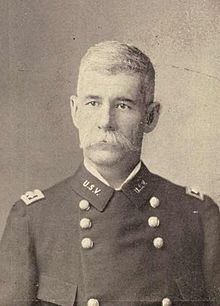
Lawton was born on March 17, 1843, at Maumee, Ohio, the son of George W. Lawton and Catherine Daley Lawton. The same year Henry Lawton was born, his father, a millwright, moved the family to Fort Wayne, Indiana. Most of Lawton’s youth was spent between Indiana and Ohio. Lawton volunteered for a three-month call in the Company E of the 9th Indiana Volunteers in the early part of the Civil War. When his three-month stint was up, he re-enlisted in the 30th Indiana Infantry. He fought in several major battles and by the end of the war had been promoted to Brevet Colonel after having received the Medal of Honor.

After studying at Harvard, Lawton accepted a 2nd lieutenant’s commission, and joined the 41st Infantry Regiment on July 28, 1866, which saw action in the Apache Wars. Lawton not only earned a reputation for being a fierce fighter but also compassionate toward the Native Americans. Lawton advocated on behalf of the Indians who were being cheated out of food allotments by the local Indian Agency.

General Henry Ware Lawton

General Henry Ware Lawton

In May 1898, after having serving continuously in several different position in the armed forces, including as Inspector General, Lawton was appointed Brigadier General and given of the 2nd Division, which was being sent to Cuba during the Spanish-American War.

img_4083

Lawton was transferred to the Philippine-American War front to command the 1st Division of Eight Army. It was during this campaign that Lawton received the nickname, The General of the Night, from General Emilio Aquinaldo, his opponent during the Philippine-American War. Aquinaldo is known that have said that “Lawton attacked him so often at night that he never knew when Lawton was coming.” Lawton was shot and killed on December 19, 1899, by a Filipino sharpshooter during the Battle of Paye. After a funeral service in the Paco Cemetery in Manila, Lawton’s body was transported to the United States and buried at Arlington National Cemetery on February 9, 1900.

img_4085

Posted in Famous graves, Symbolism | Leave a comment

Forbidden Love

img_6529

Nelson W. Blocher

February 1, 1847

January 24, 1884

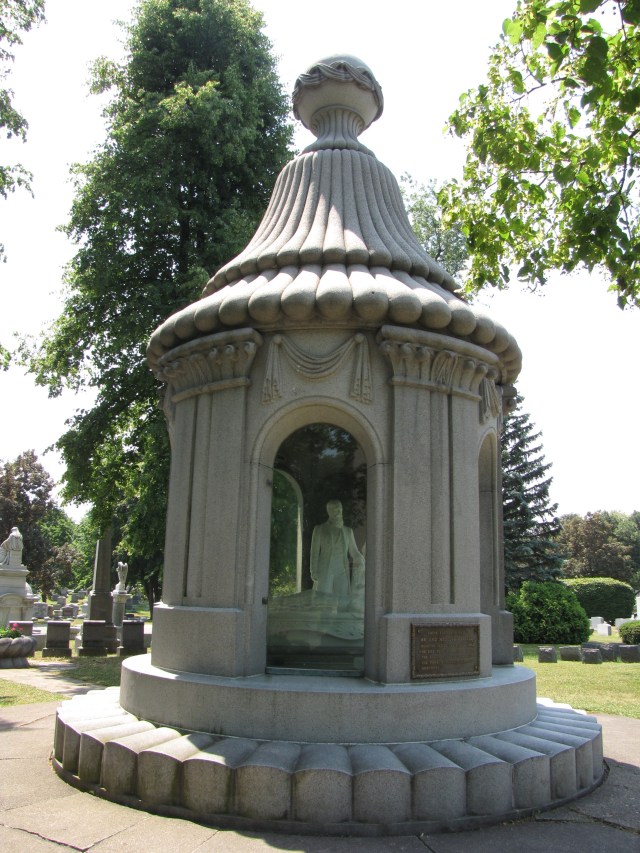
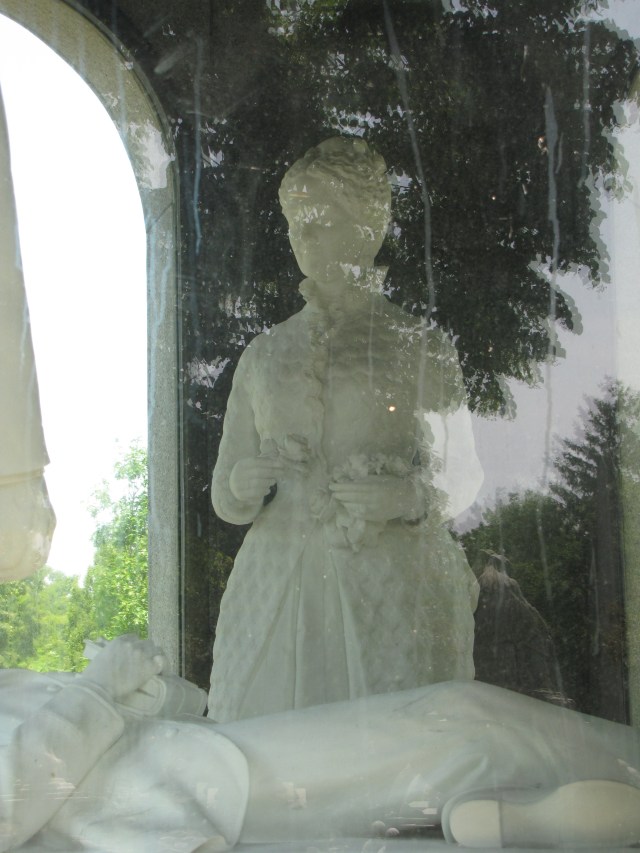
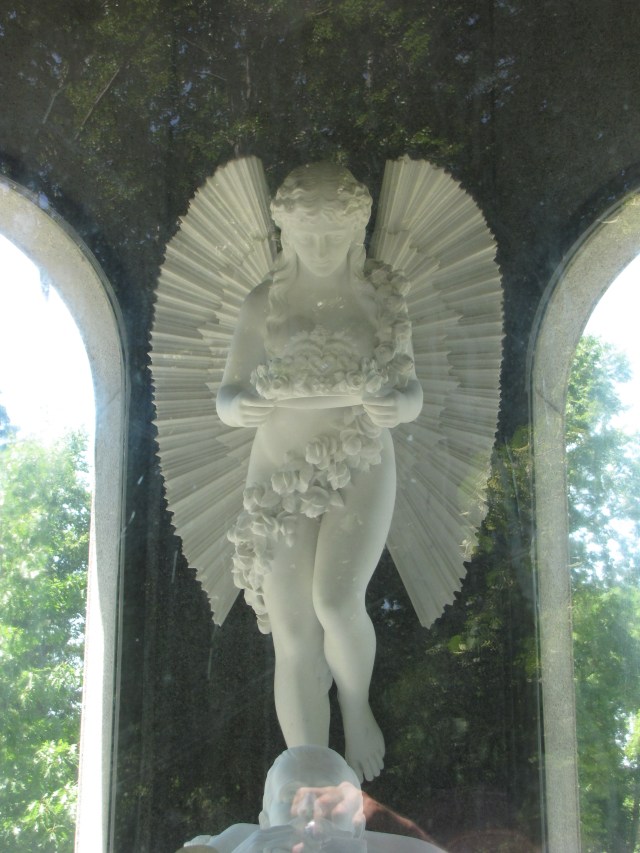
Inside the elaborate Victorian granite monument in the Forest Lawn Cemetery at Buffalo, New York, dedicated to Nelson Blocher, the son of John and Elizabeth Blocher, are four sculptures that depict the final moment of a Nelson Blocher’s life. In the center of the marble tableau is Nelson in repose depicted at the moment of his death with a Bible resting on his chest. Sculptures of his Mother and Father are standing at either side of his death bed. Lastly, there is a voluptuous winged angel figure clad only in a garland of flowers hovering above him holding a floral crown, presumably to be placed on Nelson’s head as he ascends to Heaven.

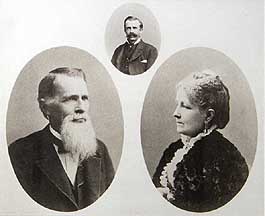
John and Elizabeth Blocher--the inset photograph in the center is their son, Nelson.

John and Elizabeth Blocher–the inset photograph in the center is their son, Nelson.

All of the figures depicted in the tomb were a part of Nelson Blocher’s tragic and forbidden love story. According to A Field Guide to Forest Lawn Cemetery, Nelson Blocher, the well-to-do only son of Buffalo merchant, John Blocher, fell deeply in love with his family’s Irish maid, Margaret Katherine “Katie” Sullivan. Nelson’s parents believed it was unseemly for their son to marry below his station and quickly arranged for a business trip for their son that took him out of the country to Italy and away from his not-to-be paramour. While Nelson was away the maid left the household leaving only her Bible behind. In the meantime, Nelson became ill and returned home to convalesce but died soon after he arrived. Some say it wasn’t an illness that felled Nelson, but a broken heart.

img_6531

His parents were bereft and felt responsible for denying their son the love he yearned for and sending him to the place where he became ill. To commemorate their son’s life, John and Elizabeth decided to construct a monument dedicated him. The immense granite structure that encases the sculptures was designed by Nelson’s father, John Blocher. The McDonnell Monument Company of Quincy, Massachusetts was contracted to cut the stone of the Victorian confection and construct it at Forest Lawn Cemetery. The bell-shaped top to the monument weighs a staggering 26 tons, “The roof rests on giant granite pilasters separated by glass doors.” The five curved glass panels between the pilasters are French glass.

img_5645

The figures inside the tomb are carved from 150 tons of white Italian Carrara marble created by artist Frank Torrey. According to legend, the woman who stood as the model for the curvaceous angel figure hovering above Nelson, was none other than the Katherine, the maid, he had fallen in love with. There are three crypts below the marble figures, one for Nelson, John, and Elizabeth Bolcher. There is no word about what became of Katie.

img_5643

There are three sofa-like benches that surround the tomb each with the name of one the Blochers and their birth and death dates.

img_5650

Posted in Famous graves, Symbolism, Tombs | 1 Comment

Crown and cross in stained glass

img_2822

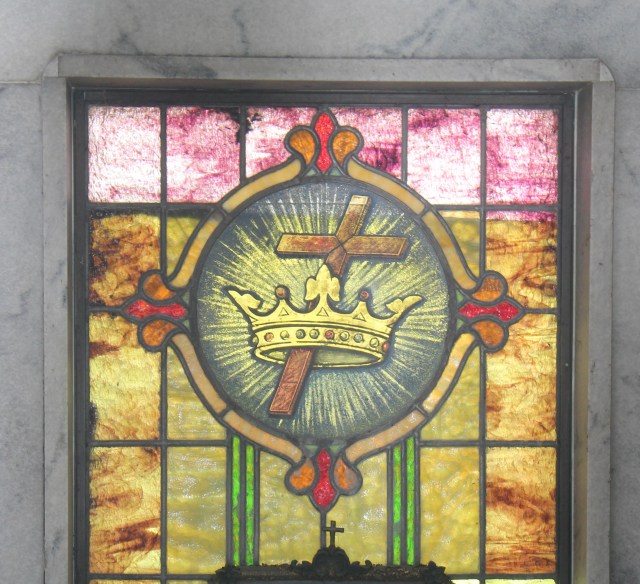
The window in the St. Adalbert Catholic Cemetery at Chicago, Illinois, displays a radiant crown and crown in a stained-glass cartouche. The crown is a symbol of glory and victory over death.  The reward awaits in Heaven where the victor will receive a crown of victory. The cross represents the suffering of Christ.

Posted in Symbolism | Leave a comment

John Belushi and Puritan Iconography

photo

Here Lies Buried

The Body Of

JOHN BELUSHI

January 24, 1949

March 5, 1982

I may be gone, but

Rock and Roll lives on.

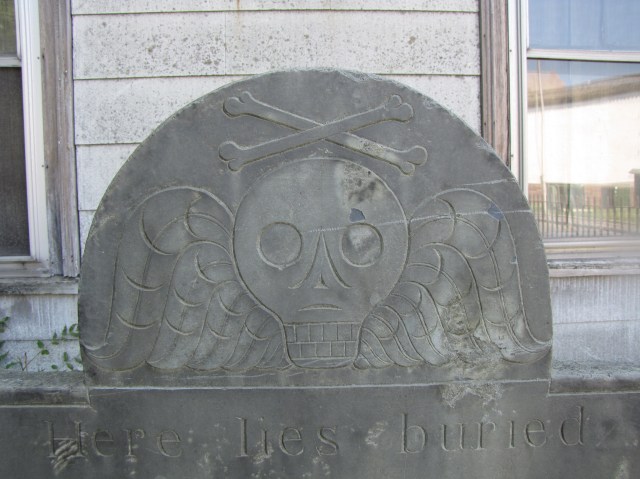
Catie, a friend of mine, was vacationing on Martha’s Vineyard and walked through Abel’s Hill Cemetery when she spied the tombstone of comedy legend John Belushi. His gray slate marker depicts the skull and crossbones. Here, what is old is new again. Some of the oldest gravestones in America display the skull and crossbones iconography broadcasting the message to “remember death” meant to remind all that life is short.

Here lies buried

The Body of Mr BENJAMIN PARKER Mercht

Who Departed this Life

The 14th day of November

1769

Aged 54 Years

Here again on this gray slate gravestone in the Granary Burying Ground at Boston is an example of the skull and crossbones symbol.

img_49861

But if you take a close look at the edges of the gravestone were the beginnings of a softer message.  Two small winged cherub faces are carved on the marker.  These images are called “soul effigies”.  They mark the transition away from harsh Puritan theology to the gentler Age of Enlightenment that gave way to the sentimentality of the Victorian Era.

These winged figures represent the flight of the soul away from the body, presumably to Heaven.  Instead of the symbolism of skulls, bones, grave-digging equipment and the like, the soul effigies speak to a message of optimism and the glory of the soul in the hereafter.

Here lies buried

The Body of

Capt JOSEPH LAMBERT

Who departed this Life

August 17th 1790

in the 60th Year

of his Age.

img_3042

The version found at the Burying Point in Salem, Massachusetts, is a variant of the skull and cross bones that depicts the skull with wings—representing the flight of life.

img_3043

Posted in Famous graves, Symbolism | 2 Comments

Rising or Setting Sun

img_3008

Here lies the body of

Miss RUTH HUNT

Who departed this life

Oct. 19th, 1792.

in the 87th Year of her age

The gray slate gravestone in the Burying Point, the oldest burying ground in the City of Salem, Massachusetts, features the incised design of a sun. The anthropomorphic sun in this case has two eyes peeking forward.

It is always difficult to look at a design like this and know whether the sun is setting or rising. The setting sun represents death—darkness. If the sun is a rising sun it represents Christ’s resurrection.

img_3007

Posted in Symbolism | Leave a comment

Wheat and Ivy

img_4209

LEVI BUCKINGHAM

BORN DEC. 15. 1795.

DIED SEPT. 26. 1857.

ELIZA BUCKINGHAM

BORN APRIL 17. 1802

DIED AUG. 20. 1865.


PETER A. BUCKINGHAM

BORN OCT. 26. 1831.

DIED NOV. 16. 1835.

SALINA BUCKINGHAM

BORN MARCH 13. 1829

DIED AUG. 6. 1836.


MARGARET A. KENDALL

BORN JULY 2. 1819

DIED MARCH 31. 1860.

MATILDA BUCKINGHAM

BORN MARCH 9. 1833.

DIED MARCH 7. 1854.

The white marble gravestone of Levi and Eliza Buckingham in the Spring Grove Cemetery at Cincinnati, Ohio, prominently displays their names and birth and death dates on the front of the stone in an elaborate cartouche. Carved into two of the sides of the marker have other names of fallen family members. The cartouche has wheat tucked into the top and the bottom of the stone is adorned with ivy leaves twinning around the gravestone. The ivy traditionally represents friendship.

Wheat’s origins are unknown but is the basis of basic food and a staple in many cultures. Because of wheat’s exalted position as a mainstay foodstuff, it is viewed as a gift from Heaven. Wheat symbolizes immortality and resurrection.  But, like many symbols found on gravestones, they can have more than one meaning.  For instance, because wheat is the main ingredient of bread, the sheaf of wheat can represent the Body of Christ.  Wheat can also represent a long life, usually more than three score and ten, or seventy years.

img_4210


Posted in Symbolism | Leave a comment

Neo-classical design

douglas_12-2-16

WILLIAM EVANS CHAPIN

AUG. 15, 1856 – JAN. 25, 1936

NANNIE NICOLSON CHAPIN

MAY 19, 1880 – APRIL 29, 1912

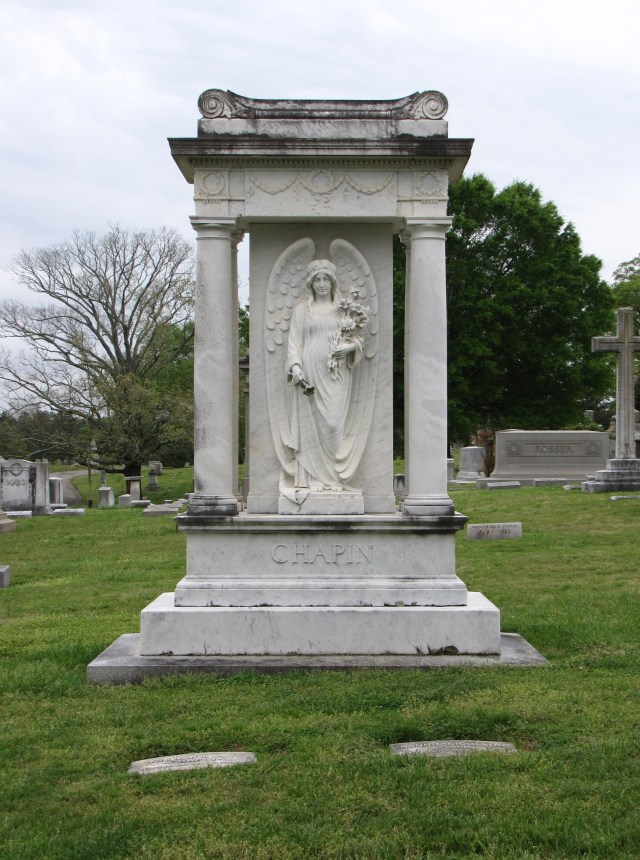
The Chapin monument in the Westview Cemetery at Atlanta, Georgia, is a neo-classical design. Many ancient classical designs are replicated in modern graveyards based on the designs of Greek and Roman temples.  The canopy on the Chapin monument is modeled after the Roman tomb of Lucius Cornelius Scipio Barbatus.

Scipio's tomb

Scipio’s tomb

The Scipio sarcophagus was erected around 150 BC.  Lucius Cornelius Scipio Barbatus (died c. 280 BC) was one of the two elected Roman consuls in 298 BC. His tomb is an example of classical Greek design based on the same design principles used for the Parthenon.  The scroll work, at the top of the canopy represents the Heavens, and also represented a bed. In an article written for “Design Hints” by John Cargill, a designer from the Chicago design firm of Chas. G. Blake & Company, describes the meaning of the scrolls writing, “The scrolls represent a bed; the bed refers to sleep and sleep is a type of death; and to the righteous death is but glorious transport to Paradise.

Cargill described the evolution of the classical architectural design principles, which he writes were conceived from the order that the ancients found in nature, primarily astrological, that were used in Greek architecture to imbue harmony into their structures.

img_0593

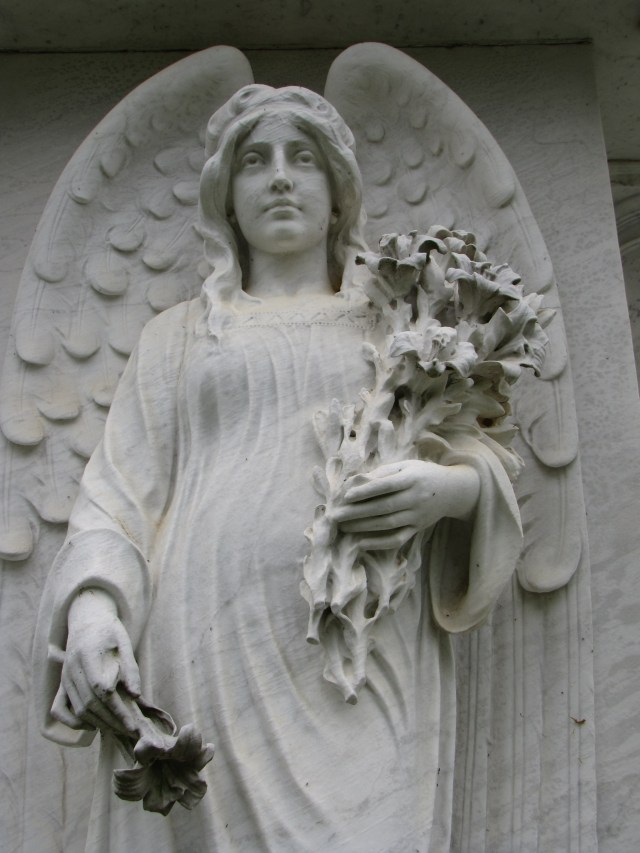
The sarcophagus, as does the Chapin monument, has three distinct planes representing the universe—the base, the middle, and the top. The base is symbolic of the Earth, the middle represented man and the gods, and the top of the sarcophagus where the scroll rests represents the Heavens. In this case, the angel, as the messenger of God, clearly stands in that middle land. An angels stands holding a bouquet of Easter lilies in one arm and a single blossom in the other.

img_0601

The lily, as a funerary symbol, has many meanings including purity, innocence, virginity, heavenly bliss, majestic beauty, and Christ’s resurrection.  Christians believe that the trumpet-shaped blossoms announce the Resurrection of Jesus Christ. If the lilies are white they symbolize the hope of eternal life. The Easter lily has long been associated with the Christian religion, commonly referred to as “White-Robed Apostles of Christ.” Early Christians believed that lilies sprouted where Jesus Christ’s sweat fell to the ground in the Garden of Gethsemane.

img_0602

White has typically been a color associated with virtues of purity and innocence.  Often the lily can be found on the grave of a child, the epitome of purity and innocence.  The white lily is also associated with virginity and marriage, in particular relationship to women.  On one hand, the lily represents virginity and innocence, which is an appropriate symbol for a young unmarried woman.  On the other hand, it is symbolic of majestic beauty and marriage, which makes it an appropriate symbol for all married women regardless of their age.

img_0603

Posted in Symbolism | Leave a comment