Prolific song writer and musician, Stephen Foster became known as the “Father of American Music,” and for good reason, too. Even though his most noteworthy songs were written well over a century ago, they are still recognized today. Two of his songs were adopted as state songs—“Old Folks at Home” also known as “Swanee River” as Florida’s and “My Old Kentucky Home” became the state song for, of course, Kentucky. Many of his other songs are also a part of American culture—such as the rollicking “Camptown Races” one of more than 200 songs he wrote during his short lifetime.
His popularity was memorialized in stained glass in the Temple of Memories, the public mausoleum dedicated in 1961 in the Allegheny Cemetery in Pittsburgh. The window features Stephen Foster in the center seated at a piano. There are scenes of his most famous songs in the window and the side panels—including depictions of “Oh, Susanna” and “I Dream of Jeannie.”
According to Images of America: Allegheny Cemetery by Lisa Speranza and Nancy Foley page 108, Arcadia Publishing 2016, Charleston, South Carolina, devoted music fan Harry Houdini visited the grave of Foster many times and even paid for the upkeep of Foster’s grave. Houdini credited Foster with the creation of “real American songs.”
Daughter of Nathaniel Breeding and Mary Ann Ewing Breeding
Born September 4, 1787
Fayette County, Pennsylvania
According to Images of America: Allegheny Cemetery by Lisa Speranza and Nancy Foley page 28, Arcadia Publishing 2016, Charleston, South Carolina, “George Hogg was born in England in 1784 and came to the United States in 1804. He was known in Pittsburgh for having developed the Brownsville Glass Factory and later as founder of the Monongahela Navigation Company in 1836.”
The monument marking the graves of George Hogg and his wife, Martha, was created by famed sculptor, Henry Kirke Brown. Though the angel has become known as the “Hogg Angel”, the artist named it the “Angel of the Resurrection”. Fittingly, the angel, resting on a sandstone pedestal, is depicted with one hand reaching toward the heavens and one toward Earth, to signify to the “creator that a Christian soul rests here, among the tree-lined paths at Allegheny.”
Henry Kirke Brown (1814-1886) was in high demand for his work creating statues of some of the most famous Americans in our history, including equestrian statues of George Washington, Andrew Jackson, and General Winfield Scott. Three of his works—statues of Nathanael Greene, George Clinton, and Philip Kearny—are in Statuary Hall in the United States Capitol.
Another of his works that can be found in the Green-Wood Cemetery in Brooklyn, New York, is a bronze statue of New York Governor De Witt Clinton. According to the Smithsonian American Art Museums Art Inventories Catalog, created a “Standing portrait of DeWitt Clinton in suit with Classical drape over left shoulder and around waist. His proper left arm is bent at the elbow, hand resting on hip and covered completely by the drape. His right arm hangs straight down, his hand resting atop a stack of books.”
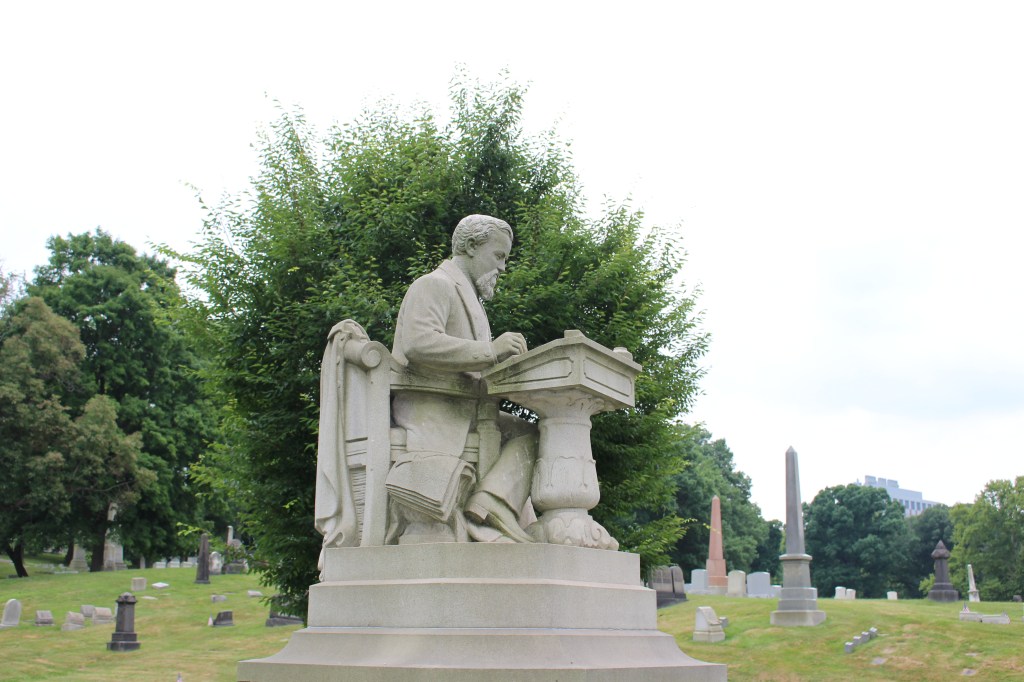
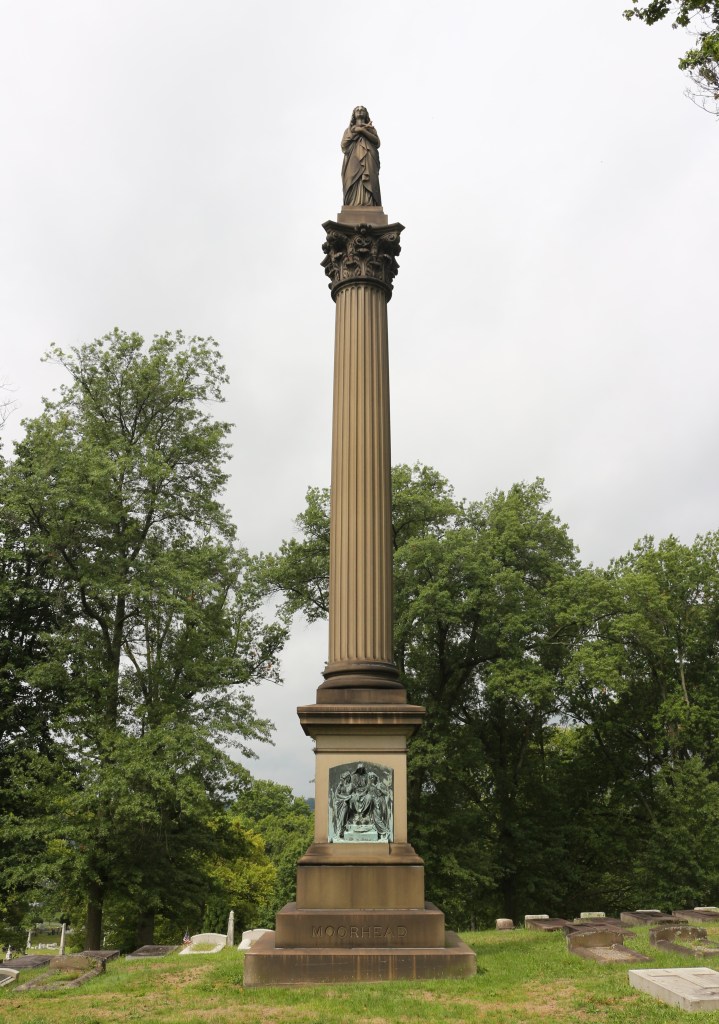
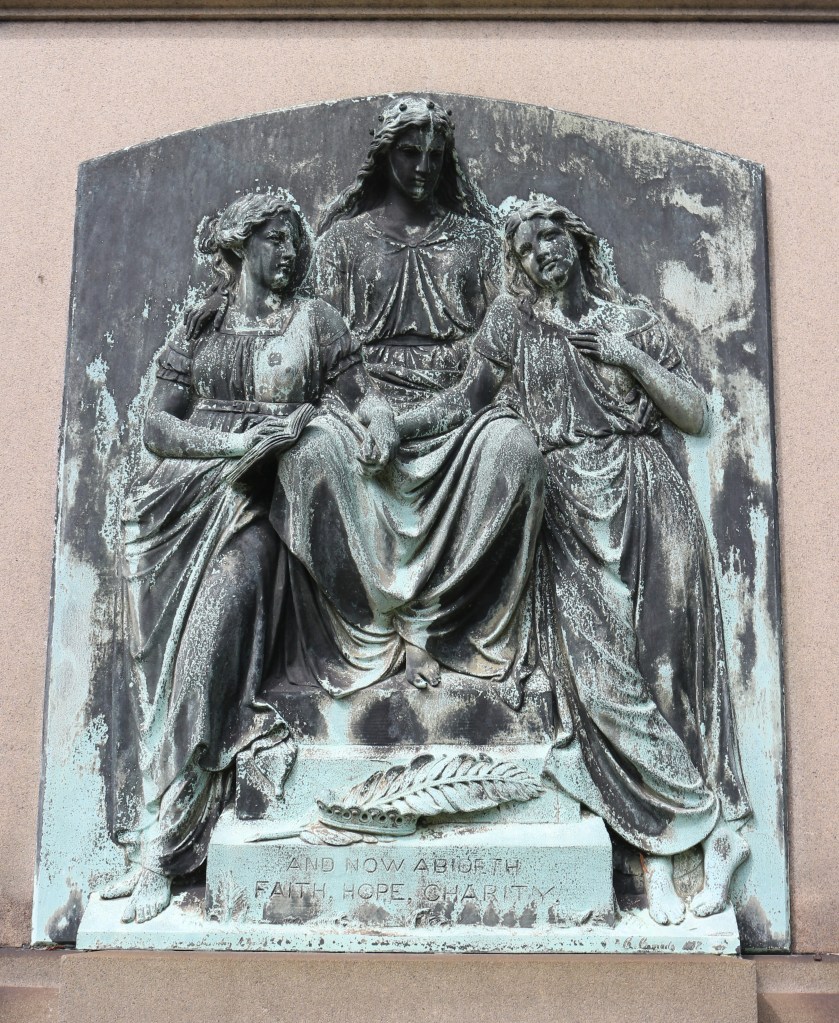
Two pieces of great art found in an open-air museum—also known as a cemetery.
Before the horrific sinking of the Titanic, another maritime disaster made huge headlines. According to Images of America: Allegheny Cemetery by Lisa Speranza and Nancy Foley page 111, Arcadia Publishing 2016, Charleston, South Carolina, “James B. Hogg was lost on the infamous sinking of the Collins liner Arctic due to a collision with the steamer Vesta off the coast of Cape Race on September 27, 1854.” Cape Race is located at the southeastern tip of the Avalon Peninsula coast of Newfoundland, Canada.
Unfortunately, for the passengers on the Arctic, there were not enough lifeboats to accommodate all of those aboard the ship. When the two ships collided, confusion and panic took over and all sense of order was lost. Chaos ensued. Of the 250 passengers and 150 crew members, only “24 male passengers and 61 crew members survived. Every last woman and child was lost…Among the survivors was the captain of the ship, who was never called to account.” The captain did NOT go down with the ship.
James Hogg, the son of George and Martha Hogg, drowned in the catastrophe. A marker was erected in the Allegheny Cemetery in Pittsburgh to commemorate his life, even though his body was never recovered. James Hogg’s marker is a cenotaph which originates from the Greek word kenotaphion. Kenos means empty and taphos translates to tomb–together they form “empty tomb.”
While the monument is badly eroded the sculpture still gives a glimpse into the confusion and drama that took place as the ship was taking on water. The Hogg’s commissioned Patrizio Piatti (1825—1888) to create the tombstone. Piatti was an Italian sculpture born in Lombardy, Italy, who immigrated to the United States in 1850, and plied his trade as a sculptor specializing in marble mantelpieces and cemetery monuments.
In the Oakwood Cemetery in Syracuse, New York, philanthropist Christina Colvin commissioned sculptor Ralph Cook (1847 – 1912) to create a monument to honor those orphans of the asylum who had died. According to the April 4, 1892 edition of the Syracuse Journal, Colvin’s “devotion to the Orphan Asylum has often stimulated others to follow her example. She labored for it in various directions … How large would be the pile of socks, stockings and mittens she knit till her lame, tired hands could knit no longer. She did good, as she had opportunity. Often stricken by sorrow, she strove in helping others to forget her own loneliness. Long connected with the Reformed church, whether she took the care and responsibility from less broad and experienced shoulders in her own social gatherings, greatly helping to ensure their success, or came into our homes with strong but tender hands and heartfelt sympathy in times of sickness and death, we all know we could trust dear “Aunt Tiny.”
According to the Smithsonian American Art Museums Art Inventories Catalog, the sculpture created by Cook depicts a “female figure holding a child in her left hand while comforting a toddler with her right.” The irony of the monument featuring a mother with two children and dedicated to the orphans of the county, is that the children buried in this section of the cemetery did not have mothers.
Two Pennsylvanian prominent families united—Johnston and McCandless. William Freame Johnston was an attorney and politician, elected to the state Assembly and state Senate and was eventually elected Governor. After a successful term as Governor, he went on to prove his ability in business in several different industries—oil refining, iron manufacture, and salt production.
Johnston’s daughter married William McCandless. William McCandless was an officer in the Civil War. After he mustered out with an honorable discharge he went into business as president of the American Window Glass Company.
Their Neo-classic monument features the Doric order characterized by columns that are usually fluted with a slightly curved and unadorned capital. The architrave is enhanced with triglyphs and a repeating motif of circles in the Allegheny Cemetery in Pittsburgh, Pennsylvania. Between the columns, the monument features a classically dressed angel standing in a field of lilies. The lily, as a funerary symbol, has many meanings including purity, innocence, virginity, heavenly bliss, majestic beauty, and Christ’s resurrection.
The Easter Lily has long been associated with the Christian religion, commonly referred to as “White-Robed Apostles of Christ.” Early Christians believed that lilies sprouted where Jesus Christ’s sweat and tears fell to the ground in the Garden of Gethsemane. Christians also believe that the trumpet-shaped blossoms announce the Resurrection of Jesus Christ.
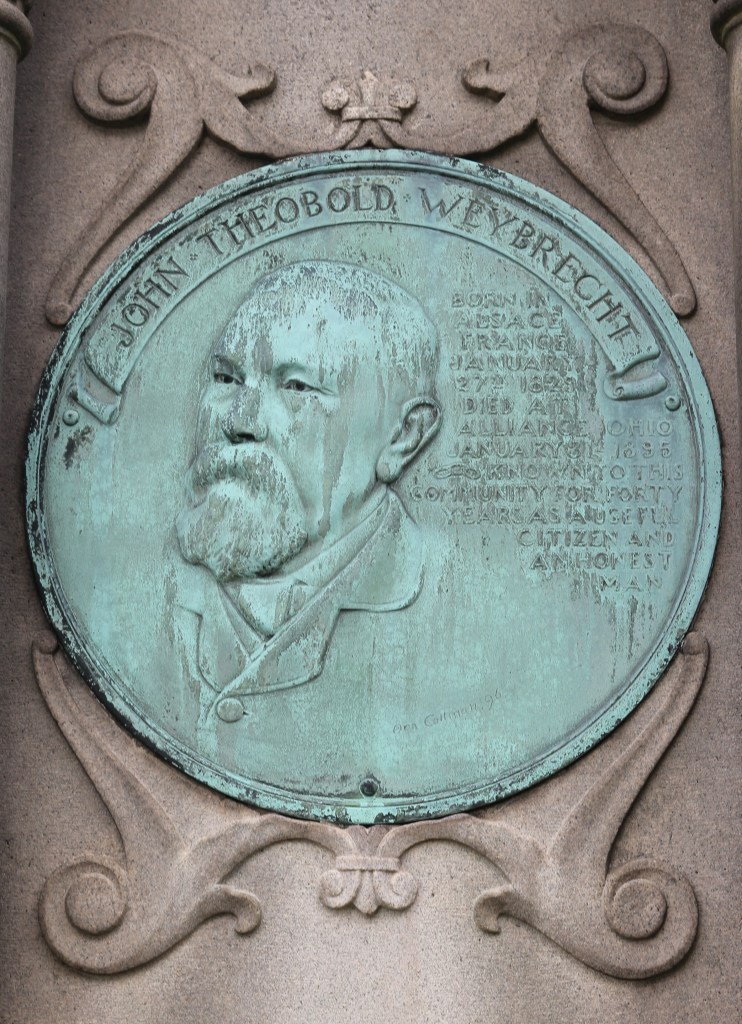
The bronze inset was cast at the T.F. McGann & Sons Foundry in Boston, Massachusetts. Unfortunately, there is not an artist’s signature on this piece.
The Brown Family Mausoleum in the Oakwood Cemetery in Syracuse, New York, is an Art Deco masterpiece. Art Deco is a design movement from the 1920s that marked a break from the fluid and flowing Art Nouveau designs of the 1890s. The term ‘Art Deco’ is derived from the Exposition Internationale des Arts Décoratifs et Industriels Modernes, an exhibition of artists that showed their work in Paris in 1925. Arts Décoratifs was eventually truncated to Art Deco.
The Brown Family Mausoleum was constructed with white granite, and exhibits the clean, straight lines characteristic of the Art Deco designs from the 1920s. This mausoleum was modelled to look like a skyscraper, partly achieved with the vertical lines and by its soaring height of 25 feet. The exterior of the mausoleum is white granite, but the interior is a stark contrast constructed of polished black marble.
The inventor, Alexander Brown and his wife are buried within the mausoleum. Brown was a serial inventor with over 150 patents to his name in a wide variety of areas which included the L.C. Smith Shotgun, the Smith Premier full-keyboard upstrike typewriter, as well as various patents for the automatic telephone and different automative parts. In addition to his inventions, Brown was president of the Franklin Automotive Company and Director of the First Trust and Deposit Company.
With all of his inventions and creations, one of his most lastly designs was the design for his own mausoleum!
Even though the Ahern Family Mausoleum in Woodlawn Cemetery in the Bronx, the Sherwood Family Mausoleum in the Rock Creek Cemetery in Washington, D.C., and the Charles Edward Crouse Mausoleum in the Oakwood Cemetery in Syracuse, New York, are in different cities and of different architectural styles, they share a common feature—the same door.
The Smithsonian Institution Research Information System (SIRIS) describes the door as a “Relief of a standing female figure with her back to the viewer and her face in profile appears on the door … The figure reaches out to the handle of the door with her proper right hand. Her proper left hand is raised and rests on some of the ornamental detail of the door. This ornamental detail consists of three rows of flowers along the top quarter followed by a narrow band of a wave-like design. The lower portion of the door is a grill work of foliage. The figure’s long flowing gown is off the shoulder on the proper right side and her hair is braided around her head.”
The door itself represent a portal. Portals come in many forms—a door, a window, even your eyes and your mouth are considered portals. Many superstitions about death concern portals, many of which come from the Victorian Age, some of which still exist today.
The eyes, for instance, are considered the windows to the soul. Victorians believed the eyes were powerful, almost magical, even in death. When a person died therefore, the body had to be removed from the home feet first (most people died at home in the 19th Century). In that way, the eyes of the deceased could not look back and lure a live person to follow the dead through the passageway to death.
The Victorians also believed that as you passed by a cemetery, you needed to hold your breath. The fear was that if one opened one’s mouth, that a spirit from the dead residing in the cemetery would enter your body through the portal—the open mouth.
Another superstition had to do with the mirrors in the home. After a death, the family very quickly covered the mirrors. It was believed that mirrors were false portals in a sense. The Victorians believed that the spirit of the dead could enter a mirror and become trapped in the mirror. If the spirit did so, it would not be able to complete its trip through the passageway from the Earthly realm to the Heavenly realm, or in some cases, to warmer climes.
The door as a motif in funerary art also symbolizes mystery. The door is the portal from the Earthly realm to the next. In Christianity, the door is usually viewed with hope, charity, and faith. The next life in the hereafter will be better than the one experienced here on Earth.
The bronze door was sculpted and signed by Stina Gustafson. Hilda Kristina “Stina” Gustafson (December 18, 1885 – March 7, 1937) was born in Sweden and married fellow artist Salvatore Lascari, who gained fame as a portrait painter. Gustafson was an accomplished sculptor winning a series of awards including the Waltrous Gold Medal from the National Academy of Design. She also won the McClees Award from the Pennsylvania of Fine Arts In 1935, she was inducted into the National Academy of Design.
Tragedy struck in 1937, Gustafson’s studio caught fire. After, she fell into a deep depression and was hospitalized. According to the Brooklyn Daily Eagle, Monday, March 8, 1937 edition, the headline read, “Hilda H. G. Lascari Noted Sculptress Plunges to Death.” The paper reported, Gustafson “plunged to her death … from the 11th floor of the French Hospital … Manhattan. Early in January Mrs. Lascari suffered a nervous breakdown from which she was slowly recovering in the hospital. The unusually-gifted artist was last seem alive reading a book in the solarium on the hospital roof. An attendant entered the solarium some time later in the afternoon and raised an alarm when Mrs. Lascari was nowhere to be seen. The book was lying beside her chair and the window was open. Her body was found in the courtyard on the west side of the hospital.”
Sadly, the award-wining and talented artist died a tragic death at the age of 51. She was laid to rest in Rome, Italy, her husband’s homeland.
The soaring monument in the Oakwood Cemetery at Syracuse, New York, memorializes Olive and Henry Wigglesworth and James and Sylvia Wigglesworth Maitland.
Henry Wigglesworth was the son of Alfred and Selina Hardy and born in Belfast. Ireland. Their imposing marble monument as described by the National Park Service, American Monuments and Outdoor Sculpture Database, “contains a relief of a full-length female figure in a long, billowy dress. She holds a baby in the crook of her proper left arm, and a branch in her proper right hand. Behind the woman’s head is laurel in low relief.” The laurel symbol dates back to Roman times when soldiers wore them as triumphal signs of glory. In funerary art the laurel, often depicted in a wreath, is seen as a symbol of victory over death.
The sculpture was created by John Massey Rhind (July 9,1860 – January 1, 1936) a Scottish-born sculptor who lived and worked in the United States creating private and public works. His most famous work is the marble statue of Dr. Crawford W. Long which is located in the National Statuary Hall Collection in Washington, D.C. Another example of his work can be found on the East side of the Philadelphia City Hall of Sam Wannamaker.
Two bronze statues in the Rose Hill Cemetery in Bloomington, Indiana, honor the men and women who fought in the service of their country.
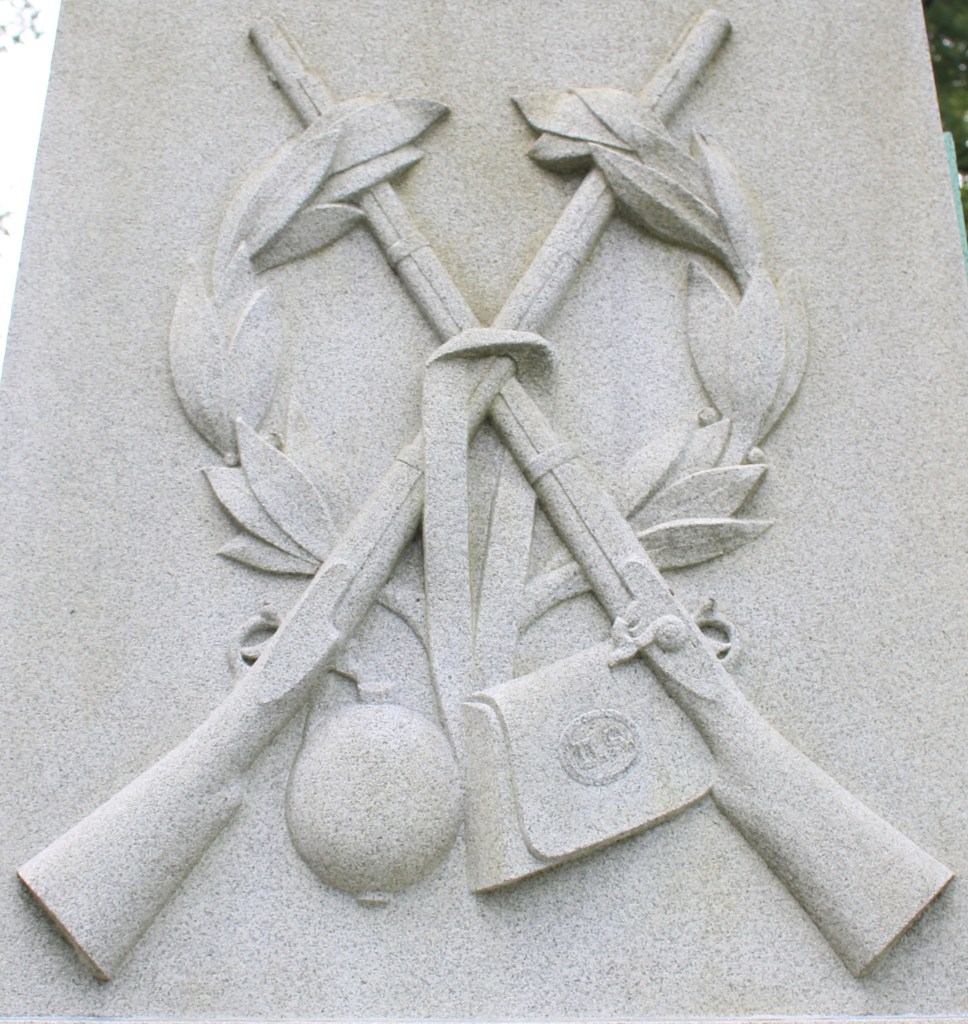
The first statue erected was a bronze of a Union soldier placed in a circle at the highest point in the cemetery. The statue stands atop a large and elaborate limestone base. The front of the base has the initials G.A.R. carved in the center of the pediment. Each of the four sides of the base has a bronze insert—two depicting battle scenes and two showing the emblems of the Grand Army of the Republic organization.
No other war was like the American Civil War for Americans because every sailor or soldier, every collateral death, every field or railway yard that was destroyed, every city or town devastated by artillery was American. During the Civil War Americans were fighting against Americans—brother against brother—cousin against cousin. The war tore the country apart and threatened the existence of the Republic. And, more Americans were killed in the Civil War than any other war that in which Americans have fought. The total American deaths by war: Civil War 625,000.
The second statue is of an advancing doughboy, complete with metal helmet and rifle. The bronze rests on top of a limestone base that has four Doric columns supporting the platform on which the soldier is placed. Inside the colonnade is a bronze plaque that lists the 34 men who gave the ultimate sacrifice during the “Great War.” The war began in 1914 when Archduke Ferdinand was assassinated setting off a chain of events that embroiled much of Europe in the war. The United States was not initially in the war but sent forces in 1917 and 1918 with 116,516 Americans dying in battle.
Cemeteries throughout the United States pay tribute to the soldiers often with war memorials erected across America in town squares and cemeteries. In this case, both statues were produced by the W. H. Mullins Company of Salem Ohio.
The company produced a wide range of statuary and produced a 120 page catalogue showing the various statuary that could produce.
A couple of years ago during Halloween week, volunteers dressed in period costumes to play Bloomington residents who had passed away and were buried in the Rose Hill Cemetery. As they stood next to the gravestone, they retold the story of the life and death of the person.
In this reenactment, the actress retold the story of Mrs. Dupree’s accidental death when she was struck by a car. She is seen in the photo above, mouth agape and horrified, as Mrs. Dupree sees the car barreling toward her at a whopping 12 miles per hour. The accident was reported by the local news:
“Mrs. Anna Dupree, sixty years old, wife of George Dupree, foreman at the Monon railroad shop in Bloomington, died last Thursday night of injuries suffered when she was struck earlier in the evening by and automobile driven by James Flynn, living 5 miles east of the city. She attempted to dodge another car and stepped in front of Flynn’s machine. Flynn was arrested, but release after it was learned that the accident could not be averted. Mrs. Dupree is survived by the husband and daughter, Mrs. Jessie Mercer.”
In 1922, 14,859 people were killed in car accidents that year, Mrs. Dupree was sadly one of them. In the last data that was collected and reported—2023—over 40,000 deaths were due to car accidents. According to the Center for Disease control, “Fatalities that result from motor vehicle crashes are the second largest cause of accidental deaths in the United States”. Unintentional poisoning, motor vehicle traffic deaths, and unintentional falls lead the way in accidental deaths.