Metaphors

The sundial has been a way to measure time since the Egyptians developed them over 3,500 years ago. Historians even believe that the obelisks of ancient Egypt were used to measure time even earlier.

The sundial monument in the Cave Hill Cemetery at Louisville, Kentucky, not only measures time, but also marks the graves of the Rae family. The Rae Family sundial surrounded by a marble colonnade punctuates that point with the symbol of the winged hourglass—a symbol that denotes how quickly life passes by, how fleeting time is.

The sundial marks the passage of time and in funerary art symbolizes the passage of time. The sundial and the winged hourglass are both metaphors.

Posted in Symbolism | Leave a comment

Two Symbols

The BRUNNER family monument in the Cave Hill Cemetery at Louisville, Kentucky, contain two symbols, both cast in bronze and set in and on the granite marker.

The first is a set of gates. The gates represent a passageway from one realm to the next.  The gates are the portal for saved souls to make their passage from the Earthly realm to the Heavenly realm upon Christ’s return.

The second symbol adorning the monument are inverted torches. The flame is symbolic of the soul.  The inverted torch represents a life that has been extinguished.

Posted in Uncategorized | 1 Comment

His Last Sculpture

Jeptha Barnard Bright, Jr., known as Barney, (July 8, 1927 – July 23, 1997), was a well-known Kentucky artist.  He was born in Shelbyville, Kentucky, and spent his career as an artist in Louisville as a foundry owner and sculptor.  Many of his commissioned statues can be found around Louisville, such as, the Louisville Clock, the River Horse Romano in front of the Ron Mazzoli Federal Building, the Floating Nudes in front of the Legal Arts Building, and in the city’s famed Cave Hill Cemetery marking the graves of luminaries like Saundra Curry Twist and Harry Leon Collins. His work can be found outside the Louisville area, as well. For instance, Bright was commissioned to create a statue of legendary basketball player Julius Erving for the City of Philadelphia.

Barney Bright created his own cemetery monument, too—reclining nudes of himself and his wife.  His wife, Gayle, is depicted as a young woman and he is depicted as an old man.  Reportedly, the Cave Hill Cemetery Association was not pleased with the erotic pose of his monument.  They, however, relented and allowed the monument to mark his grave.  It is yet another bronze that commemorates his life and a long, successful, and esteemed career.

Posted in Uncategorized | Leave a comment

Magic

The Cave Hill Cemetery at Louisville, Kentucky, is a rolling, beautifully landscaped rural garden cemetery in the finest tradition. At every turn through the cemetery there are monuments that catch the eye and draw in the viewer to wonder about the person buried underneath. None any more than that of the monument dedicated to Harry Leon Collins (April 27, 1920 – May 3, 1985). The bronze statue marking his grave is a life-size likeness of Harry Leon Collins in a tuxedo standing in front of a trunk. Collin’s hand is extended in a gesture of welcoming.

Collins was well known in Louisville for his magic. So well-known for it, that he became known by the moniker, Mr. Magic. What had started out as a teenage fascination with magic became an avocation and then a vocation later in life. Collins’ interest in magic started when a local attorney in his hometown of Glasgow, Kentucky, showed him some magic and slight-of-hand tricks. From that point on, Collins was hooked and practiced his craft until he was quite good. Good enough, in fact, to get a part in the Bob Crosby USO show during his stint in the Pacific Theater while he was serving in the Marines in World War II.

After the war, Collins moved to the big cosmopolitan city of Louisville, Kentucky, where he got a job with the Frito-Lay Company as a salesperson. Though he was working full-time during the day selling Lays potato chips (my personal favorite chip!) and Fritos, he was still practicing his craft as a magician at night. He was so good he gained the nickname as Mr. Magic and gained a large following as one of the city’s favorite entertainers. The Frito-Lay management realized that they could have Collins combine his love for magic with his sales acumen and Collins became known as the Frito-Lay Magician. Now instead of using the phrase hocus pocus or voila or abracadabra, Collins would say, “Frito-Lay” when he pulled the proverbial rabbit out of his hat!

While the statue is a fitting tribute to his skill and passion as a magician, and his 45 years at the Frito-Lay Company, it only tells part of the story about who Harry Leon Collins was. He was also the son of Paul and Sadie Emerson Collins. Harry was only 15 when his father died and took over the awesome family responsibility of running the tobacco farm while finishing high school. He continued to take care of his brothers and sisters even after high school. He sent money home to take care of them after he entered the Marines. And he never forgot his obligation to them—sending each of them to college.

When Harry Leon Collins died suddenly in 1985, his wife, Maxine Warner Lewis Collins, commissioned famed sculptor, Barney Bright, to create the bronze statue of him that marks his grave.

Posted in Famous graves | 1 Comment

HIS PRETTIEST FLOWER

SAUNDRA CURRY TWIST

Oct. 9, 1941 – Jan. 7, 1981

MARTIN RAY TWIST

April 7, 1943 – Feb. 23, 2014

EDNA WILHELM BEASLEY

Jan. 25, 1923 – Nov. 28, 2003

IN LOVING MEMORY

TONJUA LYNN TWIST

Jan. 12, 1964 – May 20, 2000

WILLIAM C. JOE BEASLEY

June 3, 1917 – Apr. 24, 2005

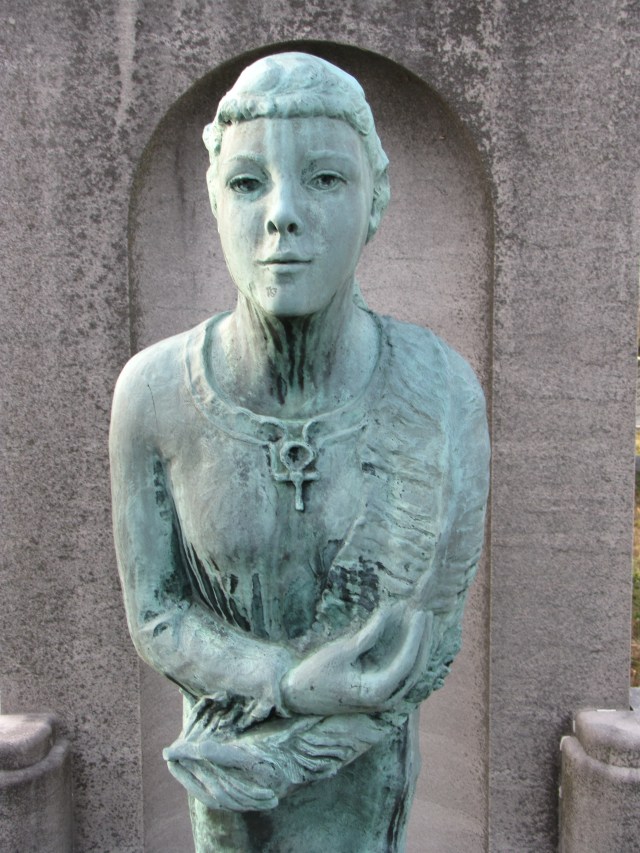
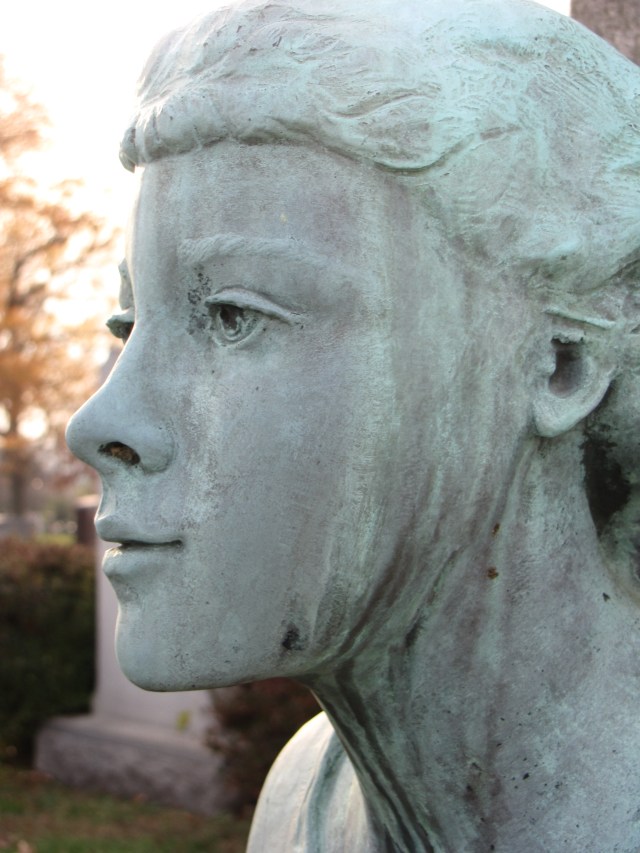
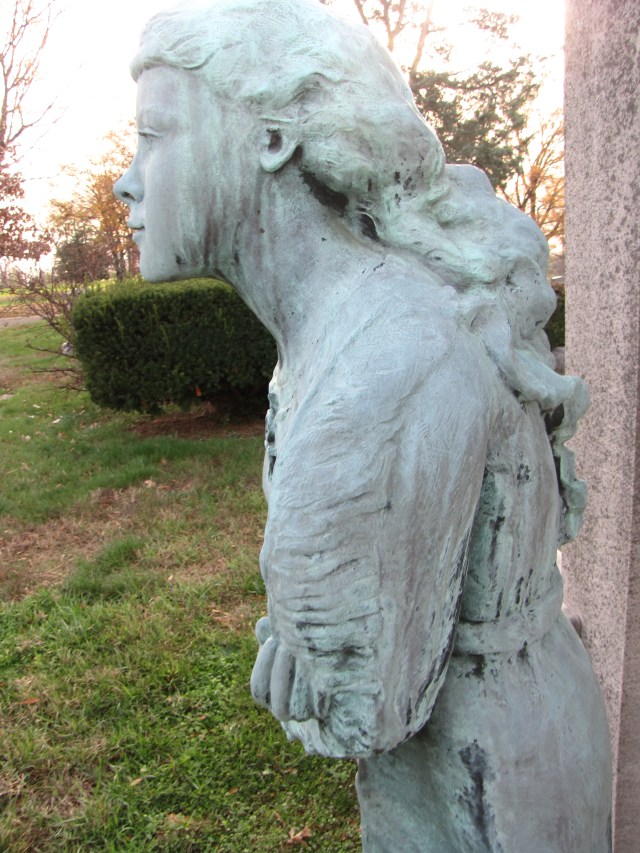
The striking bronze of Saundra Curry Twist in the Cave Hill Cemetery at Louisville, Kentucky, was created by famed Kentucky sculptor, Barney Bright. The statue was fabricated by the Riehm-Gerlack Monument Company of Louisville.

The sculpture depicts Saundra wearing a full-length dress, arms partially stretched, standing in front of a white-marble colonnade that forms a half circle behind her. The sculpture sits atop a small white-marble base with the inscription: “GOD ALWAYS SEEMS TO PICK HIS PRETTIEST FLOWER.”

In front of the statue is a granite grave ledger with the following tribute:

“TO SANDY, A LOVE LETTER

Sandy was born prematurely at home in Louisville and was laid aside by the doctor as still born. Her mother refused to give up and carefully nurtured Sandy for several days and saved her.

She went on to become a beautiful, young lady with grace and poise and won several state-wide beauty contests and had a lengthy career as a successful fashion model. Her marriage at age 21 was one of bliss. No two people were ever more in love and devoted to each other. Hard work and daily living and the fulfillment of the close relationship made the years melt easily by.

Sandy’s untimely tragic death in an auto accident came at a time when Sandy was in her prime. She had found financial success through wise investments in real estate and oil and from humble beginnings had realized for the last few years of her young life all of this world’s bountiful wonders, including three healthy, beautiful daughters and a devoted husband.

Besides her striking physical beauty, Sandy was known by her family and friends as having an inner beauty that was open, honest and loving. She will be remembered as being selfless and untiring in an effort to keep those around her warm and safe and loved. She asked for nothing more than the opportunity to devote herself to her family, and through her self-imposed high standards and example she made those of us who knew her want to try a little harder each day.

Humanity has unknowingly lost an irreplaceable asset, a great lady, and so, we laid her to rest on a beautiful cold, clear, crisp, winter morning here in this peaceful spot where she used to come with us to feed the ducks and geese and swans on Sundays.

Shakespeare said it well, “The heart, like the mind, also has memories.” Even though we have countless fond memories to sustain us, she will be sorely missed.

With Eternal Love,

Martin, Tonjua, Tyra, and Tammy”

Posted in Uncategorized | Leave a comment

Double Duty

If you walk up the sidewalk to the sales office at the Cave Hill Cemetery at Louisville, Kentucky, to your left on that path is a bronze statue of an exuberant little girl with her arms stretched as if she can reach the sky. The statue is titled “La Breeza – The Good Fairy”. The plaque on the base of the statue says that it is a reproduction of the original work of Oscar Mattison in the 1950s.

That same statue is used in the Lexington Cemetery at Lexington, Kentucky, atop the Wiggins Family Monument. The monument has a statue of “La Breeza – The Good Fairy” atop a square granite base. In this case the statue is used as part of their gravestone—not as freestanding art. Mattison’s sculpture is doing double duty.


Posted in Uncategorized | Leave a comment

Homage to a Legend

The rural garden Spring Grove Cemetery at Cincinnati, Ohio, has a sculpture by artist Robert Koepnick of Dayton, Ohio, dedicated to Johnny Appleseed. The sculpture, dedicated in 1968, is placed in the middle of a stone circle with Johnny in the middle standing on a granite boulder. The bronze is of a barefoot Johnny Appleseed, book in one hand, the other lifting up an apple sprig—presumably towards the heavens asking for God’s blessings before it was planted.

The statue honors John Chapman, known better, as Johnny Appleseed because of his dedication to plant apple orchards and nurseries throughout Pennsylvania, Ontario, the northern counties of West Virginia, Ohio, Illinois, and eventually Indiana.

This piece of artwork is art as tribute, not as a monument placed over his grave, because he is not buried in the Spring Grove Cemetery.

Johnny Appleseed died in Fort Wayne, Indiana, which is where is buried, though, the exact spot is disputed and the truth may never be known. Some believe he is buried close to the cabin in which he was living when he died, while others believe he is buried at the Archer Family Cemetery.

In any case, the sculptural homage to Johnny Appleseed is also accompanied by a plaque in the floor of the stone circle that reads:

JOHNNY APPLESEED

(JOHN CHAPMAN,  SEPTEMBER 26, 1774 – MARCH 18, 1845)

JOHNNY APPLESEED, FIGURE OF LEGEND, WAS A SWEDENBORGIAN MISSONARY TO THE OHIO AND INIDANA FRONTIER. SAINTLY IN HIS DAILY LIFE. HE LOVED LIFE IN ALL ITS FORMS AND HAD A JOYOUS WILL TO HELP THE EARTH YIELD ITS FRUITS. BIBLE IN HAND AND SACK OF SEED SWINGING FROM HIS SHOULDER HE PLANTED MANY APPLE ORCHARDS THAT LIVE TODAY IN THIS REGION. MAY HE BE REMEMBERED IN FACT AS WELL AS IN LEGEND FOR HIS GODLINESS AND GOODNESS.

The day we visited the cemetery, some clever visitor left a small individual container of Mott’s applesauce at the foot of Johnny’s sculpture—homage to his love of the apple in all its forms!

Posted in Uncategorized | 5 Comments

Beauty and the Beast, Pandora, and Sleeping Beauty all rolled into one

The Hollywood Forever Cemetery in Southern California is one of those landscaped cemeteries that has art for art’s sake on the grounds. One of the works is a replica sculpture of Antonio Canova’s Psyche Revived by Eros’ Kiss, created in 1787. His original sculpture is now housed in the Louvre in Paris. The sculpture is a neoclassical masterpiece depicting the two lovers at the height of their passion—the moment when Eros’ lips awaken the sleeping Psyche.

In mythology, Psyche was the mortal woman who had been gifted with beauty and grace that reviled all others, including the Goddess Aphrodite. The jealous Aphrodite hatched a plot to have her son, Eros, poison men’s souls in order to kill their desire for the gorgeous Psyche. But, like others, he fell under the spell of Psyche’s extreme beauty and fell desperately in love with her, too.

Even though, many suitors came forward to ask for her hand in marriage, Psyche spurned all of the advances saving herself for the one true love she was waiting for. Her worried parents asked an oracle for help to marry off their gorgeous daughter. Surprisingly and to their horror, the oracle foretold that the lovely Psyche would marry an ugly beast—shades of Disney’s Beauty and the Beast! And so, as they say in these myths, it came to pass—their beloved daughter did marry a beast, Eros as it turns out, who she could only be with after the curtain of nightfall fell. It was mysterious but his tenderness enthralled her and she was happy beyond her dreams.

Psyche’s sisters convinced her that the beast she married was evil and would eventually kill her. So she plotted to kill him first. She put her plot into action one night after he fell asleep creeping up on him with an oil lamp to illuminate the room in one hand and a knife in the other. When she saw the flawless and perfect form of Eros she was so startled that she spilled the oil on Eros. Eros fled saying Psyche had violated his trust and ruined their perfect love.

Eros was soon after imprisoned by Aphrodite in her palace. Psyche found out and pleaded with her to be re-united with her lover. Aphrodite agreed but laid out three tasks that Psyche had to perform before she would be allowed to see Eros again. The first two tasks she completed quickly but the third task took her to the underworld where she was to bring the box back to Aphrodite that contained a potion for eternal beauty. Though, Psyche was not to open the box (we’ve seen this before in mythological stories—remember Pandora?) her curious nature got the best of her. The box did not contain the coveted elixir but instead Morpheus the god of sleep and dreams. Upon opening the box Psyche fell into a deep sleep.

Eros, still in love, escaped from his imprisonment in the palace went directly to the big guy—Zeus himself—to beg for his help to save Psyche from her dream state. When Zeus realized how powerful the love between Eros and Psyche was, he did them a solid and made Psyche immortal so the star-struck lovers could be together forever. The moment when Eros leans over to kiss and awaken his bride is captured in the statue (Sleeping Beauty anyone?).

Posted in Uncategorized | Leave a comment

Salvaged Goddesses


Many rural garden cemeteries not only have gravestones, monuments, and tombs that are works of art, but also have sculptures that are freestanding and not commemorating someone deceased. Crown Hill Cemetery at Indianapolis, the largest cemetery in the state of Indiana, is no exception.

In 1962, the Marion County Courthouse in Indianapolis was razed. Some of the bits were salvaged and sold off, including 12 statues that adorned the magnificent Victorian building which was erected in 1873.  According to Memories of the Past: A Tour of Historic Crown Hill Cemetery, Recalling Nearly 200 Years of Indianapolis and Marion County History written by Wayne L. Sanford published by Crown Hill Cemetery in 1996, eight of the remaining statues were removed from the building and relocated to Holiday Park, on North Spring Hill Road—one of the statues is in a private collection. That leaves three of the statues that were purchased by the cemetery board to be relocated to the Crown Hill Cemetery at a cost of $250 per statue.


The three statues purchased by Crown Hill are of Greek goddesses. The first statue is of Themis, the daughter of Uranus and Gaia. Themis was a consort of Zeus—she was a goddess of consequence and made her home at Olympus. Themis, meaning divine law, was the goddess of law and order and is often shown with a tripod or the scales of justice.
The second salvaged Greek goddess, to be found in the Crown Hill Cemetery is Demeter, the daughter of Cronus and Rhea. Demeter is often shown with a sheaf of wheat, bread, a cornucopia, or a torch. Demeter is the goddess of the harvest and of fertility. She can be found in section 46-B where she was placed in 1963.

There is a bit of mystery about the third goddess saved from atop the demolished Marion county courthouse building. According to Memories of the Past: A Tour of Historic Crown Hill Cemetery the statue that stands close to the underpass is either Persephone or Hebe. Persephone was the daughter of Zeus and Demeter. The symbols that she is most often portrayed with are seeds of grain, the torch, flowers, deer, or the pomegranate. Persephone was the consort of Hades of the underworld. She carried out curses upon men and upon the souls of the dead. She was a formidable underworld character!

Hebe, on the other hand, was the cupbearer to the gods and the goddess of eternal youth.   She was also the daughter of Zeus but her mother was Hera. Along with a wine cup, she is also often portrayed with or as an eagle, ivy, the fountain of youth, and wings. Hebe served wine, nectar, and ambrosia to the gods. This statue is shown with a vessel, which would indicate this statue as being Hebe—but you decide.

Posted in Uncategorized | 1 Comment

Neo-classical sculpture

Many rural garden cemeteries not only have gravestones, monuments, and tombs that are works of art, but also have sculptures that are freestanding and not commemorating someone deceased. In the Lexington Cemetery at Lexington, Kentucky, sculptures add to the park-like feel.

One example is a sculpture of a woman playing a lyre. The lyre is an u-shaped stringed instrument that was found in ancient Greece. The lyre was traditionally seen as a symbol of Apollo, the Greek god of music.

In Christian symbolism it can represent harmony and Heavenly accord and song in praise of the Lord.  In funerary art, however, the lyre can also represent the end of life.

Posted in Uncategorized | Leave a comment