August Krug, Brewer

August Krug

BORN

April 15, 1815

DIED

Dec. 30, 1856

There are so many beer barons, beer masters, and brewers buried in the Forest Home Cemetery in Milwaukee, a city made famous by its name brand beers, that the cemetery has a map, titled The Story of Beer, to guide visitors to the various historic monuments, mausoleums, and gravestones on the beer trail.

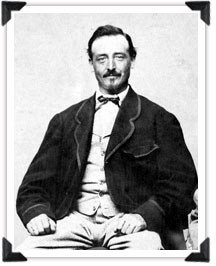
Many people have quenched their thirst to some of the name brand beers of the beer barons who brewed beers that have become household names—Pabst, Schlitz, Miller, and Blatz.  But one of the little known brewers on the guide map is August Krug.  He, like many of brewers, was a German immigrant.  Krug was born in Bavaria, the son of a brew master, and immigrated to the United States in 1848 to open a small restaurant/saloon in Milwaukee.  He added a small brewery—what we would call a microbrewery today.  Output was small, but the beer he brewed had a following.   In 1850, Krug had a windfall when his father came to visit bringing with him Krug’s nephew, August Uihlein, and eight hundred dollars which he invested in the fledgling brewery.  With his father’s investment, Krug was able to hire more staff, including Joseph Schlitz who he hired on as a bookkeeper.

The legacy of note left by Krug was the underground cellar he built to keep his beer at a constant and cool temperature.  Krug tunneled into the side of a hill to create what is credited as the city’s first underground “cooler.”

Krug’s tenure was short tenure—only seven years. In 1856, Krug had a bad fall and died a couple days after.  Within two years, Krug’s widow, Anna Maria, was remarried to Joseph Schlitz, no longer the bookkeeper.  Soon the name of the brewery was renamed and the Schlitz Brewing Company was founded.

August Krug is buried at the Forest Home Cemetery at Milwaukee.  His marker is a simple light brown unpolished limestone column with a matching cap and plinth, and a light gray granite base—no adornment, no epitaph, no family members buried near him.

Posted in Famous graves | Leave a comment

Frederick Pabst, Beer Baron

Frederick Pabst

March 28, 1836 – January 1, 1904

Frederick Pabst was born in the small Saxon village in what was then the Kingdom of Prussia.  When he was twelve, he immigrated to the United States with his father and mother, Gottlieb and Johanna Pabst.  While working at odd jobs in restaurants to make ends meet his mother died in a cholera epidemic in Chicago.  Pabst eventually took a job on a steamer on Lake Michigan.  He earned his pilot’s license and while serving as captain on a steamer met Philip Best, the owner of a small and successful Milwaukee brewery.  Pabst and Philip Best’s daughter, Maria, were married in 1862.  By 1864, Pabst had joined his father-in-law in the brewery, learning everything he could about the business.  Through savvy business and marketing skills, the Best Brewery was brewing 100,000 barrels of beer annually, up from the production of 5,000 barrels a year when his father-in-law retired nine years earlier.  The company went public to raise the money necessary to modernize the brewing process and facilities.  Pabst became president of the corporation in 1873.

By the time the Best Brewery had its name changed to the Pabst Brewing Company in 1889, Pabst was producing over a million barrels of beer annually, the first to do so, and was the largest brewing company in the world.  The beer being produced was also recognized as pretty tasty winning ribbons and gold medals.  As a marketing ploy, the company had blue ribbons hand tied to each bottle of beer to designate its “select” beer even before it actually won a blue ribbon at the 1893 Columbian Exposition in Chicago.  When customers started referring to and asking for the “blue ribbon beer” the name stuck and the company made it official.

By the time of his death in 1904, Frederick Pabst was a successful Milwaukee businessman and civic leader.  He was survived his widow, Maria, and five adult children.  Pabst was laid to rest in the Forest Home Cemetery at Milwaukee.

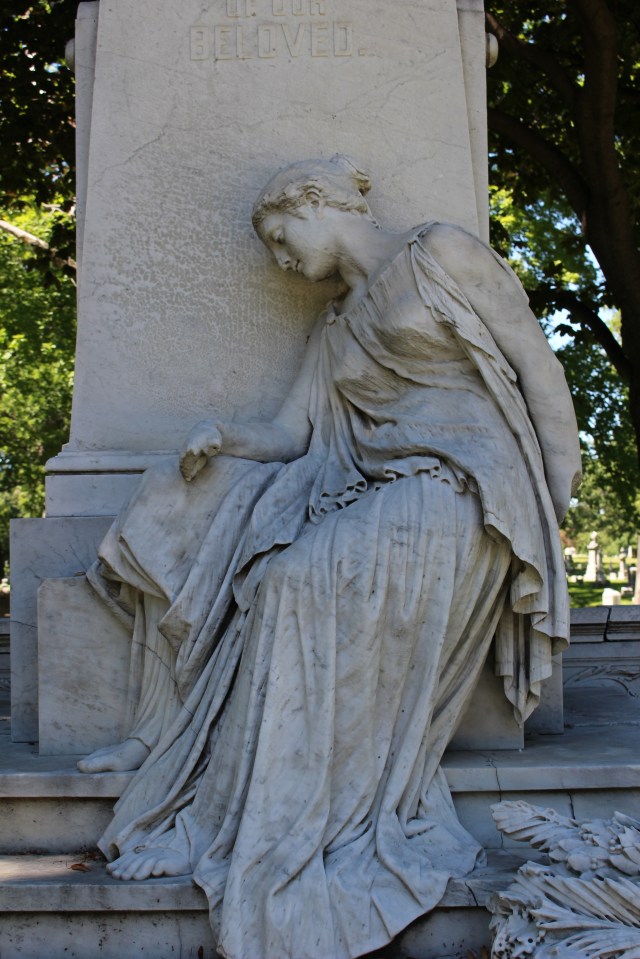
The Pabst Monument is an example of Victorian design and craftsmanship carved of white marble.  The central features is a woman in a draped and flowing gown, her head bowed in grief.  Often these sepulchral figures are referred to as weepers, representing mourning and sorrow.  Since ancient times, women have been the ones in our families and in our society who showed grief and shed tears over those lost to death. They stand over the graves and weep.

According to, Victorian Cemetery Art by Edmund V. Gillon Jr., published by Dover Publications, Inc., New York, 1972, “The large amounts of space in the Victorian cemetery were to revolutionize cemetery art, and permit the use of sculpture in a way that the crowded churchyard had never allowed.”  Now there was room in the garden cemeteries of the nineteenth century for lavish monuments. Gillon goes on to write, “Sepulchral sculpture, with its prone effigies and kneeling weepers, had flowered in the past, but only for the rich and powerful.”

Posted in Famous graves, Saving Graces | Leave a comment

Valentin Blatz, Beer Baron

Valentin Blatz

Born October 1, 1826, Miltenburg, Germany

Died May 26, 1894, Saint Paul, Minnesota

Valentin Blatz, a German émigré, settled in Milwaukee, Wisconsin, in 1849.  Blatz had worked in his father’s Bavarian brewery and others and plied the trade he knew from his youth in Milwaukee.  After having worked at a brewery, which was operated by Johann Braun, Blatz started his own brewery next door.  In 1851, Braun was thrown from a beer wagon and died.  Blatz married Braun’s widow, Louisa, and consolidated the two breweries establishing the Blatz Brewing Company.  What started out as two small breweries grew to be the third largest brewery in Milwaukee.  The buildings where the beer was brewed covered over four city blocks.  Blatz introduced bottled beer in 1874, an innovation we still enjoy to this day!

Blatz died of a heart attack on his way back from a trip to California with his wife, Louisa.  The Milwaukee Sentinel, Sunday May 27, 1894, headline read: VALENTIN BLATZ DEAD: Heart Disease Carries Off the Well-Known Brewer; SUDDENLY STRICKEN AT HOTEL RYAN, ST. PAUL.  The article went on, “Mr. Blatz and His Wife Were Returning From California on Their Way to Milwaukee-His Family Here Shocked by the Sudden Intelligence- Mr. Blatz Was One of the City’s Wealthiest Men–Started in a Very Small Way Back in the Fifties and Built Up a Vast Business.” Valentin Blatz was survived by his wife, Louisa, and five children—John, Louise, Valentine, Albert, and Emil.

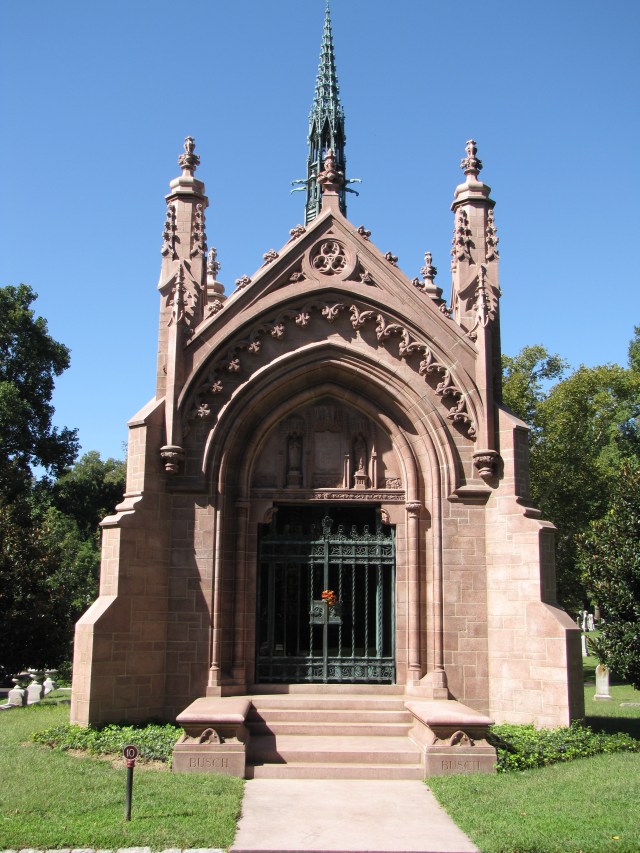
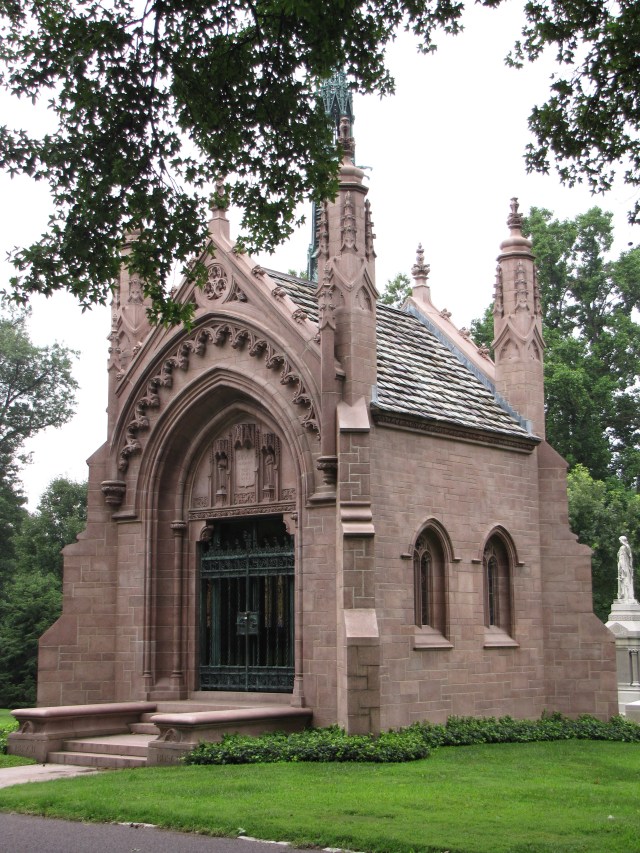
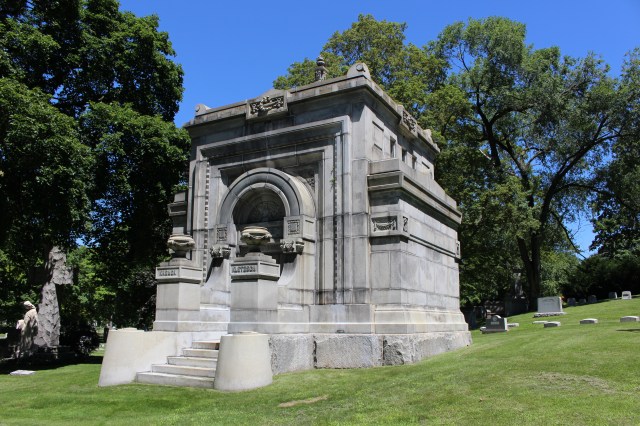
Valentin Blatz was buried in the Forest Home Cemetery at Milwaukee, Wisconsin.  The Blatz Mausoleum, the largest in the state of Wisconsin, was built in 1896 from Barre, Vermont granite.  The massive and imposing mausoleum is 40 feet tall, 38 feet long and 30 feet wide, weighing 525 tons.

Posted in Famous graves, Mausoleums | Leave a comment

Everlasting Life

Ribeth Conson Appleby

1917 — 2000

James Scott Appleby

1921 — 1974

Annie De Prairie Appleby

1885 – 1952

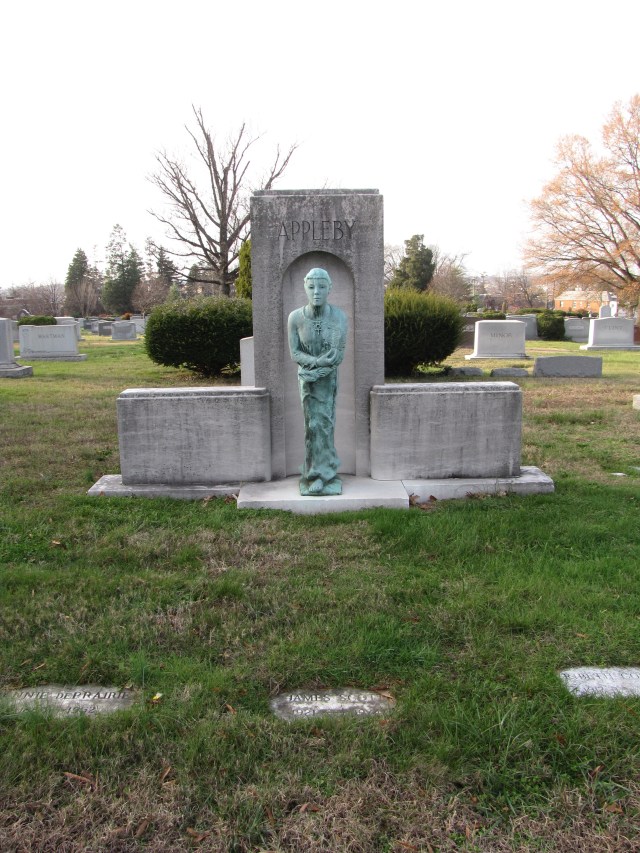
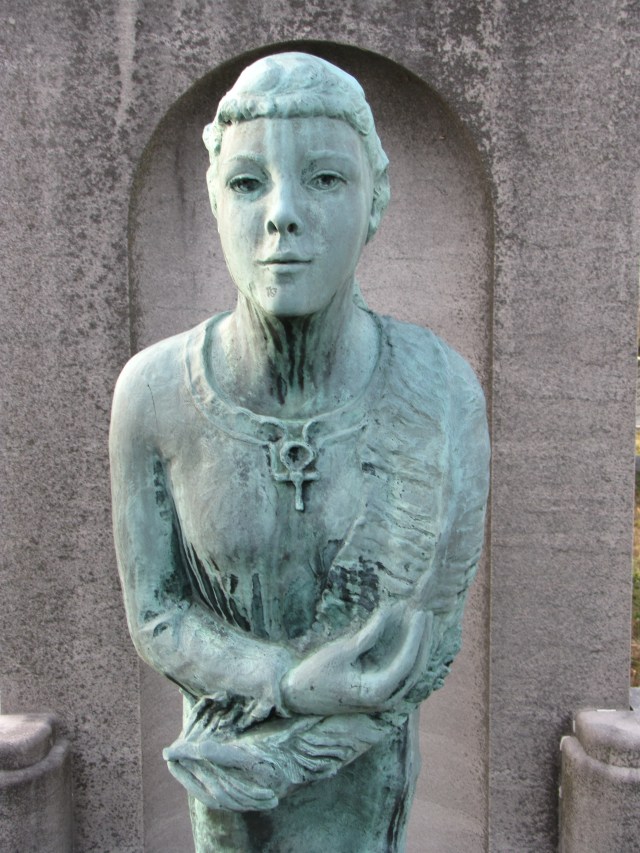
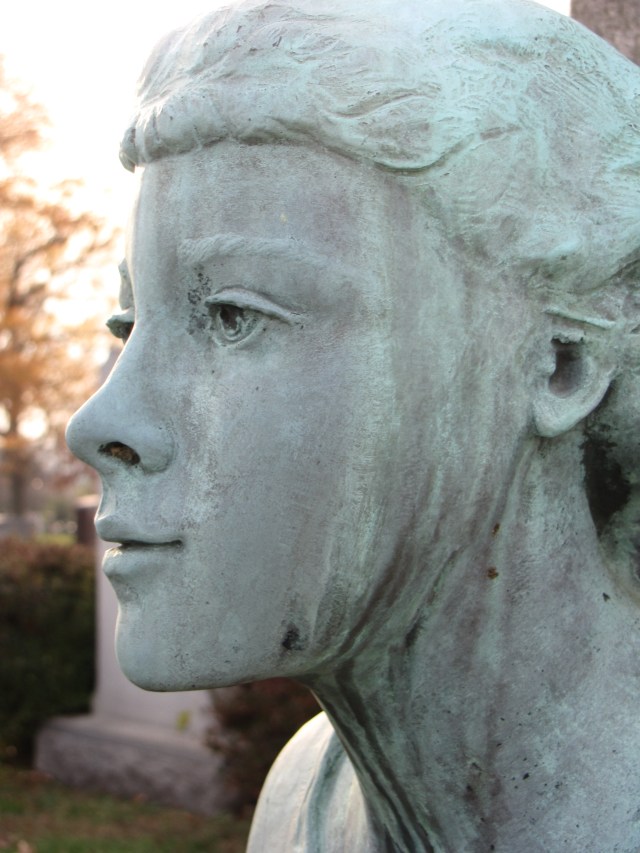
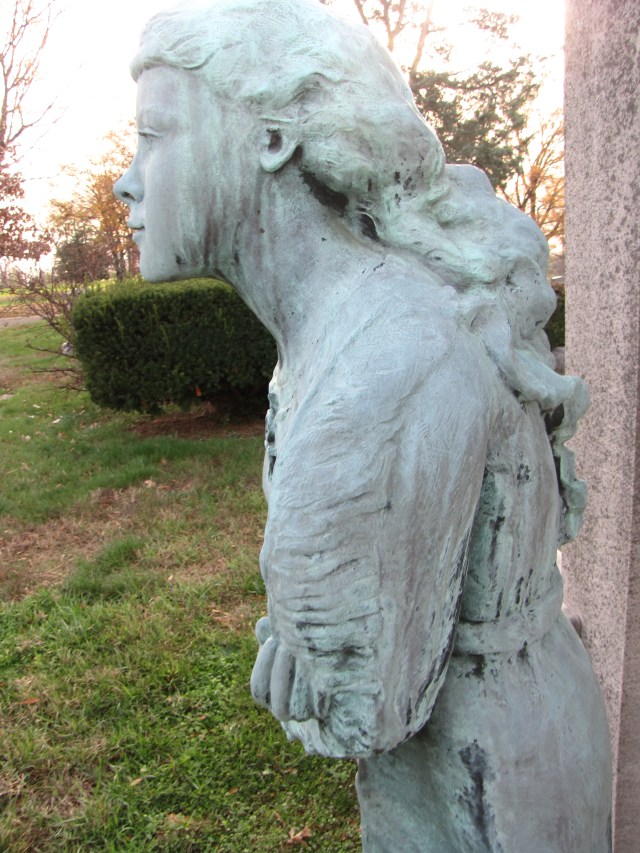
The Appleby Family Monument features a bronze sculpture standing in front of a stone arched alcove. The diminutive woman is leaning forward as if she is taking a step forward.   Two symbols are apparent in the statute—an ankh and a palm.  She wears a necklace that has an ankh and holds a palm frond.  Both symbols have religious meaning.  The palm is a symbol of spiritual victory.  The palm was the plant that was laid on Christ’s path as he entered Jerusalem.  It became a symbol of martyrdom and resurrection.  In the Middle Ages people wore the palm to signify pilgrimage.  The ankh is an Egyptian symbol of eternal life.

The statue was sculpted by Pietro Lazzari (1895—1979) an Italian born artist who immigrated to the United States in 1925 when fascism in Italy was on the rise.  He was educated at the Ornamental School of Rome where he became a Master Artist.  Lazzari’s first solo exhibition took place in Paris.  He became well known for his paintings, printmaking, and sculptures.

Posted in Symbolism | Leave a comment

Skull and Crossbones

The zinc KEESE Family Monument in the Rock Creek Cemetery at Washing D.C. displays symbols representing The Knights of Pythias—a knight’s helmet surmounts a shield with a skull and crossbones and three letters, “F”, “C”, and “B”, which stand for the fraternal organization’s motto, FRIENDSHIP, CHARITY, and BENEVOLENCE, overlaid on crossed swords.

The Knights of Pythias was founded by Justus H. Rathbone in 1864, making it the very first fraternal organization to receive a charter under an Act of the United States Congress.  The society is based on the Greek story of friendship from 400 B. C. between Damon and Pythias, members of a school founded by Pythagoras.

According to their Website, Pythians: promote cooperation and friendship between people of good will, find happiness through service to mankind, believe that friendship is essential in life, view home life as a top priority, show an interest in public affairs, enhance their home communities, respect and honor the law of the land, and expand their influence with people of like interests and energy.

Posted in Symbolism, Zinc Markers | 3 Comments

Claddagh Ring

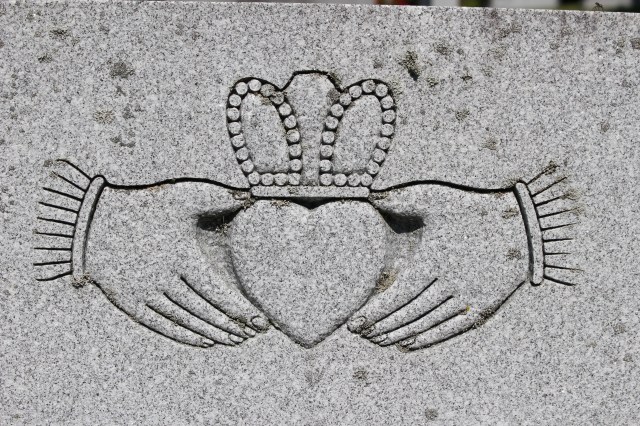
Carved into a gray Vermont granite gravestone in the Hope Cemetery at Barre is a design consisting of three symbols—hands clasping a heart surmounted by a crown.  This design is a traditional ring design, known as a Claddagh ring.  Each of the symbols found in the ring has a special meaning long associated with the Irish village of its creation, Claddagh, a small fishing town just located outside the walled city of Galway on the West seaside of Ireland.

The ring was first created over three-hundred years ago.  The heart represents love, as one might expect, the hands, friendship, and the crown symbolizes loyalty.  This a type of faith ring that was to represent an oath or promise often as an engagement or wedding ring but are also used as gifts from Mother to daughter.

The exact origins of the ring are not certain, though, most historians trace the design back to several makers of the ring in Claddagh in the mid to late 1600s.

Posted in Uncategorized | Leave a comment

Locomotive

Forest Home Cemetery, Milwaukee, Wisconsin

PAPA

MAX SCHUSTER

BORN OCT. 12, 1850

DIED SEPT. 17, 1895


MOTHER

Louisa Bindeman Schuster

1853 – 1918

The rustic movement of the mid-nineteenth century was characterized by designs that were made to look like they were from the country. Elegant and slim curved lines in furniture gave way to bulkier and heavier forms made from pieces that came directly from the trees often with the bark still intact. Homes, cabins, and garden houses were designed in the rustic style eschewing classic designs. In decorative furniture this often took the form of chairs made from rough tree limbs curved to form arms and chair backs, chair legs made from tree roots growing upwards. In cabins, railings and the siding were made from unhewn logs with the bark still in place.

In funerary art, tombstones took on the look of tree stumps. The gravestones were purposefully designed to look like trees that had been cut and left in the cemetery to mark a grave. Most of these tree-stump tombstones were carved from limestone, which is easier to carve, though some are made from marble and even a few from granite. The creativity of the carvers were boundless. Thousands of tree-stump tombstones exist in nearly as many designs.  Stonecutters displayed a wide variety of design, including this tree-stump design with a sculpture of a locomotive carved into the side of the stump.  According to Silent City: A History of Forest Home Cemetery by John Gurda and published by the cemetery itself, the gravestone with the artful train engine is a nod the Max Schuster’s career as a rail road engineer.

Posted in Symbolism, Treestump gravestones | Leave a comment

Stairway

The stony entrance of

This Sepulcher

GRENN MOUNT CEMETERY

Dedicated Sept 15, 1855

STOWELL BURIAL PLACE

Ledge work commenced – Completed

November 3 1898

KATE K STOWELL

1874 – 1968

  1. STOWELL LOWE

1893 – 1925

RUTH L. DEMING

HENRY L FARWELL

1870 – 1947

LILLIAN A STOWELL WIFE OF HENRY FARWELL

1871 – 1952

W H FARWELL

1898 – 1974

FATHER – MOTHER

DUREN STOWELL

1799 – 1885

ASENATH BAXTER

WIFE OF

DUREN STWOWELL

1837 – 1913

RUTH H MARTIN

WIFE OF

W A STOWELL

1844 – 1922

OUR SON

WILLIAM H STOWELL

1873 – 1897

William A. Stowell commissioned stone carver, Charles P. Bailey, to carve a unique sepulcher for the Stowell family.  The monument is a set of stairs carved out of a single piece of stone.  The symbolism is not clear, but could it represent a stairway to Heaven?

William A. Stowell was a prominent businessman in Montpelier as the Superintendent and General Manager of the Montpelier & Wells River Railroad.  He also served as the Vice President, Director and Managing Director of the Barre Railroad Company and general superintendent of the Montpelier & Connecticut River Railroad Company.

Posted in Uncategorized | Leave a comment

Real or Imagined?

Stories abound of the supernatural—apparitions that appear in gossamer gowns that fade into the murky night air, screams emanating from the “haunted” cemetery, sculptures that have eyes that glow red after dark.  How do these stories get started?  Are the stories true?  Are there things that just can’t be explained?

The Stepp Cemetery

One such tale has been repeatedly told about the Stepp Cemetery in the Morgan Monroe State Forest near Bloomington, Indiana, reportedly the most haunted place in the state. The stories that swirl around the cemetery first started around a fallen tree that resembled a chair that became known as the Witch’s Throne. That throne, however, was not a royal seat but a place of mourning and sorrow from a distraught and inconsolable mother. The legend told and re-told is of a young family. The husband works long days at the quarry—the mother busy in the cabin with a newborn girl. Tragically the husband is cut down in his prime in a quarry blast leaving the young mother to raise their little girl alone. She pours herself into the little girl, thinking of her every waking moment—protecting her, over-protecting her. The little girl becomes a young woman and catches the eye of a young man. Reluctantly and fearfully the mother agrees to let the boy escort the girl to a dance.

In a race to get back to the girl’s home before the curfew, the couple drove too fast on the country road slick with a gentle rain sliding off the road. The young girl didn’t survive the accident—the Mother’s heart broken, her dreams shattered, her spirit sent adrift with anguish and heartbreak.

Many campers and hikers have reported that they have felt warmed air as if a hot breath was on their necks. They have reportedly seen a dark fluttering presence hovering over what must be the long-forgotten grave near the Witch’s Throne and heard a faint sobbing.

While pictures of the apparition don’t exist or what we would call empirical evidence there are those who swear it to be true—their senses alive by the touch of the warm air and the sight of figure in the dark night. Is it real or imagined?

The Voodoo Queen

Marie Laveau was known as the Voodoo Queen and one of the most notorious practitioners of black magic in all of New Orleans.  Born in 1794 in Santo Domingo, Marie was well known throughout her adopted city of New Orleans for the potions she concocted and the spells she cast.

Marie lived a long life, giving birth to 15 children, including her daughter and namesake, Marie II, who took over for her mother when she died in 1881, casting spells for the denizens of the dark and believers in the cult.  For years after Marie died people claimed to see apparitions of Marie.  To this day, candles, coins, beads, and other gifts are still left at the crypt that is said to hold the remains of Marie and her daughter, Marie II.

The Black Angel

The black angel is in the Oakland Cemetery at Iowa City, Iowa, has dark stories surrounding it which probably began to swirl when the bright bronze statue turned black.  Teresa Dolezal hired Bohemian artist, Mario Korbel, of Chicago, to create an angel for her husband’s grave.  She also gave instructions that the angel was to hover over the body of her son’s grave, too.  Korbel created the angel with one wing spread open over Eddie’s grave.  No one remembers for sure when the angel turned color but that is when the rumors started.  One story goes that on the dark and stormy night of Teresa’s burial a lightning bolt struck the angel and turned it black instantly.  Another rumor suggests that the angel itself portends of the evil—most graveyard angels, they say, look upward with their wings lifted toward Heaven, but this one looks downward.  Ominous.

Leave it to a college town to turn the stories of evil into a reason to challenge the mysterious circumstances behind the color change of the sculpture and even build upon them making it a place for college co-eds to kiss!  The Iowa City college students created even more fanciful myths.  They say that if a college girl is kissed in the moonlight near the black angel, she will die within six months.  They also say that if you kiss the black angel you will die instantly.  Or touching the black angel at the stroke of midnight will bring death within seven years.  They also say if a virgin is kissed in front of the black angel the curse will be lifted and the angel will turn back to its original bright bronze color.  Hawkeye co-eds have performed many experiments of the kissing nature in front of the black angel and the sculpture is still black.  No deaths have been reported either as a result of the efforts of the college students—yet the rumors are retold with vigor and enthusiasm.

Black Agnus

The sculpture created by Karl Bitter for John E. Hubbard in the Green Mount Cemetery at Montpelier, Vermont, also has lore that has been promulgated.  Supposedly, if you sit on the lap of the sculpture, something bad will happen to you—some say in seven hours, some say seven days, some say seven months; the amount of time varies depending on who retells the story of the curse. Locals also tell of screams coming from the cemetery at night in the vicinity of the monument.  Others report seeing the eyes of the sculpture turn to glowing red, though, no photographic evidence of that has surfaced.

Posted in Uncategorized | Leave a comment

Compare

According to an article written by Cynthia Mills and published in Vermont History 68 (Winter/Spring 2000): pages 35-57, artist and writer Lorado Taft compared and contrasted Karl Bitter’s Thanatos and Augustus Saint-Gaudens’s Henry Adams funerary sculpture which became known as “Grief”.  Mills writes, “the Adams monument in Washington, D.C. [became] a touchstone for all draped bronze allegorical sculpture in American cemeteries at the turn of the century.”

The Adams memorial was created and designed for Henry Adams whose wife, Marian Hooper “Clover” committed suicide in 1885.  Thanatos was designed by Karl bitter for the John E. Hubbard Memorial.

Mills writes, “Lorado Taft wrote in 1903 of the Hubbard’s figure: “The breathlessness, the swaying arms, the grip of the hand, the pressure of the feet, the tangle of the enveloping shroud give this figure another kind of impressiveness from the awful calm of Saint-Gaudens’s sibyl.  Mr. Bitter’s conception is less majestic, but has an intensity which grows upon one.”

“Taft continued, however, to speak of the monument in words that could have been applied to the famous Adams monument itself:

“This unknown being, wrapped in its mantle as in one of [symbolist painter Elihu] Vedder’s swirls, this groping, unseeing creation, has in its make-up something ideal, of the large and deep, by virtue of which it seems full of significance.  The sculptor must have meant something by it.  What its meaning, each must read for himself.”**

**Lorado Taft comments in his chapter on “Decorative sculptors and men of foreign birth” in The History of American Sculpture, 1903, 460-462.

Posted in Famous graves, Symbolism | Leave a comment