Gone to the Dogs

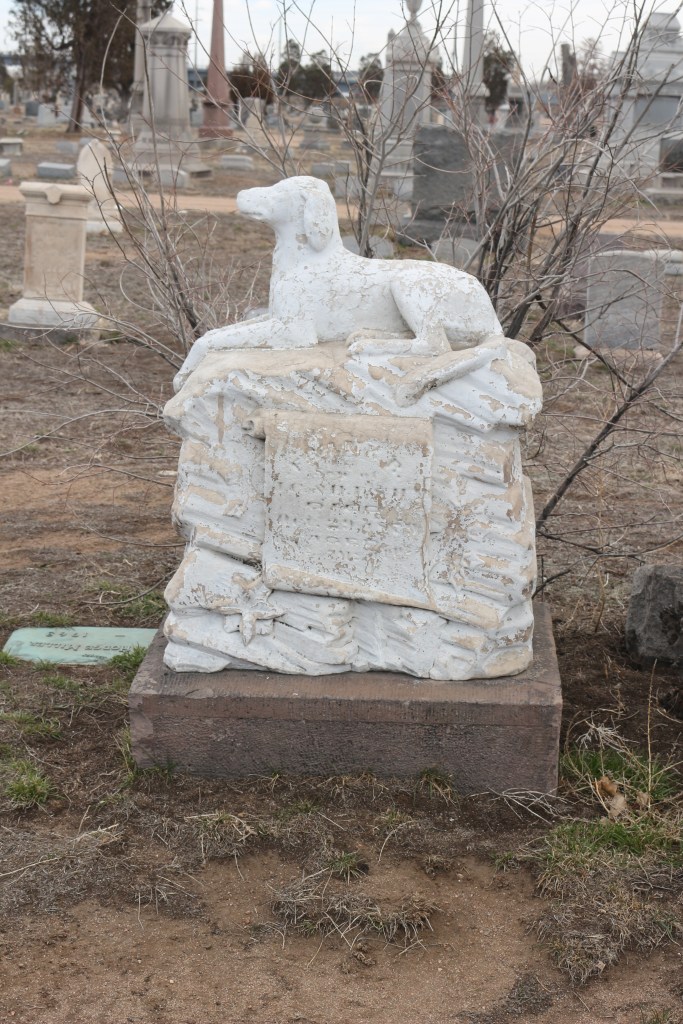
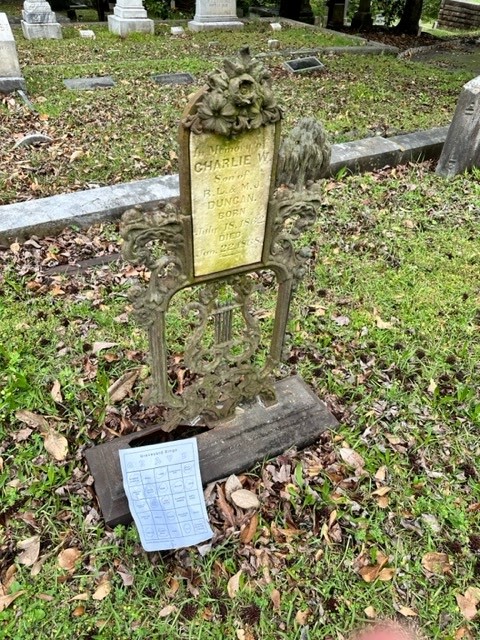
FRANK E.

Son of

J. C. & H. F. SHY

DIED

Oct. 29, 1879

We Loved Our Boy

Riverside Cemetery and Fairmont Cemetery in Denver vied for the title of premier burial ground for Denver’s elite.  Riverside, however, was the older of the two and from the beginning had less restrictive codes for monuments erected in the cemetery in its early days. Fairmont had laid out their rules early on in its development.  Riverside hadn’t and therefore, the cemetery had a hodgepodge of markers made of many different kinds of materials, including “white bronze” which was actually zinc.  The zinc markers were expressly forbidden in the rival Fairmont Cemetery.

According to Annette Stott, author of Pioneer Cemeteries: Sculpture Gardens of the Old West, published by the University of Nebraska Press, Fairmont Cemetery was the larger of the two cemeteries.  Fairmont … had a fairly strict list of what kinds of monuments were acceptable, “No footstones … only gravestones and monuments made of granite, marble, or real bronze … no monument or grave marker will be admitted which is cut in imitation of dogs, cattle, or any grotesque figure.”  The implication being that these types of monuments which could be readily found in Riverside, “were inappropriate, perhaps even in vulgar taste.”

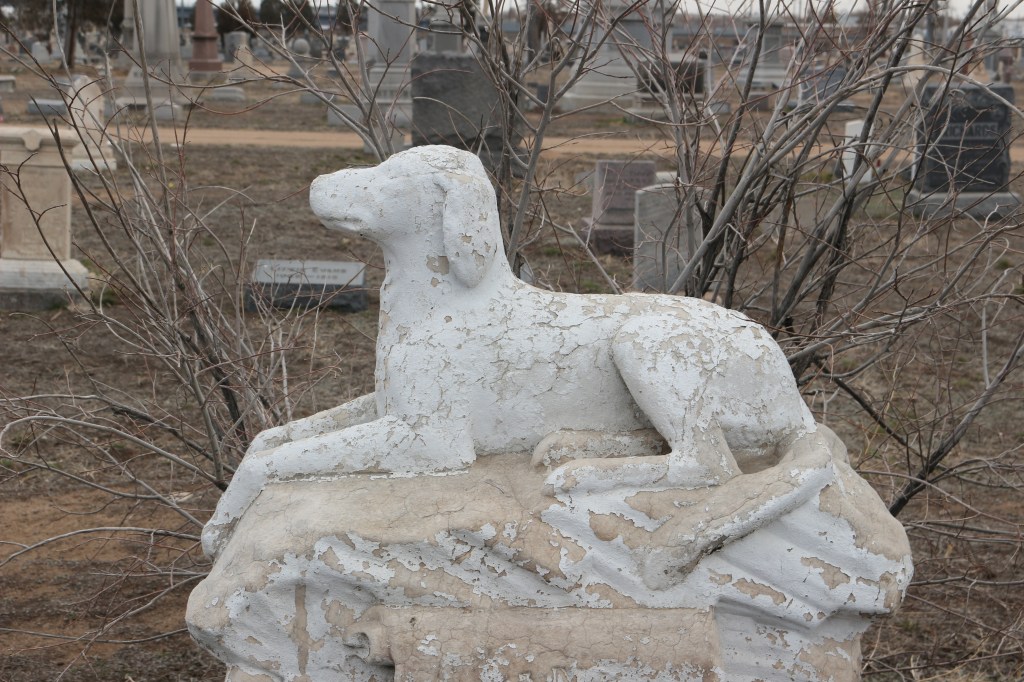
One such gravestone in the Riverside Cemetery was that of 13-year-old Frank Shy. Sheep ranchers, John and Hannah Shy, commissioned a white-washed marble dog to be placed on their son’s grave.  They tenderly inscribed it with the words, “We Loved Our Boy.”  This was not an unusual monument as carved dogs began to appear in American cemeteries in the first half of the 20th century.  According to Annette L. Student who researched and updated the pamphlet, Walk Through Historical Riverside Cemetery, (page 25), “the Shy Memorial, under a small elm tree, is a white marble monument topped with the sculpture of a dog.”  The dog was the pet of Frank Shy, and his parents wanted “their young son guarded in death by the dog he loved in life.”

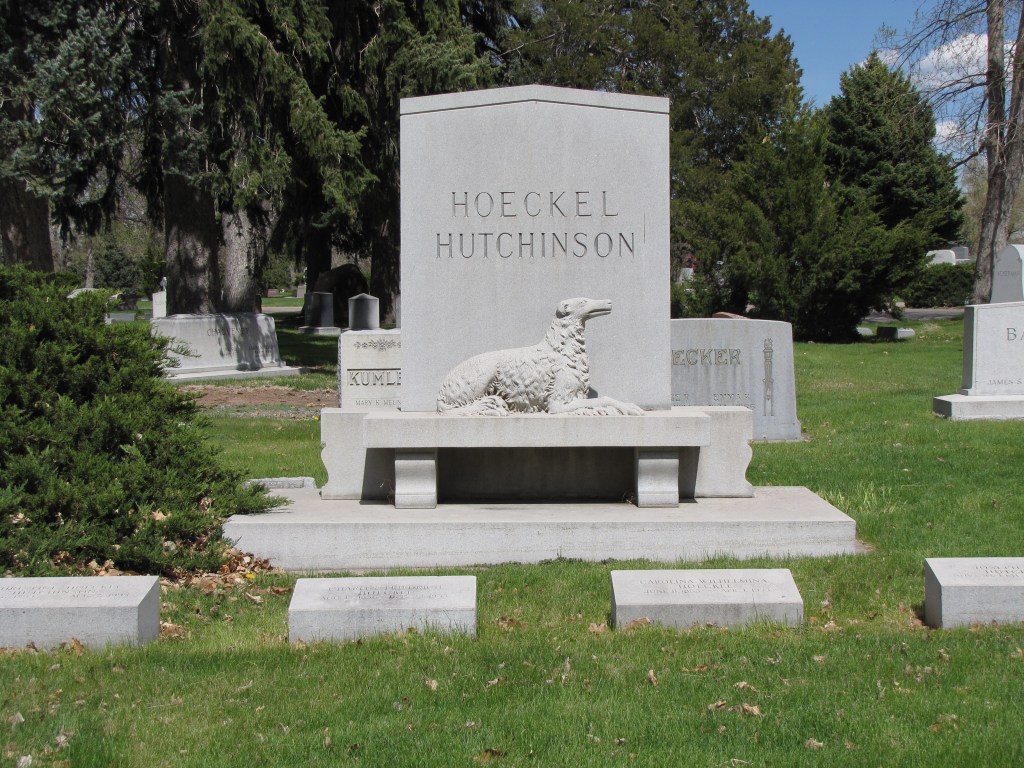
While the Fairmont trustees may have thought the Shy Memorial vulgar, Riverside had the last laugh when the Hoeckel-Hutchinson family erected a monument featuring a dog no less in the Fairmont Cemetery!

Posted in Uncategorized | Leave a comment

The Sculpture that Killed the Sculptor

Lester H. Drake

Born July 31, 1822, at Dansville, New York

Died March 17, 1889, at Denver, Colorado

Eliza A. Wheelock Drake

Born January 8, 1826, New York

Died August 4, 1916, Chicago, Illinois

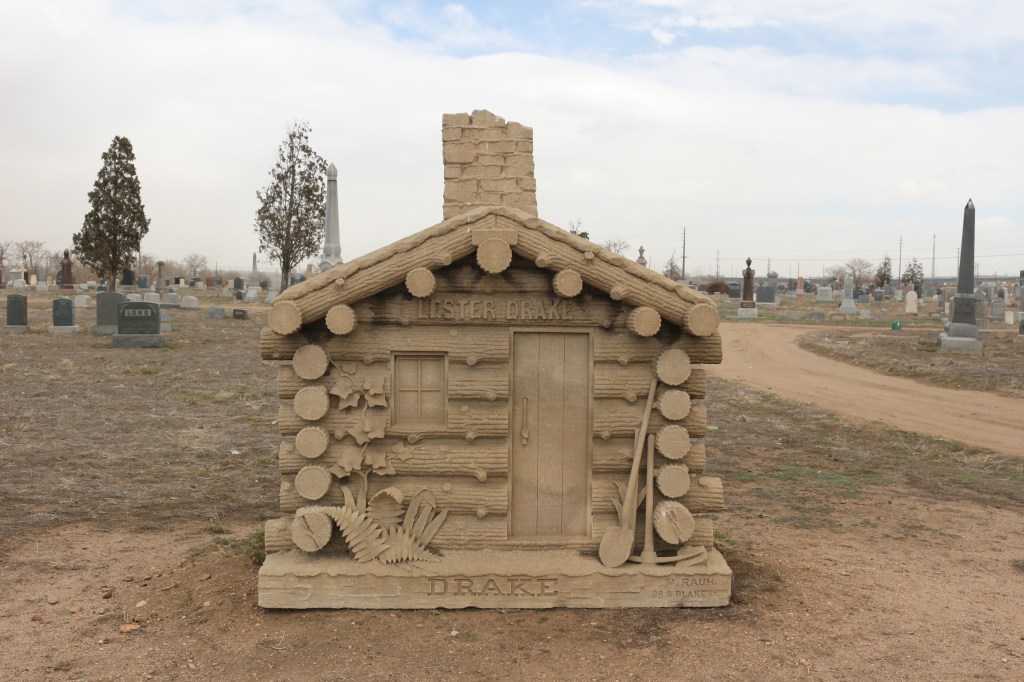
Nestled in the center of the historic Riverside Cemetery in Denver, Colorado, is a monument that is a near-replica of the mining cabin of Lester Drake, one of Denver’s earliest pioneers.  Drake, a New York native, ventured across the continental United States in the spring of 1860 in search of his fortune.  Drake had caught the “gold fever” that was sweeping across Colorado and the Western United States.  Drake settled in the Lake Gulch District of Gilpin County where he first farmed and raised horses.  He also engaged in the mining business.  He bought interest in the rich Washington Mine which made his first fortune.

After Lester Drake’s death, the M. Rauh Marble Works Company, which operated at 36 and Blake Street in Denver and operated by Adolph and Mary Rauh, was commissioned to create the mining cabin sculpture monument. According to author Annette Stott, who wrote Pioneer Cemeteries: Sculpture Gardens of the Old West, published by the University of Nebraska Press, (pages 158 and 159), “Norwegian immigrant Ole J. Rustad …carved the Drake cabin according to the oral tradition among the Rustad’ descendants.  Ole Rustad came to Denver the year before Lester Drake died and advertised himself as a stonecutter.  City directories confirm that he worked for M. Rauh from 1889 until 1893.”

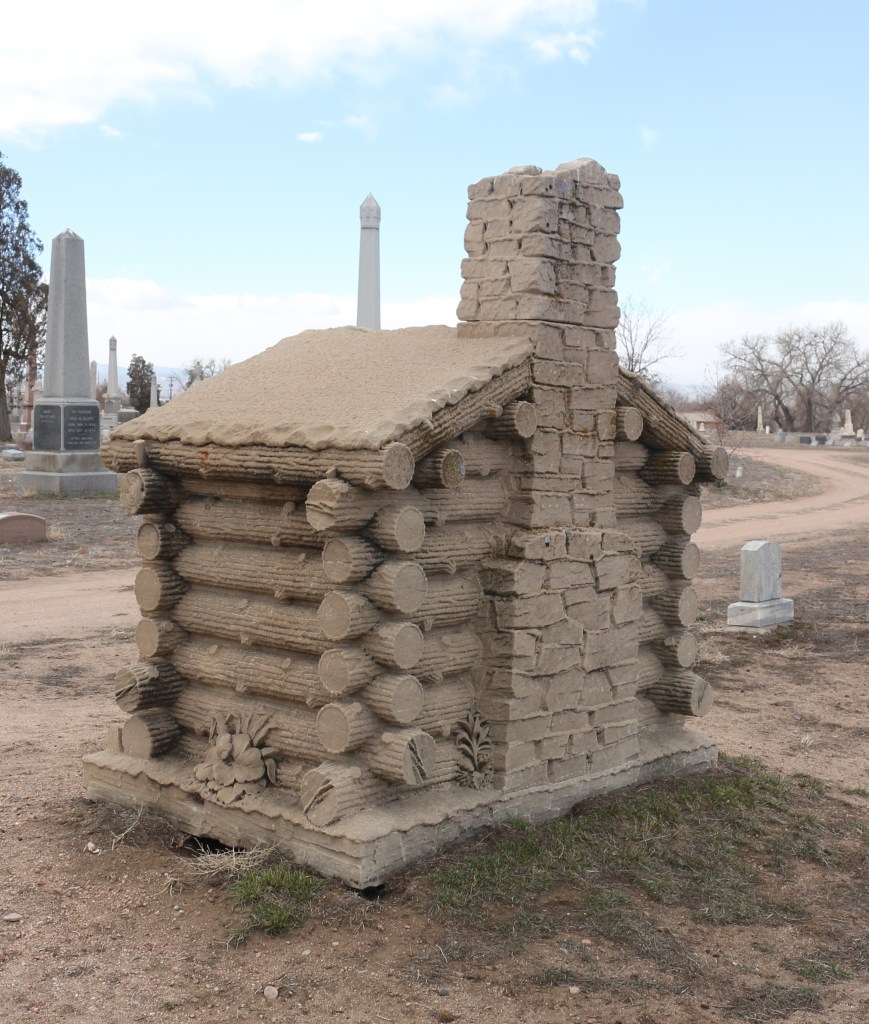
“Although it looks like cement to many people, the Lester Drake monument was carved from one block of Bedford limestone.”  The cabin, weighing several tons and standing at 5 feet tall at the roof peek, is amazing in its realistic detail.  Leaning to the right of the cabin door is a nearly life-size shovel and pickax—tools of the miner’s trade.  To the left of the door ivy vines are twinning up the face of the cabin and ferns sprouting.  In cemetery symbolism the fern has come to represent humbleness and sincerity.  It also symbolizes seclusion, which was certainly part of the early life of a miner.  The ivy symbolizes immortality.  In addition to that, because of the way the plant winds its way up a surface and clings to it the ivy has come to represent everlasting love and eternal friendship.  However, it is just as likely that these plants are merely representative of the Colorado flora.

Like many log cabins of the era, this monument depicts a latchstring as the way to open the door.   The latchstring would be pulled in at night to keep the door from being opened on the outside.  In this case the latchstring is out, which symbolizes welcome and hospitality.

According to Stott, “what is most unusual are the realistic proportions.  It measures six feet wide by four feet deep by five feet tall at the roof peek.  Doubling those figures would create a fairly normal-sized cabin.”

Tragedy struck the day the monument was loaded onto a wagon and pulled to the Riverside Cemetery.  When the great stone was being unloaded Rustad was there to see his monument put in place and help unload it.  During the unloading the monument slipped throwing most of its weight onto the thirty-one-year-old Rustad.  According to Rustad’s family members, his death was the result of complications from the accident. 

His masterpiece was the instrument of his untimely death.

Posted in Uncategorized | Leave a comment

Let the Games Begin!

My friend, neighbor, and serious reader of www.gravelyspeaking.com visited her daughter in Decatur, Georgia.  While there she and her family visited a small cemetery in the area that was established circa 1836.  While there, they played Graveyard Bingo!

In my friend’s note to me, she said, “The bingo game was interesting! We never did see an angel which really surprised us – and the game allowed us to look at a cemetery differently and see new things.” For me, that was about the best endorsement I could have heard.

I do hope other readers will share their bingo cards, too!

Posted in Uncategorized | 1 Comment

Sisterly Love

Vatter

John N. Raithel

1821 – 1889

Mutter

Barbara Kuhn Raithel

1827- 1887

Margaret Raithel

1858 – 1906

Marie Raithel

1863 – 1935

George Raithel

1848 – 1873

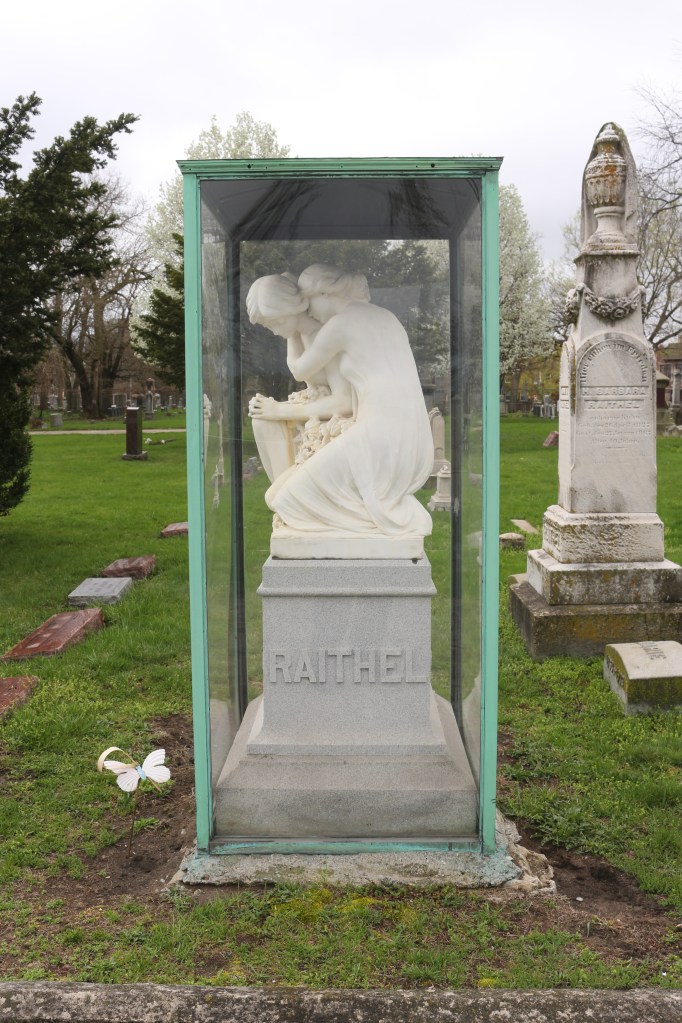
RAITHEL

There is a small 19-acre cemetery, the Wunder’s Cemetery, in Chicago, named after a German Lutheran minister, Heinrich Wunder, who had been pastor of the First St. Paul’s Evangelical Lutheran Church of Chicago.  He had served that congregation for over six decades.

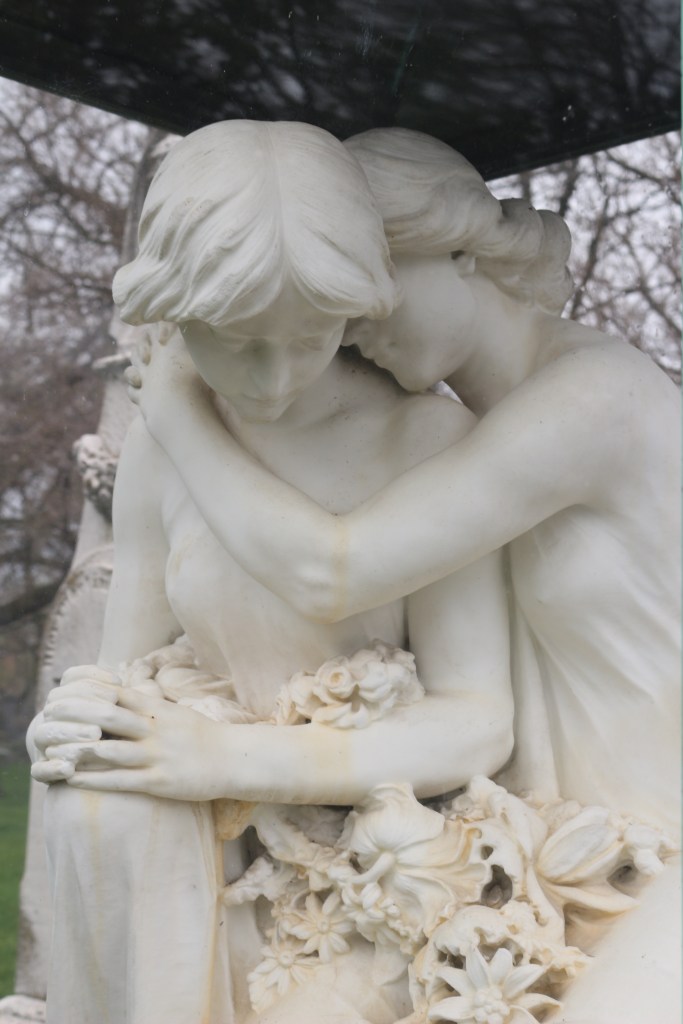
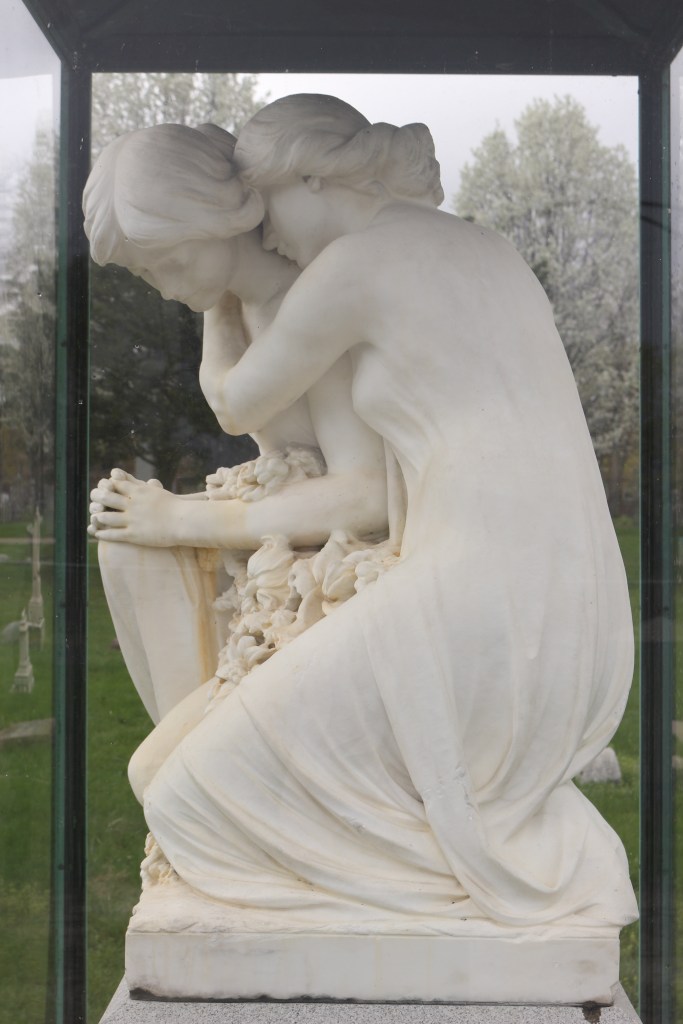
Among the gravestones, large and small, tall and short, obelisks, tablets, and columns is a marble sculpture of two young women embracing.  The first time I saw it, the monument was protected in a box with plexiglass.  The plexiglass was scratched and stained, obscuring the finely carved details of sculpture.  The draped figured have a garland of flowers in their laps.

The last time I saw the monument, the hazy plexiglass had been replaced with clear glass revealing the intricately carved figures—two sisters—Margaret and Marie.  After the death of Marie, Margaret had the monument erected to honor her sister and their relationship.  The sculpture remains as a monument to sisterly love.

Posted in Uncategorized | 6 Comments

Ode to an Arabian Horse

Addison Elton Baker

March 24,1818 – January 20, 1884

Charlotte Baker

November 19, 1820 – July 10, 1892

Standing proud in the dusty Riverside Cemetery in Denver, Colorado, is a life-sized replica of an Arabian horse, named Ali. The horse was sculpted by J. A. Byrne. The horse was owned by Colorado homesteader, Addison Baker, who raised cattle and horses and claimed to have the finest stock of anyone in the area.

Baker landed in the Denver area in 1860 on land with a fresh-water spring that later was named for him. The spring water was said to be medicinal and Baker supplied it by the barrel delivering to homes in the area. The spring was also a watering stop for explorers on their way further west with such notables as John Fremont and Kit Carson making stops.

Posted in Uncategorized | Leave a comment

For those who play

I had a reader tell me to play bingo properly you need different cards. I have played bingo but it was a somewhat traumatic affair and a very very long time ago. We had a game going one winter in sixth grade since it was too cold and snowy to go out to the playground. I won one of the games but the prize was a bag of unsalted peanuts. Alas, I am allergic–not much of a prize.

At any rate, I am supplying more bingo cards. I hope you enjoying playing with your friends and family!

Posted in Uncategorized | 1 Comment

Graveyard Bingo

I created a fun way to introduce cemetery symbolism to the uninitiated with this game of Graveyard Bingo. The bingo card has 22 common symbols and a couple types of gravestones like the tree-stump gravestone or a marker made of zinc. Print the cards and the next time you are exploring a cemetery with friends, see who gets a bingo first, or in this case shout out GRAVE.

Posted in Uncategorized | 13 Comments

Calvary

The polished granite MAY – WASSELL – GIBB Mausoleum in the Oakland Cemetery in Little Rock, Arkansas, has a beautiful stained-glass window depicting a brightly-colored angel sitting next to an empty tomb.  The ribbon at the bottom of the scene says, “HE IS RISEN” announcing that the crucified Jesus Christ who had been laid to rest in the tomb was now gone.  In the background Calvary Hill with three crosses just outside the walls of the ancient city of Jerusalem, where Jesus was crucified.

Posted in Uncategorized | Leave a comment

Pioneer Cabin

BASEL TROMBLY

October 25, 1825

October 27, 1896

In a shaded area of the Fort Meigs Cemetery in Perrysburg, Ohio, Basel Trombly’s limestone grave marker replicates an intricately carved log cabin. 

Basel Trombly’s gravestone has several markings and symbols that give an indication into the life of the deceased buried underneath the stone.  Carved on the chimney are the letters “GAR” most likely a nod to Trombly’s proud service as a sergeant in the 100th Ohio Infantry Regiment, Company F. 

Two different symbols are carved into the roof of the cabin—clasping hands and the Masonic symbol.  The clasping hands can symbolize his marriage to Victoria Bodett Trombly—the last goodbye.  It can also represent one of the fraternal organizations, such as the Masons of the Odd Fellows.  In addition, the Masonic emblem—the square and compass with the letter “G” in the middle makes it clear that Trombly was a Mason. 

The most important symbol is the gravestone itself—the Log Cabin.  The Log Cabin pays tribute to the fact that he was a pioneer of the Maumee Valley.

(Note: Basel Trombly’s name is carved into his gravestone as TROMBLY.  However, his last name is listed in several sources as TROMBLA.)

Posted in Uncategorized | Leave a comment

A Tool

FATHER

JOHN BURTON

HENWOOD

FEB. 15, 1855,

NOV. 4, 1925.

The white marble segmented-top gravestone of John Burton Henwood in the Oakland Cemetery in Little Rock, Arkansas, displays a caliper. Perhaps this is a nod to his profession–but what profession would that be? Any help?

Posted in Uncategorized | 5 Comments