
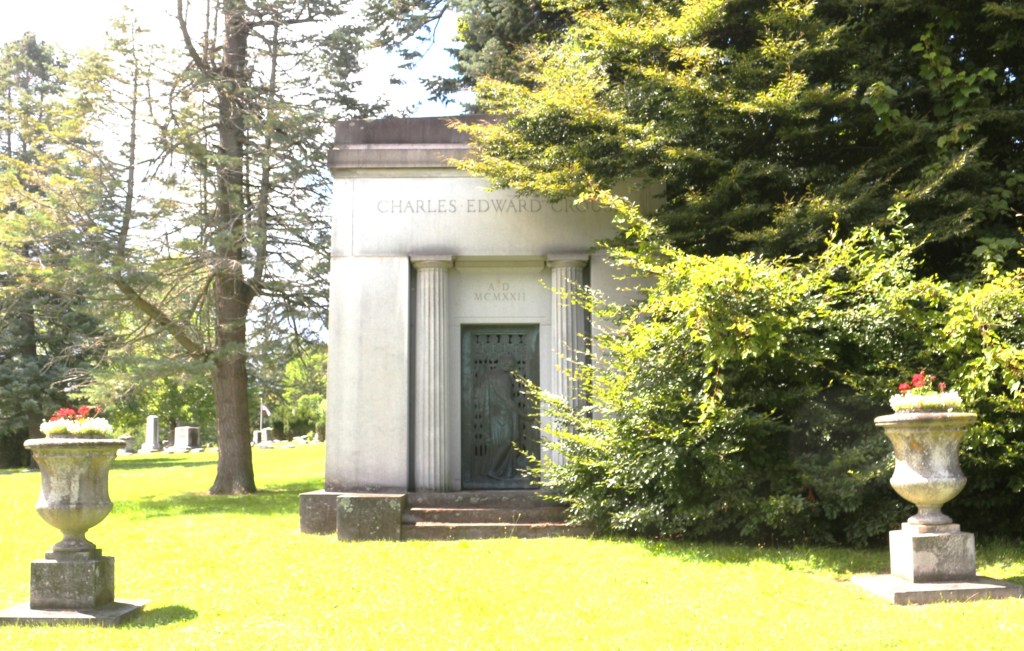
Even though the Ahern Family Mausoleum in Woodlawn Cemetery in the Bronx, the Sherwood Family Mausoleum in the Rock Creek Cemetery in Washington, D.C., and the Charles Edward Crouse Mausoleum in the Oakwood Cemetery in Syracuse, New York, are in different cities and of different architectural styles, they share a common feature—the same door.


The Smithsonian Institution Research Information System (SIRIS) describes the door as a “Relief of a standing female figure with her back to the viewer and her face in profile appears on the door … The figure reaches out to the handle of the door with her proper right hand. Her proper left hand is raised and rests on some of the ornamental detail of the door. This ornamental detail consists of three rows of flowers along the top quarter followed by a narrow band of a wave-like design. The lower portion of the door is a grill work of foliage. The figure’s long flowing gown is off the shoulder on the proper right side and her hair is braided around her head.”
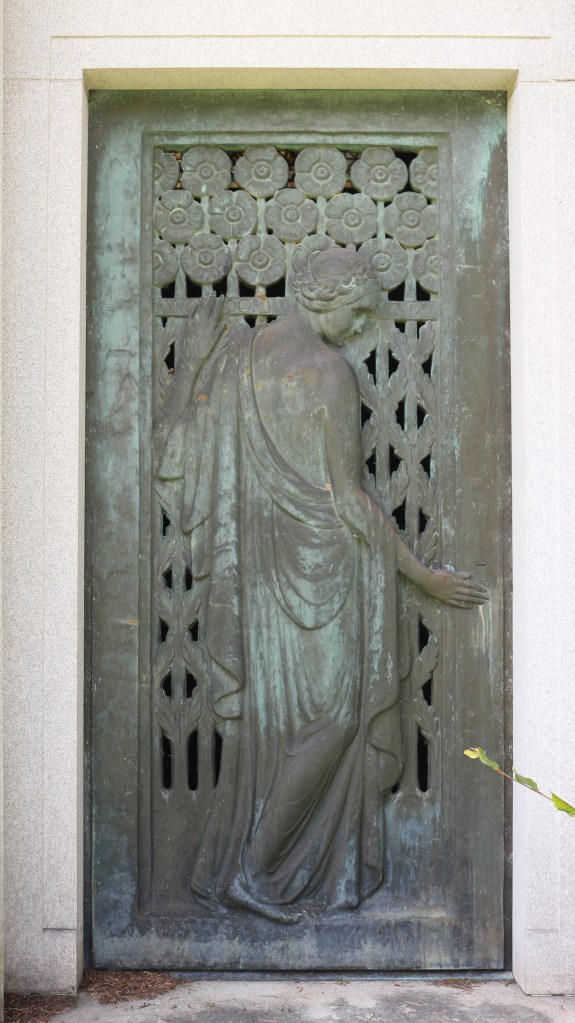
The door itself represent a portal. Portals come in many forms—a door, a window, even your eyes and your mouth are considered portals. Many superstitions about death concern portals, many of which come from the Victorian Age, some of which still exist today.
The eyes, for instance, are considered the windows to the soul. Victorians believed the eyes were powerful, almost magical, even in death. When a person died therefore, the body had to be removed from the home feet first (most people died at home in the 19th Century). In that way, the eyes of the deceased could not look back and lure a live person to follow the dead through the passageway to death.
The Victorians also believed that as you passed by a cemetery, you needed to hold your breath. The fear was that if one opened one’s mouth, that a spirit from the dead residing in the cemetery would enter your body through the portal—the open mouth.
Another superstition had to do with the mirrors in the home. After a death, the family very quickly covered the mirrors. It was believed that mirrors were false portals in a sense. The Victorians believed that the spirit of the dead could enter a mirror and become trapped in the mirror. If the spirit did so, it would not be able to complete its trip through the passageway from the Earthly realm to the Heavenly realm, or in some cases, to warmer climes.
The door as a motif in funerary art also symbolizes mystery. The door is the portal from the Earthly realm to the next. In Christianity, the door is usually viewed with hope, charity, and faith. The next life in the hereafter will be better than the one experienced here on Earth.
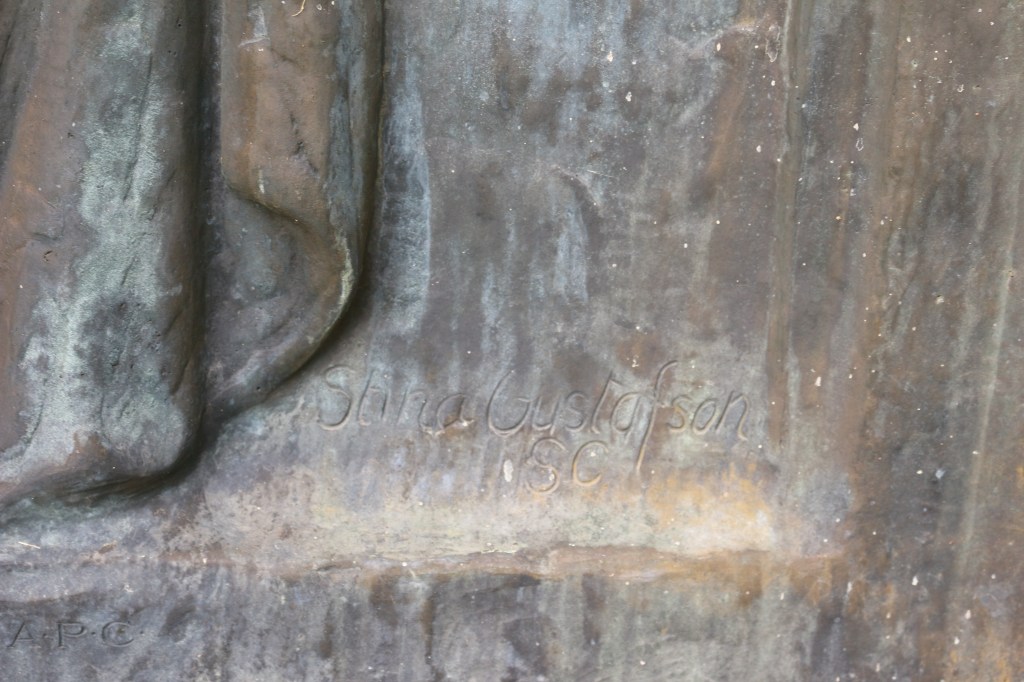
The bronze door was sculpted and signed by Stina Gustafson. Hilda Kristina “Stina” Gustafson (December 18, 1885 – March 7, 1937) was born in Sweden and married fellow artist Salvatore Lascari, who gained fame as a portrait painter. Gustafson was an accomplished sculptor winning a series of awards including the Waltrous Gold Medal from the National Academy of Design. She also won the McClees Award from the Pennsylvania of Fine Arts In 1935, she was inducted into the National Academy of Design.
Tragedy struck in 1937, Gustafson’s studio caught fire. After, she fell into a deep depression and was hospitalized. According to the Brooklyn Daily Eagle, Monday, March 8, 1937 edition, the headline read, “Hilda H. G. Lascari Noted Sculptress Plunges to Death.” The paper reported, Gustafson “plunged to her death … from the 11th floor of the French Hospital … Manhattan. Early in January Mrs. Lascari suffered a nervous breakdown from which she was slowly recovering in the hospital. The unusually-gifted artist was last seem alive reading a book in the solarium on the hospital roof. An attendant entered the solarium some time later in the afternoon and raised an alarm when Mrs. Lascari was nowhere to be seen. The book was lying beside her chair and the window was open. Her body was found in the courtyard on the west side of the hospital.”
Sadly, the award-wining and talented artist died a tragic death at the age of 51. She was laid to rest in Rome, Italy, her husband’s homeland.


 Gravely Speaking
Love your website…thank you for all of your hard work!!!
There is another example at Spring Grove Cemetery in Cincinnati: https://www.findagrave.com/memorial/34802626/charles_arthur-hinsch/photo
Mary Gilbert 513-910-5522 fllwfan@gmail.com
Thank you for sharing another example of the Gustafson door. And thanks for reading my blog!
Do you have any suggestions for NYC? I’ll be going in a week…I did find the 2 smallest cemeteries and I plan to visit them. AND…please let me know if you have plans to come to the Cincinnati area.
If you are going to be in Manhattan, I would suggest the Trinity Churchyard. If you have more time, you might want to go to Brooklyn and visit Green-wood or the Bronx to visit Woodlawn–both are spectacular.