

Matthew L. Williams
September 19, 1855 – June 17, 1937
Susan Ruth Pittman Williams
December 10, 1860 – November 20, 1948
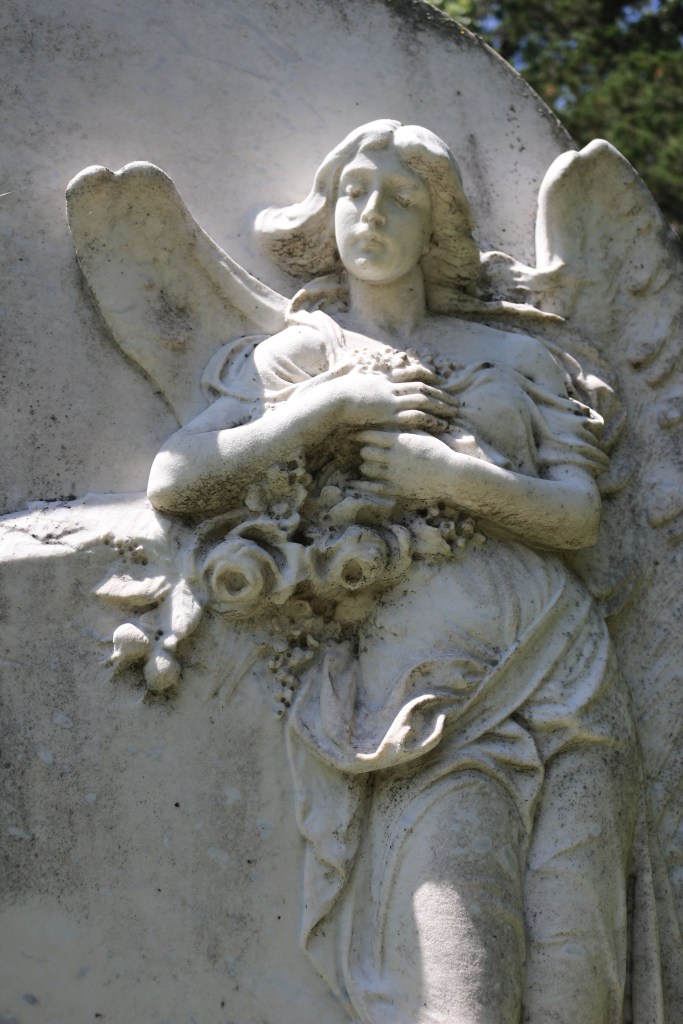
The Williams-Beachly family monument in the Wyuka Cemetery in Lincoln, Nebraska, depicts an angel clutching a garland of flowers as she looks downward toward the grave. The white marble rounded-top monument with the angle sculpture is mounted on a granite plinth atop a large flat granite base with the surnames WILLIAMS and BEACHLY etched into the facade.
The angel carrying the garland of flowers to decorate and watch over a grave is a common “angel type” found in American cemeteries. In the 2007 edition of Markers, XXIV, published by the Association for Gravestone Studies, Greenfield, Massachusetts, Elisabeth L. Roark wrote an article about angels titled, “Embodying Immortality: Angels in America’s Rural Garden Cemeteries, 1850—1900”, pages 56 – 111. Roark argues that angels were not “Romantic attempts to beautify death.” She writes, “while this was part of their appeal, angel monuments are far more complex in meaning and can act to reveal manifestations of popular Christian beliefs.”
According to the article, angels come onto the scene in rural garden cemeteries in a big way starting circa 1850 and then throughout the rest of the century. Though angels come in many variations and forms, in her study of 14 rural cemeteries from each region of America, Roark found that most angels fall into the following eight categories:
- Soul-bearing Angels
- Praying Angels
- Angels who decorate and watch over the grave
- Pointing angels
- Recording angels
- Trumpet angels
- Michael the archangel
- Child angels
Angels are mentioned over 270 times in the Bible but of the eight categories of angels that Roark describes in her article, Angels who decorate and watch over the grave are the only type not specifically defined in the Bible. Roark notes that decorating graves with flowers originates with the ancient Greeks, this type of symbolism, however, is something newly found in graveyards of the 19th Century.
After the Civil War, it became popular to decorate graves lavishly with flowers. Roark writes, “Like their live counterparts, the angels’ sculpted flowers suggest the parallels drawn at this time between the cyclical nature of plant life and human birth, death, and resurrection.”


 Gravely Speaking
I think i would like number 3 🥰