Henry Carter aka Frank Leslie

Frank Leslie (March 29, 1821 – January 10, 1880)

Frank Leslie

Frank Leslie

Henry Carter was born a glove maker’s son in Ipswich, England.  His father, Joseph, expected him to learn the family business and apprenticed him to the boy’s uncle.  Young Henry found the glove making business boring and laborious.  In every spare moment he had, Henry found himself sketching to escape the dreary business of his family.  Completely discouraged to pursue his artistic talents, young Henry began surreptitiously contributing illustrations to the Illustrated London News.  To hide his identity from his family, Henry signed his drawings Frank Leslie.  As it turned out, Frank Leslie, as he became to be known, was so talented that he left glove making and was made superintendent of engraving at the paper where he continued to toil as Frank Leslie.
IMG_4778

In 1848, Leslie crossed the Atlantic and settled in Boston.  By 1852, he was working full time as an engraver, where he innovated several processes to speed up illustrations to be ready for print.  By 1853, Leslie was producing engravings for the great showman P. T. Barnum, who owned an ill-fated newspaper.  Leslie eventually went into business producing his own newspaper, Frank Leslie’s Illustrated Newspaper.  In 1857, Henry Carter legally changed his name to Frank Leslie matching the masthead on his illustrated newspaper.

IMG_4780

Leslie was a serial entrepreneur founding several publications: The New York Journal, Frank Leslie’s Ladies’ Gazette of Fashion and Fancy Needlework, The Boy’s and Girl’s Weekly, The Budget of Fun and his flagship, Frank Leslie’s Illustrated Newspaper, which outlived him.  Frank Leslie died in 1880; though, the newspaper survived until 1922.

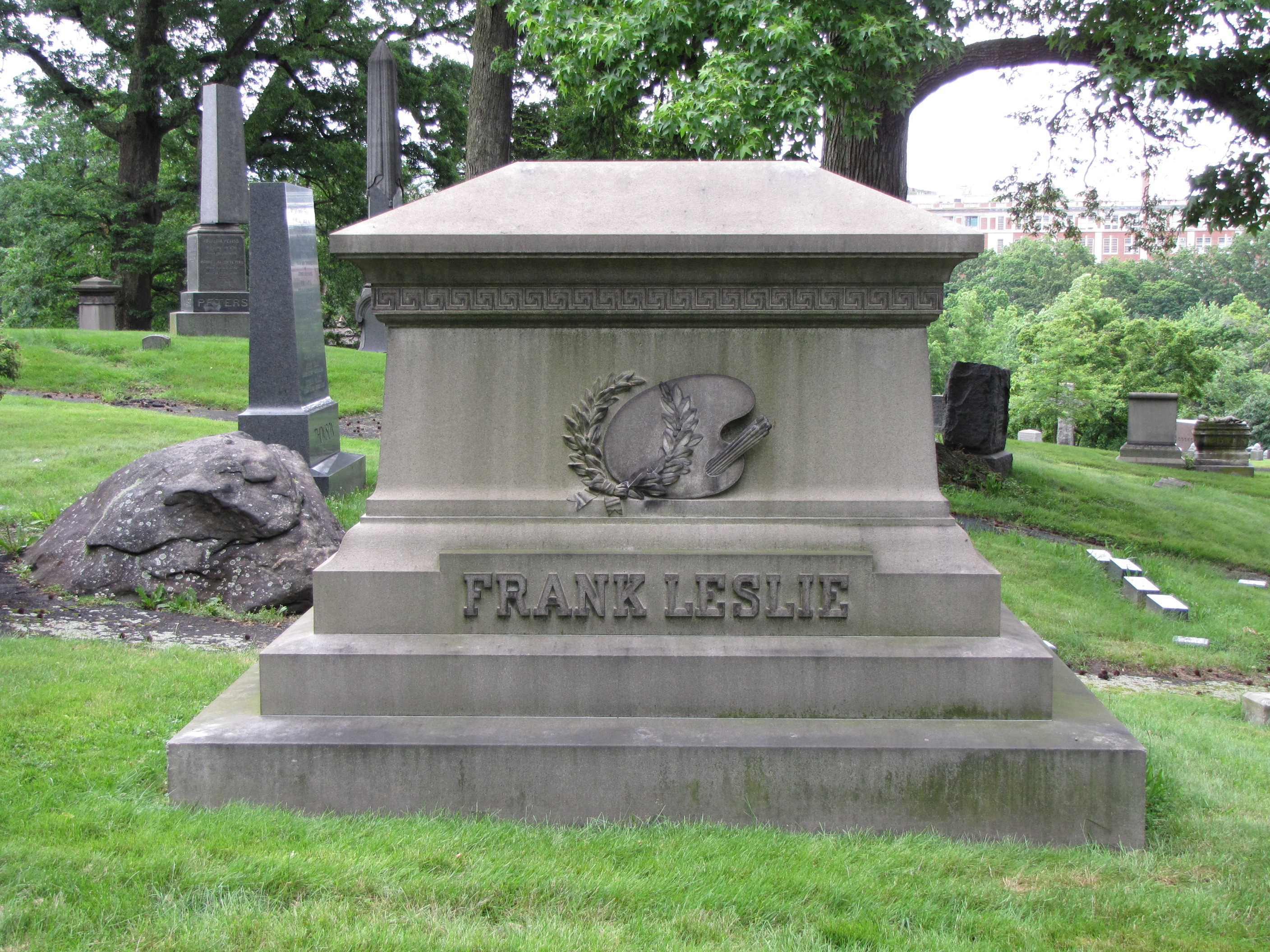
Leslie was a talented publisher and artist.  His engravings are still highly regarded for their quality and their historical value.  His monument displays an artist palette, a nod to his skill and passion.
Posted in Famous graves | Leave a comment

Art Nouveau Memorial to Henry Villard

Sleepy Hollow Cemetery, Sleepy Hollow, New York

Sleepy Hollow Cemetery, Sleepy Hollow, New York

HENRY VILLARD

BORN

HEINRICH HILGARD

AT SPEIER

RHENISH BAVARIA

APRIL 10TH 1835

DIED AT

THORWOOD DOBBS FERRY

ON HUDSON

NOVEMBER 12TH 1900

IN VIEW OF THIS SPOT

JOURNALIST

CIVIL WAR CORRESPONDENT

SOMETIME SECRETARY

OF THE

AMERICAN SOCIAL SCIENCE ASSOCIATION

EARLY PROMOTER OF CIVIL SERVICE REFORM

COMPLETOR OF THE

NORTHERN PACIFIC RAILROAD

FINANCIER

GENEROUS FRIEND

TO LEARNING SCIENCE AND THE ARTS

TO SUFFERING HUMANITY

HIS BOUNTY WAS BOUNDLESS

AS THE SEA

HIS LOVE AS DEEP

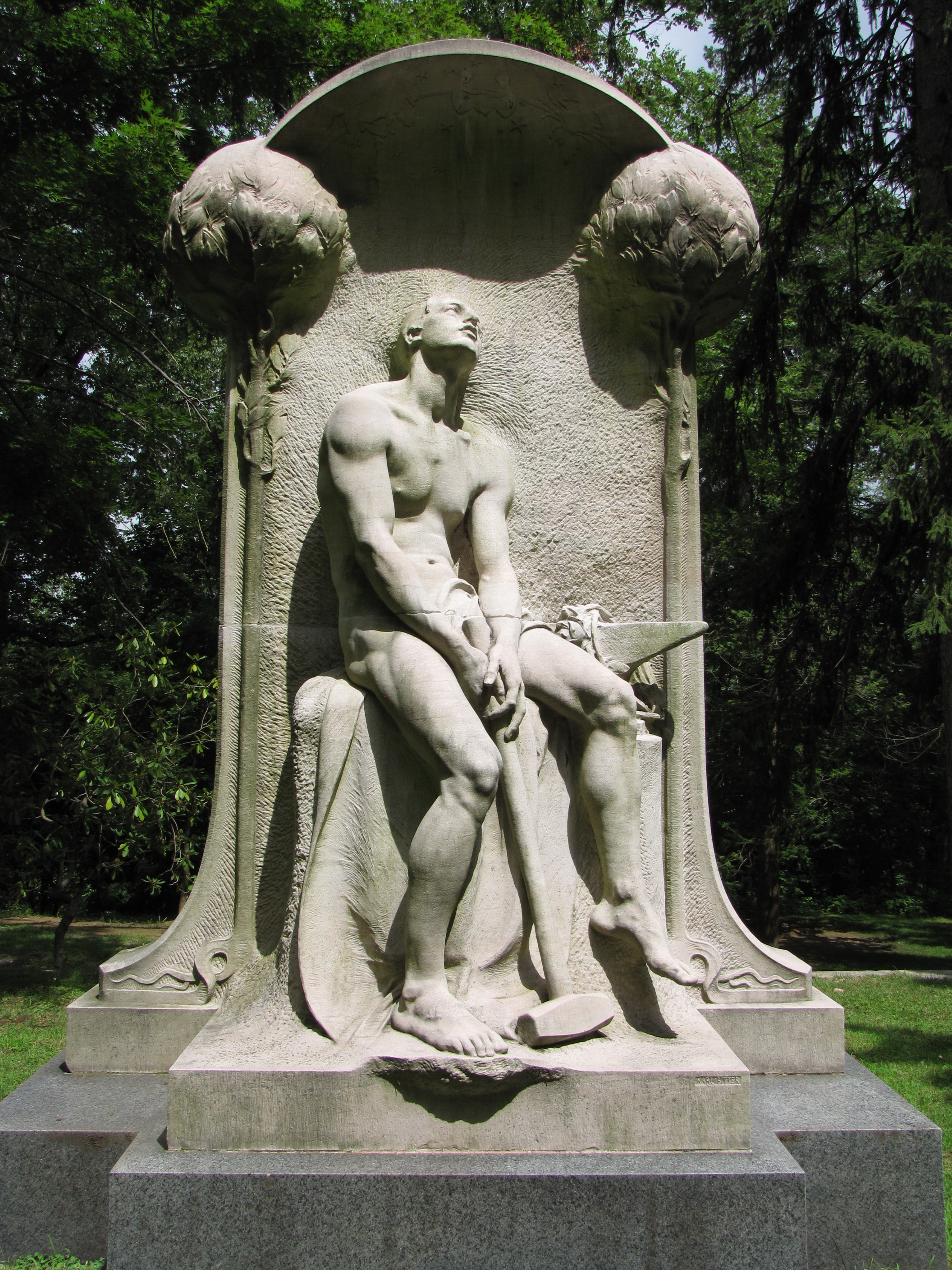
The Henry Villard Monument in the Sleepy Hollow Cemetery at Sleepy Hollow, New York, is an Art Nouveau masterpiece.

The bs-relief bronze of Henry Villard found on the back of his monument

The bs-relief bronze portrait of Henry Villard found on the back of his monument

The Art Nouveau movement was a bridge between Neoclassicism and Modernism and reached its popularity from 1890 to 1905. Luminary artists such as Alphonse Mucha, Gustav Klimt, and Henri de Toulouse-Lautrec; glass designers Rene Lalique and Louis Comfort Tiffany, and Spanish architect Antoni Gaudi among others used long fluid lines inspired from florals and plants in their work.

IMG_7220

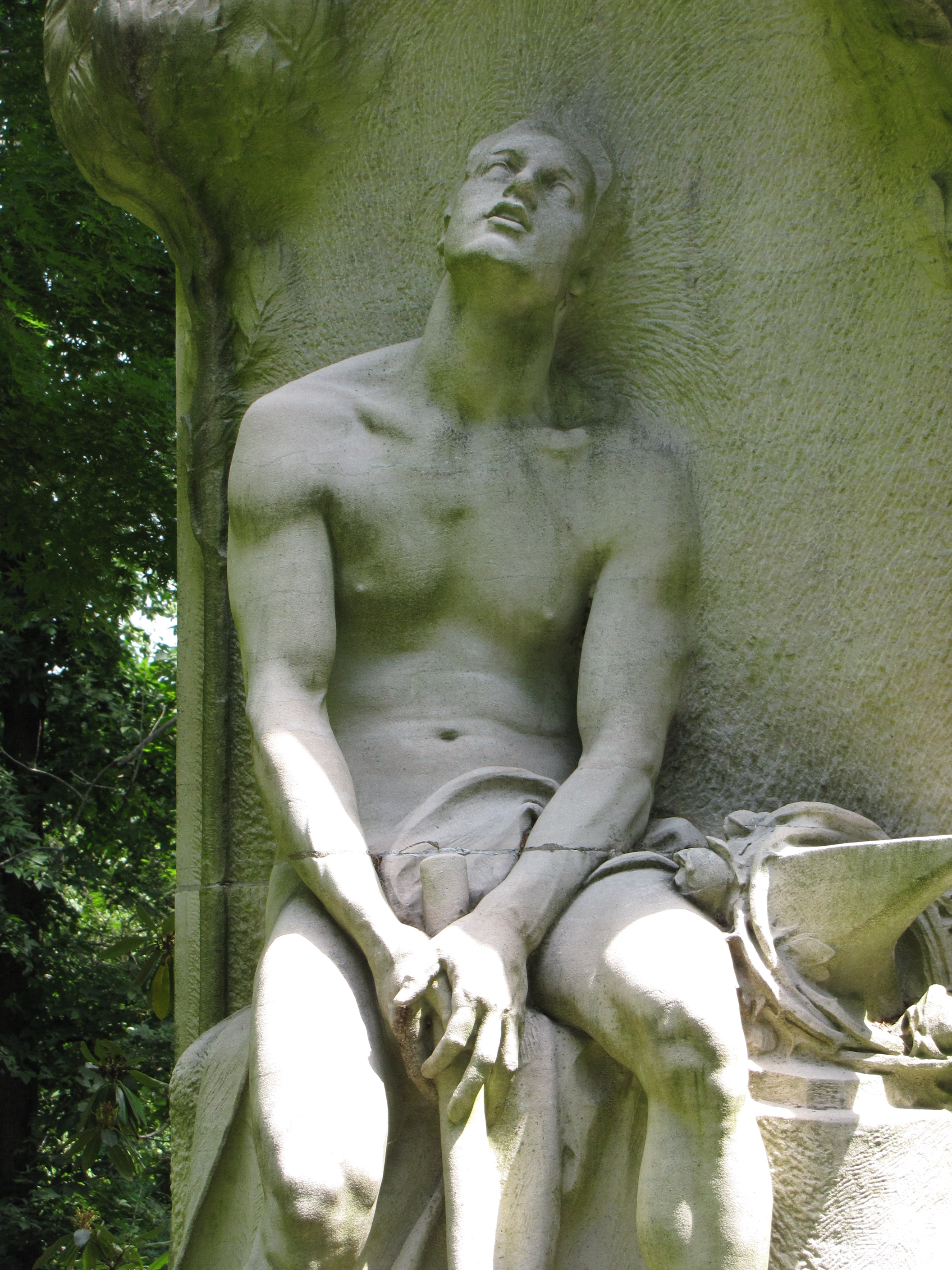
Here, Vienna-born American artist Karl Bitter, (1867-1915) sculpted fluid lines of the base of two trees that culminate in rounded tops flanking the statue of a young man depicted holding a sledge hammer, resting against an anvil as he gazes upwards.

Karl Bitter

Karl Bitter

Posted in Uncategorized | 5 Comments

The Veiled Mourning Figure

Mt. Olivet Cemetery, Nashville, Tennessee

Mt. Olivet Cemetery, Nashville, Tennessee

ALEX G. TURNER

BORN

OCT. 8, 1813

DIED

APRIL 27, 1889

Many Victorian cemetery monuments are imbued with a multitude of symbolism. In David Robinson’s book, Saving Graces, mourning figures from some of the most beautiful and famous cemeteries in Europe show sculpted beautiful, young, and voluptuous women often wearing revealing clothing mourning the dead.

Robinson identified four categories of ”Saving Graces”–first, women completely overcome by grief, often portrayed as having collapsed and fallen limp on the grave. Second are the women who are portrayed reaching up to Heaven as if to try to call their recently lost loved one back to Earth. Third, are the women who are immobile and grief stricken, often holding their head in their hands distraught with loss. Lastly, he describes the fourth category of “Saving Graces” as the mourning figure who is “resigned with the loss and accepting of death.”

IMG_5601

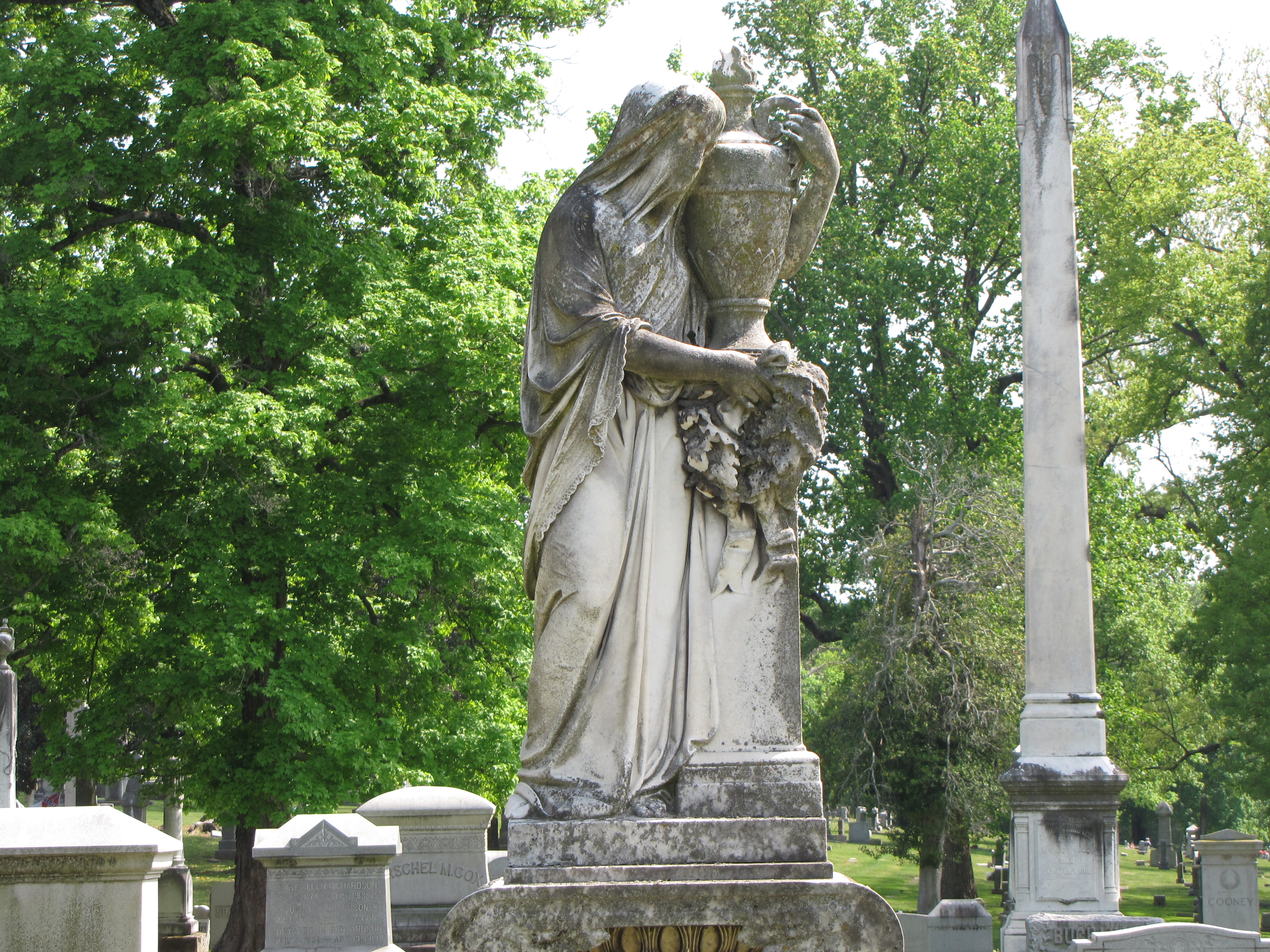
In this example from the Mount Olivet Cemetery at Nashville, Tennessee, the monument of Alex G. Turner, displays a young female figure, set upon on column, looking down in reflection and sorrow, her face draped by a veil.  The veil gives the figure an eerie look.  The veil is a motif that represents a separation between Earth and Heaven. The mourning figure leans against a post, her head against the urn set atop the post.  One of her arms interlaced with the urn with a flame billowing out from the top.  In her hand she holds a wreath. This mourning figure seems to be from the last category of mourning figure—sorrowful but resigned.

IMG_5604

The act of placing a wreath is a recurring funerary motif which is designed to remind the viewer that life is short. The urn, of course, is a container used to hold the ashes or the cremated remains of the dead. The urn was an almost ubiquitous 19th Century symbol found in nearly every American cemetery.  The flame, like many Christian symbols, has several different meanings—eternal life, religious fervor, and vigilance. The flame can also represent martyrdom.

Posted in Saving Graces | 1 Comment

Saint-Gaudens’ Angel

Hall Monument, Sleepy Hollow Cemetery

Hall Monument, Sleepy Hollow Cemetery

WRITE:

BLESSED ARE THE DEAD

WHICH DIE IN THE LORD

FROM HENCEFORTH

YEA SAITH THE SPIRIT

FOR THEY REST FROM THEIR

LABORS AND THEIR WORKS

DO FOLLOW THEM

GLORIA IN EXCELSIS DEO

JOHN HUDSON HALL

BORN OCTOBER XV, M-D-C-C-C-XXXVIII DIED MARCH III, M-D-CCC-LXXXXI

IMG_7100

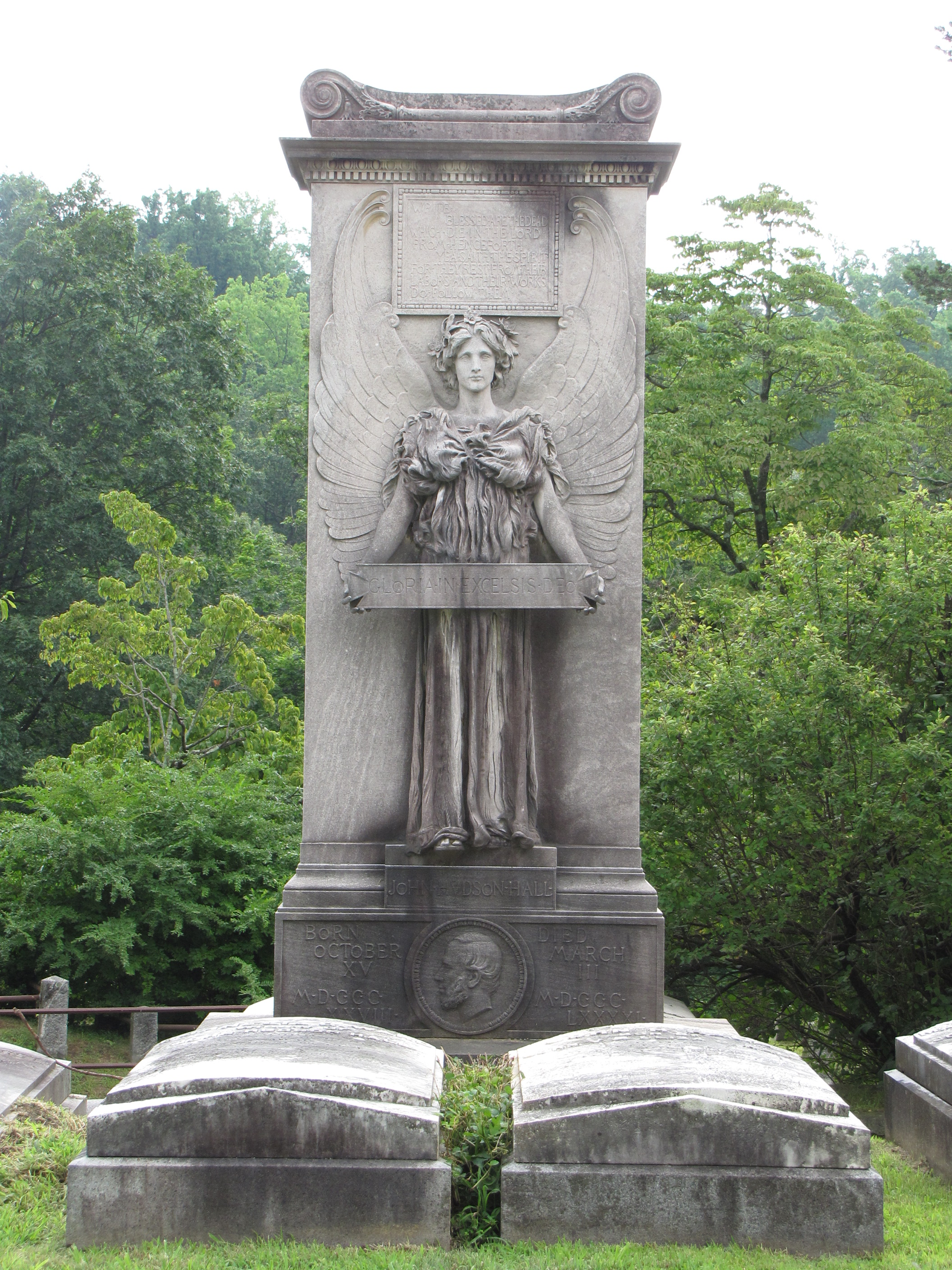
John Hudson Hall (October 15, 1828-March 3, 1891) was a successful paper manufacturer in the mid to late 19th Century.  He was also a patron of the arts.  Augustus Saint-Gaudens, the great Beaux-Arts sculptor, was commissioned to create the Hall Monument in the Sleepy Hollow Cemetery at Sleepy Hollow, New York.  The Hall Monument features an angel dressed in classical clothing holding the Latin phrase “GLORIA IN EXCELSIS DEO” which translates to “Glory to God on the highest.”  The phrase is the name of a hymn known as the Greater Doxology and also the Angelic Hymn.  The angel’s wings sweep upward above her head almost encirculing the Bibical verse, Revelation 14:13, “Write: Blessed are the dead which died in the Lord, from henceforth, Yea, saith the Spirit, for they rest from their Labors and their Works do follow them.”

Below the angel’s feet at the base of the monument is a medallion with a bas-releif portrait of John Hudson Hall with his birth and death dates on either side.

IMG_7098

Augustus Saint-Gaudens (1848-1907) gained fame for his monumental sculptures of Civil War heroes, such as the People’s General, John A. Logan.  He designed the $20 Double Eagle gold piece, thought by many critics to be the most beautiful coin ever minted by the United States Treasury.

1933_double_eagle[1]

Posted in Angels | 1 Comment

De Weldon’s Pieta

IMG_3198

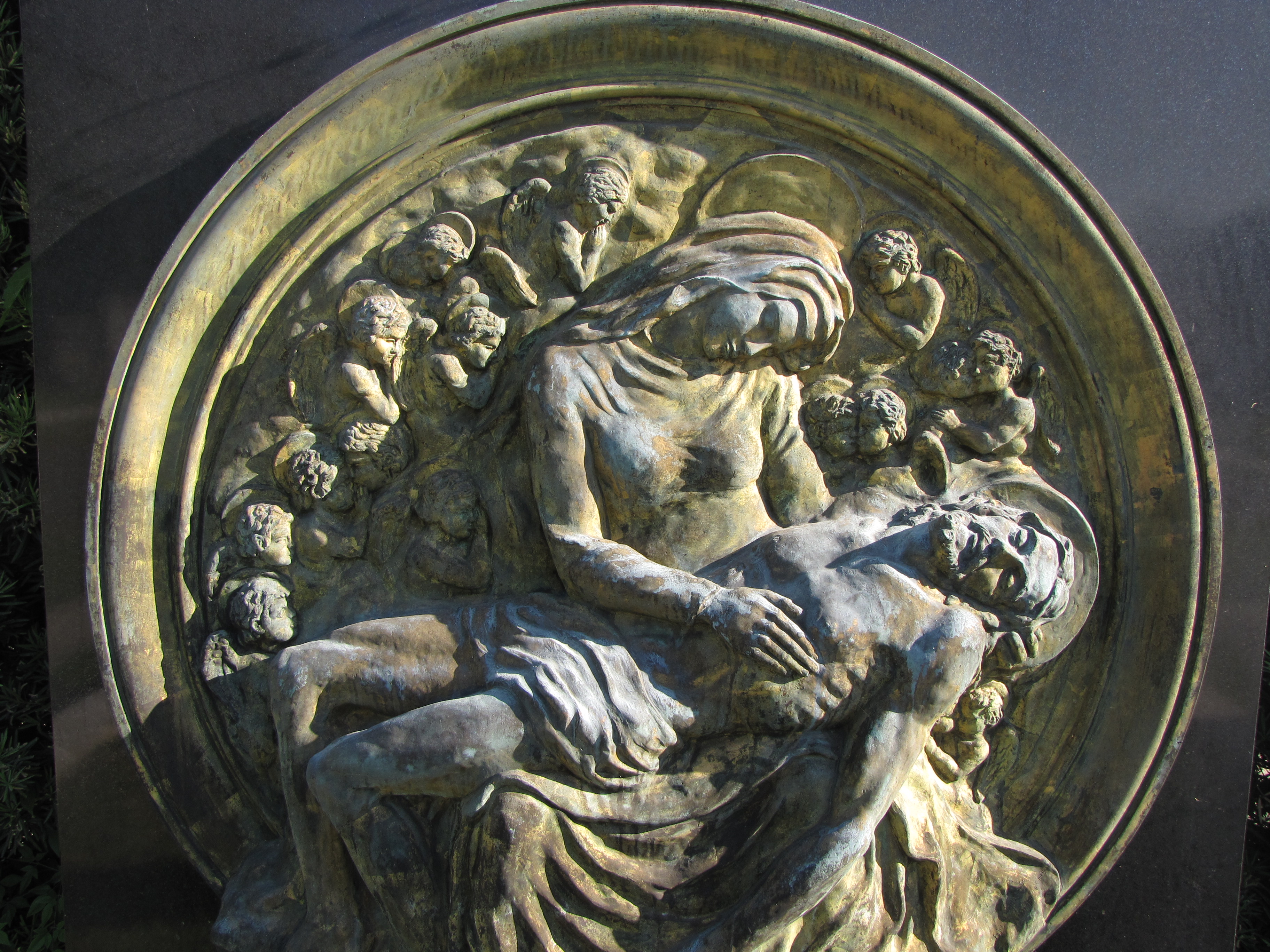
The Edith Allen Clark (1883-1965) polished black granite monument at the Metairie Cemetery at New Orleans, Louisiana, features a large circular bronze sculpture of the Virgin Mary and the dead body of Jesus Christ, known as a pieta, surrounded by more than a dozen cherubs.

Works of art, usually sculptures, depicting this subject first began to appear in Germany in the 1300s and are referred to as “vesperbild” in German.  Images of Mary and the dead body of Jesus began to appear in Italy in the 1400s. The most famous of these sculptures is Michelangelo’s pieta which he sculpted for St. Peter’s Basilica in the Vatican, carved when he was only 24 years old.  Pieta is Italian for “pity.”  The bronze is reminiscent of the sculptures that were first popularized in Germany depicting the Lamentation.

In the Heilbrunn Timeline of Art History (http://www.metmuseum.org/toah/works-of-art/2001.78 (October 2006)) a Bohemian Pieta on display at the Metropolitan Museum of Art is described in details that as easily could apply to the monument in Metairie Cemetery, “Images of the Virgin with the dead Christ reflect late medieval developments in mysticism that encouraged a direct, emotional involvement in the biblical stories… The sculptor exploits the formal and psychological tensions inherent in the composition…Christ’s broken, emaciated body, naked except for the loincloth, offers a stark contrast to the Virgin’s youthful figure, clad in abundant folds.”

IMG_3199

This particular bronze was sculpted by the famed artist Felix Weihs de Weldon (1907-2003), who created over 1200 sculptures that can be found on all seven continents.  He was, however, best known for the great and dramatic 100-ton bronze statue based on the iconic photograph taken by Joe Rosenthal on February 23, 1945, when six soldiers raised the flag over Iwo Jima.  De Weldon was directed to create a realistic memorial.  Three of those soldiers who lifted the flag modeled for De Weldon.  The other three soldiers had died in various actions after the flag was raised, so he created their images from photograpghs.  The sculpture, officially titled, United States Marine Corps War Memorial, pays tribute to the brave soldiers who raised the flag that day at Iwo Jima.

800px-USMC_War_Memorial_2008-06-23[1]

Posted in Symbolism | Leave a comment

President James Buchanan

IMG_6697

HERE REST THE REMAINS OF

JAMES BUCHANAN

FIFTEENTH PRESIDENT OF THE UNITED STATES

BORN IN FRANKLIN COUNTY, PA. APRIL 23, 1791:

DIED AT WHEATLAND. JUNE 1, 1868.

James Buchanan served as president from 1857 to the eve of the Civil War in 1861.  The presidency was the apex of his long political career—US Congressman from Pennsylvania (1823-1831), Minister to Russia (1832-1833), US Senator from Pennsylvania (1834-1845), Secretary of State (1845-1849), Minister to the United Kingdom (1853-1856).

Buchanan came to the office during a time of tumult and sectional unrest and seemed unable to lead the country out of the morass.  His efforts to appease Northerners and Southerners pleased no one.  Sentiment turned against Buchanan.  Less than two months after he left the office Fort Sumter was fired upon beginning the war.

In the many polls that are taken of the general public and historians, President Buchanan nearly always ranks at the bottom, scolded by the critics and obscured by his towering successor, President Abraham Lincoln.

Buchanan, at 78, already suffering from the effects of old age caught cold and grew weak.  He knew his time was drawing to a close and told his executor, “I have always felt and still feel that I discharged every public duty imposed on me conscientiously.  I have no regret for any public act of my life, and history will vindicate my memory.”—a defense of his administration and presidency.

President Buchanan made clear that he wanted a simple funeral devoid of pomp or circumstance.  However, that was not to be.  Nearly 20,000 filed by his casket before his burial in the Woodward Hill Cemetery at Lancaster, Pennsylvania.  He was remembered in the speeches delivered on the day of his funeral as a log cabin American; he was even compared to Lincoln—one who began in meager beginnings but rose to the highest office in the land.

His marker is tucked under several shade trees where he is laid to rest under a simple gray granite monument ornamented only with a simple band of oak leaves and acorns symbolizing strength.

Posted in Presidential graves | Leave a comment

Three Graces

Forest Lawn Cemetery at Buffalo, New York

Forest Lawn Cemetery at Buffalo, New York

In 1831, Mt. Auburn Cemetery opened in Cambridge, Massachusetts. It was the first garden cemetery to open in the country and represented a new attitude about burying the dead. These cemeteries were designed spaces, with pathways and avenues, and were landscaped to have the look and feel of a public park.

In Victorian Cemetery Art, author Edmund V. Gillon Jr. writes “The large amounts of space in the Victorian cemetery were to revolutionize cemetery art, and permit the use of sculpture in a way that crowded churchyard had never allowed. Sepulchral sculpture, with it prone effigies and kneeling weepers, had flowered in the past, but only for the rich and powerful.” The opening of Mt. Auburn was the dawning of the rural cemetery movement–the concept of the cemetery as a landscaped space.

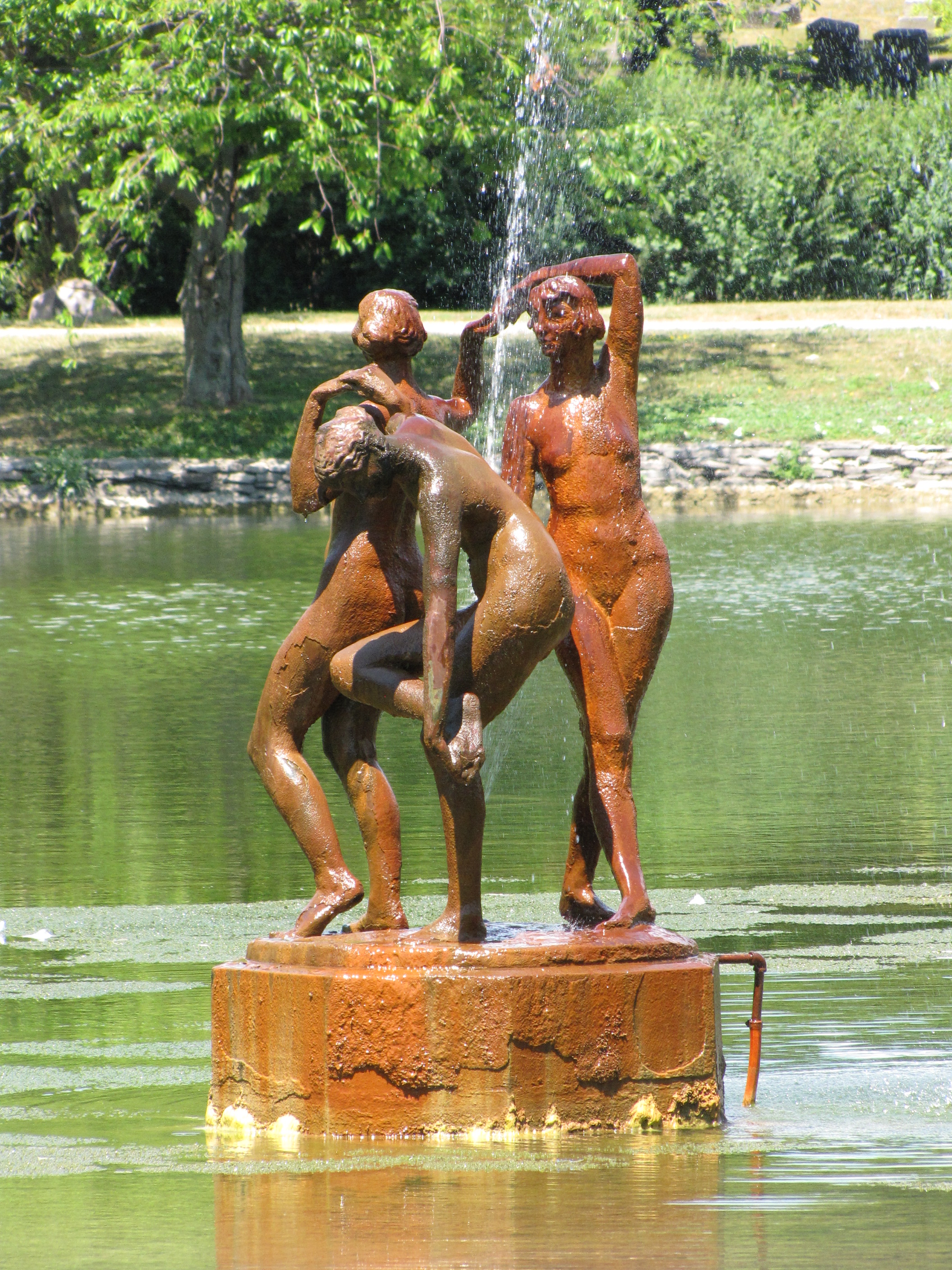
The Forest Lawn Cemetery at Buffalo, New York, opened in 1849.  The sprawling 269-acre cemetery features walkways, avenues, and lakes that are in keeping with the garden designs for cemeteries of the time period.  Mirror Lake features a statue by artist Laurence Rumsey Goodyear of the Three Graces, the goddesses of charm, beauty, and creativity from Greek Mythology.

Cities across America began to open garden cemeteries in their communities—Cave Hill Cemetery in Louisville, Laurel Hill Cemetery in Philadelphia, Spring Grove Cemetery in Cincinnati, Green-Wood Cemetery in Brooklyn, and Forest Lawn Cemetery at Buffalo, New York—to name just a few.

Posted in Uncategorized | 1 Comment

Aspiration

Forest Lawn Cemetery, Buffalo New York

Forest Lawn Cemetery, Buffalo New York

William Arthur Rogers

(1851-1946)

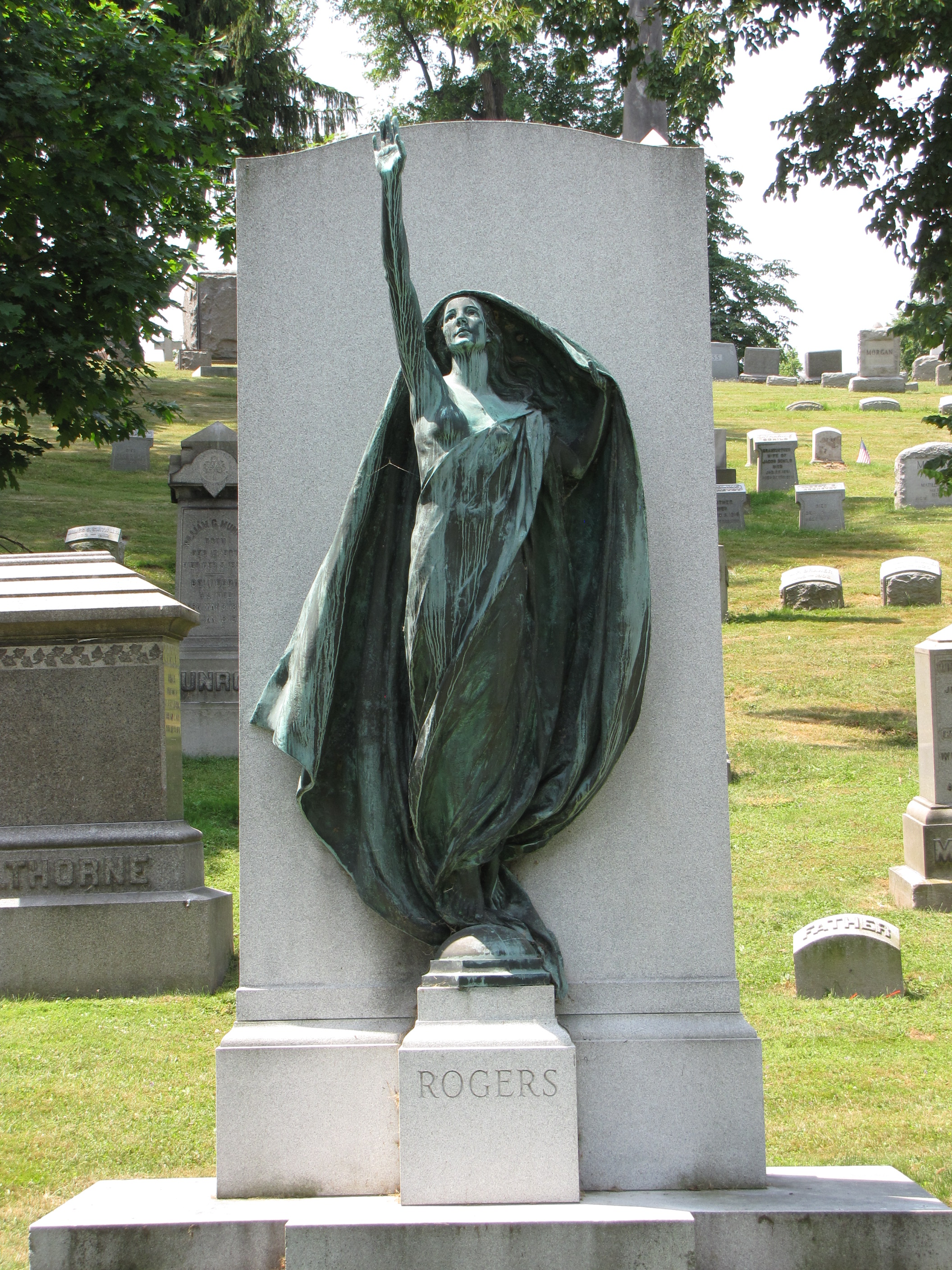
The dramatic 10-foot bronze sculpture “Aspiration” was created in 1926 by Harriet Whitney Frishmuth (1880-1980) for the Rogers monument in the Forest Lawn Cemetery at Buffalo, New York.  Frishmuth was well known for her sculptures of women.  Frishmuth studied briefly with Auguste Rodin in Paris, Cuno Von Uechtritz-Steinkirch at Berlin, and Gutzon Borglum in New York.

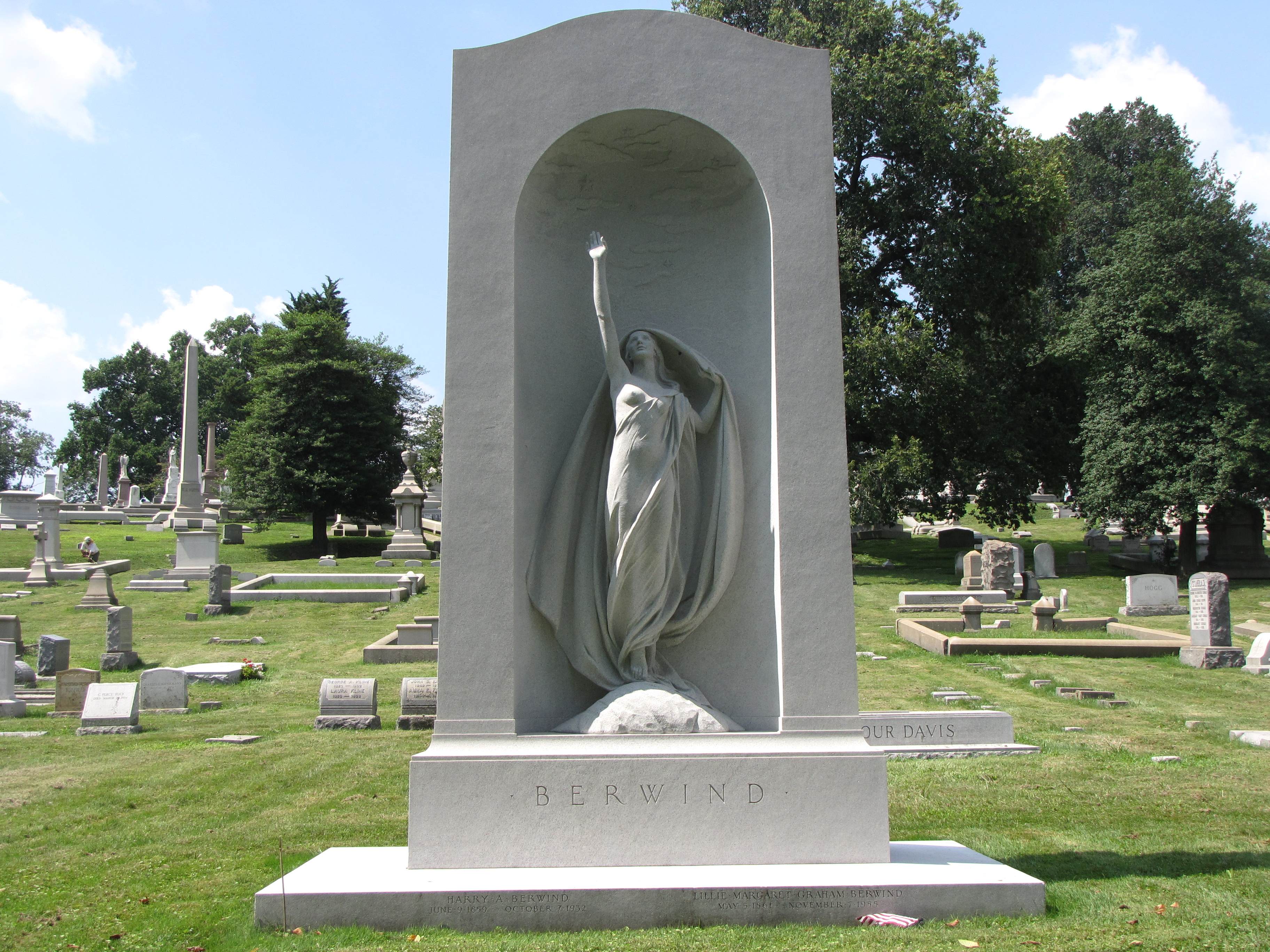
In 1933, another version of the “Aspiration” was carved out of a single block of granite for the Henry Berwind (1859-1932) monument in the Laurel Hill Cemetery, at Philadelphia, Pennsylvania. The stone version of “Aspiration” marks the grave of businessman Henry “Harry” Berwind, vice president of the Berwind-White Coal Company, run by his brother, Edward.

Laurel Hill Cemetery, Philadelphia, Pennsylvania

Laurel Hill Cemetery, Philadelphia, Pennsylvania


Posted in Symbolism | 7 Comments

Fallen Doughboy


Green-Wood Cemetery, Brooklyn, New York

Green-Wood Cemetery, Brooklyn, New York

JOSEPH QUADRI

HE BRAVELY GAVE HIS LIFE

FOR THE CAUSE OF HIS COUNTRY

BORN DEC 28, 1896 DIED OCT 2, 1918

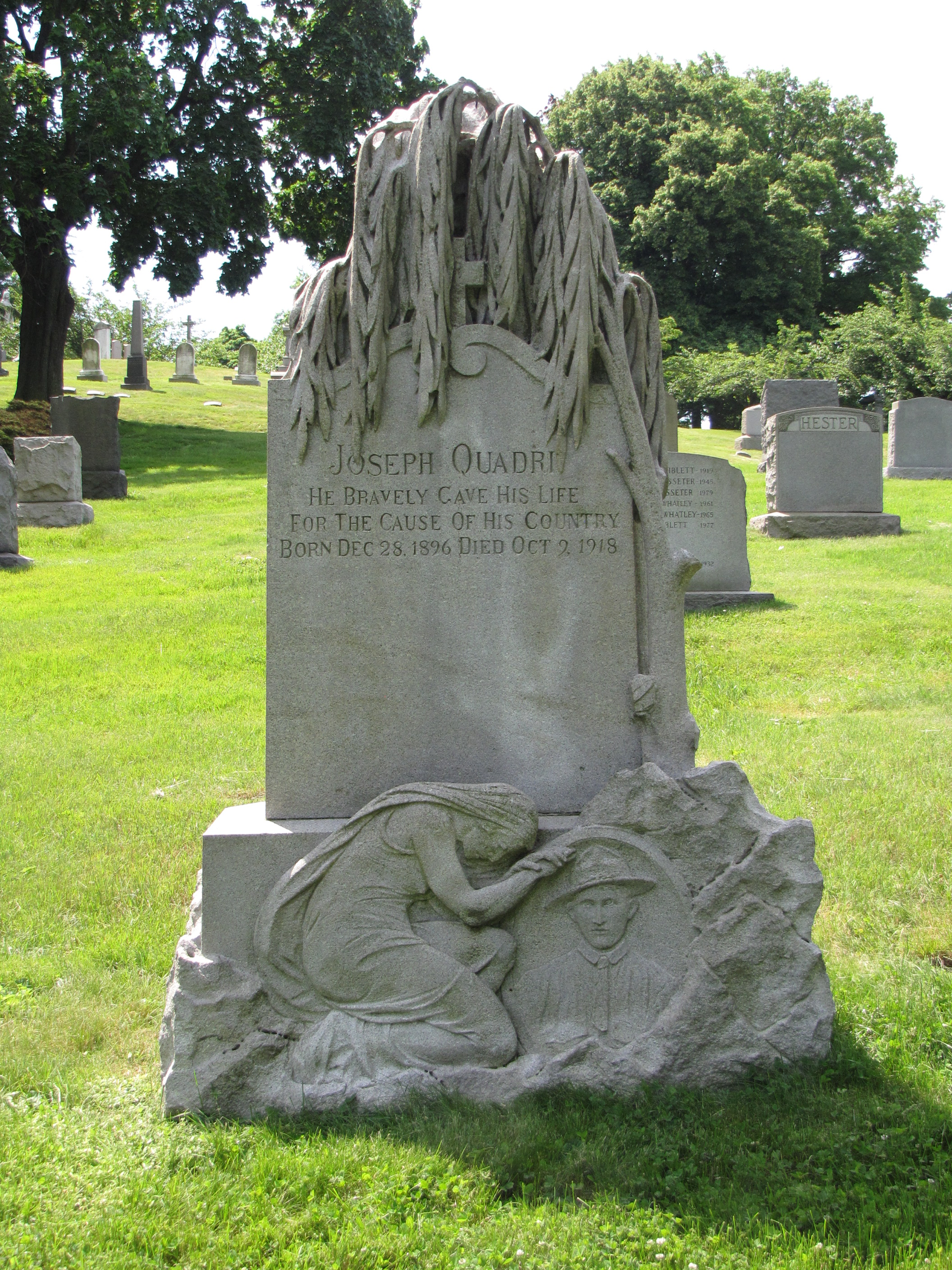
Private Joseph Quadri of Brooklyn was killed in World War I.  His body was transported to the United States on the transport ship Princess Matoika along with 417 of his fellow fallen comrades in arms and ten fallen nurses.

The gravestone marking his grave features a mourning figure bent in despair and sorrow looking at the image of a doughboy, possibly in the likeness of Private Quadri. The willow motif on this gravestone is not unusual; in fact, the willow is one of the most common symbols found in American cemeteries. What makes this willow special is that it is carved in a three dimensional form draping the top of the stone in willow branches making for a dramatic memorial.

The secular meaning of the willow symbolism represents what one might expect; sorrow and grief, it is after all a “weeping” willow. However, in Christian symbolism, the willow represents immortality because of the tree’s ability to shed so many limbs and survive.

IMG_3866

Posted in Symbolism | 3 Comments

Exedra, etc.

Sleepy Hollow Cemetery, Sleepy Hollow, New York

Sleepy Hollow Cemetery, Sleepy Hollow, New York

An exedra is a semi-circular structure, often with a bench with a high back. Sometimes there is an architectural feature in the center of the exedra, often with statuary or the family name.  In this example, the doric columns and the pediment add to the classical feel of the design, fitting for a contrivance that is classical in origin.

Originally the exedra was designed in antiquity to facilitate philosophical discussion and debate. In cemetery architecture the exedra is usually part of a landscape design.

Posted in Tombs | Leave a comment