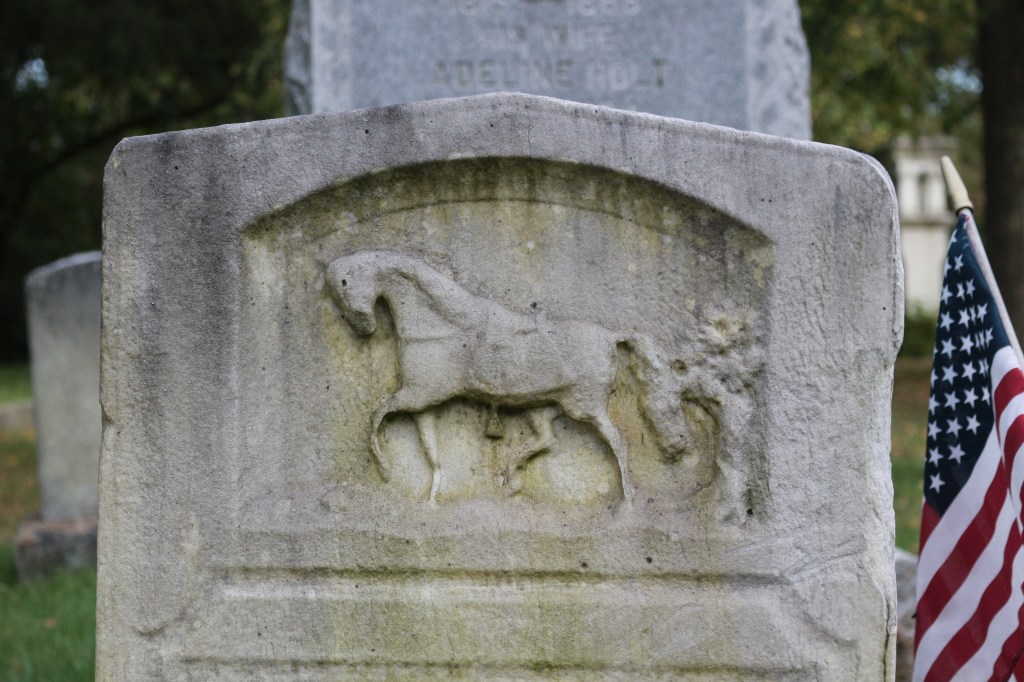
The eroded white marble gravestone of George Duncan in the Greenmount Cemetery in Burlington, Vermont, is a tribute to the sacrifice many young men made in service of preserving the Union. The battle was bloody and horrific with an estimated 165,000 Union and Confederate soldiers facing each other. After three days, General Lee’s forces had been defeated with an estimated 28,000 Confederate casualties. Even though the Union forces prevailed, more than 23,000 soldiers were wounded or dead—one of whom was Sargent George H. Duncan, only 22 years old.
The sculpture in the inset, at the top of the marker, is eroded but two images tell a story. The riderless horse indicates that the soldiers buried beneath this grave did not return from battle. The horse trots ahead of a tree with a major limb bent indicating an early death. Though faded the symbolism on this gravestone is a stark reminder of the cost of freedom.
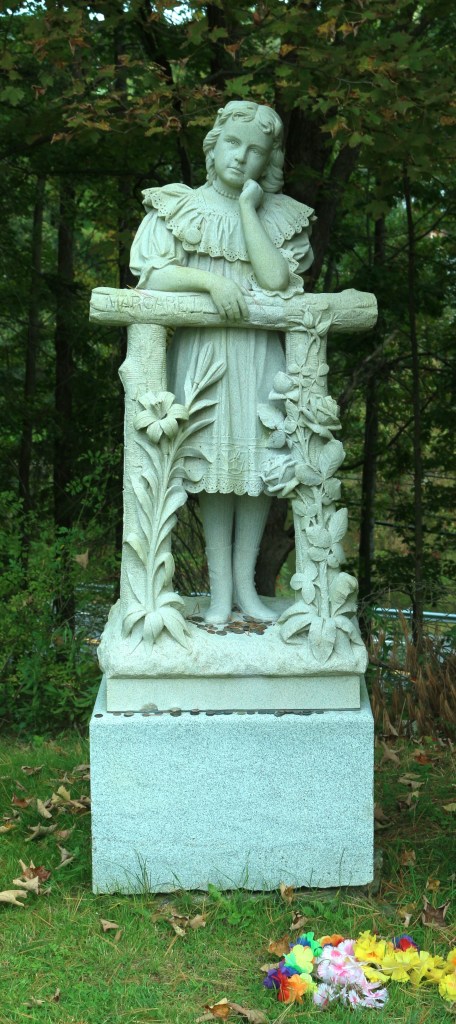
The monument in the Green Mount Cemetery in Montpelier, Vermont, commissioned by Margaret’s parents, Carroll Perley and Mary A. Devine Pitkin, was to be an exact replica of a photograph that her parents cherished. Harry J. Bertoli, a Barre, Vermont, statuary artist and sculptor, was enlisted for the daunting task of creating the granite look-a-like.
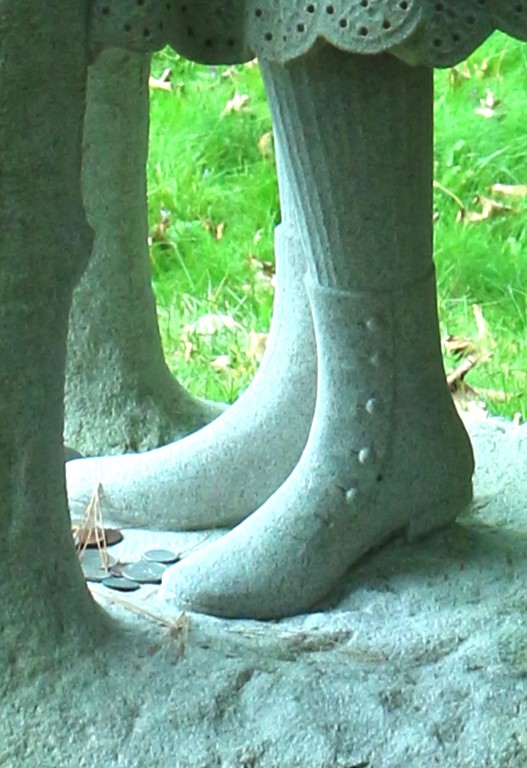
According to a brochure published by the cemetery, “Local legend has it that the Pitkin family initially refused to pay for the statue because a button was missing on one of her boots.” At closer inspection of the photograph, the Pitkins realized that indeed, the left shoe that Margaret was wearing in the photograph was missing the button and they immediately paid the debt.
They asked for an exact replica, and that is what Bertoli created.
Gravely Speaking and Syngrammata have decided to dig deep into our photo collections in order to bring you pairs of images drawn from our many years combing through American cemeteries. Each pair will be linked by a theme which we are free to interpret. Suggestions of future themes to follow are welcome in the comments! This week’s theme is: the most impressive mausoleum.
Gravely Speaking writes:
The Belmont Mausoleum, in the Woodlawn Cemetery in the Bronx, is a near replica of the Chapel of Saint Hubert; the original is in Amboise, France, the final resting place of Leonardo da Vinci.
Alva Smith Vanderbilt Belmont (1853-1933) commissioned the architectural firm of Hunt and Hunt to build the tomb after the death of her second husband Oliver Hazard Perry Belmont (1858-1908) in 1908. The mausoleum was completed in 1913 and is a masterpiece of late-fifteenth-century French Gothic architecture.
The front façade displays two intricately carved sculptures. The lintel—or horizontal block above the door—features a sculpture depicting the legend of Saint Hubert from which the chapel is named. According to the legend, while hunting Hubert saw a stag with a crucifix between his anthers. After the vision, Hubert converted to Christianity. Because of his humane treatment of the animals he hunted, Saint Hubert became the patron saint of hunters. That was particularly fitting for a focal point for the Belmont Mausoleum because of the Belmont family’s association with horse racing—the Belmont Racetrack and the world-famous Belmont Stakes, the oldest prize in the Triple Crown.
The sculpture in the pointed arch above the door depicts a scene with King Charles VIII and his wife, Anne of Brittany, kneeling in deference to the Madonna and Child.
The chapel has many architectural features that were common to Gothic design: Gargoyles—The spouts that were designed to divert rainwater away from the building were often elaborately designed to look like grotesque animals and human forms known as gargoyles. These figures became popular in France during the Middle Ages, though they can be found in other countries during that time, as well. Hood molding—If you look above the scene of the stag, there is a three-sided molding, also known as a drip molding. Pinnacles—These ornamented structures are usually pointed and are found on the corners of the Saint Hubert Chapel. They are often found on the buttresses of Gothic buildings. Stepped buttresses—in the chapel, the stepped buttresses can be seen of the front of the building’s sides. These are a mass of masonry built against a wall to give the building additional support and strength. The buttresses on the chapel are stepped, meaning in this case, the buttress has a wider segment, then on top of that is a smaller one, and still one more smaller buttress on top of that. Topping the buttress is a gargoyle. Trefoil window—In the middle of the gable on the front of the chapel is a roundel, a small circular frame. Inside the roundel is a trefoil—three-lobed form—in this case, a window. Spire—the tall, oxidized copper structure tapering up from the roof is a steeple or a spire.
Syngrammata writes:
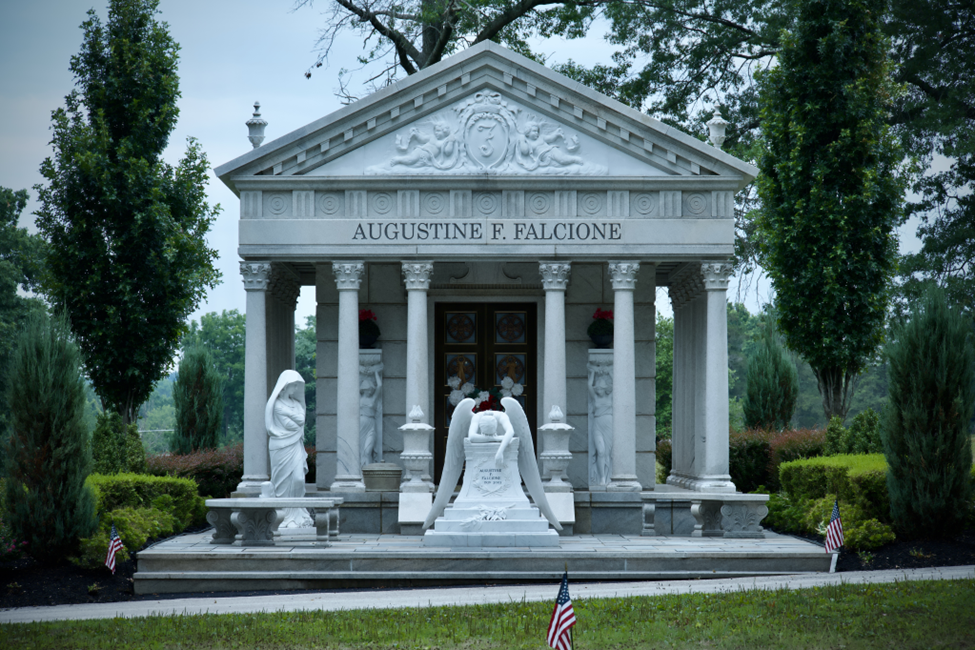
The Falcione mausoleum misappropriates Greek architecture in a dozen ways, but impresses nevertheless. One of the disappointments of my life is that the doors of the mausoleum are opaque, because I’m sure the interior is as stunning and lively as the exterior. Frankly, a preservation order should be slapped on this mausoleum: it’s that good.
I’m impressed by a rigorous commitment to symmetry which is even carried through the landscaping. The landscaper had real talent, playing effectively with the heights, shapes, colors, and brightness of the shrubs in order to create a dazzling frame for the structure. There must be a ‘perpetual care’ fund to keep everything so neatly trimmed.
A statue of the Madonna (?) on the left and a fine reproduction of William Wetmore Story’s 1894 Angel of Grief at center might be proxies for Falcione’s widow, who has humbly refused to place her name on the exterior of this complex so that it can be entirely about her beloved husband.
Gravely Speaking and Syngrammata have decided to dig deep into our photo collections in order to bring you pairs of images drawn from our many years combing through American cemeteries. Each pair will be linked by a theme which we are free to interpret. Suggestions of future themes to follow are welcome in the comments! This week’s theme is: interesting/significant mausoleum windows.
Gravely Speaking writes:
In a mausoleum in the Metairie Cemetery in New Orleans, the stained-glass window in the back of the tomb depicts an angel with vibrant red wings, an ochre gown, against a bright blue background. Angels are known as God’s messenger from the Hebrew root word meaning “send”.
This angel is thought to be a Seraphim. Seraphim are one of nine orders or choirs of angels which are organized into three spheres or orders, with three choirs in each. According to Christian tradition, the First Order, is made up of the Seraphim, Cherubim, and Thrones; the Middle or Second Order is made up of Dominions, Virtues, and Powers; and the Lowest or Third Order is made up of Principalities, Archangels and Angels.
Seraphim are mentioned in Isaiah 6:2-3 (King James Version): 2) “Above it stood the Seraphim; each one had six wings; with twain he covered his face, and with twain he covered his feet, and with twain he did fly.” 3) “And one cried unto another, and said, Holy, holy, holy, is the Lord of hosts: The whole earth is full of His glory. According to tradition, the Seraphim have red wings because they are the closet to God.
Syngrammata writes
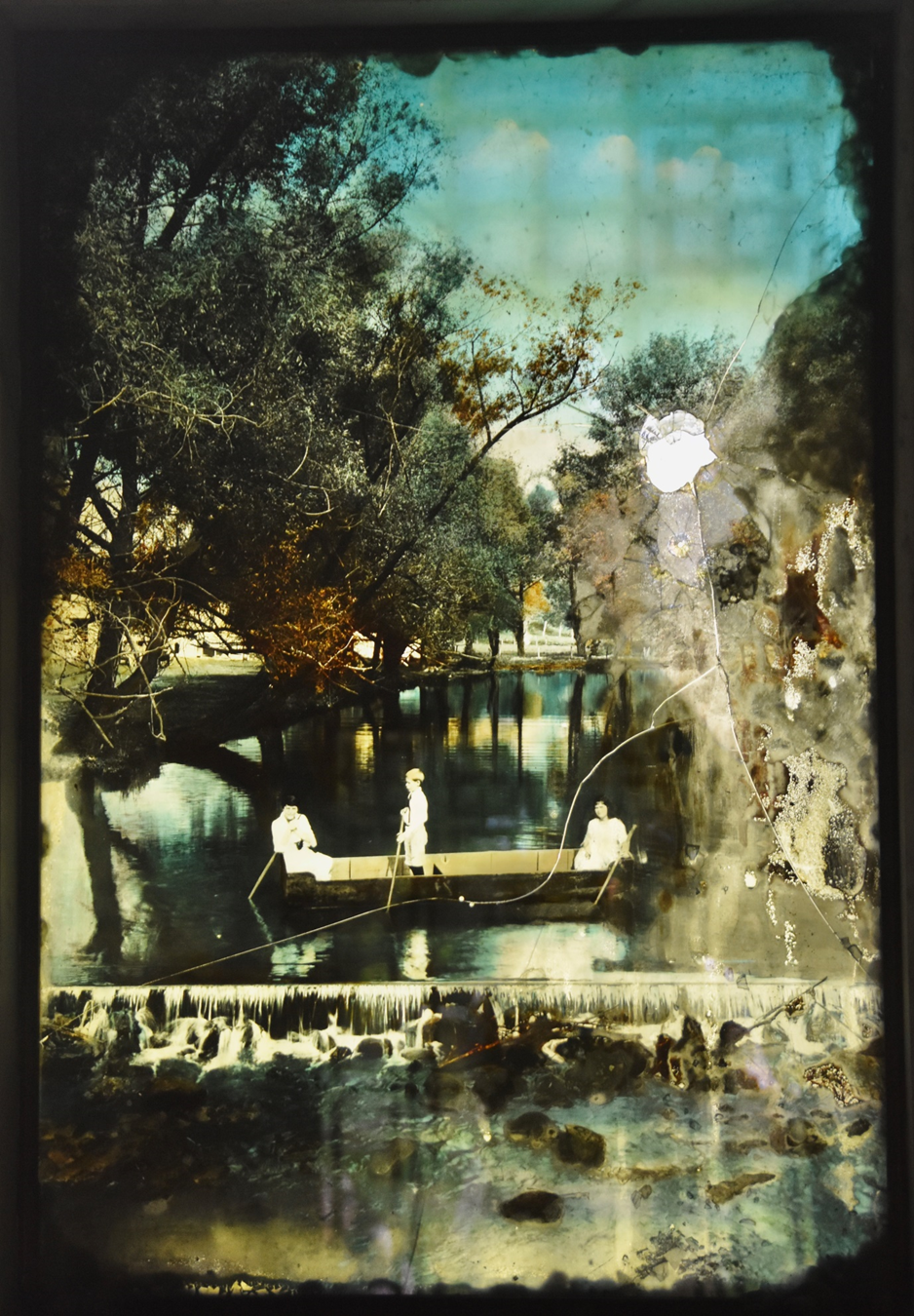
The image shows the wondrous 3’ x 2’ glass plate used as the rear window of the Mathews mausoleum in Nisky Hill Cemetery, in Bethlehem, Pennsylvania. It bears a photograph of the family made by patriarch James Mathews II (†1935) and depicts a little boat bearing his wife Carolyn (1878-1920), son James III (1908-1938), and daughter Martha (1907-1985) on a small artificial lake on a summer day. The black and white photograph has been painted with colors to render it more lifelike. Carolyn’s presence points to a date before 1920.
On that hot day when this image was created, none of these people in the flourishing prime of their lives could have imagined that it would one day illuminate their cold tomb! Someone has put a bullet through the window, and the moisture leaking in is slowly eating away both emulsion and color in a reminder that nothing is permanent.
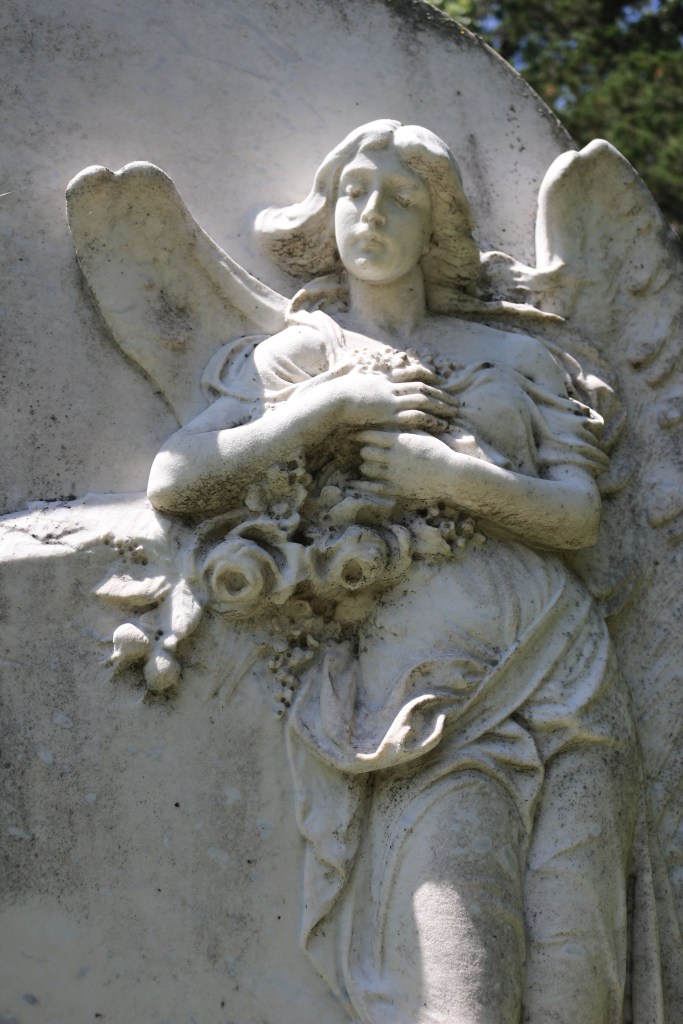
The Williams-Beachly family monument in the Wyuka Cemetery in Lincoln, Nebraska, depicts an angel clutching a garland of flowers as she looks downward toward the grave. The white marble rounded-top monument with the angle sculpture is mounted on a granite plinth atop a large flat granite base with the surnames WILLIAMS and BEACHLY etched into the facade.
The angel carrying the garland of flowers to decorate and watch over a grave is a common “angel type” found in American cemeteries. In the 2007 edition of Markers, XXIV, published by the Association for Gravestone Studies, Greenfield, Massachusetts, Elisabeth L. Roark wrote an article about angels titled, “Embodying Immortality: Angels in America’s Rural Garden Cemeteries, 1850—1900”, pages 56 – 111. Roark argues that angels were not “Romantic attempts to beautify death.” She writes, “while this was part of their appeal, angel monuments are far more complex in meaning and can act to reveal manifestations of popular Christian beliefs.”
According to the article, angels come onto the scene in rural garden cemeteries in a big way starting circa 1850 and then throughout the rest of the century. Though angels come in many variations and forms, in her study of 14 rural cemeteries from each region of America, Roark found that most angels fall into the following eight categories:
Soul-bearing Angels
Praying Angels
Angels who decorate and watch over the grave
Pointing angels
Recording angels
Trumpet angels
Michael the archangel
Child angels
Angels are mentioned over 270 times in the Bible but of the eight categories of angels that Roark describes in her article, Angels who decorate and watch over the grave are the only type not specifically defined in the Bible. Roark notes that decorating graves with flowers originates with the ancient Greeks, this type of symbolism, however, is something newly found in graveyards of the 19th Century.
After the Civil War, it became popular to decorate graves lavishly with flowers. Roark writes, “Like their live counterparts, the angels’ sculpted flowers suggest the parallels drawn at this time between the cyclical nature of plant life and human birth, death, and resurrection.”
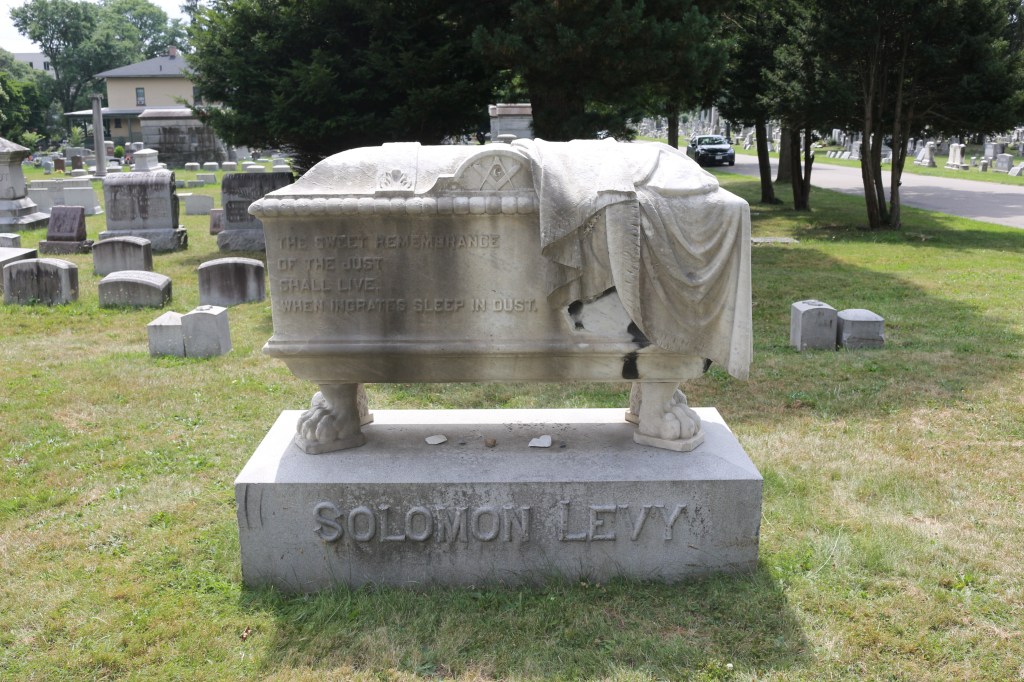
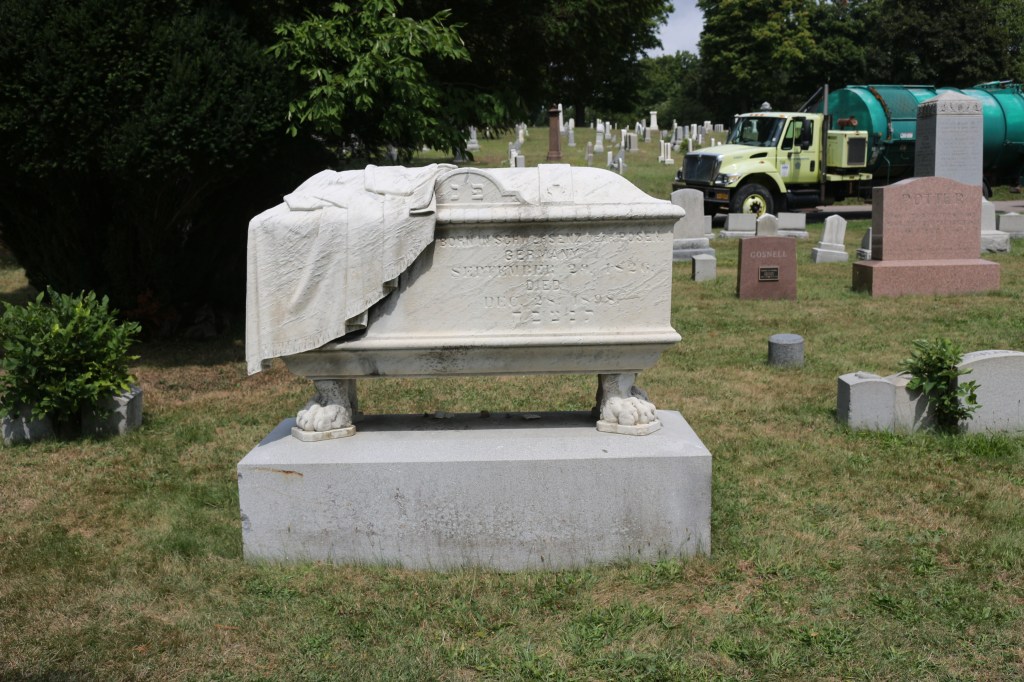
The Solomon Levy monument in the Mount Hope Cemetery in Rochester, New York, is a white marble sarcophagus—and a potpourri of symbolism. The sarcophagus as a gravestone form is an ancient burial monument designed to look like a coffin. This tomb is embellished with ornamentation and draped with a funeral pall held up with lion’s feet resting on a light gray granite block. But the “coffin” is empty–just an empty symbol of the receptacle.
The word, sarcophagus, is derived from two ancient Greek words, sarx, which meant flesh and phagein meaning to eat. The two words together, sarkophagus, mean flesh eating. The term came from the limestone used by the ancient Greeks to bury the dead which was thought to decompose the flesh of the deceased.
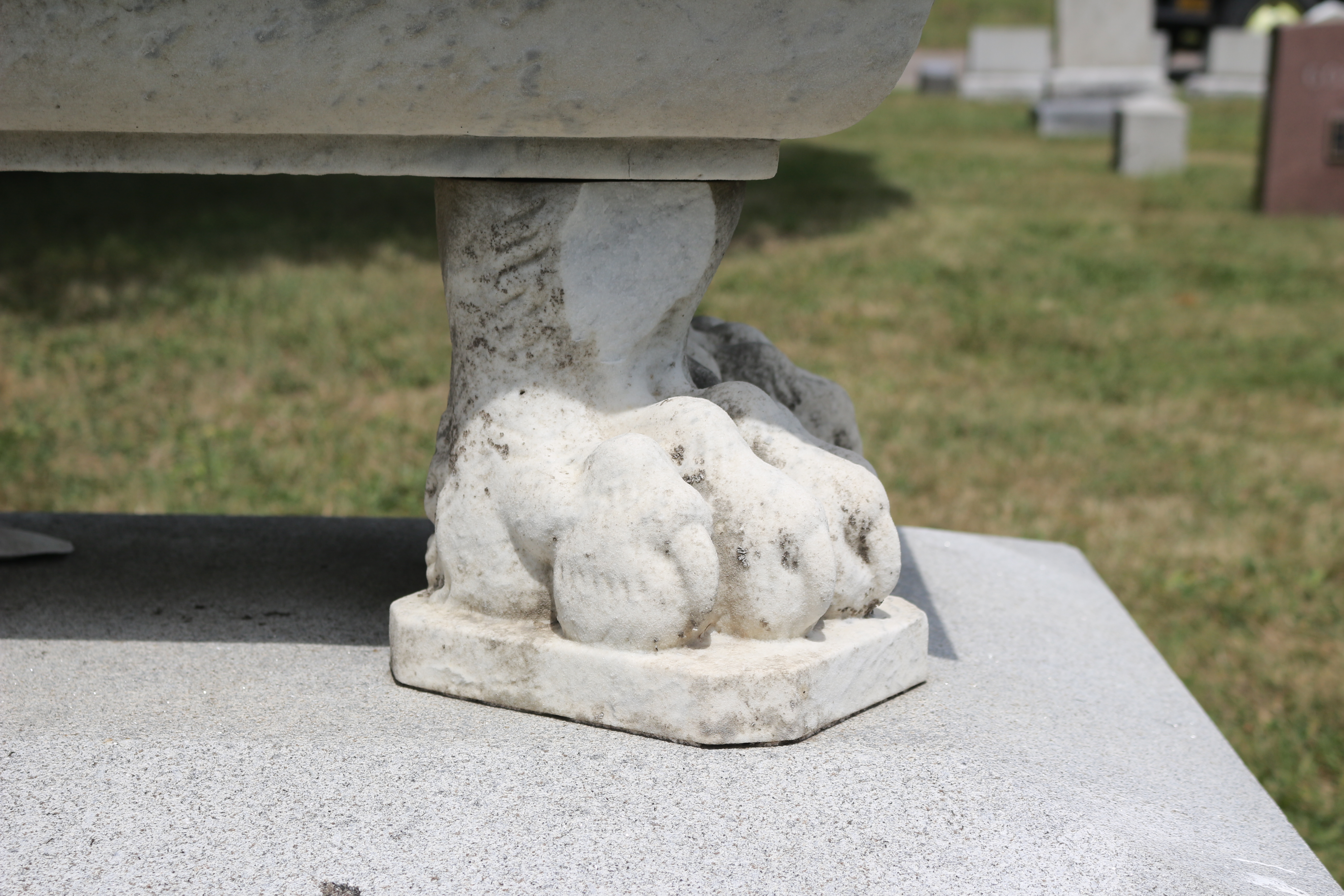
This powerful monument was designed to project strength. Holding up the tomb are four large meaty lion paws. The lion has long been a symbol of bravery, strength, and majesty. In popular culture, the lion is known for its power and is called King of the Jungle and King of the Beasts. The lion is often used as a royal emblem, found eight times in the Royal Arms for the late Queen of England alone!
The lion in funerary art symbolizes the power of God. It is often depicted flanking the entrance of a tomb to guard against evil spirits to the passageway to the next realm. It also represents the courage of the souls the lions guard. There is also a connection of the lion to the Resurrection. It was once believed that lion cubs were born dead but would come to life after three days when the cubs were breathed upon by a male lion. The three days is significant because it is the number of days Jesus was in the tomb before he was Resurrected.
In addition to the other motifs carved into this monument, the sarcophagus also displays a fringed funeral pall in a sign of grief. The drapery represents a shroud symbolizing death and sorrow. The drapery can also be a motif that represents a veil that separates the Earth and Heaven.
Emblazoned on the front of the tomb is the most recognizable emblem of the Freemasons, the square and compass, with the letter “G” appears in the middle of the emblem. Each component of the symbol represents a different Masonic orthodoxy, though, these are not hard and fast: The compasses represent the boundaries of wisdom a person should have the strength to circumscribe and stay within. The square symbolizes virtue in all actions, just as the expression “square deal” means treating people with fairness. The letter “G” seems to have more than one meaning. It could possibly mean God, as in the creator of the universe; or Gimel, which is the word for the third letter of many Semitic languages. The number three is significant to many Masonic rituals and beliefs. Some also believe the “G” may represent geometry.
Lastly, in Hebrew, in a half circle at the top of the tomb on the side that gives Levy’s scant biographical information, are the two letters “pey” and “nun” which is translated to “here lies buried”. Below the Levy’s date of death are inscribed the Hebrew letters “taf”, “nun”, “tzadik”, “bet”, and “hey” meaning “May their soul be bound up in the bonds of eternal life”.
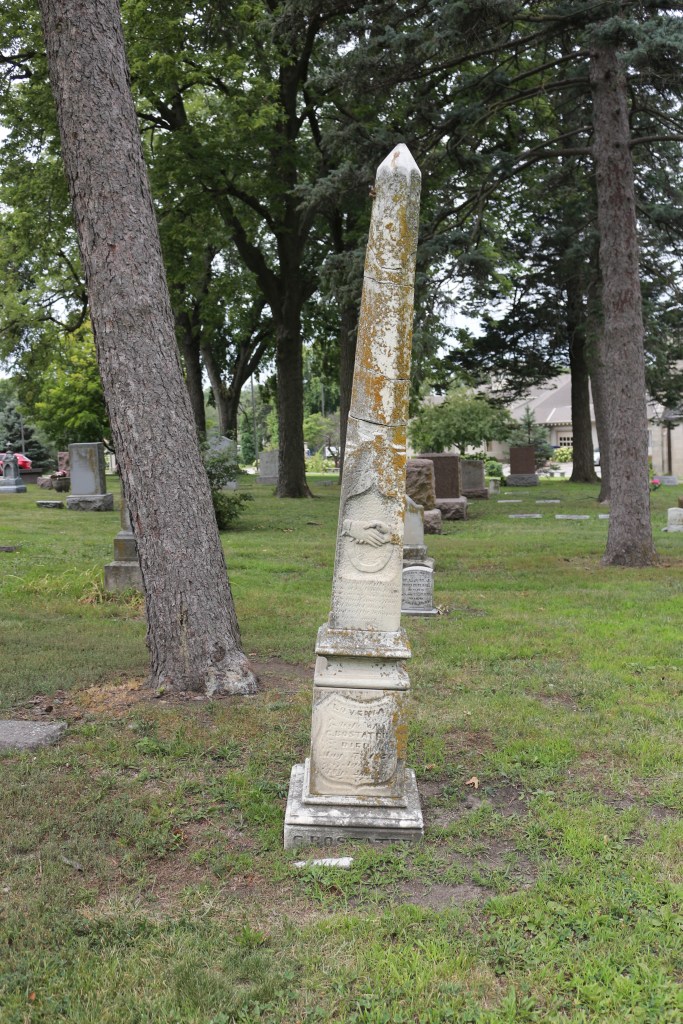
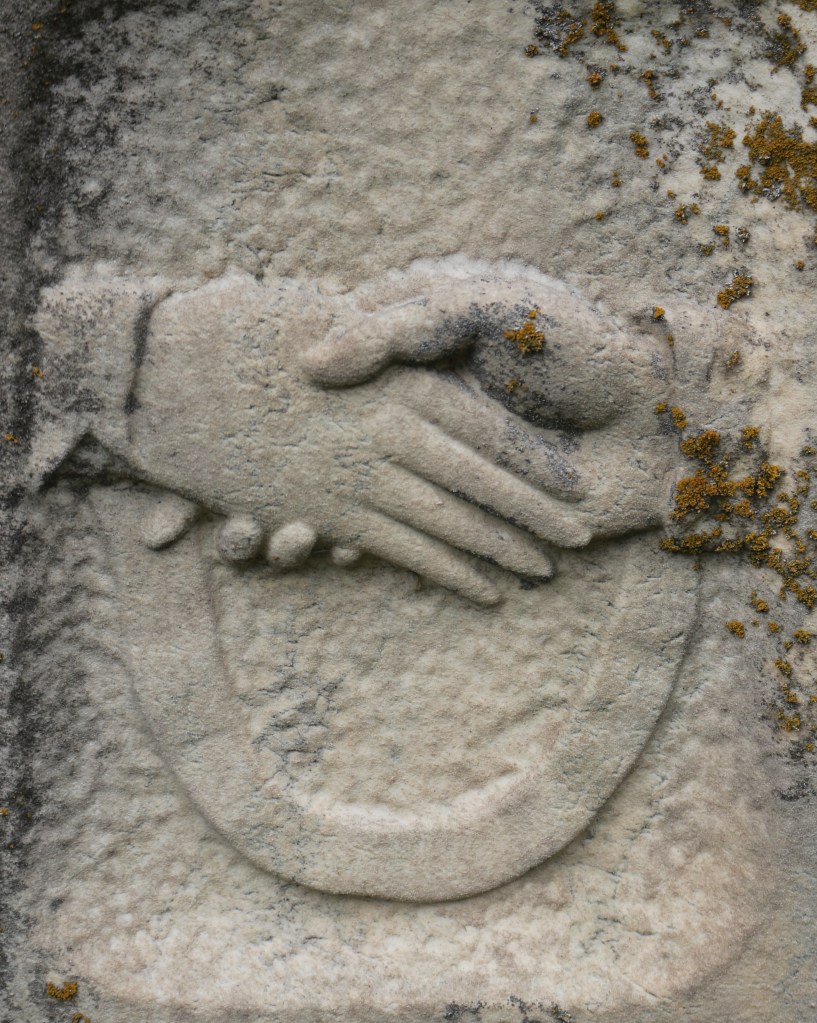
The titled and eroded white marble gravestone of Lovinia Bostater in the Wyuka Cemetery in Lincoln, Nebraska, displays one of the most common Victorian motifs found in American cemeteries—clasping hands.
The symbol can take on many meanings and sometimes the cuffs on the wrists can give the viewer a clue and can indicate a particular meaning. If for instance, one cuff has lace and one is a buttoned shirt cuff, it likely represents the matrimonial bond—that link between a married couple. If the cuffs on both wrists are shirt cuffs, it can symbolize fraternal brotherhood—for members of the same organization or union—a brotherhood.
Some gravestones depict the hands descending through the clouds—the clouds symbolizing Heaven. This motif likely represents a final farewell or eternal bond between the living and the dead. The handshake may also represent God reaching down for the deceased to bring them into his presence as a welcome to Heaven—the Heavenly handshake.
In this case, the clasping hands most likely represent the marriage bond. In addition, to the symbolism of the clasping hands, there is a ribbon draped over each wrist. This may be a depiction of “handfasting”, an ancient Celtic ritual. In this ritual, the hands are tied together to symbolize the binding together of two lives, as in marriage.
The white marble monument marking the grave of Jennie L. Hanson in the Wyuka Cemetery in Lincoln, Nebraska, depicts an angel leaning against a pilar. Billowing clouds surround the haloed angel holding a ribbon with the words, “PAX”, Latin for “PEACE.”
When we see a winged figure in a cemetery, we instantly recognize it as an angel–a messenger of God. However, Christian art did not depict angels with wings until the fourth century. Before then, angels were represented in several different forms–sometimes in human form, but also represented as a doves, or even just as a hand reaching down to Earth from the Heavens. Beginning with the reign of Constantine, angels began being depicted with wings, as this angel is portrayed.
The tall gray-marble square column gravestone in the Wyuka Cemetery in Lincoln, Nebraska, pictured above displays an incised carving of gate, a very common symbol found in American cemeteries. In this example a crown and a cross are carved above the gates. The gates, which are an important part of the Last Judgment, represent a passageway. The gates are the portal for saved souls to make their passage from the Earthly realm to Heaven upon Christ’s return.
The crown is a symbol of glory and reward and victory over death. The reward comes after life and the hard-fought battle on Earth against the wages of sin and the temptations of the flesh. The reward awaits in Heaven where the victor will receive a crown of victory. The crown also represents the sovereign authority of the Lord. The cross, of course, is the universal symbol of Christianity.
ROSA B. MOORE
1876 – 1911
GONE BUT NOT
FORGOTTEN
In the example below, also found at the Wyuka Cemetery, the symbol of the gates is not carved on the gravestone, but the gates ARE the gravestone. And, in this case the gates are not closed but slightly ajar. The cemetery booklet* suggests the gates just might be ajar “for easy passage by Rosa Moore to her eternal reward.”
*Wyuka Cemetery: A driving & Walking Tour, page 78, written by Ed Zimmer, published in 2009 by the Wyuka Historical Foundation
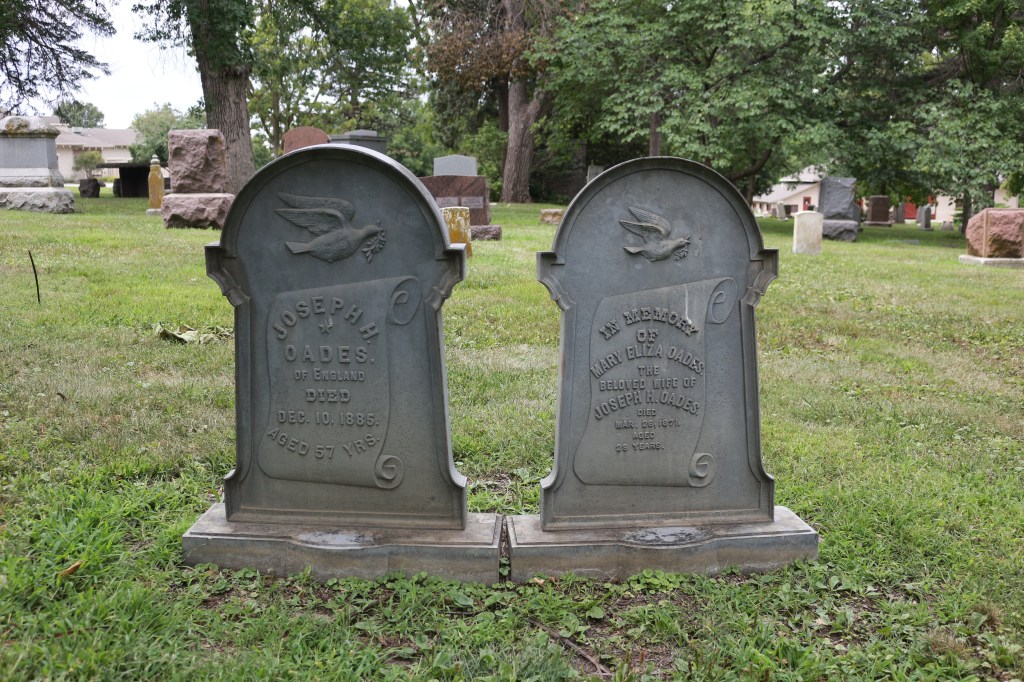
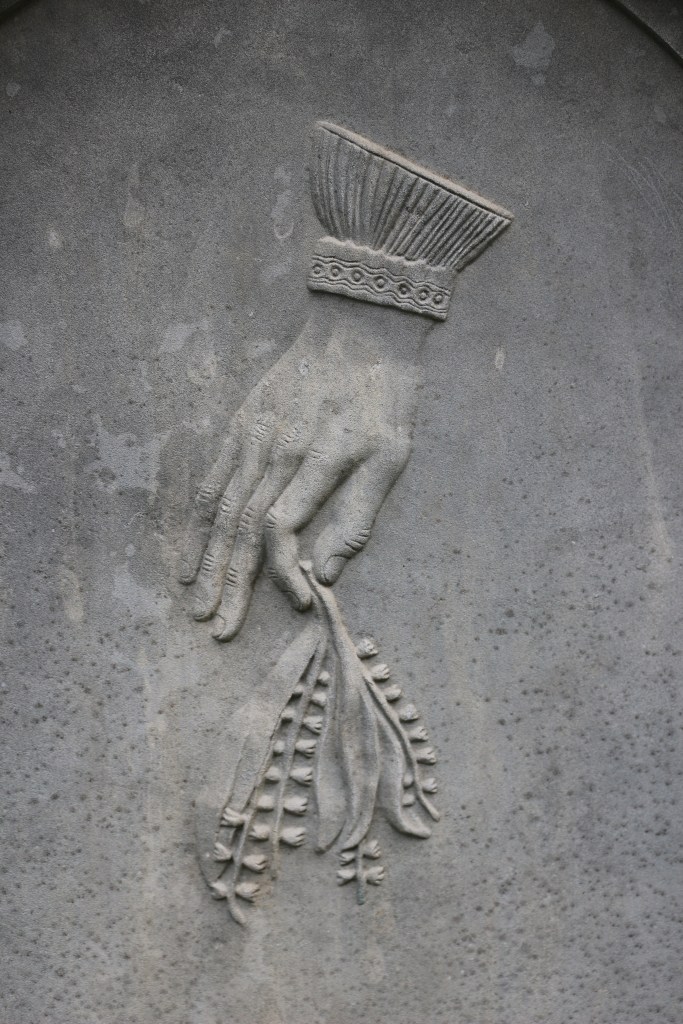
The Oades grave markers in the Wyuka Cemetery in Lincoln, Nebraska, were produced by the Western White Bronze Company of Des Moines, Iowa, a subsidiary of the Monumental Bronze Company of Bridgeport, Connecticut.
Though the company billed the markers as “white bronze” they were cast zinc. The zinc markers are often referred to as “Zincies” by cemetery aficionados. The markers are distinguishable by their bluish-gray tint. Many of the designs mimicked designs that were commonly found carved from stone. The Oades markers are designed to look like rounded-top tablets. The zinc markers were produced beginning in the 1870s until the company closed shop in 1912.
A scroll on the face of each of the markers contains the name and death dates of the Joseph and Mary Eliza Oades. The scroll represents both the life of the deceased, and the time spent on Earth.
Above the scroll is a dove. Several references in the Bible refer to the dove as a symbol of the Holy Spirit including Mark 1:10 the Bible says, “And Straightway coming up out of the water, he saw the heavens opened, and the Spirit like a dove descending upon him.” Again in John 1:32, the Bible reads, “And John bare record, saying, I saw the Spirit descending from heaven like a dove, and it abode upon him.” Along with the dove symbolizing the Holy Spirit, the dove is also closely associated with peace, often depicted with a olive in its beak. This, too, originated in the Bible. After the waters receded in the story of Noah, the dove appears. Genesis 8:11, “And the dove came in to him in the evening; and, lo, in her mouth was an olive leaf pluckt off; so Noah knew that the waters were abated from off the earth.” It was a sign of God’s forgiveness. Thus the dove symbolizes the Holy Spirit, peace, and purity.
The back of the markers features a woman’s hand holding a lily of the valley sprig. The lily of the valley is much like other lilies in funerary art and viewed as a symbol of innocence and purity.
According to the booklet, Wyuka Cemetery: A driving & Walking Tour, page 70, written by Ed Zimmer, published in 2009 by the Wyuka Historical Foundation, “The Oades were born in England and immigrated to Lancaster County through Canada. Mary Eliza was only 29 years old when she died in 1871, just two years after the founding of Wyuka. Mr. Oades was suffering from “St. Vitus’s dance” a neurological disease that causes uncontrollable movements, when he took his own life at age 57 in 1885.”









 Gravely Speaking