A Blinding Light

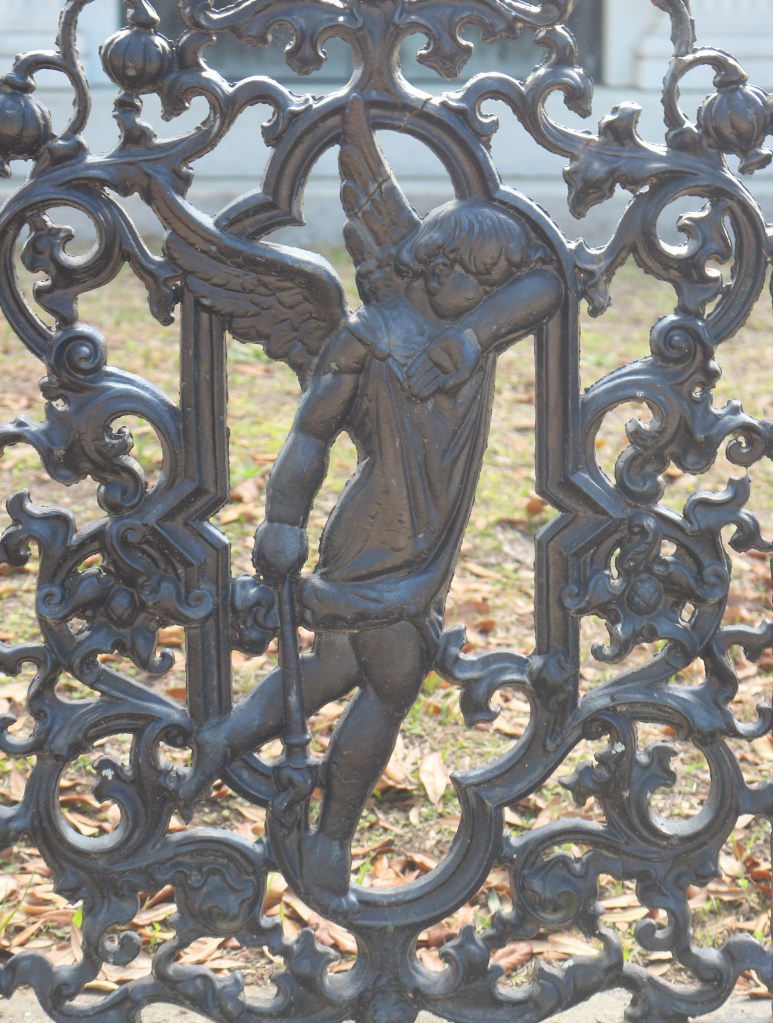
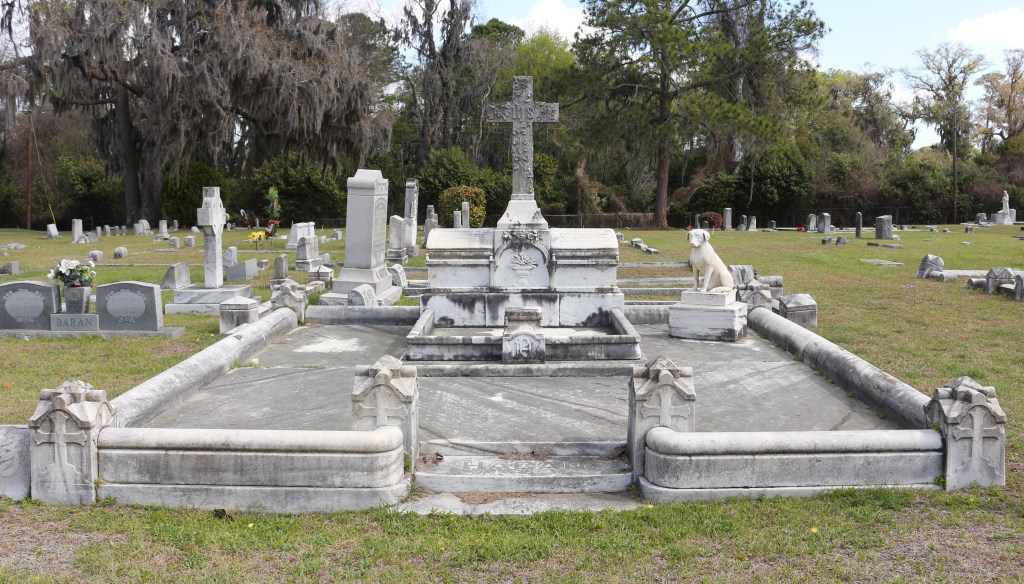
An iron fence surrounds the John Rourke Family Mausoleum in the Catholic Cemetery in Savannah, Georgia.  The iron gates and fencing around a cemetery were common and imbued with a power—the power to keep the malevolent spirits such as ghosts, fairies, and witches at bay. 

It was thought that iron had a supernatural power.  That belief manifested itself in many Victorian practices.  Hence a horseshoe nailed to a door was thought to be a talisman protecting those inside and repelling evil spirits.  Burying an iron knife in front of the threshold to your home was believed to ward off witches from coming in.  And the iron fencing around a cemetery was believed to contain the souls of the dead. 

The magical powers of the gate and fencing are also found surrounding family plots.  It was thought that once the gate was closed the spirits could not follow you home! 

The Rourke gate, in addition to keeping spirits enclosed, displays other symbols with meaning.   In the top corners above the angel in the center of the gate are poppies embedded in the design.  In the cemetery, this motif represents eternal sleep.  Just as it was portrayed in the movie, The Wizard of Oz, the main characters lie down in a field of poppies where they fall into a deep sleep.  That same imagery is used here.

Also, at the center of the gate, an angel is holding an inverted torch; and that same symbol flanks the angel in the gate.  The flame is symbolic of the soul.  Here the inverted torch represents a life that has been extinguished.

Lastly, the angel holding the inverted torch covers his face.  This act is mentioned in the Bible—Isaiah 6:2. According to theologians, the angels covered their faces as an act of respect and humility as they were not worthy of looking directly at God.  It is also thought that God’s holiness is so bright, that the light was blinding. 

Posted in Uncategorized | 1 Comment

Setting or Rising?

In a mausoleum in the Mountain View Cemetery in Altadena, California, a stained glass window represents a potent symbol throughout the world—ancient and modern.  In funerary symbolism it is depicted in many ways: as a yellow sphere; as spreading rays of light; as a geometric pattern shaped like a many-pointed star; as lines emanating from a single point outward in a fan pattern.  The ancient Egyptians depicted a single ray of the sun as an obelisk in honor of their sun god Ra.

Like many symbols, there is a duality to the sunburst.  For instance, when looking at the symbol, it is difficult to discern if it is a rising sun or a setting sun—which leads to its dual meaning.  The rising sun represents the resurrection, rebirth, and eternal life.  In fact, many Western cemeteries were oriented to bury the deceased facing the rising sun in anticipation of the return of the Savior God Jesus.  The setting sun, however, represented death and the end of the mortal life.

Posted in Uncategorized | 2 Comments

The Ubiquitous Weeping Willow

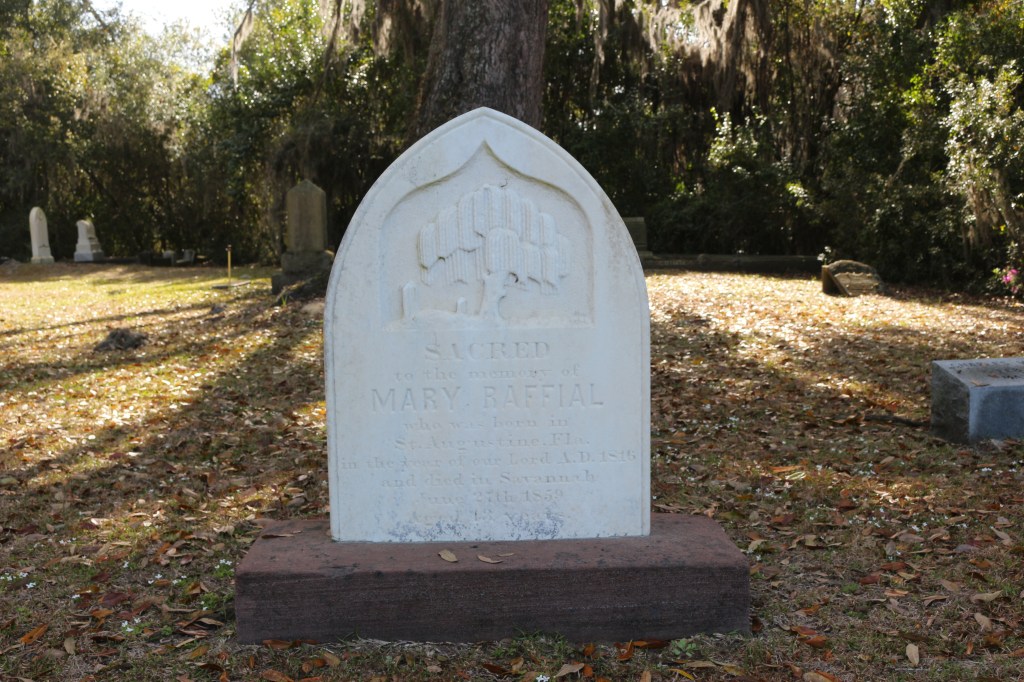
SACRED

To the memory of

MARY RAFFIAL

Who was born in

St. Augustine, Fla.

in the year of our Lord A.D. 1816

and died in Savannah

June 27th 1859

Aged 43 years

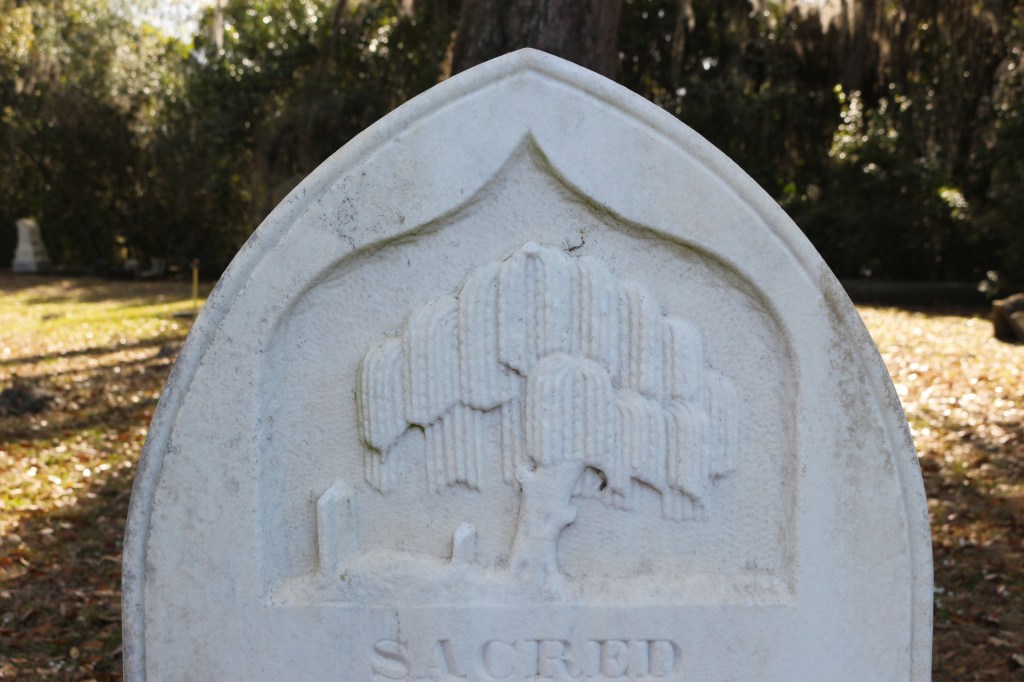
One of the most ubiquitous symbols found in American cemeteries is the weeping willow.  According to James Deetz and Edwin S. Dethlefsen, in their groundbreaking article, “Death’s Head, Cherub, Urn and Willow” the willow first made its appearance in cemeteries in the early 18th century. 

The motif represented a break from the stark and cold reminders that death would bring that the Puritans carved into their gravestones—flying death’s heads, skulls and crossbones, and gravedigger’s equipment. In addition to the grim reminders of the inevitability of death Puritan gravestones often accompanied the haunting imagery with blunt words such as, “Here lies the body.” Nothing subtle there.

The willow, however, represented a more sentimental view of death.  The willow as a symbol is sentimental and hints at the human emotions felt during grief.  The willow motif represents what one might expect; sorrow and grief, it is after all a “weeping” willow. This symbol is found on many gravestones and can be found carved in a variety of styles.  In this example, found in the Catholic Cemetery in Savannah, Georgia, the willow tree is shading the gravestone and footstone presumably of the deceased—the object of the grief.

Posted in Uncategorized | Leave a comment

The Winged Cherub

IN MEMORY OF

TWO CHILDREN OF

Andrew & Catherine

HUGHES:

JOSEPH

DIED MARCH 7, 1853

AGED 3 MO. & 7 DAYS

THOMAS N.

WAS KILLED BY A HORSE

OCT. 13, 1853

AGED 3 YRS & 14 DAYS

I take these little lambs said Christ

And lay them on my breast

Protection they shall find in me

In me be ever blest

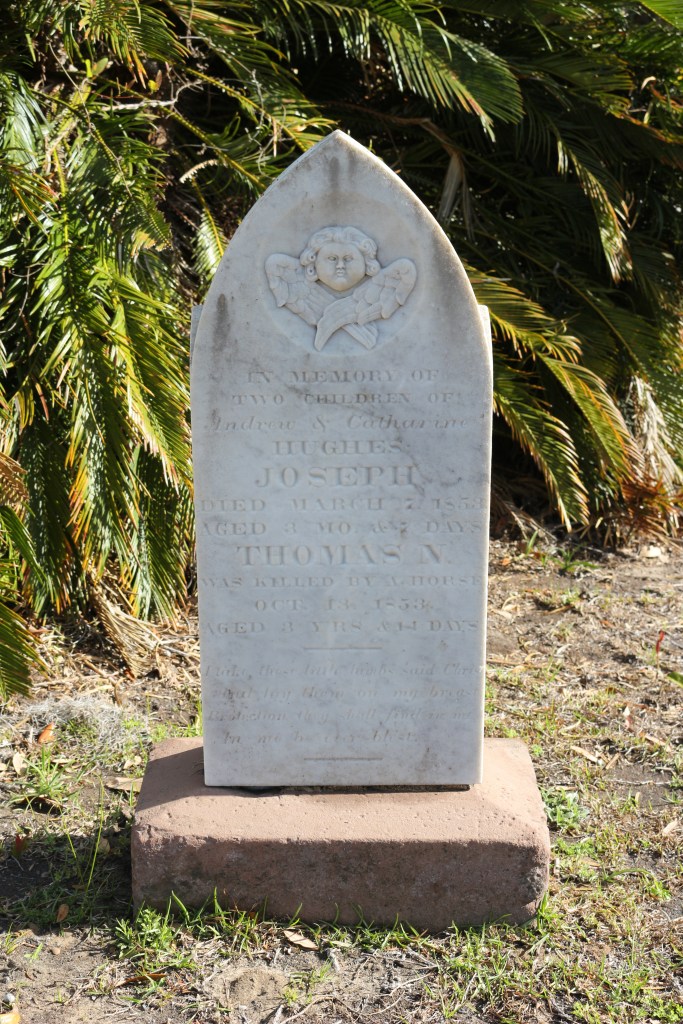
The white marble tablet of Joseph and Thomas Hughes is found in the Catholic Cemetery in Savannah, Georgia.  The pointed arch gives the gravestone a slightly gothic look. 

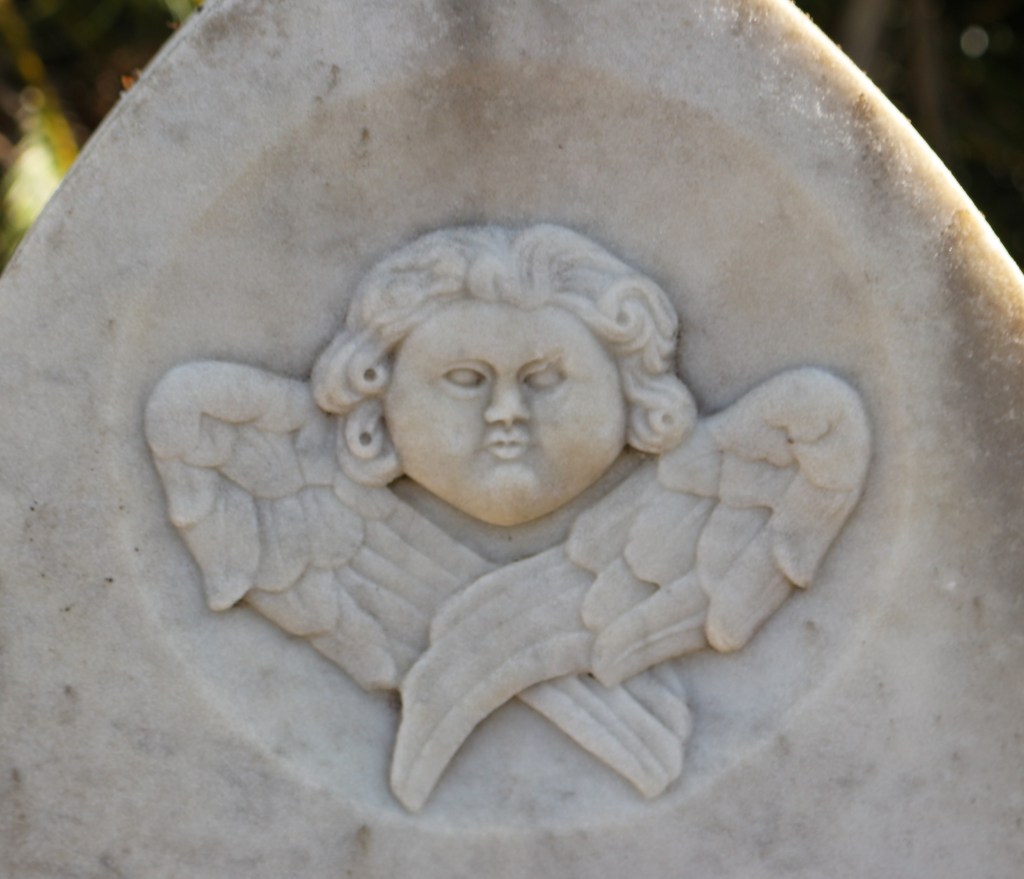
The winged cherub displayed in the arch of the gravestone was a symbol that became popular in the 18th Century.  Winged cherubs replaced the stark and morbid flying death’s heads from our Puritan forefathers.  The cherubs have a childlike countenance of innocence.  The iconography represents the flight of the soul from the body upward to Heaven and the hope of the resurrection. Surely, the cherub also represents the Hughes boys—one an infant and the other only 3 years old.

Posted in Uncategorized | 2 Comments

In Memory of a Son

SACRED TO THE MEMORY
OF MY SON
ALBERT HUBBELL WRIGHT
BORN JUNE 28, 1856
DIED AUG. 11, 1875

NEARER MY GOD TO THEE

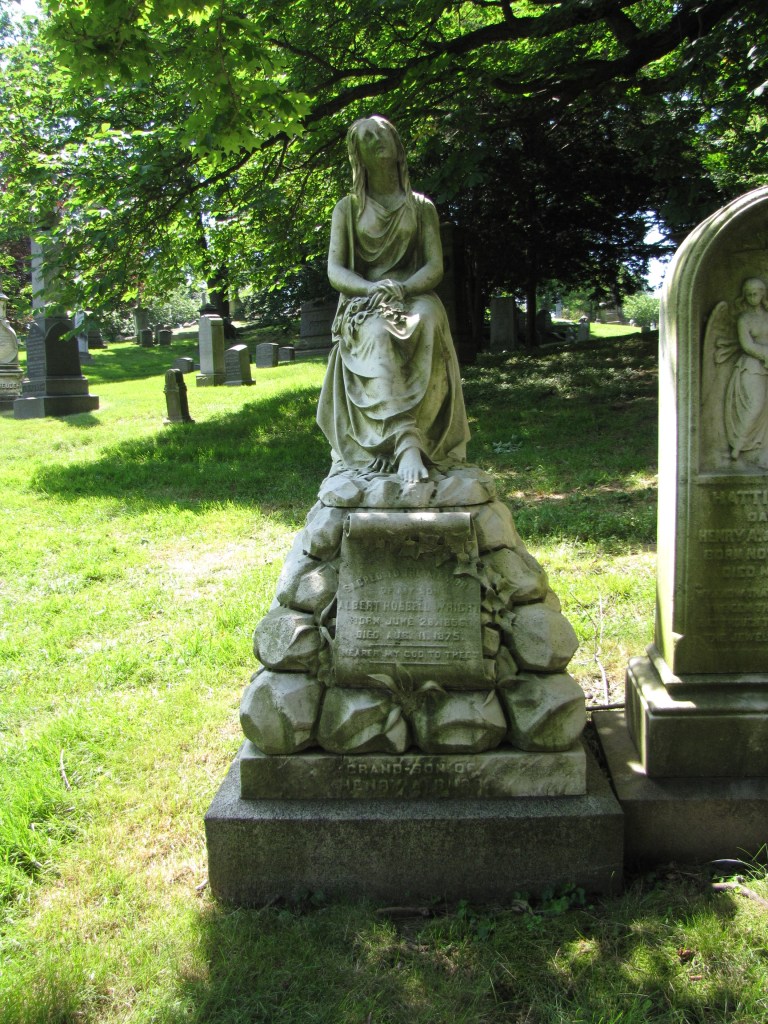
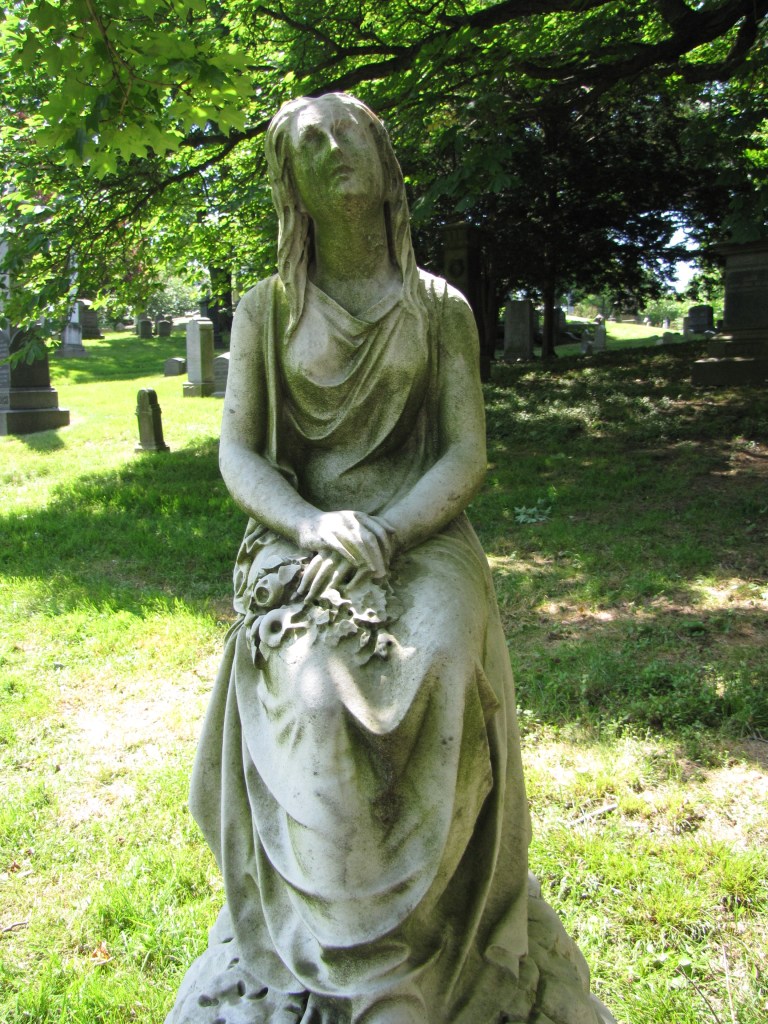
The white marble monument for Albert Wright in the Green-Wood Cemetery in New York depicts a seated mourning figure. The inscription on the scroll on the front of the gravestone gives a glimpse into the devastating loss of a mother for her son.

The epitaph, “Nearer My God To Thee”, is the title for a Christian hymn written by Sarah Flowers Adams (February 22, 1805-August 14, 1848) in 1841. The old favorite is about death and about Jacob’s stairway to Heaven. The hymn is about greeting one’s maker on the other side and is based on Genesis 28: 11—12: KJV “11 And he lighted upon a certain place, and tarried there all night, because the sun was set; and he took of the stones of that place, and put them for his pillows, and lay down in that place to sleep.12 And he dreamed, and behold a ladder set up on the earth, and the top of it reached to heaven: and behold the angels of God ascending and descending on it.”

1 Nearer, my God, to thee, nearer to thee!
E’en though it be a cross that raiseth me,
still all my song shall be,
nearer, my God, to thee;
nearer, my God, to thee, nearer to thee!

2 Though like the wanderer, the sun gone down,
darkness be over me, my rest a stone;
yet in my dreams I’d be
nearer, my God, to thee;
nearer, my God, to thee, nearer to thee!

3 There let the way appear, steps unto heaven;
all that thou sendest me, in mercy given;
angels to beckon me
nearer, my God, to thee;
nearer, my God, to thee, nearer to thee!

4 Then, with my waking thoughts bright with thy praise,
out of my stony griefs Bethel I’ll raise;
so by my woes to be
nearer, my God, to thee;
nearer, my God, to thee, nearer to thee!

5 Or if, on joyful wing cleaving the sky,
sun, moon, and stars forgot, upward I fly,

still all my song shall be,
nearer, my God, to thee;
nearer, my God, to thee, nearer to thee!

The reference to the hymn seems to be a plea presumably for the grieving mother to be reunited with her son once she climbs the ladder—a poignant wish.

The figure atop the stone is depicted gazing to the Heavens with a bouquet of flowers in her lap, possibly as an offering for the grave. The act of placing flowers is a recurring funerary motif which is designed to remind the viewer that life is short. Mourning figures are a common motif in Victorian cemeteries and found throughout the United States and Europe. This monument is a memorial to a lost son, perhaps this particular figure is not a generic mourning figure but represents the mother of the son.

Posted in Uncategorized | Leave a comment

Somebody Invented that!

JOHN HARRY STEDMAN
DIED OCTOBER 29, 1922
ALICE SHERWOOD WELLS STEDMAN
DIED OCTOBER 7, 1906

There are many objects found in our homes that we take for granted. Each one was created by an inventor. Some of these objects were created by inventors who became famous, such as Ben Franklin, who invented bifocals, swim fins, the lightning rod, and “ouch” the urinary catheter! Or Thomas Edison who held an astonishing 1,093 patents which included what has been described as his favorite invention—the phonograph. His was the first recorded voice signing “Mary Had a Little Lamb.”

But less iconic items but no less useful are items like the lowly safety pin invented in 1849 by Walter Hunt. Or Gideon Sundback’s invention in 1914 of “Hookless No. 2”, which we now refer to as the zipper.

One item that has become ubiquitous in elementary classroom art projects is the pipe cleaner also known as the chenille stem or furry wire as the name suggests, to clean out the residue and yuck in smoking pipes. The pipe cleaner was invented by John Harry Stedman and Charles Angel in Rochester, New York in the early 1900s. This simple and mundane invention made Stedman rich. He later sold his rights to the BJ Long Company which still holds the rights to the invention.

Stedman and his wife, Alice, are buried in the Mount Hope Cemetery in Rochester, New York. Their gray granite rectangular four-sided hip tomb is embellished with pectoral crosses which flank the inscription.

Posted in Uncategorized | 2 Comments

Old-World Craftmanship

According to the experts at the Phillipsburg Memorial Company in Phillipsburg, New Jersey, there are several modern techniques for carving letters and designs on tombstones, including the following techniques which are both machine made:

“Sandblasting … involves using compressed air to forcefully propel sand or other abrasive materials onto the surface of the stone. The impact of the particles erodes the stone, creating a deep and lasting engraving. Sandblasting offers a wide range of design options, allowing for intricate details and beautiful texturing. This technique is versatile and can be used on various types of stones….

“Laser Engraving … has become increasingly popular due to its precision and efficiency. This technique utilizes a concentrated laser beam to etch designs onto the surface of the tombstone. The laser removes a tiny layer of the stone, resulting in a precise and clean engraving. Laser engraving allows for intricate and complex designs, including photographs and intricate patterns. … This technique offers a high level of customization and is perfect for those seeking a more contemporary and personalized memorial.”


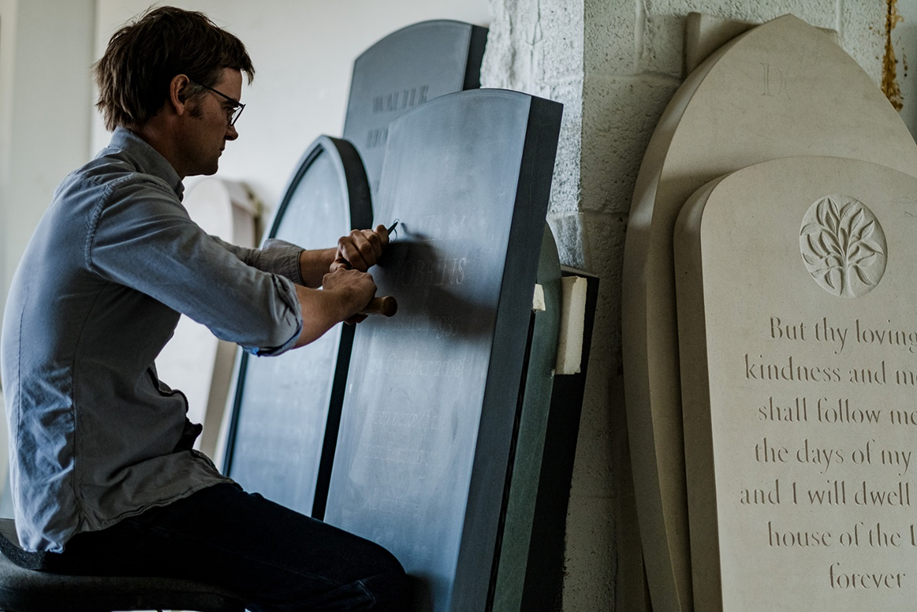
Many of the gravestones that are found in ancient cemeteries and gravestones, are however, hand carved. “Hand-carving is one of the oldest engraving techniques, dating back centuries. Skilled artisans use chisels, hammers, and other hand tools to create intricate designs and lettering on tombstones. This technique allows for incredible attention to detail and customization. Each stroke of the chisel is deliberate and precise, resulting in a truly one-of-a-kind memorial. Hand-carved tombstones exude a sense of craftsmanship and authenticity, making them a popular choice for those who value tradition and want a timeless tribute.”


However, fewer and fewer artisans are employed in this type of work. Fergus Wessel, who has a shop in Oxfordshire, England, is one of them. Fergus is an old-world artisan toiling away in his workshop, creating one-of-a-kind gravestones for those who want unique hand-crafted memorials. The shop is a small one—Hannah, Fergus’s wife takes care of paperwork and Tom Wiggins is a master letter carver. Together the three of them work with their clients to create one-of-a-kind memorials.

Fergus and his team know that after a loved one passes, “it is easy to feel under pressure to commission a headstone swiftly – a pressure that can sometimes be inadvertently compounded by family members. And this pressure can grow into guilt that the grave still has no marker, that you are somehow ‘letting down’ or failing the deceased.”


“However,” the team cautions, “it is really important not to impose an arbitrary time scale on yourself … taking your time is not only completely understandable but vital.”


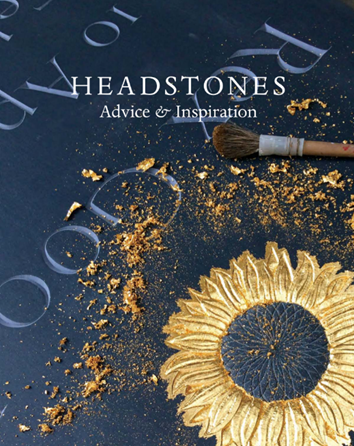
Fergus has written a book filled with timely advice about commissioning a headstone titled HEADSTONES: Advice & Inspiration. The book—filled with samples of epitaphs, pictures of gravestones carved at their shop, and descriptions of stone types—is a primer with caring advice on how to make decisions about commissioning a monument. HEADSTONES: Advice & Inspiration reflects how important it can be to simply wait, think and consider.

The book is a wonderful resource for anyone seeking advice on choosing a headstone, the idea for this book came about after Hannah’s mother died from cancer two years ago. Offering advice and inspiration on choosing a headstone, with over 150 photographs, client stories, and ideas for epitaphs, the book is an invaluable resource for anyone wanting to create a perfect memorial for their loved one. If you are interested, hard or PDF copies can be ordered at stoneletters.com/book .

While this may seem like naked commercialism to suggest a book on my blog, I want you to know that with every book purchased, all profits from the book sales are donated to Maggies. Built in the grounds of NHS cancer hospitals, Maggie’s Centres are uplifting places with professional staff on hand to offer the support people need: practical advice about benefits and eating well; emotional support from qualified experts; a friendly place to meet other people; a calming space simply to sit quietly with a cup of tea. 100% of profits from the sale of this book will be donated to Maggie’s. For more information about Maggie’s visit maggiescentres.org. The idea for this book came about after the death of Hannah’s mother from cancer and it is being sold to raise funds for Maggie’s, Oxford.

Posted in Uncategorized | 3 Comments

And I hold

ET TENEO ET TENEOR
G. A. F.
OUR SON AND BROTHER

On the large gray granite family stone behind the white marble round top column, G.A.F. is listed:

George Albert French
1841 – 1864

The column dedicated to George Albert French has two main symbols dominating the marker—the ivy tied with a bow into a wreath and, in the middle of the wreath, a hand holding a Latin cross. Both symbols, like many symbols found in cemeteries, have several different meanings.

Ivy leaves are a common motif in American cemeteries and Victorian art. Because of ivy’s ability to survive in harsh weather and dry conditions, it has become associated with immortality and rebirth. Ivy leaves twinning up a gravestone can also represent friendship. Because of its ability to “hang on” the symbol has come to represent undying attachment.

The hand holding the cross is a obvious symbol of a person’s Christian faith. It can also represent the hope for eternal life.

Lastly the Latin epitaph, ET TENEO ET TENEOR, translates in English to “And I hold and I hold”. “I hold” is repeated twice for emphasis and conveys hanging on or not giving up–determination.

Posted in Uncategorized | Leave a comment

Best of the Boneyard 5


Gravely Speaking and Syngrammata have decided to dig deep into our photo collections in order to bring you pairs of images drawn from our many years combing through American cemeteries. Each pair will be linked by a theme which we are free to interpret. Suggestions of future themes to follow are welcome in the comments! This week’s theme is humor.


Gravelyspeaking writes:

Nothing is as final as death. The quote, “Dead men tell no lies” reminds us of the silence of the grave. However, the dead can speak one last time in wills, diaries, letters, and epitaphs. Though many epitaphs are chosen for the person after he or she has passed away, some people do choose their own. Mel Blanc’s epitaph signs off with his signature Porky Pig closing at the end of the Looney Tunes cartoon, “That’s All Folks!” One wonders if Mr. Blanc was also making a larger statement on the afterlife.

In the case of Barry Becher, the advertising guru who pioneered late-night infomercials hawking Ginsu Knives who just recently died, his family has announced that his epitaph will read, “But wait, there’s more!” This is his famous catch phrase that has been mimicked by nearly every infomercial now. Again, this epitaph could be read as a double entendre referring to the hereafter.

Amaryllis Jones, who is buried in the Forest Lawn Cemetery in Buffalo, New York, also had the last word. Her epitaph reads, “I told you I was sick.” No mistaking that message; she wanted to remind those who she left behind that she was not complaining, this was not the typical ailment, that she was RIGHT, she was sick! Or, she had a good sense of humor.

Syngrammata writes:

In Riverside Cemetery in Norristown, Pennsylvania, Stephen C. Arena has built a notable monument for himself, embedding an architectural fragment within a newly carved granite framework. The architectural fragment is the keystone of an arch in the form of a lion’s head. One imagines Mr. Arena rescued or collected it in the Robert Moses era when older American buildings were being torn down for the sake of beltways and modernization. Ours is a fierce lion, threatening us with a wide-mouthed snarl.
The modern framework for the old lion’s head is worth paying attention to. The pillars are decorated streamlined fluting, and above all rests a pediment like an ancient temple. As I read the monument, it is a classical setting, an “arena,” if you will, which features a lion as a part of the entertainment. Which made me laugh out loud when I first saw it!

Posted in Uncategorized | 3 Comments

Election Day

SUSAN B. ANTHONY
February 15, 1820
March 13, 1906

There is an unassuming gravestone in the Mount Hope Cemetery in Rochester, New York—the unadorned rounded-top white marble marker for Susan B. Anthony.

On Election Day, as a tribute to Anthony’s efforts to secure voting rights for women, voters trek to her grave to place their “I VOTED” stickers on her gravestone. Even though women could not legally vote, Anthony actually did in 1872. She was arrested for that act of defiance, but it did not dampen her mission of gaining suffrage for women. Anthony devoted her energy and her life to it. Unfortunately, she died fourteen years before the 19th Amendment granted women the right to vote in 1920. However, she is still recognized and remembered for that fight.

I wonder what she’d think of this election?

The cemetery officials post signs asking visitors to her grave to not place the stickers on her grave, though, some years her entire marker has been covered with them anyway. Now some paste their stickers on the post close to her grave.

Posted in Uncategorized | 3 Comments