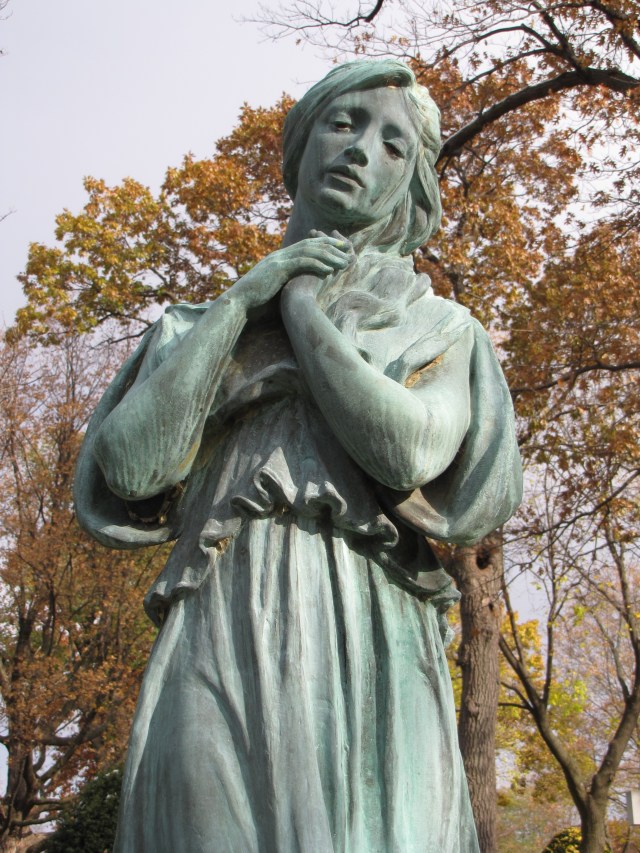
Sculptress

IMG_8011

Nellie Verne Walker (December 8, 1874 Red Oak, Iowa – July 10, 1973 Colorado Springs, Colorado) stood a whopping 4 foot 8 inches tall. The diminutive woman was not the image one thinks of when conjuring up a sculptor creating monumental works of art. But she climbed up and down ladders teetering on the steps, leaning in and over her creations to carve sculptures of all sizes earning her the moniker, “the woman who lives on a ladder”.

She first picked up a hammer and chisel in her father’s Moulton, Iowa, shop carving gravestones. But by age 17 she carved her first work of art—a limestone bust of President Abraham Lincoln. In a mere 24 days, she had created the bust for the Columbian Exposition being held in Chicago in 1893. Her first piece is now on display in the Moulton City Library.
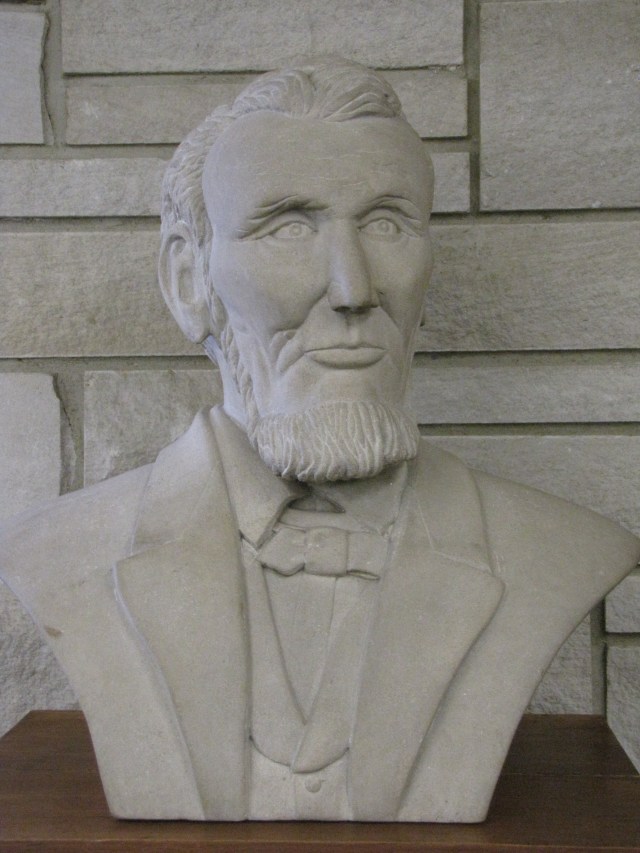
"Abraham Lincoln" at the Moulton City Library, Moulton, Iowa

“Abraham Lincoln” at the Moulton City Library, Moulton, Iowa

Nellie was determined to study art at the Chicago Art Institute and set out on that path in an unlikely place—a secretarial pool as a legal secretary. Within six years she was able to afford tuition where she studied with the famed Lorado Taft with whom she worked until his death in 1936. In fact, when he died, his Herald Square Monument in Chicago which includes statues of George Washington, Robert Morris and Haym Solomon was not completed and Nellie was one of three artists engaged to finish it.

Nellie created famous works, such as, the statue of Senator James Harlan which stands in Statuary Hall in the United States Capitol Building; the Polish War Memorial in Chicago; and Chief Keokuk in Rand Park in Keokuk, Iowa.

"Chief Keokuk" in the Keokuk City Park, Keokuk, Iowa

“Chief Keokuk” in Rand Park, Keokuk, Iowa

IMG_7892

She also returned, in a way, to her earliest work in her father’s workshop—creating cemetery monuments. But this time, she didn’t carve gravestones but instead created sculptures. Below are three examples of her cemetery commissions.

Milton T. Barlow 1844 – 1930 Forest Lawn Cemetery, Omaha, Nebraska

Milton T. Barlow 1844 – 1930 Forest Lawn Cemetery, Omaha, Nebraska

Myron Leslie Learned (1866 – 1928) and Mary Poppleton Learned (1873 – 1960) Forest Lawn Cemetery, Omaha, Nebraska

Myron Leslie Learned (1866 – 1928) and Mary Poppleton Learned (1873 – 1960) Forest Lawn Cemetery, Omaha, Nebraska

Donald Bartley McMullen (1892 – 1966) and Helen Diggins McMullen (1892 – 1918) Lakewood Cemetery, Minneapolis, Minnesota

Donald Bartley McMullen (1892 – 1966) and Helen Diggins McMullen (1892 – 1918) Lakewood Cemetery, Minneapolis, Minnesota

Nellie returned to her parent’s home in Moulton, Iowa. She attended church at the Methodist Church there, where her sculpture “Benediction” is on display.

Methodist Church, Moulton, Iowa
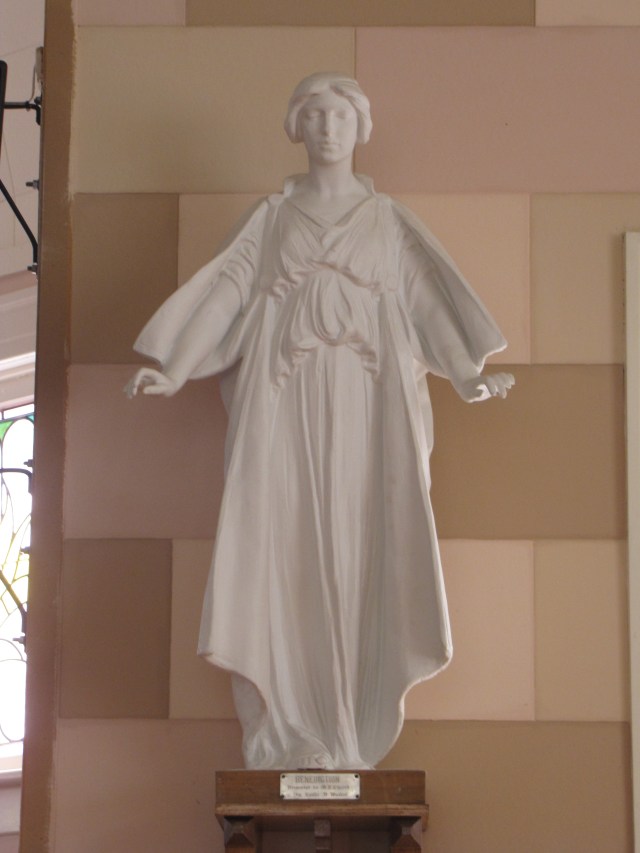
Methodist Church, Moulton, Iowa

"Benediction"

“Benediction”

A mile west of the small rural town is the Oakland Cemetery where Nellie was laid to rest beneath a plain gravestone hardly befitting an artist of her talent and status. Her tombstone bears one word that describes her and her life’s work, “Sculptress.”

Oakland Cemetery, Moulton, Iowa

Oakland Cemetery, Moulton, Iowa


Posted in Uncategorized | 1 Comment

The Celtic Cross

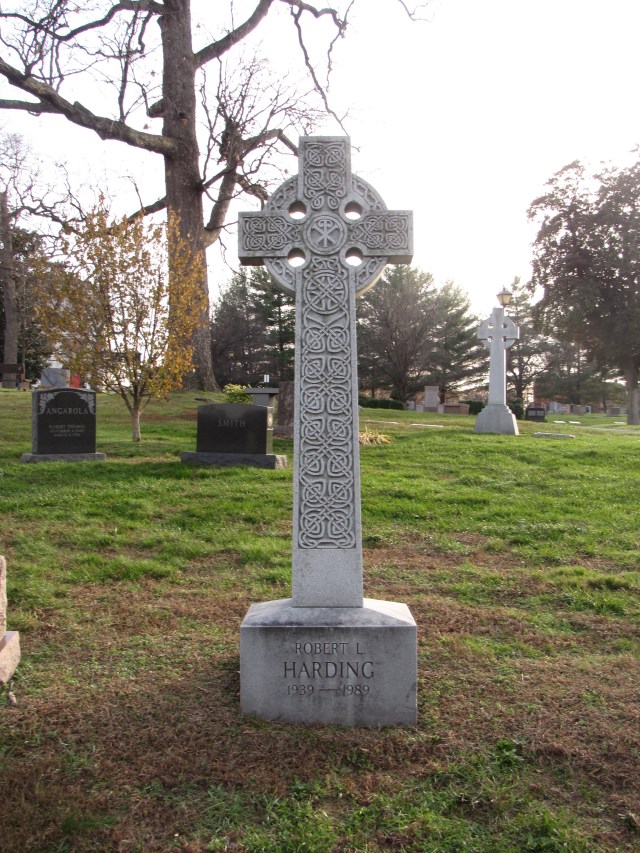
Rock Creek Cemetery, Washington, D.C.

Rock Creek Cemetery, Washington, D.C.

One of the most easily identified and plentiful crosses found in the cemetery is the Celtic cross. The Celtic cross is much like the Latin cross with a long stem and crossbeams toward the top third. But the feature that distinguishes it from other crosses is the circle that encompasses the intersection of the crossbeams. Often, but not always, the cross will also have elaborate tracery designs on the cross itself, adding to the beauty. This cross is almost always associated with a person of Irish or Scottish descent.

Rock Creek Cemetery, Washington, D.C.

Rock Creek Cemetery, Washington, D.C.

No cross is more closely associated with a people and a country as is the Celtic cross is with Ireland. The cross itself has a very long history that predates Christianity. The Celtic cross has pagan origins—some say representing the moon goddess. Others believe that the crossbeams of the cross symbolize the male while the circle represents the female. When Christianity spread throughout the Emerald Island, the Christians adopted the Celtic cross as their expression of the cross.

Rock Creek Cemetery, Washington, D.C.

Rock Creek Cemetery, Washington, D.C.

Posted in Symbolism | 2 Comments

The Rugged Cross

IMG_1843

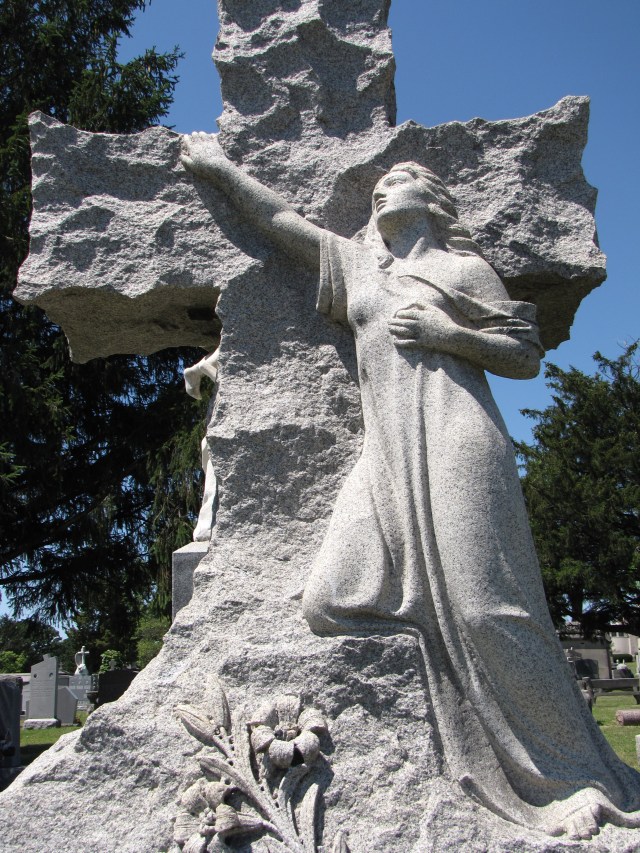
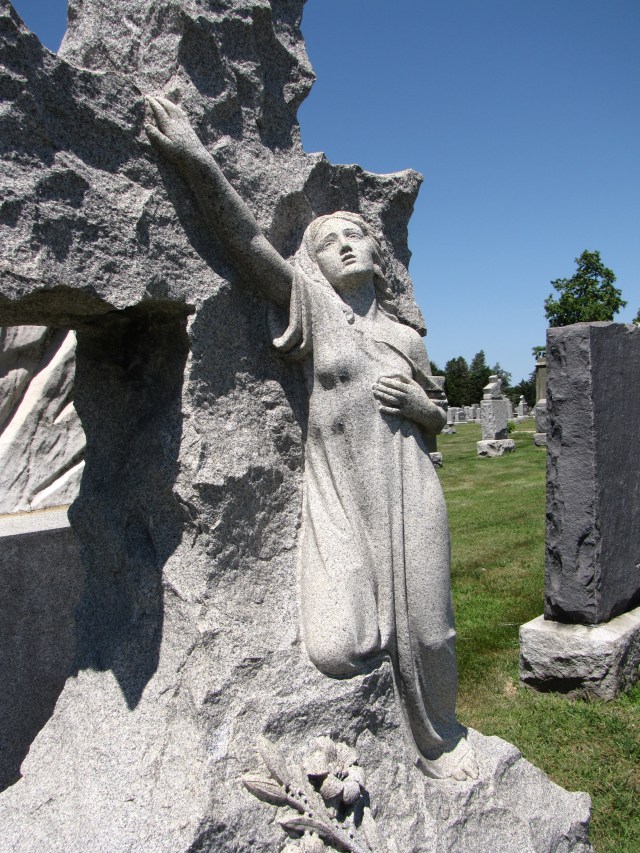
This dramatic gray granite monument erected in the Mount Carmel Cemetery at Hillsdale, Illinois, is a depiction of a line from the iconic hymn “Rock of Ages” written by Reverend Augustus Montague Toplady in 1763 and first published in 1775.  The hymn has been a popular Christian standard for over a century.

At the turn of the 19th Century, postcards depicted a dramatic scene of a woman in a flowing dress being buffeted by a storm surrounded by stormy white-crested waves clinging to a cross illustrating the first two lines of the third stanza from the hymn:

“Nothing in my hand I bring,

Simply to Thy cross I cling”

The image above is a sculpture of those two lines of the great hymn.  The woman symbolizes faith.  The raging sea (not depicted in this sculpture–the woman rests upon a rock) is a metaphor for the sea of sin in which humankind lives, and the cross is the hope to which sinners cling to be saved.

IMG_1848

Posted in Uncategorized | Leave a comment

Cross of Glass

IMG_8719

The stained and painted glass windows found in the back of many of the mausoleums in large urban city cemeteries are great works of art rarely seen by most people who walk by. Most do not peer into the windows in the doors of the mausoleums to view the windows in the back of the crypts. It feels a bit like trespassing. I do it so you don’t have to!

Stained glass is a thousand-year old art form first produced to enhance the windows of great churches and mosques. The stained glass is produced by mixing metallic salts into glass to make glass of various colors. Tiny pieces of the glass are cut and pieced together using strips of lead to create spellbinding designs. Painted glass is often added to enhance designs and add details to the figures and scenes in the windows.

This stained glass window found in a mausoleum in the Rock Creek Cemetery at Washington, D.C., depicts a woman looking toward Heaven while kneeling in front of a white cross in prayer. The portrait is surrounded by a deep blue, red, and yellow band design that frames the kneeling figure and the cross. The face and arms of the praying woman are painted glass, gently modeled to great effect. The window speaks not only to the power of prayer but to the importance of the cross as a symbol of Christianity.

Currently there is a meme being posted in social media that only begins to express the power of the cross and its deep meaning for Christians in the following acrostic:

Crowned Jesus with Glory

Reconciled us to god

Overcame the World

Shed Blood for our Sins

Saved us from His Wrath

IMG_8720

Posted in Symbolism | 1 Comment

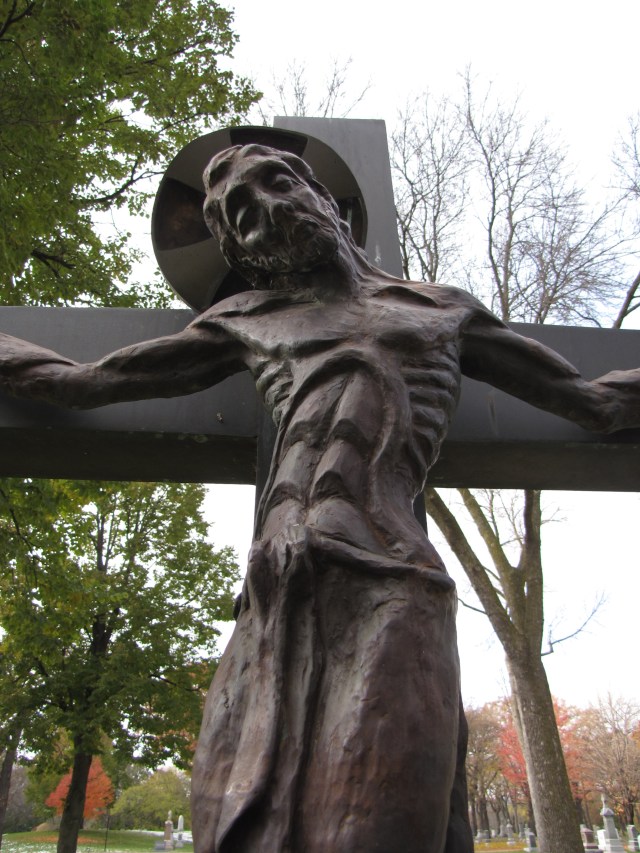
The Crucifix

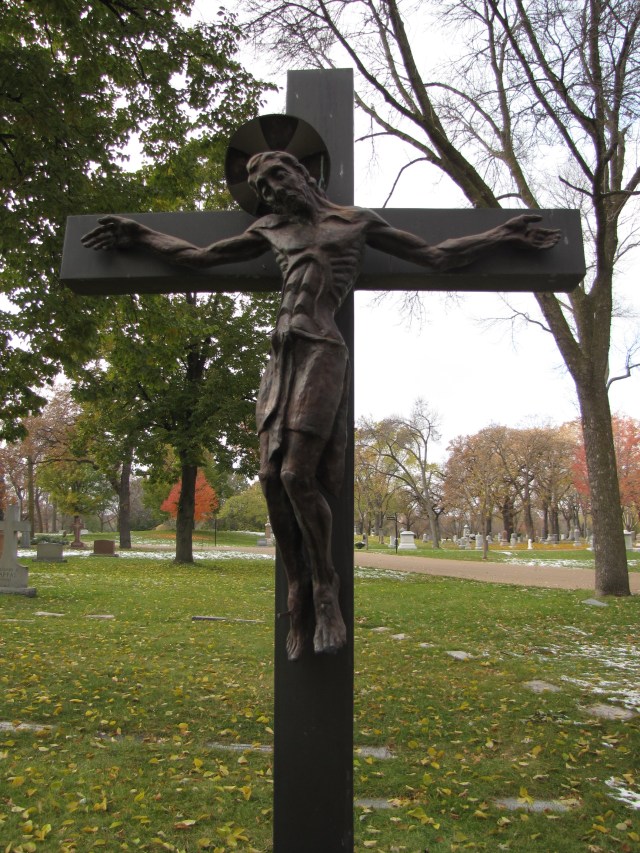
Lakeside Cemetery, Minneapolis, Minnesota

Lakeside Cemetery, Minneapolis, Minnesota

The symbol of Jesus Christ hanging on the cross is called a crucifix. This cross demonstrates the suffering of Christ. The word crucifix is from Latin and is the combination of two words—cruci and fixus—which translates to one fixed to a cross.

IMG_7896

Posted in Symbolism | Leave a comment

The Staurogram Cross

IMG_8569

HARRIET TYLER

WIFE OF

ROBERT STRETTLE JONES

FISHER

BORN WILMINGTON VERMONT

OCTOBER 21 1839

DIED

OCTOBER 16 1905

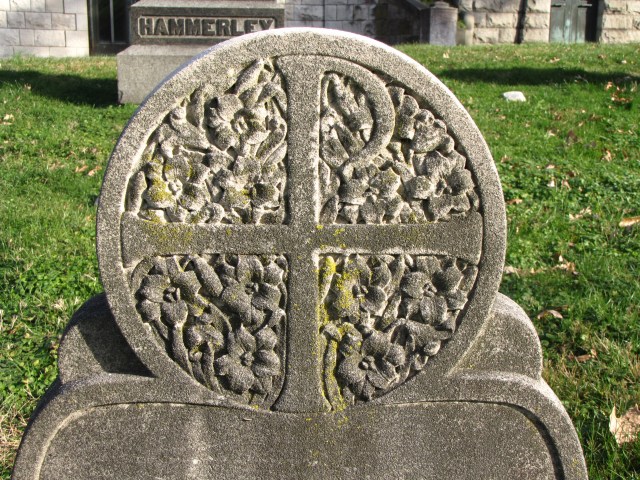
The cross surrounded by lilies at the top of this round-top gravestone in the Rock Creek Cemetery at Washington, D.C., is called a Staurogram or monogram cross. The cross is a combination of two symbols—the tau “T” and the rho “P”. The combination of symbols was a form of early Greek shorthand for the word “cross”. These two symbols were imbued with meaning—the tau referred to salvation and the rho represented Christ the Messiah.

IMG_8568

Posted in Symbolism | Leave a comment

Three Virtues

IMG_9454

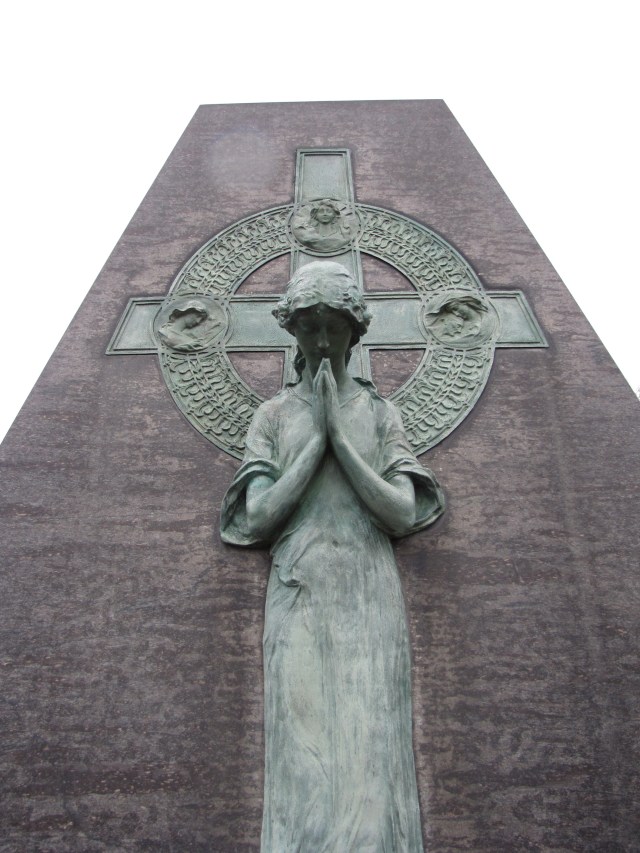
The Sanger Family monument in the Graceland Cemetery at Chicago was designed by Chicago architects George R. and Arthur R. Dean. The elegant and thin bronze mourning figure on the face of the truncated polished dark gray granite pyramid was sculpted by Leon Hermant (1866–1936), a French-American sculptor noted for his architectural sculptures throughout the Chicago area. The French Government awarded Hermant the Legion d’honneur in 1928 for his Louis Pasteur Monument in Grant Park, at Chicago.

IMG_9457

In this monument, the central feature is the female figure in a gesture of contemplative prayer leaning forward whose slender body forms the bottom portion of the Celtic cross.

IMG_9464

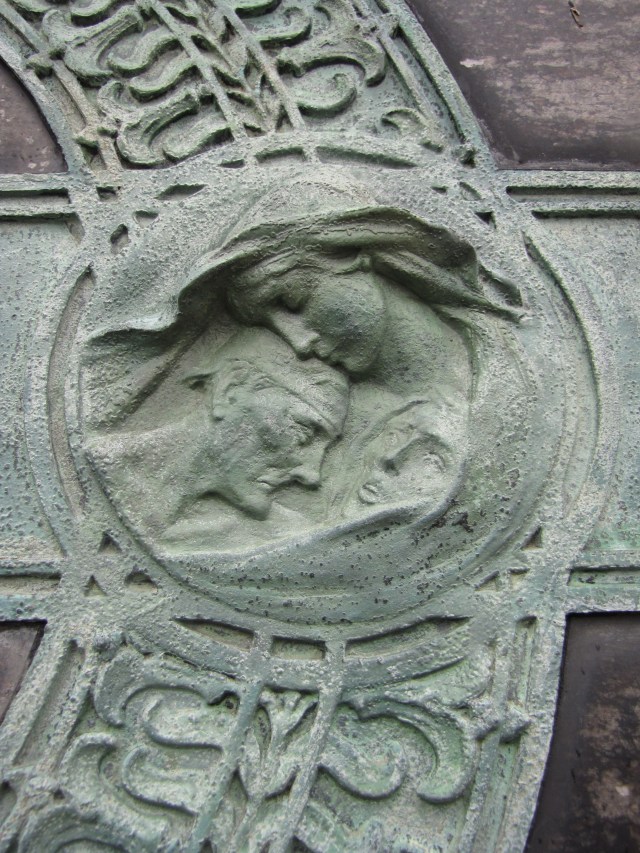
The medallions on the cross represent three virtues:

Faith

IMG_9460

Hope

IMG_9461

and Charity.

IMG_9462

Posted in Saving Graces, Symbolism | Leave a comment

Anchor Cross

img_6274[1]

SALLIE M.

Daughter of

Wm. M. & JUDITH A.

DISMUKES

Born

March 18, 1842

Died

May 10, 1864

Aged

22 Y’rs. 2 Mo’s & Days

Not dead but sleepeth.

On this plain rounded-top white marble tablet in the Springhill Cemetery at Nashville, Tennessee, the anchor cross is carved into the oval inset at the top of the gravestone. The anchor cross is an ancient Christian symbol that has been found in catacomb burials as early as the First Century and as late as the Third Century.  Romans persecuted early Christians—feeding them to the lions, forcing them battle to the death in the arenas, or burning them at the stake. The Christians who hid in the catacombs and practiced their religion in secret left messages of hope carved next to the anchor cross symbols.  In this way, the anchor was used by early Christians as a disguised cross.

Some Church historians believe that the anchor cross was adopted when Emperor Trajan had Saint Clement tied to an anchor and thrown into the sea for proselytizing and converting Romans to Christianity. Others believe it was a clever way to disguise the most Christian of symbols—the cross.

Over time, the anchor served as a symbol of Christ and his anchoring influence in the lives of Christians.  Just as an anchor does not let a moored boat drift, the anchoring influence of Christ does not allow the Christian life to drift. The anchor cross is also called the Mariner’s Cross. It is viewed as a symbol of hope. It can also represent a “fresh start”.

img_6275[1]

Posted in Symbolism | Leave a comment

The Russian Cross

IMG_7938

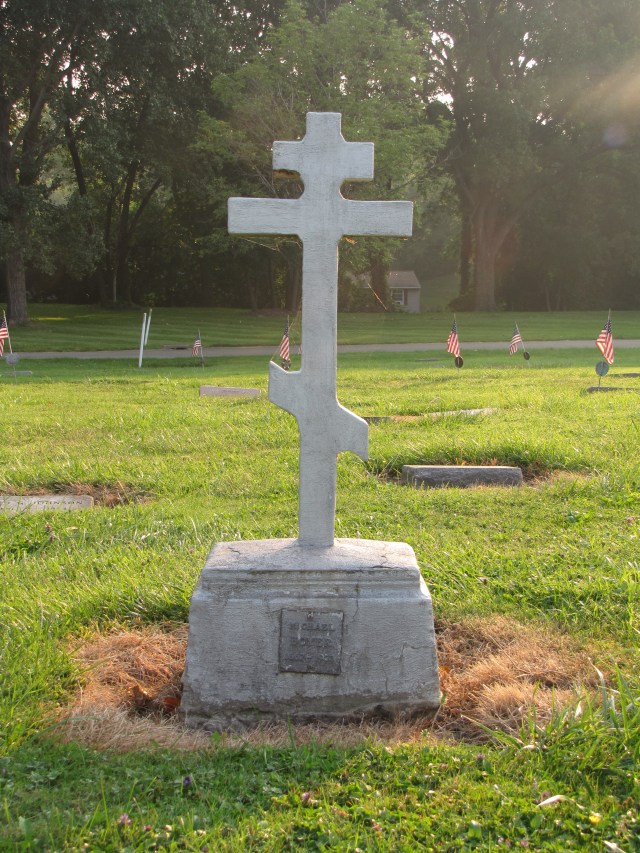
The Russian Cross, marking the grave of Michael Boyer 1867 – 1953 in the Lakeside Cemetery at Erie, Pennsylvania, is also known as the Orthodox Cross, the Byzantine Cross, and the Suppedaneum Cross. The features that distinguish the Russian Cross from the Latin Cross are that it has three horizontal crossbeams instead of one.

The top crossbeam originated from the Greek tradition that says that Pontius Pilate nailed it to the top of the cross above Jesus Christ’s head with the message, “King of the Jews.”

Jesus was nailed to the second crossbeam.

The third crossbeam which is pitched upward to the right by tradition is where those hanging on a cross would have rested their feet. In this representation of the cross, however, the crossbeam rises to the right. There are two competing theories about why that is. One theory suggests that it points upward toward Heaven, while the left side points downward toward Hell. Most believe that the footrest points to the right to where St. Dismas, the thief hanging next to Christ was, who confessed and asked for forgiveness. On the left side was the unrepentant Gestas.

Posted in Symbolism | 2 Comments

The Cross and the Crown

IMG_8065

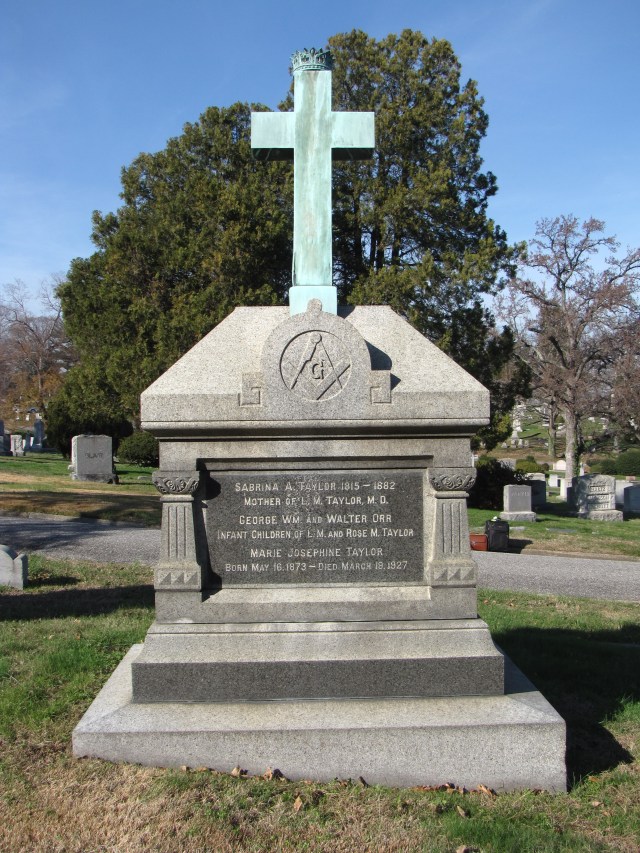
SABRINA A. TAYLOR 1815 – 1882

MOTHER OF L.M. TAYLOR, M.D.

GEORGE WM. AND WALTER ORR

INFANT CHILDREN OF L.M. AND ROSE M. TAYLOR

MARIE JOSEPHINE TAYLOR

BORN MAY 16, 1873 – DIED MARCH 19, 1927

IMG_8066
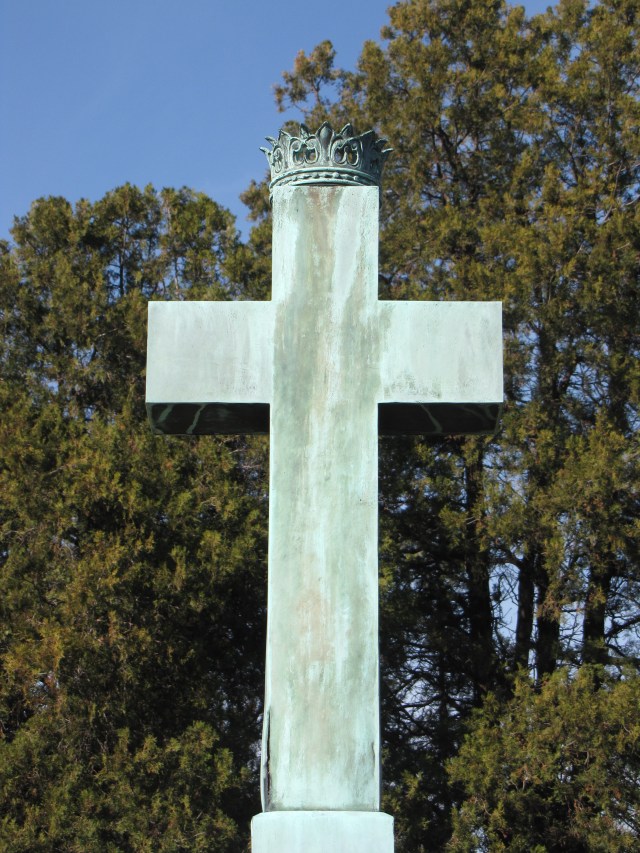
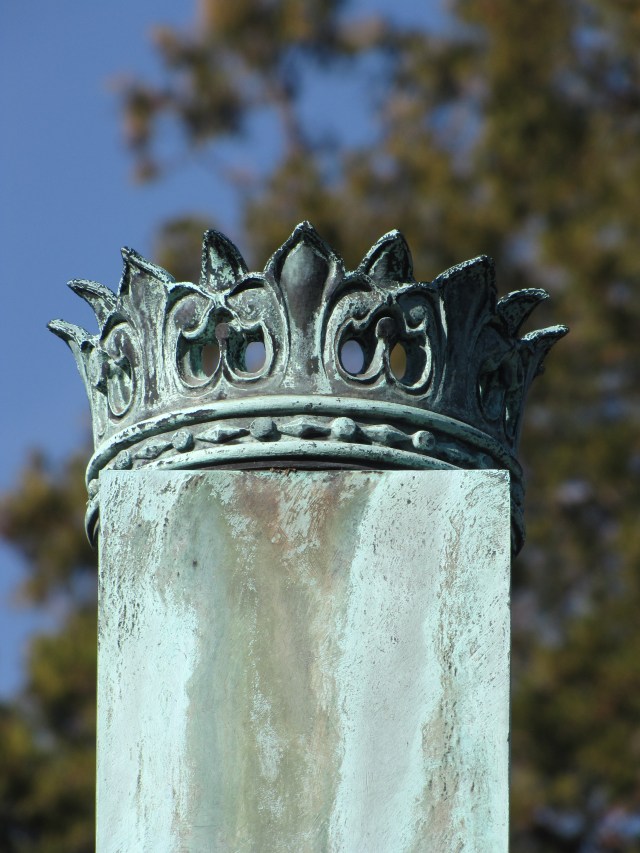
A cross with a crown sitting on top of it tops the large gray granite Taylor Family monument in the Rock Creek Churchyard Cemetery at Washington, D. C. The crown is a symbol of glory and victory over death.  The reward awaits in Heaven where the victor will receive a crown of victory. The cross represents the suffering of Jesus.

IMG_8064

Posted in Symbolism | Leave a comment