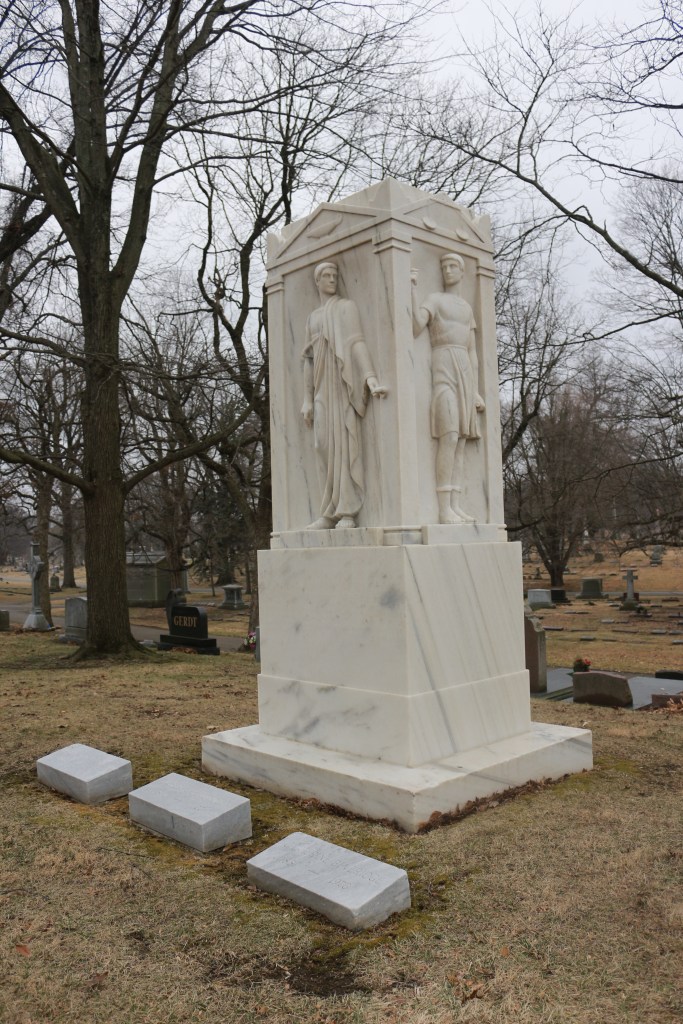
Peace and Harmony

HENRY KAU

OCTOBER 18, 1863 – AUGUST 7, 1943

KATHERINA KAU

BORN OHIO, ILLINOIS

JUNE 15, 1867 – DECEMBER 6, 1933

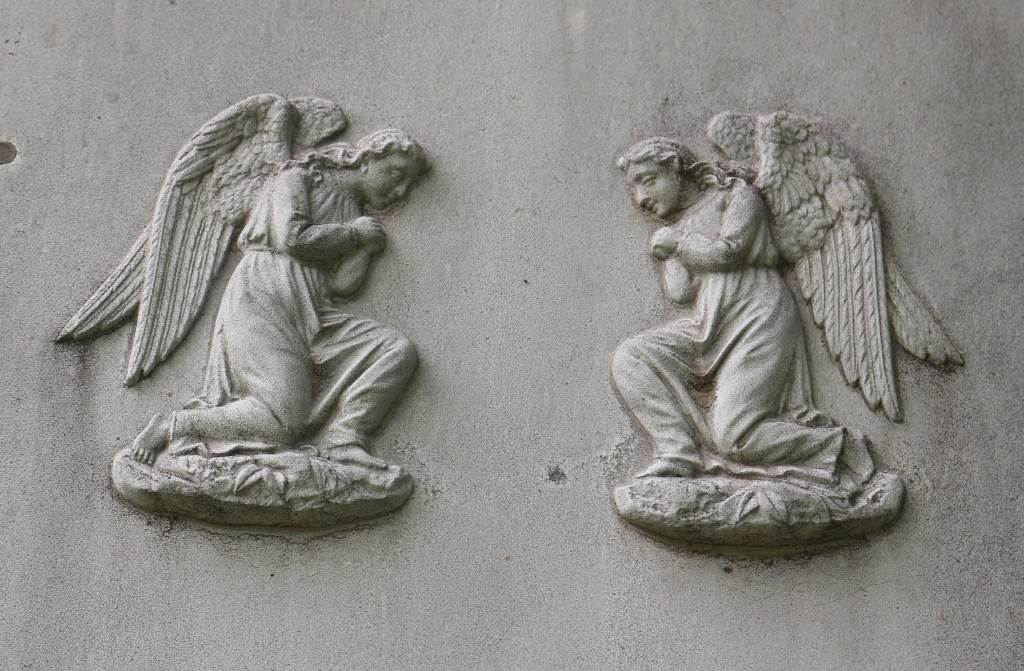
Elisabeth L. Roark wrote an article about angels titled, “Embodying Immortality: Angels in America’s Rural Garden Cemeteries, 1850—1900”, pages 56 – 111, 2007 edition of Markers, XXIV, in which she wrote that in the second half of the 19th Century. there was an “invasion” of angels in rural garden cemeteries, which were for the most part Protestant graveyards. Roark explains in the article that Protestants accepted the concept of angels because they not only expressed a message of consolation but were also utilitarian—these angels performed tasks.

According the article, angels come onto the scene in rural garden cemeteries in a big way starting in 1850 and then throughout the rest of the century. Though angels come in many variations and forms, in her study of 14 rural cemeteries from each region of America, Roark found that the majority of angels fall into the following eight categories:

Soul-bearing Angels

Praying Angels

Angels who decorate and watch over the grave

Pointing angels

Recording angels

Trumpet angels

Michael the archangel

Child angels

    In this example, in the Rose Hill Cemetery in Chicago, Illinois, the Kau monument depicts a classically dressed soul-bearing angel standing in front of a seated woman.  The angel, a messenger of God, in a comforting moment touches the woman’s shoulder while offering her an olive sprig.  This seems to be the moment just before the angel and the woman ascend to Heaven. Here the olive branch likely symbolizes that the soul of the soon-to-be departed woman will leave in peace with God.  The olive sprig can also represent a desire for peace and harmony for the loved ones who are left behind.

    Posted in Uncategorized | Leave a comment

    Bring Your Work Gloves!

    Saturday August 30th from 10am – 2pm is the next headstone restoration work date at Rose Hill Cemetery in Bloomington, Indiana.

    Come help wash and re-set gravestones.  Stay as long as you can and help out.  As you all know, volunteers play a vital role in the maintenance of our local cemetery.  Bring some work gloves and join in!

    If you don’t live in Bloomington, volunteer in your own local cemetery.  If it doesn’t have a volunteer group—start one! 

    Posted in Uncategorized | Leave a comment

    A Call for Servant Leadership

    Michael “Mike” Benedum

    Born: July 16, 1869, Bridgeport, West Virginia

    Died: July 30, 1959, Pittsburgh, Pennsylvania

    Sarah Nancy Lantz Benedum

    Born: September 22, 1872, Blacksville, West Virginia

    Died: August 11, 1951 Pittsburgh, Pennsylvania

    Lieutenant Claude Worthington Benedum

    Born January 13, 1898, Cameron, West Virginia

    Died October 17, 1918, Washington, DC

    The rounded arched stained-glass window in the back of the Renaissance Palazzo-style Benedum Family mausoleum at the Homewood Cemetery in Pittsburgh, Pennsylvania, likely depicts St. Michael, as he is shown wearing a sword.  Like much symbolism found in cemeteries, however, this could have a more personal meaning.  The Benedum’s only son was serving in Washington DC as a chemical warfare specialist when he contracted the influenza and died. This scene could possibly depict Lieutenant Claude Benedum, the Benedum’s only child, as a soldier being lifted to Heaven by the two winged angels flanking the figure. 

    But the message on the bottom of the window, partly obscured, quotes the Biblical passage Mark 10:45: “For even the Son of man came not to be ministered unto, but to minister, and to give his life a ransom for many.” This passage calls on Christians to live lives dedicated to service rather than be served.  Even though, Jesus was the son of God, he demonstrated servant leadership and called on others to do the same with humility and selflessness.

    Posted in Uncategorized | Leave a comment

    Volunteer!

    Cemeteries, large and small, urban and rural, often need volunteers to help maintain them.  That help can range anywhere from volunteers planting flowers in cradle gravestones, washing grave markers, resetting gravestones, mending fences, trimming trees, and even lawn care. 

    For instance, every year for the past several a group of volunteers led by Jaclyn and Scott have dedicated 5 or 6 Saturday mornings during the summer months to wash and reset fallen and broken gravestones.  Jaclyn is a grant writer who solicits different groups for funding to buy the materials needed for gravestone repair and reconstruction.  Scott, the onsite limestone cutter and specialist purchases the gravel, prepares limestone bases, and other materials needed for the proposed projects.  On any given Saturday morning, Jaclyn and Scott direct the volunteers to various sections in Rose Hill Cemetery to clear debris, wash gravestones, and reset them.

    In addition to grant money, sometimes volunteers also help raise money for costly projects that cemeteries don’t have the budget to complete.  In Bloomington, Indiana, for instance, a group of actors dress in period costumes to play Bloomington residents who passed away and were buried in the Rose Hill Cemetery.  As they stand next to the gravestone, they retell the dramatic stories of the lives of people within the cemetery walls.  Of course, this takes place in October with all proceeds going to projects for the cemetery!

    Volunteers can play a vital role in the maintenance of local cemeteries.  Support your local cemetery and volunteer today!  If your local cemetery doesn’t have a volunteer group—start one! 

    The next Rose Hill Cemetery volunteer day in Bloomington, Indiana, is August 30th! Bring some work gloves and join in.

    Posted in Uncategorized | 2 Comments

    Open to Interpretation

    The stained-glass window in the back of the Wittmer Family Mausoleum in the Allegheny Cemetery in Pittsburgh is a montage of symbolism.  Like many such displays the meaning of the symbolism is not always straight forward—that is, it is subject to interpretation.  The window could be a bucolic landscape with the dove gently descending on the Earth bringing peace.  Or it could be a scene imbued with meaning, with each element adding to the interpretation.

    At the top of the window is a dove.  It is surrounded by a halo suggesting it is holy. There are several references in the Bible that refer to the dove as a symbol of the Holy Spirit. Matthew 3:16 reads, “And Jesus, when he was baptized, went up straightway out of the water: and, lo, the heavens were opened unto him, and he saw the Spirit of God descending like a dove, and lighting upon him.” In Mark 1:10 the Bible says, “And Straightway coming up out of the water, he saw the heavens opened, and the Spirit like a dove descending upon him.” Again in John 1:32, the Bible reads, “And John bare record, saying, I saw the Spirit descending from heaven like a dove, and it abode upon him.” 

    However, the dove is also closely associated with peace, often depicted with a sprig of an olive in its beak, as is the case here. This, too, originated in the Bible. After the waters receded in the story of Noah, the dove appears. Genesis 8:11, “And the dove came in to him in the evening; and, lo, in her mouth was an olive leaf pluckt off; so Noah knew that the waters were abated from off the earth.”  It was viewed as a sign of God’s forgiveness. 

    The landscape has a river running through it.  In Greek mythology, the River Styx wrapped its way around Hades (the Underworld) nine times.  To cross from this life to the next, the dead had to pay with a coin to be ferried from the realm of the living to the realm of the dead.  The toll was placed in the mouth of the deceased to pay Charon, the ferryman.  It was said that if the dead person did not have the coin, he was destined to wander the shores of the River Styx for a century.  The “boat” was one of the images found on Victorian graves to represent the crossing from one world to the next.  Leaving a coin on a gravestone, then, becomes a way to pay the ferryman and saving the spirit of the dead from the fate of wandering in the depths for a hundred years.

    In the foreground of the scene are two plants—cattails tulips.  Cattails are found in marshes and at the pond’s edge.  The cattail is a plain plant, a common plant that flourishes next to the water.  In Christianity, the great prophet—the infant Moses—was found floating in a tiny basket woven of bulrushes and among the cattails.  Cattails, therefore, became connected to a place of Salvation.  And because cattails only thrive with “wet feet” faithful Christians see it as a plant that is connected to the source of living waters—the teachings of the Church.  Cattails are a metaphor for the humble servants of the Lord who live a life of humble obedience.

    In Victorian times, flowers took on significance as a way to send coded messages; this was known as floriography from the Latin combining flora—“goddess of flowers”—and graphein—“writing.”  In 1878, Kate Greenaway, a popular author and illustrator, gained fame for an illustrated children’s book of verse she wrote titled Under the Window, which delighted children.  Just six short years later, Greenaway published the Language of Flowers.  Tulips have a secular meaning—a symbol of love and passion but in funerary art it most likely represents eternal life.

    Posted in Uncategorized | Leave a comment

    Resume in Stained Glass

    John Lupher Porter

    July 1, 1868, Meadville, Pennsylvania

    January 18, 1896, Oil City, Pennsylvania

    Augusta Marlin Fisher Porter

    October 2, 1868, Oil City, Pennsylvania

    July 8, 1939, Pittsburgh, Pennsylvania

    John Lupher Porter was a Pennsylvania native and except for a short stint in London, spent most of his life in his native state.  He graduated from Allegheny College.  After his marriage to Augusta Fisher, he joined his father-in-law’s business as President of the Union Storage Company.  He was successful in business and spent much of his time engaged, when not working, supporting the arts, a member of various clubs, and philanthropy.  He was a member of the Sons of the American Revolution and the Fox Chapel Country Clubs.  According to the November 1937 issue of the Sheild of Phi Kappa PSI, pages 34 – 37, “Shortly after receiving his A. B. degree from Allegheny College, Brother Porter went to work for the Miller Pipe Line Company, at Oil City, Pennsylvania….

    “[Porter] was a director of the Enlow OU Co., and of the Pittsburg Oil & Gas Co.; a director and secretary treasurer of the Hazleton Land Co.; chairman of the Bondholders’ Protective Committee, Boise & Interurban Railway Co. Ltd.; vice president and a member of the fine arts committee of the Carnegie Institute; vice chairman of the board of trustees and chairman of the trustees’ committee of Carnegie Institute of Technology, serving in the latter capacities for a period of sixteen years.  

    “In civil life his activities were many and varied. Perhaps he was best known in Pittsburgh as the founder and moving spirit of the “One Hundred Friends of Pittsburgh Art”, an organization he established in 1916 to encourage Pittsburgh artists by buying outstanding examples of their work at their annual exhibition and presenting them to public schools to foster an appreciation of art among school children.

    The pointed arch stained-glass window in the back of the Porter Mausoleum at the Homewood Cemetery in Pittsburgh, Pennsylvania, displays a flower in the center, which could possibly be a mayflower and a nod to his membership in the Society of Mayflower Descendants—Mr. Porter was an avid genealogist and descended from Mayflower Pilgrim Isaac Allerton.

    The top center depicts a figure holding a chalice in one hand and a loaf of bread in the other with a ribbon behind spelling CHARITY indicating his participation in many of Pittsburgh’s charities. The bottom of the window depicts an actor, a musician, and an artist which pay homage to Mr. Porter’s membership in the Fine Arts Committee at the Carnegie Museum and his chairmanship on the Board of Trustees of the Carnegie Institute of Technology. One of the windows depicts a building at Allegheny College, his alma mater and the other the main building at Carnegie University, both learning institutions he left large endowments.

    The pointed arch stained-glass window nearly reads like a resume for John Porter’s life.

    Posted in Uncategorized | Leave a comment

    Light of the World

    An oil lamp is the centerpiece of the stained-glass window in the Fisher Family Mausoleum in the Allegheny Cemetery in Pittsburgh, Pennsylvania. The oil lamp hangs from the ceiling and is flanked by fluted Neo-classic pilasters.  A flickering flame billowing shades of blue and gray smoke provides hues of yellow to the window.

    The oil lamp is not an uncommon symbol found in cemeteries and is recreated as bas-relief sculptures in stone, bronze sculptures, and here in stained glass.  For Christians meaning is found in many Bible verses:

    II Samuel: Chapter 22, verse 29, says, “For thou art my lamp, O LORD: and the LORD will lighten my darkness.”

    Psalms 119:105: “Thy word is a lamp unto my feet, and a light unto my path.”

    John 8:12: “Then spake Jesus again unto them, saying, I am the light of the world: he that followeth me shall not walk in darkness, but shall have the light of life.”

    The light emanating from the lamp represents the pathway to Truth and to Knowledge and also represents Christ as the Light of the World.

    Posted in Uncategorized | Leave a comment

    The Color Purple

    The long slender stained-glass window in the Allegheny Cemetery in Pittsburgh, displays a crown and cross in a purple quatrefoil. The quatrefoil in Christian symbolism represents the four evangelists—Matthew, Mark, Luke, and John—and is often found in the tracery of Gothic Churches. 

    Even the color of the glass surrounding the motif is significant.  Purple was the color that signified royal authority.  It also represents the suffering and mourning associated with the Passion of Christ. During the Passion of Christ, Roman soldiers placed a purple robe around Jesus and crowned him with thorns mocking Him. The color purple is also a reminder to Christians of Jesus’s suffering and their need to confess their sins and seek forgiveness.

    The crown is a symbol of glory and victory over death.  The reward awaits in Heaven where the victor will receive a crown of victory. The cross represents the suffering of Christ and is a universal symbol of Christianity.

    Posted in Uncategorized | Leave a comment

    PEACE

    Often the inside of a mausoleum is more impressive than the exterior displaying sculptures and stained-glass windows that are not readily accessible to be viewed. The window shown here displays a woman in white robes cradling a dove in her hands. 

    There are several references in the Bible that refer to the dove as a symbol of the Holy Spirit. Matthew 3:16 reads, “And Jesus, when he was baptized, went up straightway out of the water: and, lo, the heavens were opened unto him, and he saw the Spirit of God descending like a dove, and lighting upon him.” 

    In Mark 1:10 the Bible says, “And Straightway coming up out of the water, he saw the heavens opened, and the Spirit like a dove descending upon him.” Again in John 1:32, the Bible reads, “And John bare record, saying, I saw the Spirit descending from heaven like a dove, and it abode upon him.” 

    However, along with the dove symbolizing the Holy Spirit, the dove is also closely associated with peace, often depicted with a sprig of an olive in its beak. This, too, originated in the Bible. After the waters receded in the story of Noah, the dove appears. Genesis 8:11, “And the dove came in to him in the evening; and, lo, in her mouth was an olive leaf pluckt off; so Noah knew that the waters were abated from off the earth.”  It was viewed as a sign of God’s forgiveness.  Though the dove does not have an olive sprig in its beak in this representation, the ribbon with “PEACE” emblazoned at the bottom of the window gives away the meaning here.

    As is often the case, symbols not only have a religious meaning but often share a secular one, as well.  The mourning figure above is draped in white robes and the white dove with the color white typically associated with the virtues of purity and innocence. 

    Posted in Uncategorized | Leave a comment

    Artwork and Ashes

    Here Lies

    PEGGY GUGGENHEIM

    1898 – 1979

    HERE LIE MY BELOVED BABIES

    CAPPUCINO 1949 – 1953

    PEGEEN 1951 – 1953

    PEACOCK 1952 – 1953

    TORO 1954 – 1957

    FOGLIA 1956 – 1958

    MADAM BUTTERFLY 1954 – 1958

    BABY 1949 – 1959

    EMILY 1945 – 1960

    WHITE ANGEL 1945 – 1960

    SIR HERBERT 1952 – 1965

    SABLE 1958 – 1973

    GYPSY 1961 – 1975

    HONG KONG 1964 – 1978

    CELLIDA 1964 – 1979

    Marguerite Guggenheim, known as Peggy, was born into great wealth in New York City, the middle daughter of Benjamin Guggenheim and Florette Silegman Guggenheim.  The Guggenheim family made their fortune mining and smelting metals.  The Silegman’s were bankers.  Peggy’s father, Benjamin, was tragically lost on the Titanic.

    Peggy married Laurence Vail and had two children—Sinbad and Pegeen.  The marriage ended in divorce and she married again to Max Ernst.  This marriage also ended in divorce.

    Peggy was the quintessential collector of modern art and opened a series of art galleries in her lifetime—in Paris, New York, and the last of which was in her home, the Palazzo Venier dei Leoni, located on Venice’s Grand Canal. 

    She made her collection her life’s work.  She wrote of herself, “I am not a collector, I am a museum.” And during her life, she was indeed a museum, opening her home to visitors three days a week to share her impressive collection of modern artworks by artists such as Max Ernst, Picasso, Alexander Calder, Vasily Kandinsky, and Jackson Pollock, among others. 

    After her death on December 23, 1979, her home became a permanent art gallery and her final resting place.  Her ashes, along with the ashes of her 14 dogs, were buried in a quiet corner of her garden at the Palazzo.

    Posted in Uncategorized | Leave a comment