Tombstones and Gravestones…Take 3…Clay

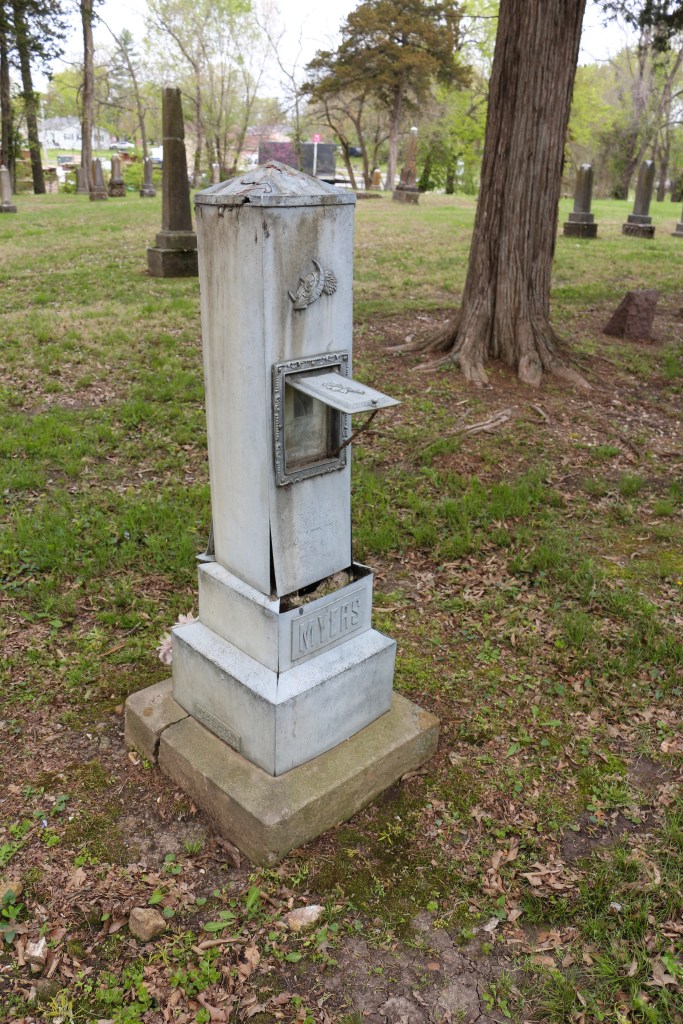
The last few posts have concentrated on grave markers made of material other than stone.  Often the material is whatever is at hand when marble, granite, or slate, aren’t’ or is too expensive for some of the families burying their dead.  In this case, in the small town of Uhrichsville, Ohio, many grave markers made of sculpted clay dot the city’s Union Cemetery.  These markers are more folk art than grave marker and are artistic creations by artisans living and working with the native clay.

As it turns out, Uhrichsville has had a tile company, the Superior Clay Company, which has produced fine terra cotta and fired clay items for over a century.  For more than four generations the workers at the factory have and still turn out clay chimney pots, firebricks, and other terra cotta decoratives.  As the story goes, a talented and enterprising craftsperson in the tile company began fashioning markers out of the clay, most likely for relatives or friends, at least at first.  These unique fired clay markers were sculpted in the rustic tradition–to look like tree stumps. 

Tree stump gravestones were a part of the rustic movement of the mid-nineteenth century which was characterized by designs that were made to look like they were from the country. The rustic movement complemented the rural cemetery movement which began in the United States in 1831 with the opening of Mt. Auburn Cemetery in Cambridge, Massachusetts. The rural cemeteries were often located on the outskirts of town and laid out as a park would be—with broad avenues and winding pathways, featuring picturesque landscaping such as ponds, abundant trees, and shrubs. The tree-stump tombstones were a funerary art contrivance mimicking the natural surroundings of the cemetery. The tree-stump tombstones were most popular for a twenty year-period from about 1885 until about 1905.

In funerary art, tombstones took on the look of tree stumps. The gravestones were purposefully designed to look like trees that had been cut and left in the cemetery to mark a grave. Most of these tree-stump tombstones were carved from limestone, which is easier to carve, though some are made from marble and even a few from granite. But in Uhrichsville they were created from native clay.  The creativity of the craftsmen creating the tree-stump markers exist in many designs, each one separate and distinct.

For the most part, the clay markers are hollow and open often with sprigs of saplings growing from the tops!  Just as in traditional markers, the clay markers were created with diversity of design and tailored to the individual tastes and interests of the deceased as the example below that displays the emblem of the Knights of Pythias. 

Posted in Uncategorized | Leave a comment

Tombstones and Gravestones…Take 2…Zinc

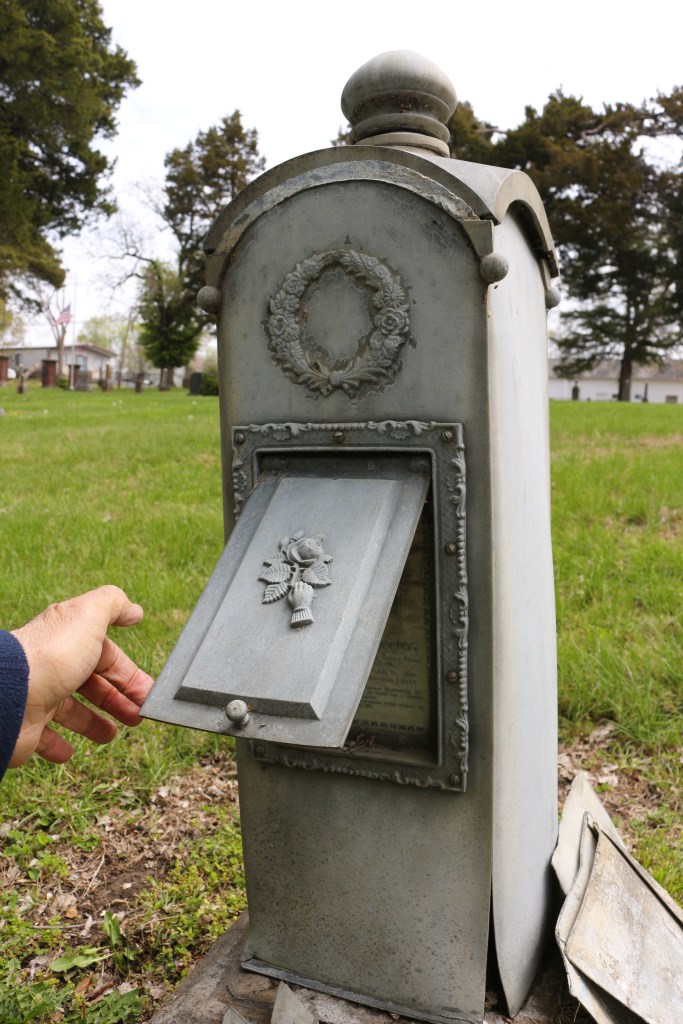
As stated in the previous post, “Tombstone” and “gravestone” are words that are used interchangeably to describe all grave markers, no matter what they are made of.  And, in fact, gravestones or rather grave markers are made of many kinds of materials, including zinc. 

Zinc markers, often referred to as “Zincies” by cemetery aficionados, were produced and sold by the Monumental Bronze Company of Bridgeport, Connecticut.  Though the company billed the markers as “white bronze” they were cast zinc.  The markers are distinguishable by their bluish-gray tint. Many of the designs mimicked designs that were commonly found carved from stone.

The company set up their first subsidiary in Detroit, Michigan. Others followed in Philadelphia, New Orleans, St. Thomas, Ontario, Des Moines, and Chicago. Enterprising salesmen carried a catalog door-to-door with them to show customers the many styles and price ranges of the product line. In many cemeteries you can find evidence of highly successful salesmen who sold a large number of the markers. The zinc markers were produced beginning in the 1870s until the company closed shop in 1912.

These grave markers came in a wide assortment of sizes and shapes and were somewhat like grave marker erector sets. The more elaborate markers had a shell of sorts and then various panels could be bolted on according to the tastes of the family ordering the grave marker. In this way, each marker could be “customized” to the tastes of the individual.

Posted in Uncategorized | Leave a comment

Tombstones and Gravestones…Wood

“Tombstone” and “gravestone” are words that are used interchangeably to describe all grave markers, no matter what they are made of.  And many think of gravestones and tombstones as being made of stone, after all stone is in the name, right?  

In fact, the dusty Western town Tombstone, Arizona, was named when a prospecting miner was searching for silver.  Soldiers in the area were trying to warn him, “You keep fooling around out there amongst the Natives Americans and the only rock you’ll find will be your tombstone!”  There it was—tombstone.  The miner named his claim tombstone, and it was later adopted as the name of the town.

Ironically, in the famous Boot Hill Cemetery in historic Tombstone, Arizona, nearly every grave marker is not made of stone, but of painted wood.  Gravestones, or rather, grave markers are made of many kinds of materials other than stone including wood which was often the only material readily available and easily carved or painted even though its ephemeral quality almost guaranteed that eventually the name of the person buried underneath the wooden marker wood fade and be long forgotten to history.  For instance, Effie Maud Crippen’s marker in the Yosemite Cemetery, in the Yosemite Valley of California, is a carved wood slab that becomes more faint with each passing year.   

Effie Maud had suffered from a lingering illness and her frail body succumbed, her September 3, 1881, Mariposa Gazette death notice described her untimely passing, “The grim monster, Death holds an impartial respect for persons: blooming youth, as well as the aged, must yield to the sickle, and fall into the swath, which is to be gathered into the fold and gathered with others who have preceded, and those who are soon to follow.” 

She died and was buried the next day, followed to the grave by her family, friends, neighbors, and her classmates.  Her epitaph now faintly whispers, “She faltered by the wayside and the angels took her home.” How long before the wooden grave marker that bears witness to her life fades along with her name?

Posted in Uncategorized | Leave a comment

A Clue

George Henry Hall

Born: September 21, 1825 in Boston, Massachusetts

Died: February 13,1913 in New York, New York

Most tombstones don’t give up much information about the deceased, save the name, dates of birth and death and sometimes a fraternal association or military service.  But occasionally, if one is observant there is a hint about the person buried beneath the stone. 

In this case, the gravestone of George Henry Hall, in the Green-Wood Cemetery in Brooklyn, New York, tells us about his character with his epitaph, which is not a pedestrian epitaph chosen from a book at the gravestone seller’s business or through a catalog.  It reads, “TRUE, JUST, AND HONORABLE IN ALL RELTATIONS OF LIFE.” 

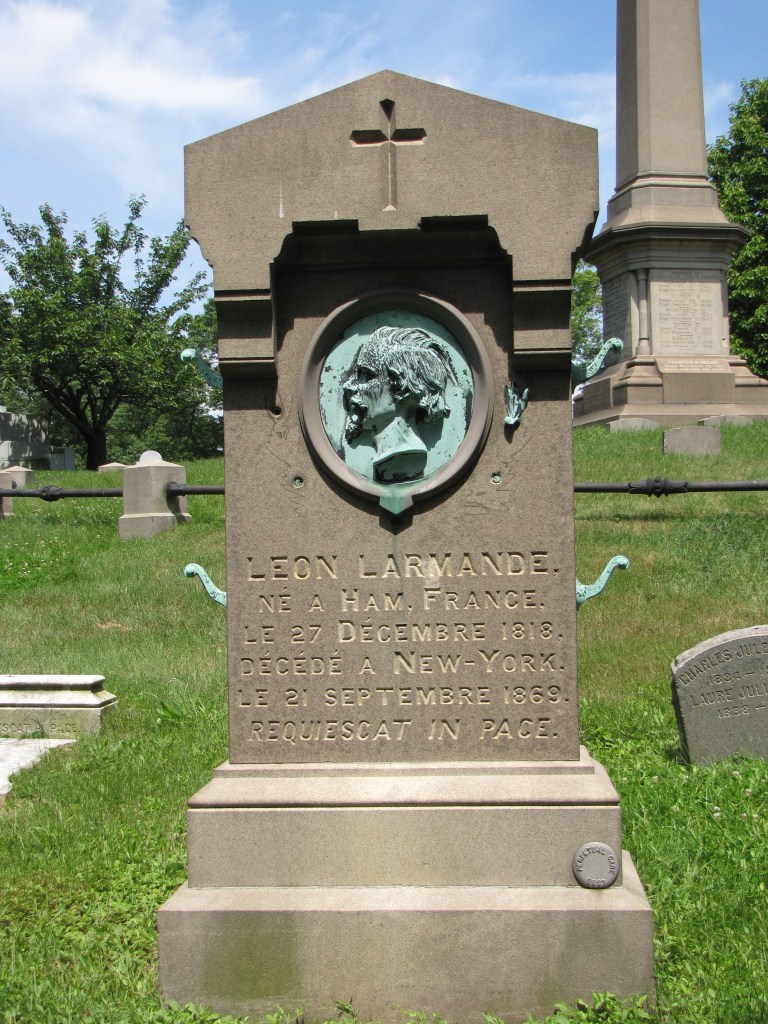
And, the bronze bas-relief on the face of the stone also gives us a clear image of what Hall looked like.  But, if you look closely at the bottom of the profile, there is a hint as to Hall’s occupation.  There below the bust carved into the bronze is an artist’s palette and paint brush.  George Henry Hall was an artist.  He was considered by many to be one of the best still-life artists of the 19th Century, a genre of paintings which were in vogue at the time.  Hall also painted landscapes, peasants, and figures.  He was well-known and a prolific artist selling more than 1,600 paintings in his lifetime, as well as prints ad sculptures.  Many of his paintings can be viewed in US and European museums.

Hall studied in Germany, Paris, Switzerland, and Rome, but did most of his painting in New York where he had a studio for many years.  While the gravestone doesn’t tell Hall’s whole story, it does give an intriguing clue that will cause some to investigate the man buried below the tombstone.

Posted in Uncategorized | Leave a comment

The Cemetery as an Open-Air Classroom

This year marks my 46th year since I started my first job in educational publishing.  In that time, I have met and worked with thousands of talented and gifted educators.  One of those teachers is MaryKim, a creative force, who used the cemetery as an open-air classroom as part of a Death: Fact and Fiction course in her St. Charles, Missouri, classroom.  In that course she used Edgar Lee Masters’s Spoon River Anthology as course material for the class.  Her school was 150 miles away from where the characters from the anthology are buried, so she would load her students up and make the trek to Lewistown and Petersburg so they could see the communities and cemeteries for themselves that had inspired Masters.

The anthology reads like a soap opera because characters come in and out of each other people’s poems and more and more connections are made among the people in the monologues. One of the main reasons MaryKim selected Spoon River Anthology as a text for the class was because it taught students how to pick out subtleties and build a sensitivity to language.  After constant practice that came with such a volume of poems, 244 in all, students would get the hang of the style, rhythm, and structure. As part of the course MaryKim would have the students mimick Masters’s style in poems of their own.    

The students especially found the sets of poems that told two or more sides to someone’s life. Two of their favorites were the poems about Elsa Wertman and Hamilton Greene:

Elsa Wertman

I was a peasant girl from Germany,

Blue-eyed, rosy, happy and strong.

And the first place I worked was at Thomas Green’s.

On a summer’s day when she was away

He stole into the kitchen and took me

Right in his arms and kissed me on the throat,

I turning my head.  Then neither of us

Seemed to know what happened.

And I cried for what would become of me.

And I cried as my secret began to show.

One day Mrs. Greene said she understood,

And would make no trouble for me,

And, being childless, would adopt it.

(He had given her a farm to be still.)

So she hid in the house and sent out rumors,

As if it were going to happen to her.

And all went well and the child was born—They were so kind to me.

Later I married Gus Wertman, and years passed.

But—at political rallies when sitters-by thought I was crying

At the eloquence of Hamilton Greene—

That was not it.

No! I wanted to say:

That’s my son! That’s my son!

Hamilton Greene

I was the only child of Frances Harris of Virginia

And Thomas Greene of Kentucky,

Of valiant and honorable blood both.

To them I owe all that I became,

Judge, member of Congress, leader in the State.

From my mother I inherited

Vivacity, fancy, language:

From my father will, judgment, logic.

All honor to them

For what service I was to the people!

According to the map and key that is available at the entrance to the Oak Hill Cemetery in Lewistown, the fictional person, Hamilton Greene, depicted in the poem was Thomas A. Boyd.  It is clear that Masters fictionalized the account.  For one, the real-life Boyd, although, he was an attorney and did serve in state government and in Congress in the House of Representatives, he was born in Pennsylvania, not Kentucky.  It is unclear how much of the rest of the account after that was fictional. Unfortunately, there is no indication of who Elsa Wertman might have been or even if she had been based on a real person who lived in the area. Her secret has been kept.

At the end of the unit, the class would have a great celebration to share the projects they created—cakes in the form of tombstones, poetic monologues in Spoon River fashion about students’ ancestors, parades of characters with props speaking to us from their graves, and once even a movie from a group of boys who visited the cemeteries and shot the film.  For many students it was a “family affair” day since so many students wrote poems about their own dead relatives.

To get the students in her classroom started on their creative journeys, MaryKim would share poems she wrote about her own parents: her mother who died from cancer she got because of a wrong prescription and one about her dad who died a few days after having gone fishing and written, of course, in Edgar Lee Masters’s style:

Vera Nylon Dotzler 

The doctors said “it was all in my head…” 

(it was my 43rd birthday) 

but I knew something was growing inside 

eating me up little by little. 

Finally the cancer showed up on an x-ray 

and I was sadly vindicated. 

Yet, how was I to give my four children 

the lifetime’s worth of mothering they would need 

with only six months left ? 

What happened to them? 

Are they happy? 

Did they marry and have children? 

So much unanswered. 

Better a long life of pain and disappointment 

than a life cut short and left unfinished 

leaving only questions. 

Mark Dotzler 

1906-1987 

I died on a Monday 

the weekend before I spent fishing 

How I loved the sight of the sun coming over the trees 

splashing down into the water. 

How I loved the dancing ripples around the line, taut with a 

nibble… 

Life was a lake to me 

with shallows and deeps, beauty and dangers, 

and always mysteries hovering just below the surface. 

Over the years 

the Fisher of Men – Death – 

had done a lot of catch and release with me. 

At the age of 81 

he decided I was a keeper… 

I was perhaps, even – 

the Catch of the Day!

Posted in Uncategorized | 2 Comments

Lincoln’s early love memorialized

In Edgar Lee Masters’s Spoon River Anthology some of the names that topped the poetic monologues were fictious and seemingly plucked out of thin air.  Some were chosen from the Illinois State Constitution and some were real people such as Hannan Armstrong, Chase Henry, and Anne Rutledge, the woman who was purported to be a love interest of a young Abraham Lincoln.  Historians disagree whether Lincoln and Rutledge were truly romantically connected. 

Anne was born near Henderson, Kentucky, January 7, 1813.  When she was a teenager, Anne moved, along with her family, to New Salem, Illinois, which was co-founded by her father.  It was there where she met the young and gangly Abraham Lincoln.  However, a wave of typhoid swept through the area and Anne succumbed.  She died August 25, 1835 and was buried in the small country Old Concord Burial Ground. 

Many years later, when a Petersburg, Illinois, undertaker took a financial interest in the Oakland Cemetery, he had Anne Rutledge’s body exhumed and moved her remains to a grave in Petersburg.  Her tombstone was replaced with a large granite monument with Edgar Lee Master’s poem about her etched on its rock face:

Out of me unworthy and unknown
The vibrations of deathless music:
“With malice toward none, with charity toward all.”
Out of me the forgiveness of millions toward millions,
And the beneficent face of a nation
Shining with justice and truth.
I am Ann Rutledge who sleeps beneath these weeds,
Beloved in life of Abraham Lincoln,
Wedded to him, not through union,
But through separation.
Bloom forever, O Republic,
From the dust of my bosom!

Posted in Uncategorized | Leave a comment

Time heals…

In 1915, Edgar Lee Masters’s book of poetry, Spoon River Anthology, was published to wide acclaim.  The book was an instant and international sensation. One reviewer wrote, “At last, America has discovered a poet!”

The book is composed of a series of free-verse poems that serve as monologues of the dead residents of a mythical cemetery in the Spoon River Valley.  The poems told of the lives of the men and women who once lived in Spoon River and were buried in their graves on The Hill.  “The weak of will, the strong of arm, the clown, the boozer, the fighter?  All, all, are sleeping on the hill.”

The dead were given voice to vent their grievances, to celebrate their victories, and to defend scandalous behavior.  Masters drew on his knowledge of the people from the area.  He remembered the stories—good and bad—of people dead and still living and used their lives as fodder for the poems.  In all, 214 citizens of the valley spoke from their graves to tell the blunt truth of their lives.  The monologues were of gossip, despair, loss, and greed…

…the married couple buried side by side, who despised each other,

or the town drunkard buried next the banker and his wife,

or the judge who complained that he lies buried in an unmarked grave,

or the soldier who died from an enemy’s bullet at the Battle of Missionary Ridge.

Those epitaphs gave voice to the dead in poems with stories so well known that the residents of Lewistown and Petersburg recognized who each monologue was about, and they were appalled.  As books became available, the residents began to gossip about the book and point out who was who in the book.  People were incensed and angry especially as some names were barely masked—such as, Judge Somers for Judge Winters, just a switch of seasons for the last name, or Doc Hill for old Doc Hull—a letter difference is all.  Others were figured out by the story in the poem that would have been known by most of the residents of Lewistown or Petersburg.  Soon lists were created by locals to identify the actual characters.  Because some of the poems drew upon the lives of the still living, the book caused such a stir the Library Board in Lewistown voted to ban the book.  This was certainly an embarrassment to Edgar Lee Masters’s mother who was the librarian at the time.

But as the real-life inhabitants of the mythological cemetery died along with their ancestors and the memories of them and their antics were buried along with them, tempers cooled and the scandal the anthology had caused was eventually forgotten.  By the 60s there was a renewed interest in the book and the stories contained within its pages.  Now there are 40 numbered markers throughout the Oak Hill Cemetery and one marker in St. Mary’s Cemetery in Lewistown marking the names of the fictional people identified in the anthology and who their actual counterpart was printed on a map that takes the reader though the cemetery.  The markers are in the shape of a silhouette of Edgar Lee Masters himself.  There is also a red granite marker at the entrance to the Oak Hill Cemetery dedicated to the author and his work, Spoon River Anthology.

Memories faded, tempers cooled, and time heals.

Posted in Uncategorized | 2 Comments

The Scythe and the Sickle, Wheat and Souls

The sickle and the scythe are ancient farm hand tools dating back thousands of years that were used to harvest cereal grains such as wheat.

Wheat’s origins are unknown but is the basis of basic food and a staple in many cultures. Because of wheat’s exalted position as a mainstay foodstuff, it is viewed as a gift from Heaven. Wheat symbolizes immortality and resurrection.  But, like many symbols found on gravestones, they can have more than one meaning.  For instance, because wheat is the main ingredient of bread, the sheaf of wheat can represent the Body of Christ.  Wheat can also represent a long life, usually more than three score and ten, or seventy years.

Coupled with the epitaph, “Gathered Home,” the wheat, in this case, suggests that the sheafs of wheat are gathered together like Christian souls on their way to Heaven.

The sickle and scythe implements to gather the wheat are used in funerary symbolism to represent a “harvesting of souls.”  The tools can be shown alone or coupled with another object—such as a sheaf of wheat or with the Grim Reaper, himself! 

The “grim” reaper is aptly named.  Usually depicted as a male, the reaper is a personification of Death and is in the nasty business of collecting a deceased person’s soul.  Some mythologies hold that the Specter severs the soul from the deceased and helps to guide the soul to the afterlife making the journey from the Earthly Realm to the Heavenly Realm.  Like other tools displayed on gravestones, such as gravediggers tools and coffins, the sickle and scythe are reminders the of the ephemeral nature of life itself.

Posted in Uncategorized | Leave a comment

The Open Door

The neo-classical mourning figure in the Green-Wood Cemetery in Brooklyn stands next to the grave of a mother and father and their children.  The unfurled scroll in her hands often represents both the life of the deceased and the time spent on Earth. In this case, however, the motif is used to reveal a long poem.  The soft white marble erodes easily and some of the poem has become unreadable, though most of the lines are legible and reveal the love of a mother for her children.

………………………..afraid

………………..take your hand

…. you through the open door

……..a strange and beautiful land

….there is another land

That exists for your & me

A magic place of love & rest

Beyond Eternity

..a land beyond our life, you’ll see

Free from greed & hate

…do not be afraid my dear

God willed it to be our fate.

So fall asleep & your dreams will come true

And when you awaken, my sweet

…in this garden, a beautiful land

Where once again we shall meet.

You see may darlings. Once you have stepped

Beyond this open door

It’s where you shall find your loved ones

Waiting for you once more.

So, when you are tired and oh s weary

& you care no more to roam

Tap gently on the open door

I’ll be there to welcome you home.

Posted in Uncategorized | 1 Comment

1,000

Nearly ten years ago, my oldest daughter, who was eleven at the time, said she wanted to start a blog.  I said, I would, too, as a sign of solidarity.  I hoped if we both blogged together it would encourage her writing and creativity.  So, my wife who is far more technical than I am, set each of us up with a WordPress blogsite.  As it turned out, my daughter wrote one blogpost and quit—I am still writing and now this is my one-thousandth post. 

I was going to repost my very first blogpost in honor of the event, but my youngest daughter suggested something different— “Why not write about your favorite gravestone?”  Well, that is a tough one—there are so many from which to choose!  But it got me to thinking about my first trip to Savannah, Georgia.  I had just read Midnight in the Garden of Good and Evil by John Berendt.  The image intrigued me—right in the center of the book cover was the statue made famous by the book—The Bird Girl sculpted by Sylvia Shaw Judson in 1936.  There she stands with her arms out holding a bowl in each hand like scales—weighing, I suppose—good and evil.  The statue is plain.  The girl is expressionless as she stands there, with her head titled slightly—not knowing whether it is a nod to the virtuous or the villainous.  I couldn’t wait to see it in its natural habitat—the graveyard. 

So, after I arrived in the charming city of Savanah, I checked into the hotel and headed for the famed Bonaventure Cemetery to see it.  Turns out one of the funerary memorials I like the most isn’t in a cemetery at all.  Because so many sightseers flocked to see The Bid Girl after the book and subsequent movie was released, the family, who had concerns about damage to the statue, had it moved.  Now it can be seen in the Telfair Museum of Art, and miniature reproductions of the statue for sale throughout the downtown area.  I had chased around to see it and was not disappointed.  After, I decided to treat myself to lunch at Clary’s.  A favorite place to eat described in the book.  The café has a stained-glass tribute to the statue which I enjoyed as I ate a hearty lunch. My trip was complete!

Posted in Uncategorized | 12 Comments