A Soldier’s Last March

IN

memory of

Benjamin Buckman

A revolutionary

Soldier;

Who was born in Hadley,

Mass. April the 16th 1759;

Died Oct. the 1st 1842.

About 2,400 soldiers, commanded by General George Washington, gathered at the water’s edge of the Delaware River late on Christmas day, 1776.  Earlier, a large collection of boats of various sizes and kinds had been assembled to ferry the troops and artillery across the icy waters.  The plan was to cross the river and mount a surprise attack on the Hessian soldiers stationed in and around Trenton.  The plan was daring and a victory for the rag-tag army was much needed—the Continental troops were demoralized, and the force was shrinking due to expiring enlistments and desertions. 

In the face of driving winds and hard rain, Washington and his men successfully completed the crossing in three hours.  However, two other contingents of the army were not able to cross and join up with Washington.  Against mounting odds, Washington made the fateful decision to march his army to Trenton on the morning of December 26—the trip took about four hours but positioned the Continental Army in Trenton early with 18 pieces of artillery aimed at the Hessian barracks.  The two armies skirmished and over 1,000 Hessian soldiers were captured.  Washington’s bold plan gave the Continental Army a much-needed victory and re-ignited the cause of freedom.

One of the brave soldiers who fought alongside General Washington that bitterly cold night, was 18-year-old Benjamin Buckman, who enlisted right after the Battle of Bunker Hill.  Buckman first served with General Arnold in his wilderness march through Maine.  Buckman was taken a prisoner at Quebec and held for six months before his release.  His next harrowing battle was with the Continentals at Washington Crossing.

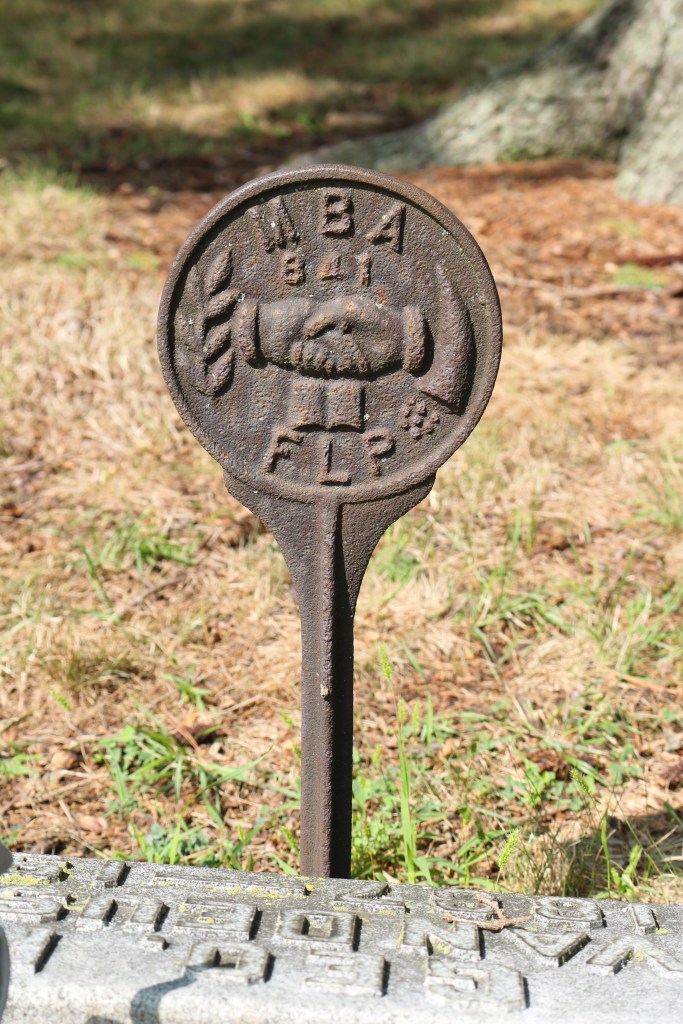
After the war, Buckman moved to Salem, Indiana, where he lived until his death at the age of 84. Benjamin Buckman was buried in the Masonic Cemetery on October 1, 1845.  However, after the cemetery was abandoned, his remains and limestone tombstone were moved the more than 30 miles to the Fairview Cemetery in New Albany, Indiana—”his last march.”  His tombstone gives a nod to his membership in the Masonic Lodge.  The eagle with a ribbon in its beak with the simple inscription “Independence” bears witness to his service in the cause of freedom and our fledgling country.

Posted in Uncategorized | 1 Comment

The Rival

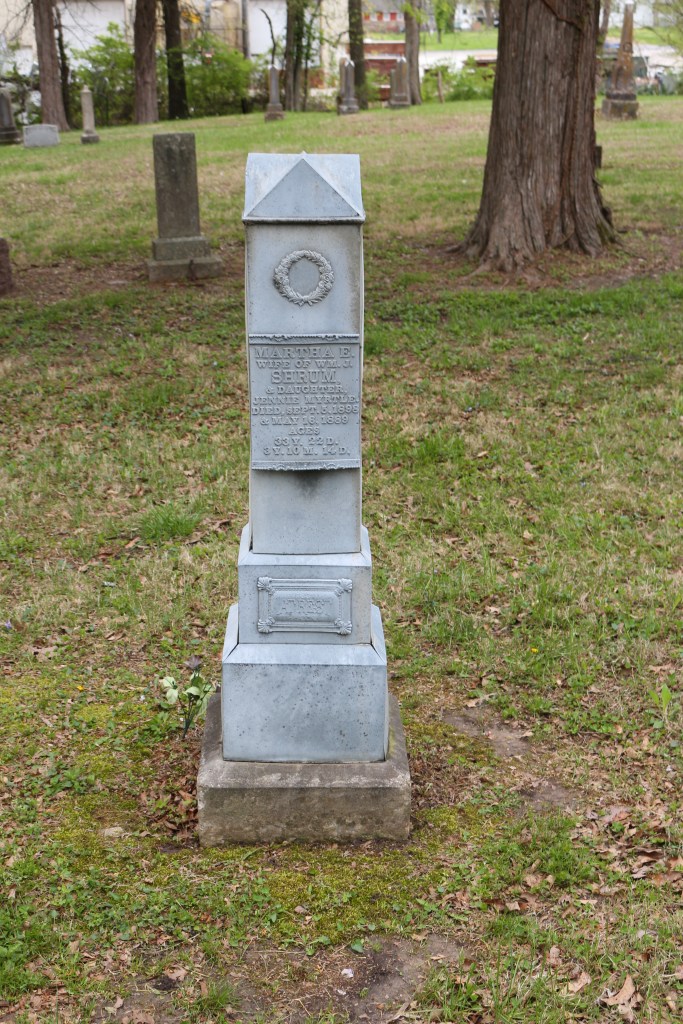
Much has been written and documented about the zinc markers produced by the Monumental Bronze Company of Bridgeport, Connecticut.  Though the company billed their markers as “white bronze” they were actually cast zinc.  The markers are distinguishable by their bluish-gray tint and easily identifiable. The company set up their first subsidiary in Detroit, Michigan. Others followed in Philadelphia, New Orleans, St. Thomas, Ontario, Des Moines, and Chicago. Enterprising salesmen carried a catalog door-to-door with them to show customers the many styles and price ranges of the product line. In many cemeteries you can find evidence of highly successful salesmen who sold large numbers of the markers. These grave markers came in a wide assortment of sizes and shapes and were somewhat like grave marker erector sets. The more elaborate markers had a shell of sorts and then various panels could be bolted on according to the tastes of the family ordering the grave marker. In this way, each marker could be “customized” to the tastes of the individual.  The company began manufacturing in the 1870s until the company closed shop in 1912.

There was another company producing zinc markers, as well.  The White Monument Company of Warsaw, Missouri.  According to The History of Benton County, Missouri: Volume 3—The People, written and complied by Kathleen Kelly White and Kathleen White Miles, 1971, page 459, “Behind his furniture store was the Monument Works operated…by Mr. Mahlon White. The plant manufactured monuments or tombstones from zinc and finished [them] in a dull satin finish by sandblasting the smooth metal.”  The company held two patents issued to Thomas Benton White.  The first patent, issued on December 2, 1901 (No. 688,043) described how the markers were to be constructed, “The structure embodies an outer metallic casing combined with an inner metallic casing or core with an interposed filling and means for permitting a circulation of air for the purpose of equalizing the temperature and for allowing for expansion or contraction of the metallic parts without danger or fracture.”  The space between the outer core of zinc and the inner core of zinc had a composite filling to give the structure stability.

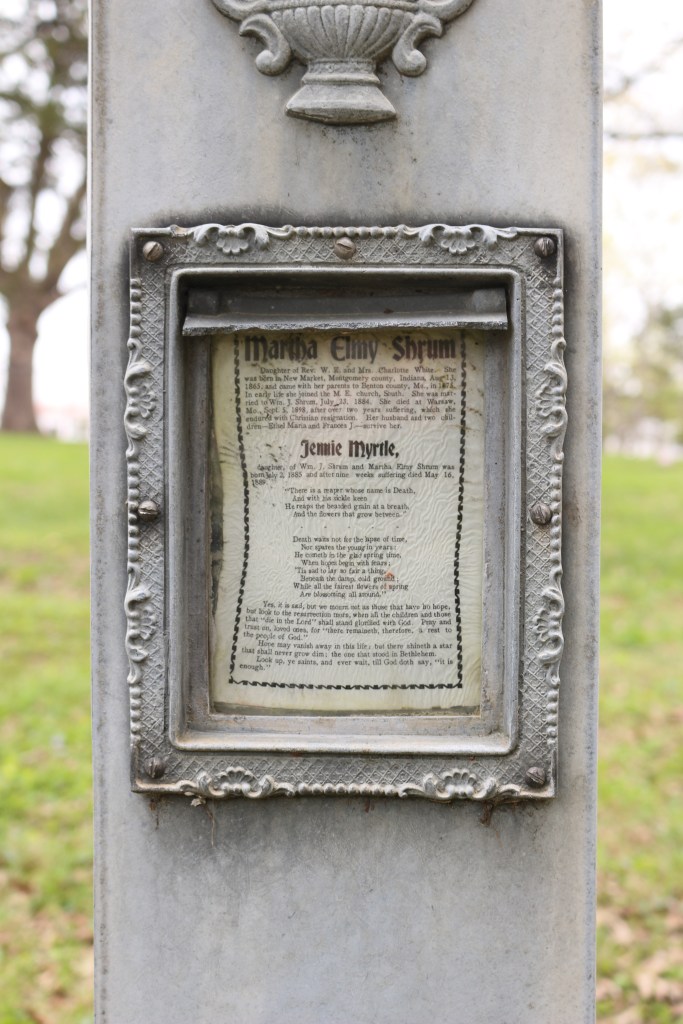
The second patent, also issued to Thomas Benton White (patent no. 695,774 March 18, 1902) was for an unique and inventive way to display a image and/or obituary of the deceased, “An inscription-frame for monuments and the like, comprising a continuous internal bead, a door enclosed by the frame at one side of the bead, an inscription-holder enclosed by the frame at the opposite side of the bead consisting of transparent parallel plates, a weatherproof binder-strip uniting all of the edges of said plates, a cushion of metal fiber surrounding the edges of the holder, a layer of flexible cement arranged next to the cushion and serving to enclose the same, and a seal of weatherproof cement covering the flexible cement.

The name plates were affixed to the markers with a cement.  These zinc markers manufactured by the White Monument Company produced several different models, several of which can be seen in the Warsaw City Cemetery and other cemeteries in central Missouri.  Four have been spotted in the country West Haven Cemetery outside Washington, Iowa, and some as far away as Colorado.  These zinc markers, often referred to as “zincies” by cemetery aficionados, mimicked designs that were commonly found carved from stone.

Posted in Uncategorized | 4 Comments

Forgery

Many cemeteries are like outdoor sculpture gardens, with statues of angels, allegorical figures, weeping women, and saints at nearly every turn.  And in some cemeteries even some of the most renowned sculptors of the 19th and early 20th Century can be seen and enjoyed, great artists such as, Robert Ingersoll Aitken, Karl Bitter, John Gutzon Borglum, Alexander Milne Calder, Sally James Farnham, Harriet Whitney Frishmuth, James Earle Fraser, Mario Korbel, Martin Milmore, Brenda Putnam, Augustus Saint-Gaudens, Lorado Taft, and Daniel Chester French.  I still remember discovering an original Daniel Chester French in the Fairview Cemetery in Council Bluffs, Iowa—the so-called “Black Angel” as it is called locally, sculpted for Ruth Anne Dodge.  The very same Daniel Chester French who sculpted the monumental Abraham Lincoln in the Lincoln Memorial in Washington, D.C.

Occasionally, however, an artist’s name doesn’t ring a bell and the research begins.  The fun part is making a discovery.  The angel in question was created by an artist named Leonardo Rossi.  A perfect name for a sculptor—clearly the boy had the name of an artist and had grown into his name.  But when you Google “Leonardo Rossi” his name comes up at askART, “Evidence suggests that this is a fictitious name being used by companies in Thailand and Germany to produce fakes by other artists….”  Then the site refers the reader to wikipedia.org—Art forgery.  And Wikipedia defines forgery as “creating and selling of works of art which are falsely credited to other, usually more famous artists. Art forgery can be extremely lucrative, but modern dating and analysis techniques have made the identification of forged artwork much simpler.”

So, this angel is made by an unknown artist, most likely in a factory by a talented artist known only by his fictitious name Leonardo Rossi.

Posted in Uncategorized | 1 Comment

Portals—Heavenly and “Not So Much”

A common and oft heard remark from Christians is that when they die, they will go to Heaven and meet with St. Peter at the “Pearly Gates” when they enter the Kingdom.  This is such a popular scenario that there are entire Web sites devoted to St. Peter-at-the-Pearly-Gates jokes!  There are also many and varied representation of the Gates of Heaven that can be found in cemeteries across the United States.  Often the Gates are shown in conjunction with other symbols, such as the star, or a dove, or an upward pointing finger, or a crown.  And nearly always, the Gates are open, as if they are inviting the soul of the deceased to enter.

In religious paintings, St. Peter is often shown with keys, referring to the Matthew 16:18-19: “And I say also unto thee, That thou are Peter, and upon this rock I will build my church and the gates of hell shall not prevail against it.  And I will give unto thee the keys of the kingdom of heaven: and whatsoever thou shalt bind on earth shall be bound in heaven: and whatsoever thou shalt loose on earth shall be loosed in heaven.”

The term “Pearly Gates” also has its origin in a Biblical passage, Revelation 21:21: “And the twelve gates were twelve pearls; every several gate (sic) was one pearl; and the street of the city pure gold, and it were transparent glass.”

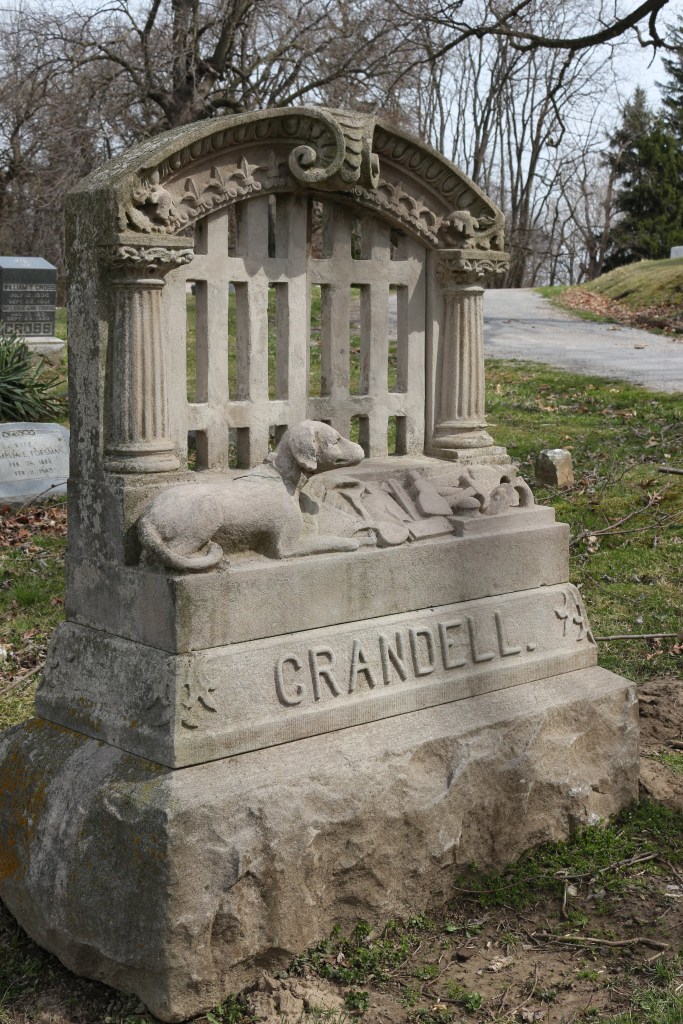
The Crandall Family gravestone, in the Springdale Cemetery in Peoria, Illinois, is in that tradition, gates slightly ajar as an invitation.  But what makes this gravestone different is that it is free-standing and not an incised design carved into the face of a column.  And, there are two elements not usually found in front of the gates—the master’s dog and his tools of trade.   

Interpreting gravestone symbolism can be tricky, especially without the benefit of knowing the deceased, the person or person’s responsible for commissioning the gravestone, or being able to discuss the symbolism with the carver.  But at first glance, it almost looks as if the deceased got to the gates with his dog and tools and had to leave them behind to enter the Kingdom of Heaven.

Some of the symbolism is well known.  The open gates are central to the Last Judgment.  As a funerary symbol, the gates represent a passageway from one realm to the next.  The gates are the portal for saved souls to make their passage from the Earthly realm to the Heavenly realm upon Christ’s return.  The dog is typically seen representing fidelity and loyalty.  And, it is highly likely that Eugene Crandall was carpenter given the tools—saw, plane, square, and hammer—left in front of the gates.

What is also clear from the gravestone, is that it was carved by an expert.  Often the carver’s identity is lost, but in the case, the carver was Italian immigrant, Joseph Petardi/Petarde, who was born into a family of stone carvers in Rome, Italy.  Joseph immigrated to New York and was soon working for a building firm.  One of his early jobs took him to Peoria where he was to cut stone for bridge pilings.  As fate would have it, Joseph met Hannah Partridge and the two met, married, had eight children, and he stayed the rest of his life in Peoria. 

One of his sons, Clyde, followed in Joseph’s footsteps, and the two of them carved some intricate statues for their own home in Peoria.  One porch support depicted a man holding up his loin cloth.  Typically, male supports were referred to as Atlas figures and were popular in Classical and Baroque Architecture.  The porch also had two female figures holding up the front porch.  Columns that were personified as females are referred to as caryatids and common in Greek architecture.   

In Greek Revival architecture the caryatid “represents the way women have traditionally carried large burdens on their heads.”  But to the horror and shock of the neighbors, all three support figures were semi-nude and too much for the neighbors’ Midwestern sensibilities.   In fact, the next-door neighbor who was an occasional visitor to the Crandall residence refused to pass through the door on the front porch in protest of the scantily-clad sculptures!  That was one portal that was “not so” Heavenly!

Posted in Uncategorized | 1 Comment

Trompe L’œil

Three mausoleums in the Springdale Cemetery in Peoria, Illinois, employ the use of the visual illusion of trompe l’œil.  For instance, from the street the J. LEE NEWTON Jr. Mausoleum looks like it has an elaborate filigree bronze door—detailed and set back from the columns that frame it.  But at closer look, the doorway has been plastered over and the bronze door is painted to look as if it an actual three-dimensional object. 

This technique is called trompe l’œil, “fooling the eye”, for it is meant for the viewer to see something that is not actually there.

The HALL Family Mausoleum is also painted to give the viewer the impression that the tomb has an elaborate bronze door.

The WINKELMEYER Family Mausoleum depicts and angel and mimics other mausoleum doorways made of sculpted angels or mourning figures.

The artist of these three works is artist, Don Kettleborough, who receive his Bachelor’s Degree in art education at Northern Illinois University and received his M.A. from Bradley University.  At first, Kettleborough put his art education degree to use by teaching art but after 16 years made the decision to go full time creating his own works of art.  His masterful artwork now can be found in homes and galleries across the US—and even on greeting cards!

Posted in Uncategorized | 2 Comments

Empty Bassinet

JAMIE SON OF

J.B. & STELLA R. SAX

BORN NOV. 12, 1886

DIED MAY 8, 1887

The gray marble gravestone of Jamie Sax, who died just shy of being 6 months old, is an empty bassinet.  The intricately carved basket weave is still clear after over 130 years since it was erected.  The turned down blanket, the pillow, and the empty bassinet has a simple inscription that says, “JAMIE”.  The neighboring family monument gives the details of his birth and death dates. 

The symbolism is obvious.  The marker is clearly for an infant and represents the emptiness and incomparable sadness of the loss of a child.

Posted in Uncategorized | 2 Comments

HE is Risen

THE TWELVE GATES WERE TWELVE PEARLS, REV. 21:21

“TO-DAY SHALT THOU BE WITH ME IN PARADISE.” LUKE 23:43

FRANK HAMILTON, 1853 – 1947, RESTING

CARRIE HAMILTON, 1852 – 1908, RESTING

ELBERTINE R. HAMILTON, 1862 – 1958, DEVOTED DISCIPLE

Two monuments, one in the Rock Creek Cemetery at Washington D.C. and the other in Cave Hill Cemetery at Louisville, Kentucky, depict an opening or gateway with a rock rolled away from the opening.

The Hamilton Tomb has two Bible verses carved into the face of it that indicate that the opening of that monument is meant to portray Jesus’s entry into Heaven, “To-day shalt thou be with me in paradise.” The second Bible verse, Revelation 21:21, goes on to describe the destination, “And the twelve gates were twelve pearls; every several gate was one pearl; and the street of the city was pure gold, as it were transparent glass.”

The second monument, that of Zachariah Madison Sherley, a prominent riverboat fleet owner and pilot and his wife Susan Wallace Cromwell Sherley, also depicts a rock next to an entryway. This one, too, depicts the Resurrection of Jesus.

Many places in the Bible describe the Holy event, as does John 20:1 – 2, “The first day of the week cometh Mary Magdalene early, when it was yet dark, unto the sepulcher, and seeth the stone taken away from the sepulcher. 2. Then she runneth and cometh Simon Peter, and to the other disciple, whom Jesus loved, and saith unto them. They have taken away the Lord out of the sepulcher, and we know not where they have laid him.”

SHERLEY

Z. M. SHERLEY, 1811 – 1879

SUSAN W. CROMWELL, HIS WIFE, 1831 – 1928

However, the Bork Family monument in St. Joseph’s Cemetery in Tiffin, Ohio, depicts Jesus’s ascension to Heaven. Here Jesus leaves the Earthly realm for the Heavenly realm—this is the Resurrection of Christ.

Posted in Uncategorized | 3 Comments

Rock & Roll Pioneer

The polished black granite gravestone in Cleveland’s Lakeview Cemetery honors disc jockey Alan Freed, a pioneer in Rock & Roll radio.  His gravestone displays an image of a juke box on the face of the stone and the following epitaph carved on the back:

ALAN FREED

1921 – 1965

“ROCK & ROLL” WAS BORN IN

CLEVELAND WHEN OHIO NATIVE

AND RADIO DISC JOCKEY

ALN FREED CONINED THE PHRASE

IN 1951.  HE CHAMPIONED THE UPTEMPS, RHYTHM-AND-BLUES

SOUND, AND THE MUSIC APPEALED

TO PEOPLE ON BOTH SIDES OF THE

RACIAL DIVIDE.  FREED USHERED IN

A NEW SPIRIT THAT HELPED BREAK

THE BARRIERS OF SEGREGATION AND

PROVIDED A JOYFUL SOUNDTRACK

FOR HOPE AND CHANGE.

A TRAILBLAZER FOR ROCK & ROLL

THROUGH HIS RADIO SHOWS, CONCERTS,

TELEVISION SHOWS, AND MOVIE

APPEARANCES, THE MUSIC’S POPULARITY

WENT GLOBAL AND FOREVER CHANGED

OUR CULTURAL LANDSCAPE.

WITH THE SUCCES OF HIS

“MOONDOG ROCK & ROLL HOUSE PARTY”

RADIO SHOW, FREED ORGANIZED

CLEVELAND’S “MOONDOG CORONATION BALL”

THE WORLD’S FIRST ROCK CONCERT

ON MARCH 21, 1952.

Posted in Uncategorized | Leave a comment

Tombstones and Gravestones…Take 5…Bronze

Bronze, which is distinguished from other metals by its brown coloring when new, and a green patina after it has aged, is another metal that is commonly found in cemeteries, though limited because of its great expense. 

Because bronze is an expensive material it is often in small pieces of the metal that adorn gravestones such as medallions that include bas-relief sculptures.

Mausoleum doors are usually constructed of bronze and come in hundreds of different designs.

Metal funerary sculpture is also often cast bronze.

Lastly, grass markers, or those that are level with the ground, are often bronze, too.  These are often issued by the Department of Veteran’s Affairs for the men and women who served in our Armed Forces.  These can also be purchased for use for those outside the military.  Memorial Parks, those that require “grass markers” often have hundreds of these marking graves.

Much of the bronze work including sculptures was cast by foundries, such as the JNO Williams Foundry in New York City.  The foundry was established in 1875 by John Williams who had been an employee of Tiffany & Company who left to start his own enterprise.  The foundry worked with some of the most influential and well-known sculptors of the late 19th and early 20th Centuries, such as, Louis Amateis, Karl Bitter, Gutzon Borglum, Pompeo Coppini, Daniel Chester French, Harriet Frishmuth Carl Augustus Heber, Anna Hyatt Huntington, Charles Keck, Edward Kemeys, Samuel Kilpatrick, Augustus Lukeman, Frederick MacMonnies, R. Tait McKenzie, Percival J. Morris, Allen George Newman, Charles Niehaus, Roalnd Hinton Perry, J. Massey Rhind, Andrew O’Connor, Alexander Phimister Proctor, Augustus Saint Gaudens, Anton Schaaf, Francois Tonetti, Gaetan Trentanove, J. Q. A. Ward, Olin Levi Warner, Albert Weinert, and George Julian Zolnay.

The foundry manufactured architectural pieces, such as bronze doors, for the Boston Public Library, the Library of Congress, and the United States Capitol building, as well as, sculptural pieces, such as, the tigers in front of Nassau Hall at Princeton University.

NOTE: The JNO. Williams advertisements were all from an industry publication, The Monumental News, and were researched and provided by Peggy Perazzo who shares her vast collection of gravestone catalogs and resources at her Website: http://quarriesandbeyond.org/cemeteries_and_monumental_art/cemetery_stones.html.

The Quarries and Beyond Website was created by Peggy B. and Patrick Perazzo. It focuses on historic stone quarries, stone workers and companies, and related subjects such as geology. Whenever possible links of finished products are provided on the Website. There is a “Quarry Articles” section that presents articles, booklets, and links from the late 1800s to early 1900s, including the 1856 “The Marble-Workers’ Manual.” The “Cemetery Stones and Monuments” section provides references and resources, including many old monument magazines, catalogs, price lists, and a photographic tour “From Quarry to Cemetery Monuments.

Posted in Uncategorized | 2 Comments

Tombstones and Gravestones…Take 4…Cast Iron

Another material that grave markers are made of is cast iron, though as common as some others. Cast iron became much less expensive in the second half of the 19th Century coupled with the ease of making more intricate patterns and designs made it a material that some chose. 

Cast iron markers come in many different forms—some traditional such as a rounded-top marker that mimics the look of a traditional marble gravestone.  Even the symbolism on this marker in the Kingsbury Cemetery, in Kingsbury, Indiana, is a weeping willow, an ubiquitous motif found in nearly every cemetery across the country.

Other cast iron designs were readily available, too, such as intricate crosses.

Even some mausoleums were constructed of cast iron, such as the Reynolds Family Tomb in New Orleans, Louisiana.  Of course, the choice of cast iron for the building instead of marble or granite for the tomb of William H. Reynolds, however, was likely due to the fact that he owned the Reynolds foundry at New Orleans.  His family tomb is the only cast-iron tomb in the Metarie Cemetery.  Built in 1877, the tomb is an eclectic design featuring Byzantine-style twisted corner columns, an Italianate cornice, and a highly decorative iron work adorning the top.

Posted in Uncategorized | Leave a comment