The Draped Cannon

LUTHER

SON OF S. P. & M. E.

WINKLEPLECK

BORN JULY 5, 1877

DIED NOV. 6, 1898

A MEMBER OF BATERY G. U.S.

HEAVY ARTILLERY

A precious one from has gone

A voice we loved is still

A place is vacant in our home

Which never can be filled

Luther, the son of Simeon P. and Mary E. Winklepleck, joined the Army and was training at Fort Sam Houston when he died of typhoid fever. He had a military funeral and was buried at the San Antonio National Cemetery. But, on November 16th, 1898, according to the U. S. Burial Registry, Military Post, and National Cemeteries records, his body was exhumed and shipped home to Odon, Indiana, where he was re-buried in the Walnut Hill Cemetery, on the land near where he grew up.

His tombstone is in the rustic style which was popular the late 19th Century and the very beginning of the 20th Century, coinciding with the Rural Cemetery Movement. The rustic movement of the mid-nineteenth century was characterized by designs that were made to look like they were from the country, complemented the rural cemetery movement which began in the United States in 1831 with the opening of Mt. Auburn Cemetery in Cambridge, Massachusetts. The rustic gravestones were a funerary art contrivance mimicking the natural surroundings of the cemetery and were most popular for a twenty year-period from about 1885 until about 1905.

Most of these rustic designed tombstones were carved from limestone to look like tree stumps.  In this case, however, the branches on the outside of the block face surrounding the inscription and the branches at the bottom of the plinth are consistent with rustic design.  But the crowning glory of this monument is the draped cannon that tops the tombstone, a nod to Luther Winklepleck’s short service in the Army. Here the cannon, in all of its rich detail including the bolts, is at rest and draped. Drapery seen on gravestones often symbolizes the veil between life and death and the passage of the soul from the Earthly plane to the Heavenly plane.

Posted in Uncategorized | Leave a comment

Real or Imagined?

Stories abound of the supernatural—apparitions that appear in gossamer gowns that fade into the murky night air, screams emanating from the “haunted” cemetery, sculptures that have eyes that glow red after dark.  How do these stories get started?  Are the stories true?  Are there things that just can’t be explaine

The Stepp Cemetery

One such tale has been repeatedly told about the Stepp Cemetery in the Morgan Monroe State Forest near Bloomington, Indiana, reportedly the most haunted place in the state. The stories that swirl around the cemetery first started around a fallen tree that resembled a chair that became known as the Witch’s Throne. That throne, however, was not a royal seat but a place of mourning and sorrow from a distraught and inconsolable mother. The legend told and re-told is of a young family. The husband works long days at the quarry—the mother busy in the cabin with a newborn girl. Tragically the husband is cut down in his prime in a quarry blast leaving the young mother to raise their little girl alone. She pours herself into the little girl, thinking of her every waking moment—protecting her, over-protecting her. The little girl becomes a young woman and catches the eye of a young man. Reluctantly and fearfully the mother agrees to let the boy escort the girl to a dance.

In a race to get back to the girl’s home before the curfew, the couple drove too fast on the country road slick with a gentle rain sliding off the road. The young girl didn’t survive the accident—the Mother’s heart broken, her dreams shattered, her spirit sent adrift with anguish and heartbreak.

Many campers and hikers have reported that they have felt warmed air as if a hot breath was on their necks. They have reportedly seen a dark fluttering presence hovering over what must be the long-forgotten grave near the Witch’s Throne and heard a faint sobbing.

While pictures of the apparition don’t exist or what we would call empirical evidence there are those who swear it to be true—their senses alive by the touch of the warm air and the sight of figure in the dark night. Is it real or imagined?

The Voodoo Queen

Marie Laveau was known as the Voodoo Queen and one of the most notorious practitioners of black magic in all of New Orleans.  Born in 1794 in Santo Domingo, Marie was well known throughout her adopted city of New Orleans for the potions she concocted and the spells she cast.

Marie lived a long life, giving birth to 15 children, including her daughter and namesake, Marie II, who took over for her mother when she died in 1881, casting spells for the denizens of the dark and believers in the cult.  For years after Marie died people claimed to see apparitions of Marie.  To this day, candles, coins, beads, and other gifts are still left at the crypt that is said to hold the remains of Marie and her daughter, Marie II.

The Black Angel

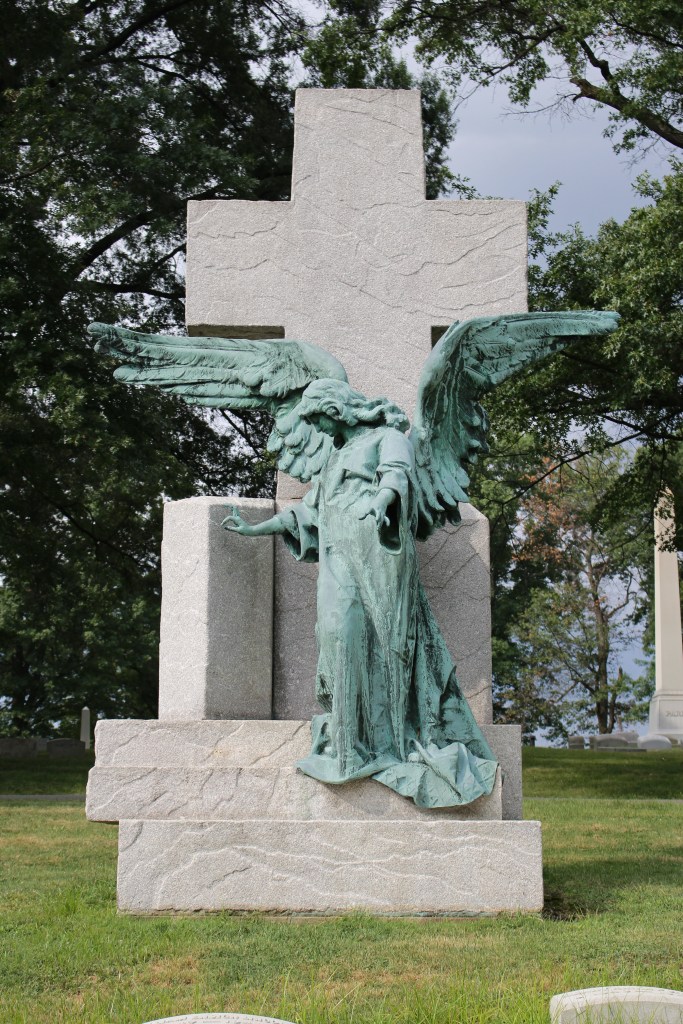
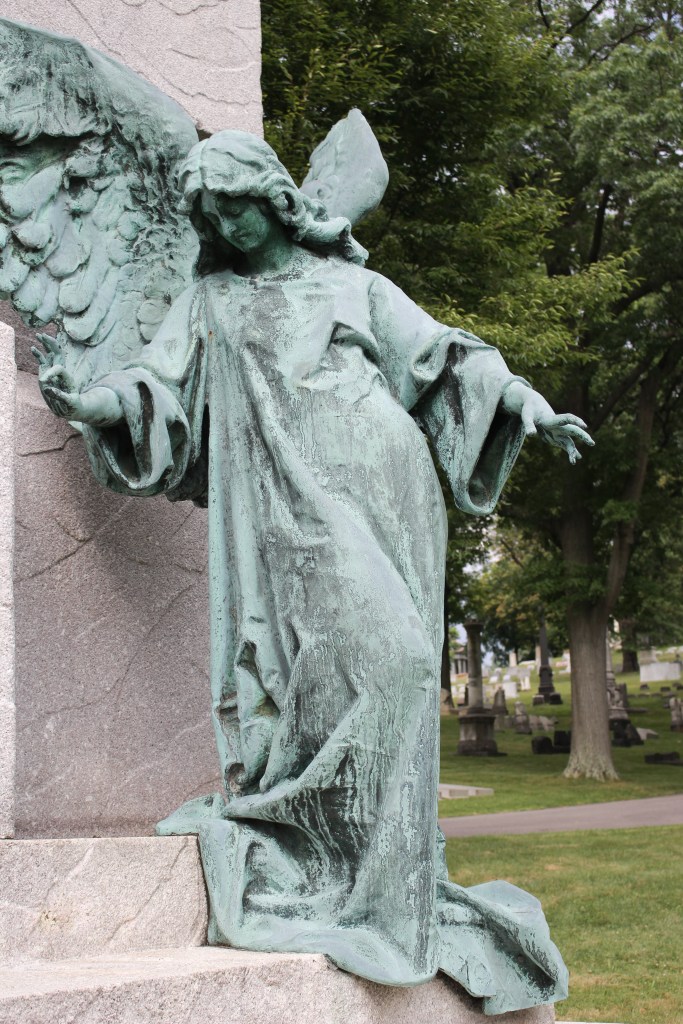
The black angel is in the Oakland Cemetery at Iowa City, Iowa, has dark stories surrounding it which probably began to swirl when the bright bronze statue turned black.  Teresa Dolezal hired Bohemian artist, Mario Korbel, of Chicago, to create an angel for her husband’s grave.  She also gave instructions that the angel was to hover over the body of her son’s grave, too.  Korbel created the angel with one wing spread open over Eddie’s grave.  No one remembers for sure when the angel turned color but that is when the rumors started.  One story goes that on the dark and stormy night of Teresa’s burial a lightning bolt struck the angel and turned it black instantly.  Another rumor suggests that the angel itself portends of the evil—most graveyard angels, they say, look upward with their wings lifted toward Heaven, but this one looks downward.  Ominous.

Leave it to a college town to turn the stories of evil into a reason to challenge the mysterious circumstances behind the color change of the sculpture and even build upon them making it a place for college co-eds to kiss!  The Iowa City college students created even more fanciful myths.  They say that if a college girl is kissed in the moonlight near the black angel, she will die within six months.  They also say that if you kiss the black angel you will die instantly.  Or touching the black angel at the stroke of midnight will bring death within seven years.  They also say if a virgin is kissed in front of the black angel the curse will be lifted and the angel will turn back to its original bright bronze color.  Hawkeye co-eds have performed many experiments of the kissing nature in front of the black angel and the sculpture is still black.  No deaths have been reported either as a result of the efforts of the college students—yet the rumors are retold with vigor and enthusiasm.

Black Agnus

The sculpture created by Karl Bitter for John E. Hubbard in the Green Mount Cemetery at Montpelier, Vermont, also has lore that has been promulgated.  Supposedly, if you sit on the lap of the sculpture, something bad will happen to you—some say in seven hours, some say seven days, some say seven months; the amount of time varies depending on who retells the story of the curse. Locals also tell of screams coming from the cemetery at night in the vicinity of the monument.  Others report seeing the eyes of the sculpture turn to glowing red, though, no photographic evidence of that has surfaced.

Share this:

Posted in Uncategorized | Leave a comment

The Tree of Life

This gray granite Steele in the Homewood Cemetery in Pittsburgh, Pennsylvania, depicts an intricately carved Tree of Life with two opposing figures facing each other. The Tree of Life is found in many cultures and is an archetype found in religion, folklore, fiction, and culture.  Often depictions show two figures facing each together with the Tree in the middle.  Sometimes the characters represent deities or rulers.  In this case however, as the inscription on the bottom of the stone indicates, the figure on the right holding the lily represents youth while the bearded figure to the left symbolizes age—both standing before the Tree of Life. 

In funerary art the Tree of Life represents earthly or heavenly spiritual life with its meaning coming from Christian origins. The Tree of Life is first mentioned in the Bible in Genesis 2:9, “And out of the ground made the Lord God to grow every tree that is pleasant to the sight, and good for food; the tree of life also in the midst of the garden, and the tree of knowledge of good and evil.”  Later, again in Genesis 3:22, 23, and 24, “And the Lord God said, Behold, the man is become as one of us, to know good and evil: and now, lest he put forth his hand, and take also of the tree of life, and eat, and live for ever: Therefore the Lord God sent him forth from the garden of Eden, to till the ground from whence he was taken.  So he drove out the man; and he placed at the east of the garden of Eden Cherubims, and a flaming sword which turned every way, to keep the way of the tree of life.”

To Catholics the Tree of Life represents the purity of life free from sin before the Fall. According to Saint Albert the Great, if the Tree symbolized Life, the Blood and Body of Christ represented the “fruit”.

Posted in Uncategorized | Leave a comment

Portals—Heavenly and “Not So Much”

Additional photos

A common and oft heard remark from Christians is that when they die, they will go to Heaven and meet with St. Peter at the “Pearly Gates” when they enter the Kingdom.  This is such a popular scenario that there are entire Web sites devoted to St. Peter-at-the-Pearly-Gates jokes!  There are also many and varied representation of the Gates of Heaven that can be found in cemeteries across the United States.  Often the Gates are shown in conjunction with other symbols, such as the star, or a dove, or an upward pointing finger, or a crown.  And nearly always, the Gates are open, as if they are inviting the soul of the deceased to enter.

In religious paintings, St. Peter is often shown with keys, referring to the Matthew 16:18-19: “And I say also unto thee, That thou are Peter, and upon this rock I will build my church and the gates of hell shall not prevail against it.  And I will give unto thee the keys of the kingdom of heaven: and whatsoever thou shalt bind on earth shall be bound in heaven: and whatsoever thou shalt loose on earth shall be loosed in heaven.”

The term “Pearly Gates” also has its origin in a Biblical passage, Revelation 21:21: “And the twelve gates were twelve pearls; every several gate (sic) was one pearl; and the street of the city pure gold, and it were transparent glass.”

The Crandall Family gravestone, in the Springdale Cemetery in Peoria, Illinois, is in that tradition, gates slightly ajar as an invitation.  But what makes this gravestone different is that it is free-standing and not an incised design carved into the face of a column.  And, there are two elements not usually found in front of the gates—the master’s dog and his tools of trade.   

Interpreting gravestone symbolism can be tricky, especially without the benefit of knowing the deceased, the person or person’s responsible for commissioning the gravestone, or being able to discuss the symbolism with the carver.  But at first glance, it almost looks as if the deceased got to the gates with his dog and tools and had to leave them behind to enter the Kingdom of Heaven.

Some of the symbolism is well known.  The open gates are central to the Last Judgment.  As a funerary symbol, the gates represent a passageway from one realm to the next.  The gates are the portal for saved souls to make their passage from the Earthly realm to the Heavenly realm upon Christ’s return.  The dog is typically seen representing fidelity and loyalty.  And, it is highly likely that Eugene Crandall was carpenter given the tools—saw, plane, square, and hammer—left in front of the gates.

What is also clear from the gravestone, is that it was carved by an expert.  Often the carver’s identity is lost, but in the case, the carver was Italian immigrant, Joseph Petardi/Petarde, who was born into a family of stone carvers in Rome, Italy.  Joseph immigrated to New York and was soon working for a building firm.  One of his early jobs took him to Peoria where he was to cut stone for bridge pilings.  As fate would have it, Joseph met Hannah Partridge and the two met, married, had eight children, and he stayed the rest of his life in Peoria. 

One of his sons, Clyde, followed in Joseph’s footsteps, and the two of them carved some intricate statues for their own home in Peoria.  One porch support depicted a man holding up his loin cloth.  Typically, male supports were referred to as Atlas figures and were popular in Classical and Baroque Architecture.  The porch also had two female figures holding up the front porch.  Columns that were personified as females are referred to as caryatids and common in Greek architecture.   

In Greek Revival architecture the caryatid “represents the way women have traditionally carried large burdens on their heads.”  But to the horror and shock of the neighbors, all three support figures were semi-nude and too much for the neighbors’ Midwestern sensibilities.   In fact, the next-door neighbor who was an occasional visitor to the Crandall residence refused to pass through the door on the front porch in protest of the scantily-clad sculptures!  That was one portal that was “not so” Heavenly!

Posted in Uncategorized | 1 Comment

Rustic Monument to a Judge

DANIEL GANTT

DIED AT NEBRASKA CITY

MAY 28, 1878

AGED 63 YEARS

At the time of his death

he was honorably serving

the State of Nebraska

in the high position of

CHIEF JUSTICE

NON ENIM TAM AUCTORITATIS IN DUSPUTANDO

QUAM RATIONIS MEMENTA QUAERENDA SUNT.

CICERO

The ledger laid atop carved stone logs in the Wyuka Cemetery in Nebraska City, Nebraska, was created for Daniel Gantt in the Rustic Style which was popular the late 19th Century and the very beginning of the 20th Century, coinciding with the Rural Cemetery Movement. 

Daniel Gantt (June 29, 1814—May 28, 1878) was born in Perry County, Pennsylvania.  Gantt, after a serious jobs, was admitted to the Pennsylvania Bar in 1843. In May 1857, Gantt and his wife, Agnes, moved to the Nebraska Territory. He first settled in Douglas County.  In October of that same year, Agnes died of lung-fever.  The following year, he married Harriet Cooper in Pittsburgh making their home in Omaha, where he became active in local politics.  In 1861, Gantt was elected City Treasurer in 1861.  Two years later, Gantt won a seat in the Territorial House of Representatives.  President Lincoln appointed Gantt U.S. District Attorney for the Nebraska Territory on May 10, 1864.  After his appointment was over, the Gantt’s moved to Nebraska City, where he hung out his shingle and went into private legal practice.  In 1872, he was elected an Associate Justice of the Nebraska Supreme Court. In January of 1878, Gantt became Chief Justice of the Nebraska Supreme Court, a position he held until his death just five short months later.

Gantt’s legal career and penultimate rise to Supreme Court Justice of Nebraska is most likely noted by the stack of books on one end of his grave ledger. It is likely they represent law books and are a nod to his career in the law.  The scales carved on the lower portion of his gravestone, on the other hand, are a symbol, like many, that can have more than one meaning.  For instance, it could be as simple as representing his Zodiac sign.  Libra is representing by the scales. Except that he was born June 28th, which makes his Zodiac sign Cancer, which is the crab.  In cemetery symbolism, the scales traditionally represent justice being rendered and administered by Lady Justice—weighing guilt and punishment.  In this case, the scales are again, as are the books, a reference to Gantt’s position on Nebraska’s High Court.

The Latin inscription at the bottom of the ledger was very difficult to decipher. I had little luck with it, only being able to read a couple of words.  The rest of them looked like a jumble of letters to me.  A friend and colleague of mine, Charlotte, who has studied Latin, however, was able to read the inscription even though it was weathered, pitted, and stained.  The line, “NON ENIM TAM AUCTORITATIS IN DUSPUTANDO QUAM RATIONIS MEMENTA QUAERENDA SUNT.” is from Cicero’s book De Natura Deorum, or On the Nature of the Gods. The loose translation reads, “In every disputation, we should look more to the weight of reason than to the weight of authorities.”  Again, a nod to his achievement as a judge of which he must have been extremely proud.

Posted in Uncategorized | 1 Comment

Tree-stump Monument as a Tribute to Arbor Day

CAROLINE

WIFE OF

J. STERLING MORTON

DIED AT ARBOR LODGE

JUNE 29, 1881

AGED 47 YEARS

She was the Mother of

JOY, PAUL, MARK,

and, CARL MORTON.

J. STERLING MORTON

BORN

APR. 22, 1832

DIED

APR. 27, 1902

EMMA MORTON

SISTER OF J. STERLING MORTON

JAN. 19. 1837 – APR. 13. 1912

CYNTHIA

A. FRENCH

Wife of

DAVID FRENCH,

FOSTER MOTHER OF

Mrs. J. STERLING MORTON

DIED AT

ARBOR LODGE NOVEMBER 1857

AGED 70 YEARS

CARL MORTON

FEB. 18. 1865 – JAN. 7. 1901

BOATIE PAYNE MORTON

WIFE OF CARL MORTON

OCT. 31, 1869 – DEC. 9. 1932

I was born in Nebraska and attended kindergarten through fifth grade in a North Omaha suburb and because of that I was well studied about Arbor Day, since it was originated by J. Sterling Morton of Nebraska City, Nebraska. 

Arbor Day was the modern-day equivalent of Earth Day, only its focus was solely on planting trees to better the environment.  Planting trees was especially important in a Plains state like Nebraska where the joke was that the state tree was a telephone pole.  The first Arbor Day in the United States was held in Lincoln, Nebraska, on April 10, 1872, when an estimated one million trees planted in the state.  Not only did Morton advocate the planting of trees, but he also was against cutting down trees to be used as Christmas decorations.

The towering Morton Family monument in the Wyuka Cemetery in Nebraska City, Nebraska, sits in the middle of a large family plot that is set off by carved limestone logs marking its boundaries.  It is certainly fitting that his monument is a tree, and one of the largest tree-stump gravestones I have seen and is the largest in the Wyuka Cemetery.  Tree stump gravestones and curbing carved to resemble branches and logs were a part of the rustic movement of the mid-nineteenth century which was characterized by designs that were made to look like they were from the country. While the tree-stump monuments usually symbolize a life cut short, in this case the tree-stump is more likely to represent Morton’s dedication to planting trees and the founding Arbor Day in the United States.

Julius Sterling Morton (April 22, 1832 – April 27, 1902) was a newspaper editor who was active in Democratic politics.  Morton served as in the Nebraska Territorial House of Representatives (1855-1856), was appointed Secretary of Nebraska Territory (1858-1859) and served as Acting Territorial Governor of Nebraska (1858-1859).  In 1893, President Grover Cleveland appointed Morton Secretary of Agriculture, a position in which served until 1897. 

His home in Nebraska City, known as Arbor Lodge, is a 52-room mansion that is now the centerpiece of the Arbor Lodge State Historical Park in Nebraska City.  On the winding drive to the mansion is an alcove with two bronze statues by famed sculptor Rudulph Evans—one of J. Sterling Morton and an allegorical figure holding a sapling.

Evans (February 1, 1878 – January 16, 1960) was an American-born sculptor, who is most famous for the towering sculpture of Thomas Jefferson standing in the center of the Jefferson Memorial in Washington, D.C.  Evans was trained at the Ecole des Beaux-Arts in Paris with fellow students Augustus Saint-Gaudens and Auguste Rodin.

Posted in Uncategorized | 1 Comment

Monument to a Businessman–a Desk

The Harding Family monument in the Wyuka Cemetery in Nebraska City, Nebraska, sits in the middle of a large family plot that is set off by carved limestone logs marking its boundaries. 

Tree stump gravestones and curbing carved to resemble branches and logs were a part of the rustic movement of the mid-nineteenth century which was characterized by designs that were made to look like they were from the country. The rustic movement complemented the rural cemetery movement which began in the United States in 1831 with the opening of Mt. Auburn Cemetery in Cambridge, Massachusetts. The rural cemeteries were often located on the outskirts of town and laid out as a park would be—with broad avenues and winding pathways, featuring picturesque landscaping such as ponds, abundant trees, and shrubs. The tree-stump tombstones were a funerary art contrivance mimicking the natural surroundings of the cemetery. The tree-stump tombstones were most popular for a twenty year-period from about 1885 until about 1905.

The centerpiece of the Harding Family plot sitting in the middle is a roll-top desk carved out of limestone, intricate in every detail, right down to the ink well and pads of paper underneath the roll.  The desk has several books displayed on top of the desk and inside it that have the names of various family members inscribed on the pages and covers of the books—Bennett S. Harding Born Jany 28, 1856 Died May 21, 1857; Frederick C. Harding Born Jany 31, 1865 Died Aug 17, 1872; Alice Harding Born Dec 14, 1871 Died June 18, 1872; Grace H. Harding Dec. 15, 1863 Sep. 22, 1937; Mary H. Miller Oct. 13, 1955.  The open book on top of the desk is inscribed: N. S. Harding Feb. 2, 1831 Mar. 30, 1915 and Mary K. B. Harding Oct. 25, 1833 Sept 15, 1900. The back of the desk also has names carved it, too—Mary H. Baldwin Feb. 1, 1804 Feb. 12. 1883; Fanny K. Blackman Born Aug. 8, 1858 Died July 5. 1859; Theodore B. Van [there is damage on this name but it looks like—Horne] Nov 27. 1829 Nov 16. 1858.

If you read about the progenitor of the Harding family, Nehemiah Story Harding, it is easy to see that the desk is a monument to his many careers—most likely doing his work behind a desk much like the one carved for him and his family.  Most likely the desk is a nod to his many years working in an office at a desk much like this one.

An excerpt from A History of Nebraska from the Earliest Explorations of the Trans-Mississippi Region by Julius Sterling Morton, Albert Watkins, and George L. Miller, published by the Western Publishing and Engraving Company of Lincoln, Nebraska, in 1918, (pages 671-672) describes Harding as a civil servant, serial entrepreneur, businessman, and philanthropist: “pioneer and prominent man of business, he embarked in the mercantile business in Cincinnati in 1852 as a member of the firm of Wright & Harding, booksellers and stationers, at 131 Main Street from 1852 to 1855.  He removed from Cincinnati Ohio in 1855, and arrived in Nebraska City, Nebraska Territory, November 28, 1855…He first served as deputy clerk of the United States District Court for one year, and then became cashier of the Platte Valley Bank, and agent for the Aetna Insurance Company.  He was the first insurance agent and wrote the first policy in the then Territory of Nebraska in August of 1857.  He early engaged in the book, stationery, and …which he followed for twenty-six years.  He has served for thirty-six years as special agent for the Springfield Fire and Marine Insurance Company of Massachusetts…He served as one of the first county commissioners of Otoe County, as town clerk, and member of the board of trustees.  In 1875, he was named by the state legislature to secure a location for, and to build the institution for the blind in Nebraska City, Nebraska, and served as treasurer of the board of trustees during the years 1875-76… Mr. Harding is a member of the Masonic Order, Western Start Lodge No. 2, A. F. and A. M., of which he has been several times master.  He is also a member of the Frontier No. 3, I. O. O. F., and a member of the Nebraska Society, Sons of the American Revolution.  He is a prominent member of the First Presbyterian church of Nebraska City, of which he has been an elder for about thirty years.  Mr. Harding has been an active and busy man during the half century of his residence in Nebraska and has been an important figure in the business life of Nebraska City, where he is recognized as one of the progressive and influential citizens.”

According to A History of Nebraska from the Earliest Explorations of the Trans-Mississippi Region, N. S. Harding was born at “Iberia, Morrow County, Ohio, February 12, 1831…of English descent; his ancestors were of Puritan stock and settled in Massachusetts in 1623.  Several members of the family served in the Continental army during the Revolutionary war, and others have been prominent on the bench before the bar.  His father, Chauncey Harding, was a native of Pennsylvania, a worthy man of more than ordinary ability and intelligence.  He was an executor and administrator of several large estates, and died in 1880, after a long and honorable career, at the age of seventy-two years.  Rachel (Story) Harding, mother of N. S. Harding was a native of Maine, a daughter of a Baptist minister, a woman of strong and lovely character, and greatly beloved by her six children.  N. S. Harding acquired his early education in the common schools, supplemented by partial courses in the Marion, Ohio, academy and Central college in Franklin County.  Mr. Harding was married August 4, 1853, in Cincinnati, Ohio, to Miss Mary King Baldwin of Newark, Ohio, who, two years later, accompanied her husband to the new home in Nebraska City, where she exercised a benign and gracious influence in the social life of the community until her death, September 15, 1900, at the age of sixty-seven years.  Ten children were born to Mr. and Mrs. Harding, six of whom are now living: Mrs. Charles S. Nash, St. Louis, Mo.: Mrs. Walter D. Hill, Beatrice, Nebraska; Mrs. William N. Dekker, San Francisco, California; Grace H. Mary R., and Willard S., all residents of Nebraska City.”

Posted in Uncategorized | 2 Comments

A Useful Citizen and Honest Man

J. T. Weybrecht

January 27 1829 – January 31, 1895

The elaborate Victorian unpolished granite monument for John Theobold Weybrecht in the Alliance City Cemetery, in Alliance, Ohio, is one of the tallest in the cemetery and speaks to the success of the businessman.  An immigrant from Alsace-Lorraine, France, Weybrecht opened and operated the first lumberyard in Alliance with his sons, Benjamin and Charles. 

The monument, topped with a draped urn, features a bronze medallion with a likeness of Weybrecht as its centerpiece, commissioned in 1896.  The bas-relief or low-relief of Weybrecht was sculpted by Ohio artist Ora Coltman (December 3, 1858 – July 2, 1940).  The difficulty in creating a flattened sculpture of a face is giving it a three-dimensional look and feel and capturing the visual qualities of the man.  Coltman’s talent is clear.

Coltman was a painter, as well as a sculptor.  His painting, “The Dominance of the City”, is his most famous work, which is a sweeping triptych of Cleveland was commissioned by the Public Works Art Program in 1933.  The painting was the first New Deal mural in the city and can be seen on the third floor of the Cleveland Public Library. 

Written on the medallion is the following inscription, “Born in Alsace, France, January 27th, 1829.  Died at Alliance, Ohio, January 31, 1895, known to this community for forty years as a useful citizen and honest man.”

Posted in Uncategorized | 2 Comments

A Soldier’s Service

A.L. JONES

RUTH A. JONES

BORN OCT. 22, 1827,

MARRIED

OCTOBER 2, 1849,

DEPARTED THIS LIFE OCT. 29, 1878,

AGED 51 YRS. & 7 DAYS.

No other war was like the American Civil War for Americans because every sailor and soldier, every collateral death, every field or railway yard that was destroyed, every city or town devastated by artillery was American.  And, more Americans were killed in the Civil War than any other war that Americans have fought.  The war tore the country apart and threatened the existence of the Republic. 

Cemeteries throughout the United States feature memorials to honor the soldiers who fought.  The soldiers, proud of their service, also denoted it in many ways—some with elaborately carved commissioned statues, some with inscriptions that memorialized each battle in which they served, while others have little more than a metal marker that noted their service.

The humble zinc grave marker of A.L. Jones in the Alliance City Cemetery in Alliance, Ohio, doesn’t give his birth or death date, let alone the unit in which he served, but it is adorned with two symbols representing his service—on one side of the column an American flag and on another, a uniformed soldier astride a strutting horse.

Posted in Uncategorized | 2 Comments

The Author of the 14th Amendment?

Stephen Neal

June 11, 1817 – June 23, 1905

The large, polished granite column topped with a bronze bust in the Oak Hill Cemetery in Lebanon, Indiana, commemorates the life of Stephen Neal.  Neal was a prominent citizen of Lebanon, serving as an attorney, represented Boone County in the Indiana State House, and later as circuit court judge. 

However, Neal is most remembered for his purported role in the drafting of the 14th Amendment to the United States Constitution. Various reports credited Neal with sending a draft he wrote of the 14th Amendment to Godlove S. Orth.  Orth was a former Indiana state legislator serving in the U.S. Congress in 1866 when the amendment was being considered. However, there is debate as to whether this claim is true or not. 

Amendment XIV

Section 1.

All persons born or naturalized in the United States, and subject to the jurisdiction thereof, are citizens of the United States and of the state wherein they reside. No state shall make or enforce any law which shall abridge the privileges or immunities of citizens of the United States; nor shall any state deprive any person of life, liberty, or property, without due process of law; nor deny to any person within its jurisdiction the equal protection of the laws.

Section 2.

Representatives shall be apportioned among the several states according to their respective numbers, counting the whole number of persons in each state, excluding Indians not taxed. But when the right to vote at any election for the choice of electors for President and Vice President of the United States, Representatives in Congress, the executive and judicial officers of a state, or the members of the legislature thereof, is denied to any of the male inhabitants of such state, being twenty-one years of age, and citizens of the United States, or in any way abridged, except for participation in rebellion, or other crime, the basis of representation therein shall be reduced in the proportion which the number of such male citizens shall bear to the whole number of male citizens twenty-one years of age in such state.

Section 3.

No person shall be a Senator or Representative in Congress, or elector of President and Vice President, or hold any office, civil or military, under the United States, or under any state, who, having previously taken an oath, as a member of Congress, or as an officer of the United States, or as a member of any state legislature, or as an executive or judicial officer of any state, to support the Constitution of the United States, shall have engaged in insurrection or rebellion against the same, or given aid or comfort to the enemies thereof. But Congress may by a vote of two-thirds of each House, remove such disability.

Section 4.

The validity of the public debt of the United States, authorized by law, including debts incurred for payment of pensions and bounties for services in suppressing insurrection or rebellion, shall not be questioned. But neither the United States nor any state shall assume or pay any debt or obligation incurred in aid of insurrection or rebellion against the United States, or any claim for the loss or emancipation of any slave; but all such debts, obligations and claims shall be held illegal and void.

Section 5.

The Congress shall have power to enforce, by appropriate legislation, the provisions of this article.

The bust of Neal was sculpted by Clara Barth Leonard Dieman (1877-1959) who studied sculpture with the great artists Lorado Taft and Charles Mulligan at the Art Institute of Chicago.  Dieman’s career and life took her to many parts of the country where she pursued her craft in Illinois, Texas, Colorado, New York, Pennsylvania, Iowa, and New Mexico where she spent the last part of her life.  One of Neal’s sons also gave a copy of the bust to the Indiana State Government, which is now on display in the Indiana State Capitol rotunda.

Posted in Uncategorized | 2 Comments