A President’s Day Tribute–OK?

Martin Van Buren (December 5, 1782 – July 24, 1862) was a very successful political figure during the early part of the 19th Century and is considered one of the founders of the Democratic Party. Van Buren was born in Kinderhook, New York, where he began his career as an attorney but became involved in politics, first at the state level as a member of the New York Senate, the 14th Attorney General of New York, US Senator of New York, and as the 9th Governor of New York.  Andrew Jackson appointed Van Buren Secretary of State in 1829, and then in 1832 he ran as Jackson’s running mate becoming the 8th Vice President of the United States. 

During Van Buren’s political career, he had many nicknames—the Sly Fox, Little Van, the Little Magician, and Old Kinderhook, a nod to his hometown.  The later became part of his campaign slogan when he ran for the presidency in his own right—”VOTE for OK.” Many have attributed the term “OK” to Van Buren, but the term was first used in an article printed in the Economist and was used as a satirical abbreviation for “Oll Korrect.”  However, Van Buren’s campaign did help to popularize the term.

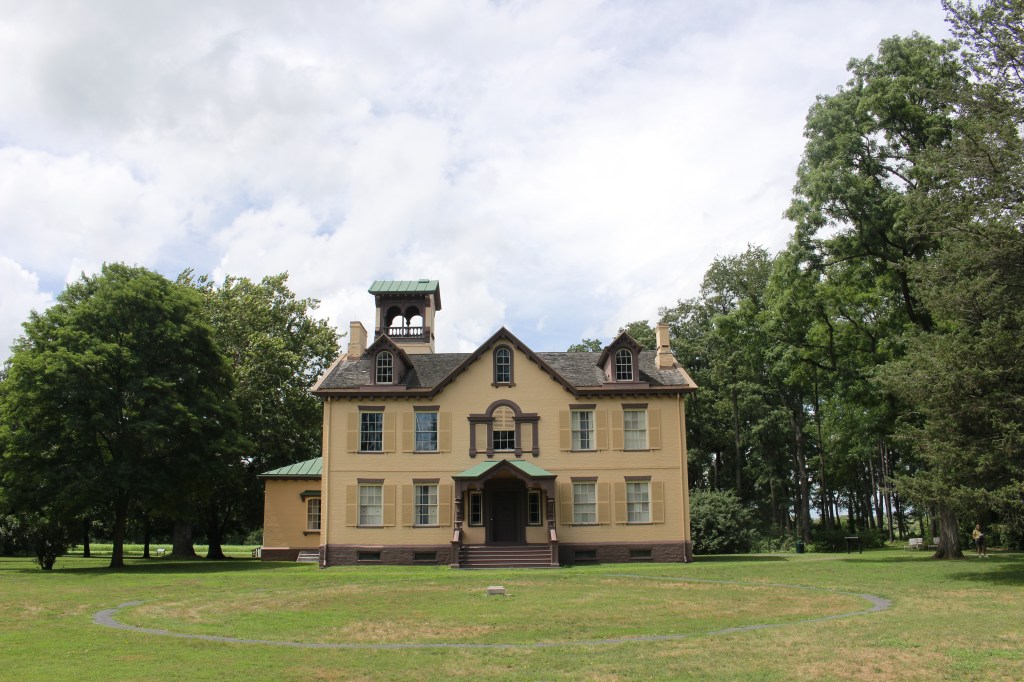
Van Buren won becoming the 8th President. But, largely due to the Panic of 1837, Van Buren lost his bid for a second term.  He did run again in 1848 nominated as the candidate for both the Barnburners Party and the Free Soil Party but lost that bid, as well.  Van Buren completely retired from politics living the rest of his life in his estate, Lindenwald, in Kinderhook, New York. 

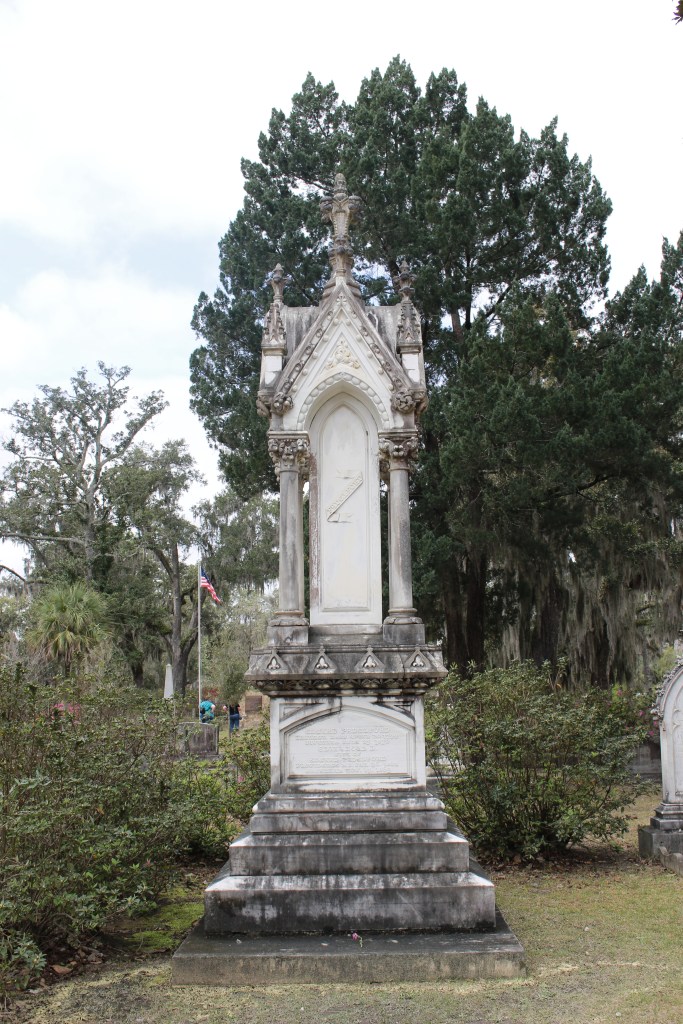
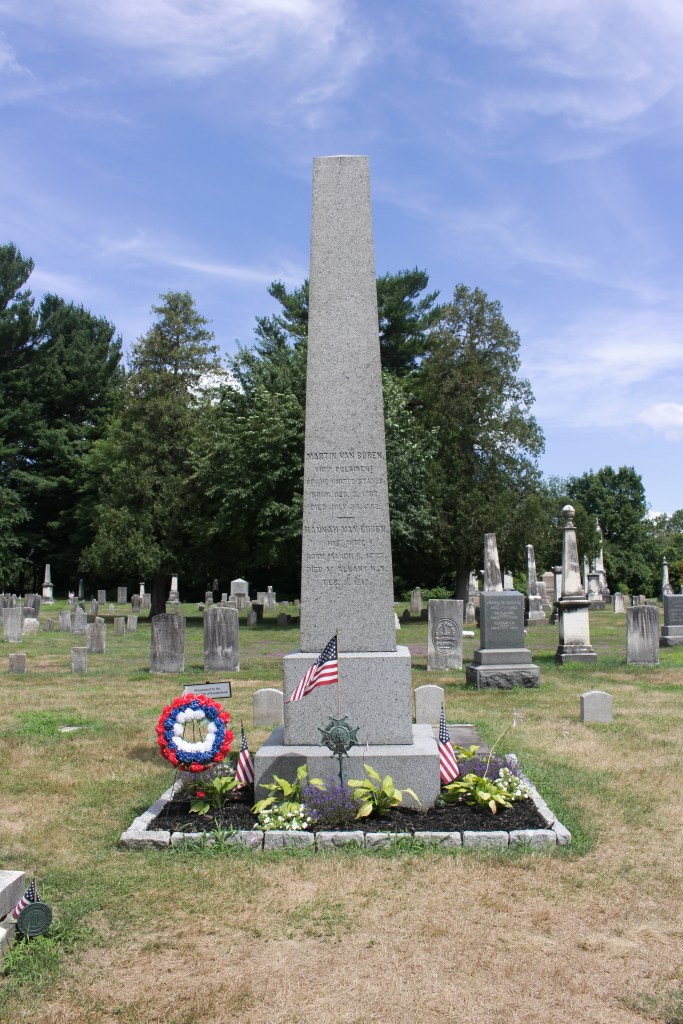
In 1862, suffering from bronchial asthma and heart failure, he died on July 24th.  He was 79 years old.  Van Buren was buried in the Kinderhook Reformed Dutch Church Cemetery where his parents are also buried.  An obelisk set on a plinth and a base made of gray granite marks the graves of Martin Van Buren, Hannah, his wife, and their son, Martin Van Buren Jr.

Posted in Uncategorized | Leave a comment

Mrs. Gamble’s Grave

This blog post is a departure from my usual posts in two ways.  First, it is a guest blogpost written by a friend of mine, Martin Henley.  Martin is an author of many books, most written for educators, but his latest read is titled, Scoundrels Who Made America Great, a book with a fresh look at five well-known figures who changed the course of history, such as, Anne Hutchinson, Benedict Arnold, and Clarence Gideon.

The second way in which this post is different, is that Martin shares a remembrance from his childhood about a colonial cemetery that was moved from one site to another in his town.  His story is follows: 

Mrs. Gamble’s Grave

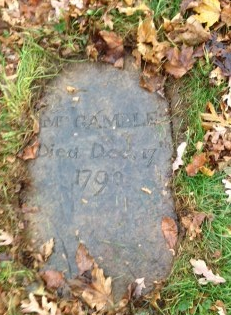
            I am seventy years old.  The preceding sentence is simple and declarative, yet for me it is as unfathomable as time itself.  How did I get to seventy years, and why am I still here while some of my closest childhood friends have died. These were my thoughts as I stood over Mrs. Gamble’s grave. Her tombstone is a simple gray granite marker. Wreathed with grass and leaves, it lies flush with the ground. The inscription is brief.  In letters worn smooth from 145 years of weather, it reads: “Mrs. Gamble, Died Dec 17th, 1798.” Her simple stone is the only visible marker in a neglected colonial cemetery in Syracuse, New York.   

              In 1955, when I was twelve, stately elms and shady chestnut trees dotted the open green fields of the cemetery. Kids from the neighborhood made it their playground and called it “the Park.” In the fall we played football, and during the winter the diminutive cemetery hills bristled with sleds. Summer was the best. Baseball games followed the sun. We started early, suspended play for lunch, and resumed until supper. We chose sides by picking the two best players as captains. Chosen last was a temporary humiliation quickly dissipated as we embraced the flow of the game. The batting order was determined by the quickest to speak up. “I got first ups,” “I got second ups,” the chorus continued until the sequence of “ups” concluded with the last batter.  For the rest of the day the cemetery resonated with the crack of wooden bats on rawhide baseballs, and the shouts of hooting kids.

              We devised several ball fields, each with its own set of ground rules and golf-course contours. On one field a ball hit over a path was a home run.  On another fly balls bounced through tree branches. An improbable catch earned a week of bragging rights. Trees, rocks, and stumps served as bases. In my favorite field a chestnut tree was first base, a forlorn baseball mitt served as second, and Mrs. Gamble was third base. My friends and I sailed together through the boundless summer joking, teasing, swearing, and playing. They were precious times, and we knew it. 

        These days I travel to Syracuse infrequently, but when I do I visit the cemetery. It is quiet and empty. Kids don’t play there anymore. I clear off Mrs. Gamble’s tombstone, and I look around recalling the bittersweet days of my youth. The neighborhood has changed. The big red house I lived in on the corner is divided into apartments.  Surrounding houses look worn and weary. The Irish and Italian families who were the backbone of the neighborhood moved to the suburbs years ago. The park seems smaller, shrunken. Blight destroyed the elm trees. A few stunted chestnut trees still stand. Only Mrs. Gamble is unchanged. Her solitary tombstone remains, an obscure memorial to the joy of childhood and the melancholy of old age. 

Note: Mrs. Gamble was not included in the list of interned souls. According to local lore her grave just appeared in the cemetery. There is no record of her burial either in the first location on in the “park”. Hers is the only visible marker indicating that the “park” is a cemetery.

Posted in Uncategorized | 1 Comment

The Porter Angel

HENRY KIRKE PORTER

1840 – 1941

Porter had a brief stint in the 45th Regiment, Massachusetts Volunteer Militia during the Civil War.  After, he had a distinguished career as an industrialist manufacturing light locomotives.  He also served a term as a US Congressman. But Porter is most remembered for his philanthropic work. He was one of the founders of the Young Men’s Christian Association (Y.M.C.A.) and served as the president of the Pittsburgh Y.M.C.A. from 1868 to 1887.   He served on various other community and international boards, as well, including, the Pittsburgh Chamber of Commerce, the Western Pennsylvania Institute for the Blind, the International Committee of the Y.M.C.A., the Carnegie Institute, the Crozier Theological Seminary, and as a member of the Board of Fellows of Brown University.

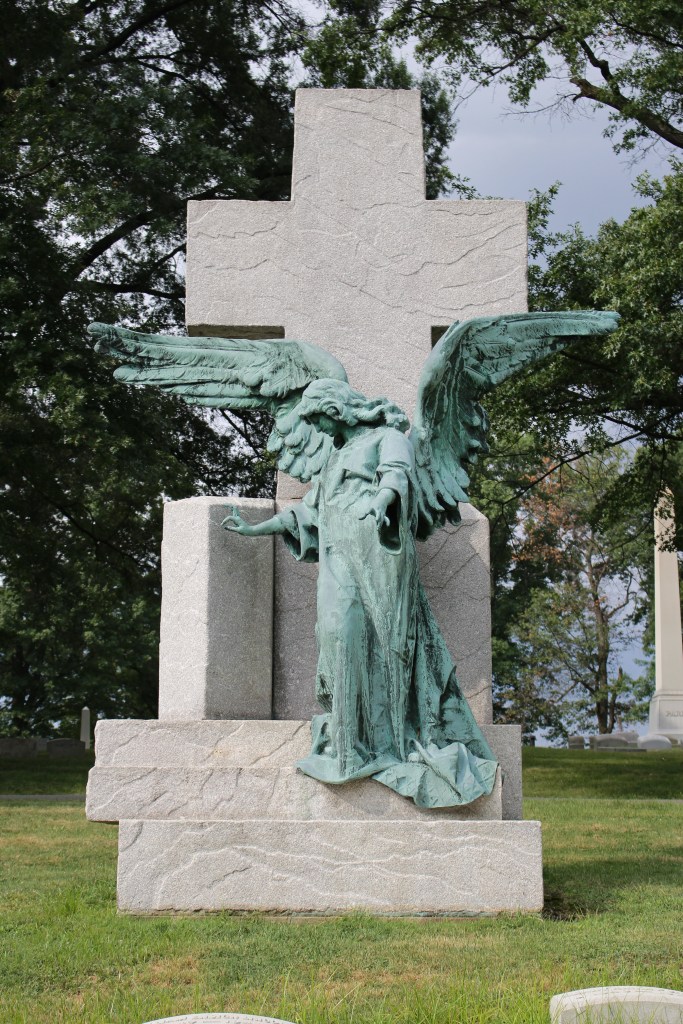
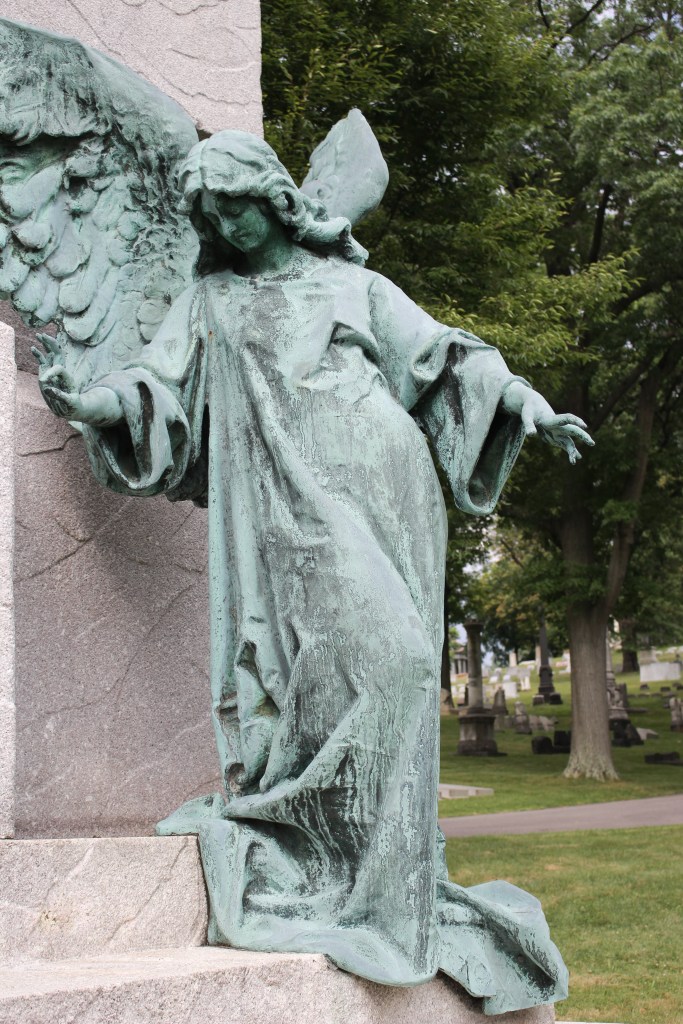
Henry Kirke Porter and his family plot is commemorated by a bronze angel, one of the most visited monuments in the Allegheny Cemetery. The angel is a classic example of mourning figures found in cemeteries—head bent down in grief, wide wing span, and draped gown. 

In the book, Images of America: Allegheny Cemetery, published in 2016, page 29, published by Arcadia Publishing, Charleston, South Carolina, authors, Lisa Speranza and Nancy Foley describe one of the most impressive monuments in the Allegheny Cemetery in Pittsburgh—the Porter Angel.

“…perhaps one of the most recognizable faces within the cemetery, standing watch over the family of Henry Kirke Porter.”  …The current Porter Angel likely dates to the 1920s.  However, as early as 1906, a Pittsburgh Daily Post article shows a marble angel and sandstone cross at the family grave.  Imported from Italy, it was reputed to be one of the most striking examples of marble carving in any cemetery in America.  As it weathered, it was likely replaced with the stunning bronze monument that so many recognize today.” 

The replacement angel was created by sculptor Enrico Butti (April 3, 1847 – January 21, 1932) of Milan, Italy and cast at the Kunst Foundry in New York.  Sculptor Butti came by his talent naturally having been born into a family of sculptors and marble cutters.  At an early age, Butti went to study with renowned Italian sculptors Pietro Magni, Francesco Barzaghi, and Ugo Zannoni.  By the age 25, Butti won praise for his first exhibited work, Raphael cementing his career as a budding sculptor winning commissions during the rest of his lifetime.

The Porter Angel is cast bronze, standing the second of three steps that lead down from a Latin Cross.  The Latin Cross is universally recognized as a symbol of the Christianity however, it is not the only symbolism in the monument, which may be lost on some viewers. In this monument, the cross rests on a foundation of three progressively larger stones as a base. Each represents a different virtue—“Faith in the will of God…Hope for the dawn of that yet more glorious day and Charity toward all men.”

In the journal article: “Transmigration/Transformation Enrico Buttie’s Angel in Milan and Pittsburgh” by Elisabeth L. Roark, (Italian Review Vol. 7, No. 2, Summer 2017, pp. 148-179 (32 Pages) published by the University of Illinois Press) she describes the drama of the sculpture,

Nine feet tall, with an astonishingly detailed ten-foot wingspan, it wears a wide-sleeved, loose gown that cascades over its body and down three outsize granite steps.  Its pose is theatrical; a dramatic weight shift thrusts its lower torso forward, balanced by outstretched arms that extend to the front and the side.  Its long fingers form graceful gestures: on the left hand, spread wide and held parallel to the ground; on the right hand, the thumb and forefinger almost meet and reach toward the stone block beside it.  The angel’s head is bent as if concentrating on its right hand, eyes cast down and face framed by long wavy hair.”

Posted in Uncategorized | Leave a comment

My Special Angel

Recently on a drive to attend a company retreat in sunny Captiva, Florida, while listening to the radio, I heard Bobby Helms sing one of his 50’s hits, “My Special Angel”.  It reminded me of one of the gravestones I recently photographed in the Cliff Hill Cemetery in Versailles, Indiana, (pronounced ver-sailes), not to be mistaken for the pronunciation of the Palace of Versailles—(ver-sigh) in France.

The angel in this case is standing with one hand resting on a broken column and holding a small bouquet of roses in the other hand.  She looks downward.  In an article about angels titled, “Embodying Immortality: Angels in America’s Rural Garden Cemeteries, 1850-1900”, pages 56 – 111, 2007 edition of Markers, XXIV, Elisabeth Roark categorized the eight most commonly found types of graveyard angels grouped by the task they performed: soul-bearing; praying; decorating and guarding; pointing; recording; trumpeting; sword-bearing (archangel Michael); and child angels.

Angels are mentioned over 270 times in the Bible but of the eight categories of angels that Roark describes in her article, decorating is the only type not specifically defined in the Bible. Roark notes that decorating graves with flowers originates with the ancient Greeks, this type of symbolism, however, is something newly found in graveyards of the 19th Century. After the Civil War, it became popular to decorate graves lavishly with flowers. Roark writes, “Like their live counterparts, the angels’ sculpted flowers suggest the parallels drawn at this time between the cyclical nature of plant life and human birth, death, and resurrection.”

The angel in the monument holds roses. Romantics have waxed poetic about the rose and the connection to love for centuries which has made the rose an undeniable symbol of love.  However, the roses in this case, are unlikely to symbolize romantic love but instead represent martyrdom and the messianic hope that Christ will return. The number “3” is also important—she holds three roses which may very well represent the Holy Trinity.

The column, too, is an important piece of iconography.  In the cemetery, much of the symbolism that can be found represents a life ended—the winged death’s head, the hanging bud, the broken wheel.  Some sources say that the broken column represents the loss of the head of the family—others that it represents the life cut down in its prime. In this case, however, the deceased couple whose graves this monument marks lived past 70.

Posted in Uncategorized | 1 Comment

Collaboration

The Mori monument in the Woodlawn Cemetery in the Bronx was a collaboration between sculptor Charles Keck (September 9, 1875 – April 23, 1951) and architect Raymond Mathewson Hood (March 29, 1881 – August 14, 1934).

PLACIDO

SEPT 11 1868 – JULY 17 1927

ALBERT H

SEPT 5 1897 – NOV 4 1951

MORI

Hood was an American architect who had an outsized influence that dominated twentieth century architecture.  His designs include the Tribune Tower in Chicago and Rockefeller Center in New York City, an iconic Art Deco masterpiece. Charles Keck was a famed sculptor born in New York who studied at the National Academy of Design, the American Academy in Rome, the Art Students of New York, and was a protégé of the renowned sculptor Augustus Saint-Gaudens. His masterpieces include Lifting the Veil of Ignorance at Tuskegee University, the statue of Huey Long in Statuary Hall, and the Lincoln Monument in Wabash, Indiana, among many many others.

Together Hood and Keck collaborated to create the Mori Monument in Woodlawn Cemetery.  The monument is an Art Deco masterpiece.  Art Deco was a design movement from the 1920s that marked a break from the fluid and flowing Art Nouveau designs of the 1890s.  The term ‘Art Deco’ is derived from the Exposition Internationale des Arts Décoratifs et Industriels Modernes, an exhibition of artists that showed their work in Paris in 1925.   Arts Décoratifs was eventually truncated to Art Deco.  

Here the simple lines of the platform are a contrast to the curved lines of many of the monuments seen in funerary art that feature Art Nouveau and Gothic designs.  The mourning figure looks off in the distance in a contemplative stare.  The basket with the flowers reinforces the feeling of melancholy and sadness as the strewn flowers are a symbol of grief and loss.

Posted in Uncategorized | Leave a comment

A Legacy

John Walz (1844—1922) was a popular sculptor in Savanah who was commissioned to create many monuments that can be found in the famed Bonaventure Cemetery.  Walz, a talented German immigrant, began his career as a stonecutter but only as a means of saving enough money to gain a classical education in sculpture.  After working as a stonecutter for eight years, he’d saved enough to travel to Europe to study in Paris and Vienna before returning to the United States to ply his artistry.

The gravestone he carved for the Wheless family depicts two children’s winged heads that appear to be floating on a cloud.  The cloud is atop a cartouche with the letter “W” carved into it signifying the last name of the family.  The names and birth and death dates of the Wheless children flank the carving:

CATHERINE

June 28, 1904 – Oct 25, 1906

PEARCE

Sept 21, 1892—May 24, 1895

The most famous gravestone carved by Walz and most likely the most photographed in the cemetery was created for Gracie Watson (1883-1889) who died of pneumonia.  The story told and re-told is that the father of the little girl was so grief stricken that he could not speak when he met with Walz to commission a monument for his sweet six-year-old girl, Gracie.  Instead, he handed his only photograph of Gracie to the sculptor—who went to work creating a chillingly accurate replica of the young girl.  The white Georgia marble monument depicts Gracie seated next to a tree stump with ivy leaves twinning round it.  The sculpture of the little girl rests on a plinth sitting on a base.  In front of the base is a small planter with a cartouche folded over with the letter “W” emblazoned on it—a noted hallmark of Walz’s work.  Gracie’s gravestone is the only one in the family plot.  Her parents, W. J. and Frances Watson, hoteliers in Savannah eventually moved from the city.

These two monuments represent only a small part of Walz’s legacy.  His sculptures can been seen in the Bonaventure and Laurel Grove Cemeteries in Savannah as well as other works in the city.

Posted in Uncategorized | 2 Comments

The Sheltering Branches of the Willow

On a slope south of Nashville, Indiana, lies the rural New Bellsville Cemetery founded in 1853.  The cemetery has a mix of old and new gravestones.  Among them, a limestone gravestone carved for Solomon Moore who it looks like died in 1856—the last two numbers of his death date are still discernable.  Unfortunately, much of the stone has flaked off and the rest of the inscription is gone.  However, the symbolism is clear—a Willow tree with its branches sheltering an obelisk and a sleeping lamb.

The obelisk on this gravestone is on top of a plinth and a base. The obelisk is a stone shape that is ubiquitous in American cemeteries and part of the Egyptian Revival Period which was inspired by the French and then the British presence in Egypt in the late 18th and early 19th Centuries. The obelisk is said to represent a single ray of sunlight, petrified from sunlight into stone.  It was thought that the Egyptian sung god Ra lived within the obelisks.  These towering monuments were often placed flanking the entrance to temples.

The willow motif represents what one might expect; sorrow and grief, it is after all a “weeping” willow.  The lamb is the symbol of the Lord, the Good Shepherd. It also represents innocence, likely the reason why this motif often adorns the tombstones of infants and young children.

Posted in Uncategorized | Leave a comment

Sunset or Sunrise?

The sun is a potent symbol throughout the world—ancient and modern.  In funerary symbolism it is depicted in many ways: as a yellow sphere; as spreading rays of light; as a geometric pattern shaped like a many-pointed star; as lines emanating from a single point outward in a fan pattern.  The ancient Egyptians depicted a single ray of the sun as an obelisk in honor of their sun god Ra.

Like many symbols, there is a duality to the sunburst.  For instance, when looking at the symbol, it is difficult to discern if it is a rising sun or a setting sun—which leads to its dual meaning.  The rising sun represents the resurrection, rebirth, and eternal life.  In fact, many Western cemeteries were oriented to bury the deceased facing the rising sun in anticipation of the return of the Savior God Jesus.  The setting sun, however, represented death and the end of the mortal life.

So, which do you see–the rising sun or a sunset?

Posted in Uncategorized | 3 Comments

From Rages to Riches

Our history is full of stories about smart and ambitious immigrants who “struck it rich” after they came to America.  One such story about Irish immigrant, James Graham Fair, who was born December 3, 1831, in Clogher, Ireland, to a poor family, recounts how he and his father moved to America.  The family tried farming in Illinois, but Fair moved West to seek his fortune in the gold country of California.  Eventually moving to Nevada to mine silver, he and three business partners literally struck it rich.  Fair became known as one of the “silver kings” who made millions on the Comstock Lode when they tapped into a large silver vein that was dubbed “the big bonanza!”

Fair invested in real estate, railroads, and banking increasing his vast fortunes. As his fortunes rose, so did his political fortunes—in 1881, Fair was elected to the U.S. Senate representing Nevada for a single term.  Though, Fair had been very successful in business, his personal life was less so.  His long-time marriage to Theresa Rooney, mother of his children, ended in 1883, when she requested a divorce because of his habitual infidelity.

Fair is buried in a towering mausoleum in the Holy Cross Catholic Cemetery at Colma, California.  The mausoleum is a masterpiece of eclectic architectural styles.  The half circle façade is reminiscent of the Baroque and Rococo, which used rounded shapes to exploit curves for plan forms.  The two “wings” of the façade envelope the viewer and are punctuated by modified and decorated Tuscan columns that support an elaborate cornice.  The cornice is decorated with lionheads while the friezes above the columns display Greek letters—alpha on the left and omega on the right. Alpha is the first letter of the Greek alphabet and omega is the last—they are respectively the “A” and “Z”. In this case, alpha and omega are a reference to the Biblical passages found in the Book of Revelation, Chapter 1, Verse 8: “I am Alpha and Omega, the beginning and the ending, saith the Lord, which is, and which was, and which is to come, the Almighty”.

There are three steps to the doorway to the mausoleum. This may be a nod to Christian symbolism, each step representing a different virtue—“Faith in the will of God…Hope for the dawn of that yet more glorious day and Charity toward all men.”

Even though, the doorway is a practical way to enter the tomb, even the door as a motif in funerary art symbolizes mystery.  The door represents the pathway from the Earthly realm to the Heavenly realm—the doorway is the portal the next and better life.

Carved in a low bas-relief above the doorway, is a winged angel.  Winged figures in a cemetery are instantly recognize as angels–messengers of God.  However, Christian art did not depict angels with wings until the fourth century.  Before then, angels were represented in several different forms–sometimes in human form, but also represented as a dove, or even just as a hand reaching down to Earth from the Heavens.  Beginning with the reign of Constantine, angels began being depicted with wings, as we commonly portray them today.  “Based on the winged Greco-Roman Nike or Victory, their form thus embodied Christianity’s promised triumph over death.  Medieval and Renaissance tombs often featured angels that attended images of the deceased.”

This angel is seated with an open book resting on her lap.  She looks down to view the register of names that have been recorded in the book.  In Judaism and Christianity, the names of the righteous were recorded in the Book of Life; they were assured entry into Heaven.

In her article, “Embodying Immortality: Angels in America’s Rural Garden Cemeteries, 1850—1900”, pages 56 – 111, 2007 edition of Markers, XXIV, Elisabeth Roark categorized the eight most commonly found types of graveyard angels—which included recording angels.  The “Book” is referenced many times in the Bible (King James Version), including Revelations, Chapter 20,Verse 12: “And I saw the dead, small and great, stand before God: and the books were opened: and another book was opened, which is the book of life: and the dead were judged out of those things which were written in the books, according to their works.”

Verse 13: “And the sea gave up the dead which were in it; and death and hell delivered up the dead which were in them: and they were judged every man according to their works.”

Verse 14: “And death and hell were cast into the lake of fire.  This is the second death.”

Verse 15: “And whosoever was not found written in the book of life was cast into the lake of fire.”

Posted in Uncategorized | 1 Comment

Profusion of Flowers

The Amadeo Pietro Giannini (May 6, 1870-June 3, 1949) and Clorinda Agnes Cuneo Giannini (March 4, 1869-December 21, 1941) gravesite in the Holy Cross Catholic Cemetery in Colma, California, marks the grave of A.P. Giannini and his wife, Clorinda, and many of their children who are also buried in the family plot.  A.P. Giannini, the progenitor of the family, was a prominent and successful businessman who founded the Bank of Italy which later became Bank of America.

The family plot is surrounded by curbing with a stone black and white checkerboard pattern covering the entire floor.  In the center of the gravesite is a monument featuring a seated mourning figure.  Behind the woman is a bas-relief of Jesus Christ in a roundel in the center of the Latin cross. 

Surrounding the cross is a profusion of flowers.  Without the benefit of color, the erosion of the marble, and the stylistic devices of the carver, it is difficult to discern the types of the two flowers displayed on the stone with certainty.  However, the flowers in the upper portion of the stone appear to be pansies. In the lower half, the flowers are most likely chrysanthemums.  In Victorian times, flowers took on significance as a way to send coded messages; this was known as floriography from the Latin combining flora—“goddess of flowers”—and graphein—“writing.”

In 1884, Kate Greenaway, a popular author and illustrator published a book titled, the Language of Flowers.  According to her book, each flower had a meaning that was conveyed to the viewer or receiver of the flower or bouquet of flowers—for instance, the weeping willow represented mourning, the white lily represented purity, the Easter lily represented the Resurrection, and so on.  The book is a nearly complete listing of flowers along with their “secret” or symbolic meanings. 

In Greenway’s book, most flowers have a one-word descriptor or meaning.  In the case for the flower pansy the word is thought. Greenway used thought, no doubt, because pansy is derived from the French word pensée which translates to thought which is recorded in her book.  It wasn’t only the Victorians who identified the meaning of pansies in that way.  Pansies are mentioned in Shakespeare’s Hamlet Act 4, Scene 5, when Ophelia is talking to Laertes about her father’s funeral—“There’s  rosemary, that’s for remembrance.  Pray you, love.  And there is pansies, that’s for thoughts.”  In gravestone symbolism the pansy has come to represent the remembrance of a loved one—fitting with which to decorate a stone.

The chrysanthemum is more problematic.  Greenway breaks the meaning out by color—red for “I love”; white for “truth”; and yellow for “slighted love”.  But obviously, the white marble doesn’t give a hint to the color of the flower intended.  But European tradition gives a clue to the meaning on a gravestone.  In many countries, including Italy where the family originated, the chrysanthemum was frequently used to decorate coffins and graves and became to be used as a token of comfort and condolence to the grieving family.

The language of flowers is quite beautiful, if you know it.

Posted in Uncategorized | Leave a comment