Sleeping Cherub

Sculptures of cherubs often adorn the graves of children. Here, is an example found in the Greenwood Cemetery in New Orleans, Louisiana, on the top of a family tomb commemorating the grave of a five-year-old boy.  The chubby angel above lays on the tomb sleeping.

Cherubim are one of nine orders or choirs of angels which are organized into three spheres, with three choirs in each sphere.  According to Christian tradition, the first sphere, which is made up of the Seraphim, Cherubim, and the Thrones, are considered the closet to Heaven. 

In Ezekiel 10:14, the Cherubim are described as having four likenesses or four faces, “And every one had four faces; the first face was the face of a cherub, and the second face was the face of a man, and the third the face of a lion, and the fourth the face of an eagle.” 

The Cherubim were to be guardian angels.  This angel sleeps instead.

Posted in Uncategorized | 2 Comments

Mourning

Many Victorian cemetery monuments are imbued with a multitude of symbolism.  In David Robinson’s book, Saving Graces, mourning figures from some of the most beautiful and famous cemeteries in Europe show sculpted beautiful, young, and voluptuous women often wearing revealing clothing mourning the dead.

Robinson identified four categories of what he called ”Saving Graces”–first, women completely overcome by grief, often portrayed as having collapsed and fallen limp on the grave. Second are the women who are portrayed reaching up to Heaven as if to try to call their recently lost loved one back to Earth.  Third, are the women who are immobile, and grief stricken, often holding their head in their hands distraught with loss.  Lastly, he describes the last category of “Saving Graces” as the mourning figure who is “resigned with the loss and accepting of death.”

In this example from the Vysehrad Cemetery in Prague, the Tragrova family monument depicts two views of a mourning figure in the bas-relief bronze sculpture on the face of the monument.  In the background the mourning figure is depicted with her hands holding her head, stricken with grief and is the third type of mourning figure Robinson mentions.  The figure in the foreground is shown kneeling with her head bowed and appears to be resigned to accept the loss.  She holds a rose, possibly as an offering for the grave.  The act of placing the flower is also a recurring funerary motif which is designed to remind the viewer that life is short. The Victorian funerary symbolism associated with flowers used the rose to represent the love.  It also symbolized the messianic hope that Christ would return.

Posted in Uncategorized | Leave a comment

The vigilant rooster

The rooster atop the Vandenweghe Family tomb in Metairie Cemetery in New Orleans, most likely represents vigilance and awakening. 

One can also imagine how the rooster crowing at the first rays of sunlight in the morning can also symbolize the resurrection.

Posted in Uncategorized | 4 Comments

I Also Sing of Lust and Love and Life

CARL HEINZ

GEB. 13. APRIL 1841. GEST 25 JULI 1900

SOPHIE HEINZ

GEB HUMBERT

GEB. 2. MAI 1842. GEST 28 JULI 1905

PHILIPP CARL HEINZ

GEB 24 MAI. 1864 GEST 9. JUNI 1912

In 1902, Austrian sculptor, Friedrich Christoph Hausmann (June 23, 1860—October 23, 1936) created the delicately-carved white marble Heinz monument in Frankfurt Hauptfriedhof.  The monument depicts a young woman draped in a diaphanous wrap wearing a flower diadem and sitting under what appears to be a budding oak tree. Birds perch overhead.

Hausmann was commissioned to create many public and private works including fountains and tombs, many still extant.  During the time he created this sculpture, he served as the director of the Frankfurt’s School of Applied Arts.

The monument, dedicated to the Heinz family, features the following epitaph:

DOCH WENN AUS DEM

AUGE TRUBE

MIR EIN MEER VON

SCHMERZEN SAH,

SANG VON LUST ICH UND

VON LIEBE

UND VON LEBEN SANG ICH DA

Which loosely translates to:

“Even if, from my cloudy eyes, an ocean of pain appears to me, I also sing of lust and love and life.” 

The epitaph was written by Saxen-Hausen, which is a pseudonym for Carl Heinz.  Heinz was a published author. 

Posted in Uncategorized | 1 Comment

Fidelity and Loyalty

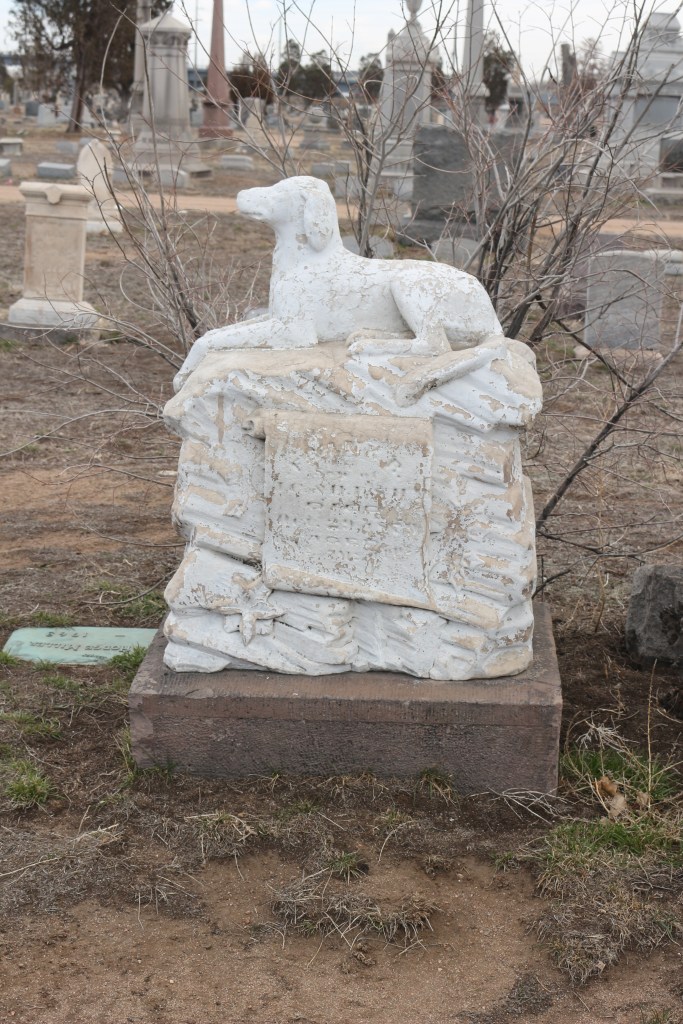
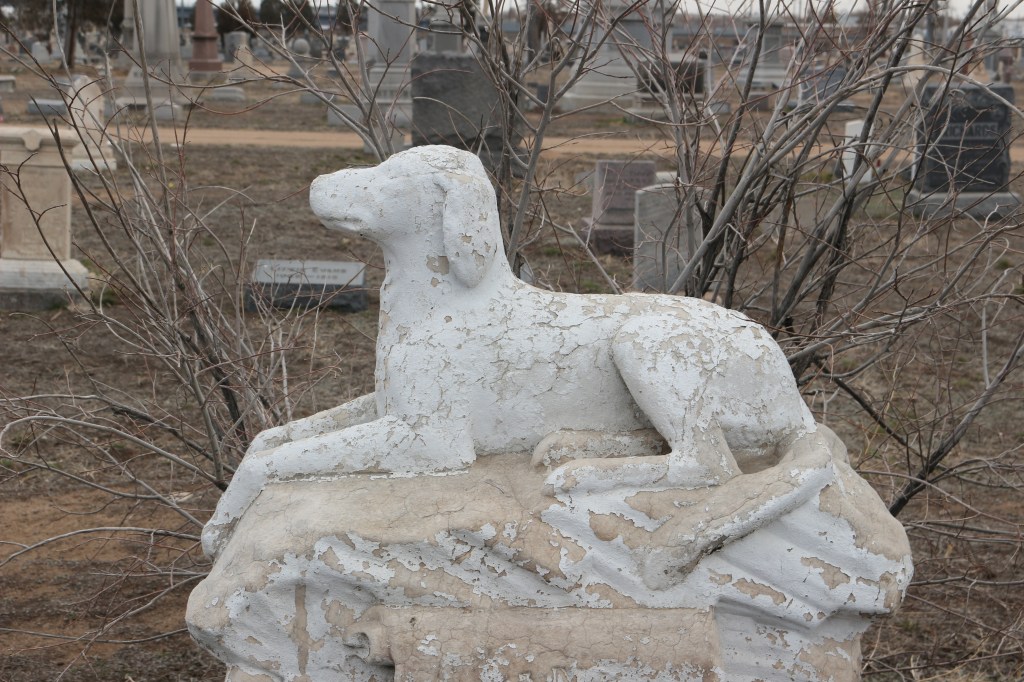
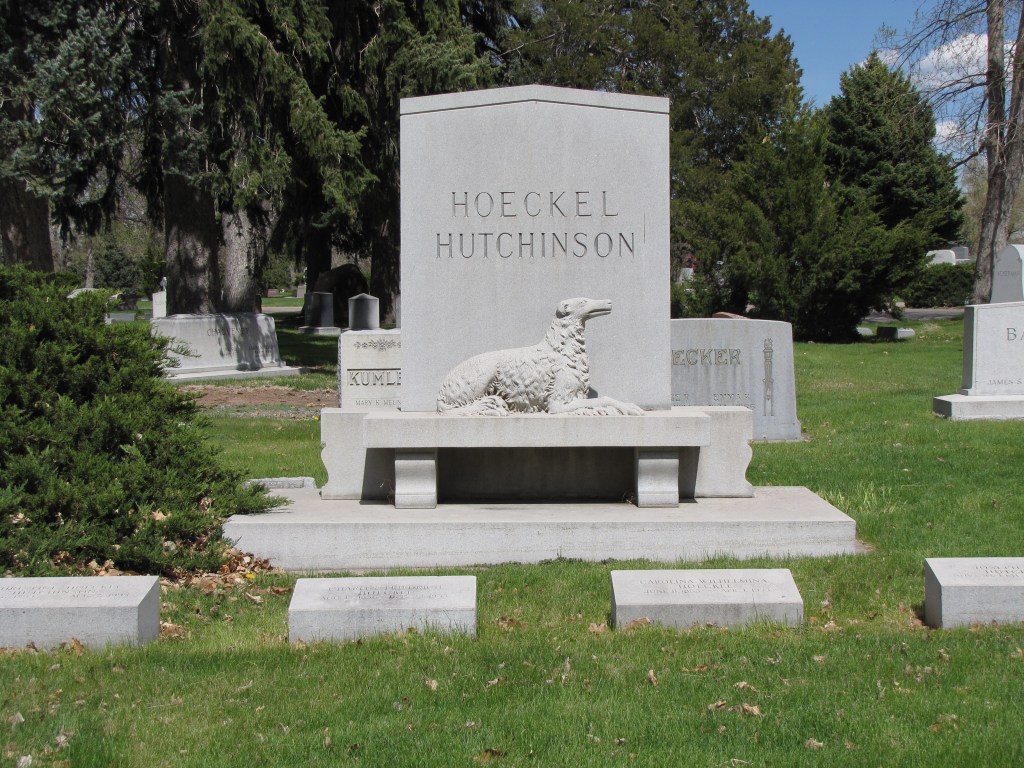
Two bronze dogs flank the steps to the massive granite Michel Mausoleum in the Green-Wood Cemetery in Brooklyn, New York.  Though the dogs are laying down, their heads are slightly raised as if they are ready to jump into action.  

The dog is typically seen representing fidelity and loyalty.

Posted in Uncategorized | Leave a comment

The Star and the Harp

FAMILY CEMETERY

OF

JOHN S. EBAUCH. V.D.M

A.D. 1850

For if we believe that Jesus died and rose again, even

So them also which sleep in Jesus will God bring with him.

1 Thess; 4 Chap. 14 Verse

 Thus when we in Christ have slumbered,

We shall rise, with the Wise,

And with them be numbered.

The Ebauch red sandstone family mausoleum in the Green-Wood Cemetery in Brooklyn has two symbols carved on the tomb’s door—a seven-pointed star with the words “OF BETHLEHEM” and below the star is an intricately carved harp with the words, “OF ZION.”

According to the Gospel of Matthew, chapter 2, the Star of Bethlehem was the light that signaled the miraculous birth of the Christ child that inspired the Magi to travel to Bethlehem just south of Jerusalem.

The harp has been considered the instrument of angels.  The Biblical passages Psalm 137, verses 1 through 3, read, “By the rivers of Babylon, there we sat down, yea, we wept, When we remembered Zion. We hanged our harps Upon the willows in the midst thereof. For there they that carried us away captive required of us a song; And they that wasted us required of us mirth, saying, Sing us one of the songs of Zion.”  The light and airy tones that emanate from the harp, ethereal and almost mystical, have long been thought of as the sound of Heaven.  

Posted in Uncategorized | 1 Comment

Lady Justice

The Greenwood Cemetery is one of the largest cemeteries in New Orleans with over 150 acres of graves and tombs still with active burials.  The cemetery was founded in 1852 by the Fireman’s Charitable Benevolent Association and has a number of communal vaults including the General Mechanics Society vault. 

The white marble vault is crowned with a draped urn. Urns are found on top of columns and mausoleums. The urn, of course, is a container used to hold the ashes or the cremated remains of the dead.  In this case, the urn is draped.  The drapery either represents a shroud symbolizing death and sorrow or can also be a motif that represents a veil that separates the Earth and Heaven.  The urn was an almost ubiquitous 19th Century symbol found in nearly every American cemetery. 

The decorative gable features an inset depicting the allegorical figure, Lady Justice, which was introduced into the Roman pantheon of gods by Augustus as Justitas.  Here she is shown blindfolded with her arm around the scales and a sword at her side. 

Lady Justice is most often found in a courthouse pediment or as a statue at the entrance of the building.  The blindfold is meant to show that justice is meted out fairly and impartially with no judgment regarding a person’s wealth, social status, or station in life.  The scale is a symbol that dates back as far as ancient Egypt, with the heart of the deceased being weighed against the feather of truth.  Here, rather than weighing the evidence of a crime, Lady Justice in a cemetery may be weighing a lifetime of sin or one of virtue.  Some believe the double-sided sword at her side symbolizes reason and justice while others believe it represents justice as swift and final.

Posted in Uncategorized | 1 Comment

Alois Alzheimer Remembered

HIER RUHT

CECILE ALZHEIMER

6 JULY 1860 – 28 FEBRAUARY 1901

ALOIS ALZHEIMER

14 JUNE 1864 – 19 DEZEMBER 1915

For anyone who has experienced the blank look in your mother’s eyes when she struggled to remember who you are, the name Alzheimer is a familiar name.  The name of the disease strikes fear in people diagnosed with it and those who are the caregivers.  The disease robs a person of their memories.

While I generally focus my writing on North American cemeteries I was in Frankfurt, Germany, on business in the last couple of weeks and had an afternoon to myself.  I jumped on the Metro and made my way to the Frankfurt Hauptfriedhof—the main cemetery.  And buried there in the magnificent cemetery with broad tree-lined alleys and walkways is the famous scientist, Alois Alzheimer, known for his work with Auguste Deter, the first person diagnosed with pre-senile dementia.

In 1906, Alzheimer published a paper describing the condition that he identified in his patient Deter.  Though Deter was only 50 years old, she exhibited short-term memory loss, paranoia, aggression, and sleep disturbance.  After her death, he studied her brain tissue and Alzheimer noted abnormal plaques and neurofibrillary tangles in her brain histology.  Though the medical field took little notice of Alzheimer’s paper, his colleague, Emil Kraepelin included the disease in his 1910 edition of Psyciatrie, naming it Alzheimer’s disease for the clinical psychiatrist and neuroanatomist—Alois Alzheimer.

His grave is in a corner of the cemetery far away from the main gate.  His monument backs up to the brick wall that encompasses the cemetery.  The bas-relief depicts a young boy clutching to what appears to be a rose and bud as he stands before a woman whose head is bent.

Posted in Uncategorized | Leave a comment

Installed but Did Not Serve

As mentioned in the previous post, Greenwood Cemetery, in Columbia, Tennessee, has several prominent Masons buried in the small cemetery, including Hezekiah Ward, who held the exalted office of Grand High Priest of the Grand Chapter of Royal Arch Masons in 1831 and 1832.  In a box or chest tomb not far away lies buried Taswell Alderson.

The following is a partial inscription on the top of his tomb:

SACRED

to the memory of

TASWELL S. ALDERSON, Esq.

Past Grand Master of the Grand Lodge of Tennessee and Past Grand High Priest of the Grand Lodge of Tennessee.  A native of Virginia and long a citizen of Tennessee, He was born on the 2nd of November 1802 and departed this life 24th of August 1842.   He was a Christian. And in his life adorned the doctrines of the one and obeyed the precepts of the other.  He took delight in doing good.  He was a friend to the poor the widowed and the fatherless.  Sorrow and want were never turned from his door without consolation and relief.  His whole life was one of active usefulness and benevolence and though death struck him down almost without warning In the full strength and pride of manhood. Still he was not unprepared for the blow.  For he made the word of God his counsel.

According to an article written by Nancy Adgent titled, “In Peace and Harmony”: Masons in Greenwood Cemetery, which appeared in the Association for Gravestone Studies QUARTERLY / Vol. 32, No. 4 / Fall 2008, the Taswell Alderson’s tomb, which was elaborately embellished with Masonic symbols indicated that Alderson was the second of two Grand High Priest buried in the tiny cemetery. 

            Adgent goes on the describe the panels of the Alderson box tomb that display Masonic symbols and explains why one of the panels may be without symbolism altogether.

“One end panel of Alderson’s tomb has a quarter moon crescent enclosed by the square and compasses, a symbol seen in jewels of the Junior Deacon and Deputy Master offices.  The other end has a blank panel, symbolically facing north, the direction Masons consider a place of darkness.” 

One side panel depicts the pick, hammer, and spade which represent some of the Master Mason’s tools.

Another panel adjacent panel “contains three six-pointed stars (hexalpha) above a crescent.  In ancient Masonry, the hexalpha was considered the Seal of Solomon and Shield of David, and it represented the universe, sun, and the planets.”

“Perhaps the most arcane carving is on the opposite side.  Although three and nine are significant numbers in Masonic culture, and candles are integral to the Masons’ search for spiritual illumination, the specific meaning of this motif is speculative. Pyramids often indicate God and the universe or ancient knowledge.  The triangular placement of the columns supporting the Masonic rule replicates the configuration of the three great lights on the lodge floor with the candles representing the sum, moon, and Master of the Lodge.  It may also be a stylized form of the icon for the Cryptic degree of Royal Master.  In addition to the number three, three-sided symbols also represent the Holy Trinity as well as wisdom, power, and creativity.”

“The last Alderson panel show three triangles, each with a trowel hanging from the top, a symbol found in jewelry for the Senior Warden office and the Cryptic degree level.”

However, there should be an asterisk on this box tomb, because while Alderson was inducted as the Grand Master of the Grand Lodge of Tennessee, he did not serve.  In fact, he was unable to serve because he was dead.

Reported in The Columbia Daily Herald, November 2, 2013, Bob Duncan, the then director of the Maury County archives, noticed the grave of Tazwell Alderson and his elaborate box tomb.  Duncan deciphered the faded entablature on the top of the box tomb. One of the things that the inscription said was that Tazewell Alderson had been Grand Master of the Grand Lodge of Tennessee.  When he visited the Columbia Lodge No. 31 he discovered that in the great lineup of oil portraits of Tennessee Grand Masters there was not one of Tazewell Alderson.

After a trip to the archives, the mystery was solved.  Alderson who was to be installed as Grand Master died just before the induction ceremony.  As a courtesy to honor the recently deceased Alderson and his family, the members of the Grand Lodge traveled to Columbia to give him Masonic last rites.  First, however, they installed him as Grand Master.  Installed but he did not serve.

Posted in Uncategorized | Leave a comment

Grand High Priest

Hezekiah Ward

Born March 10, 1795

Died May 10, 1836

Aged 41 years

Greenwood Cemetery, the original burying ground for the city of Columbia, Tennessee, established in 1809, sits on a bluff overlooking the winding Duck River.  Many notables are buried in the two-acre plot that was set aside over two centuries ago, including, Major Samuel Polk and Jane Know Polk, the parents of the 11th President of the United States, James Knox Polk.  Along with soldiers of the American revolution, Mexican American War, and the Civil War, there are several prominent Masons buried in the small cemetery, including Hezekiah Ward, who held the exalted office of Grand High Priest of the Grand Chapter of Royal Arch Masons in 1831 and 1832.

Hezekiah Ward worked as a carpenter.  He and his wife, Elizabeth Ridley, were married on May 2, 1822.  James Knox Polk, future president served as his bondsman.  The couple had seven children.  Ward died in 1836 at the young age of 41 years.  Ward was buried in a gray marble chest tomb.

The chest tomb side panels features ovals, two of which, depict Masonic motifs.  The end panel obscured by a tall gray tablet has a quarter moon crescent enclosed by the square and compasses. 

The side panel of Ward tomb is imbued with symbolism.  It depicts an oval with a keystone.  The keystone indicates that Hezekiah achieved the Mark Master degree.  The keystone is the architectural device that gives strength and durability to an arch. 

Inside the keystone is a circle with the letters H. T, W, S, S, T, K, S which stands for Hiram the widow’s son sent to King Solomon.  This is a reference to the Biblical passage 1 Kings 7:13-14:

“13 Now King Solomon sent and brought [a]Huram from Tyre

14 He was the son of a widow from the tribe of Naphtali, and his father was a man of Tyre, a bronze worker; he was filled with wisdom and understanding and skill in working with all kinds of bronze work. So, he came to King Solomon and did all his work.”

Within that circle is a coffin representing death next to a tree symbolizing the tree of life. 

In a very short time Hezekiah Ward had made his mark as a Mason achieving the highest office in the state.

Posted in Uncategorized | 1 Comment