Elks Rest

In many cemeteries across the country are common burial spots owned by Elks Lodges for fraternity members who would like to be buried next to their Departed Brothers.  These burial plots are often marked by a statue of an elk.  Sometimes the elk is carved from stone, other times, a bronze elk marks the final resting plots where the fraternal brothers rest until their final summons to the Celestial Lodge.

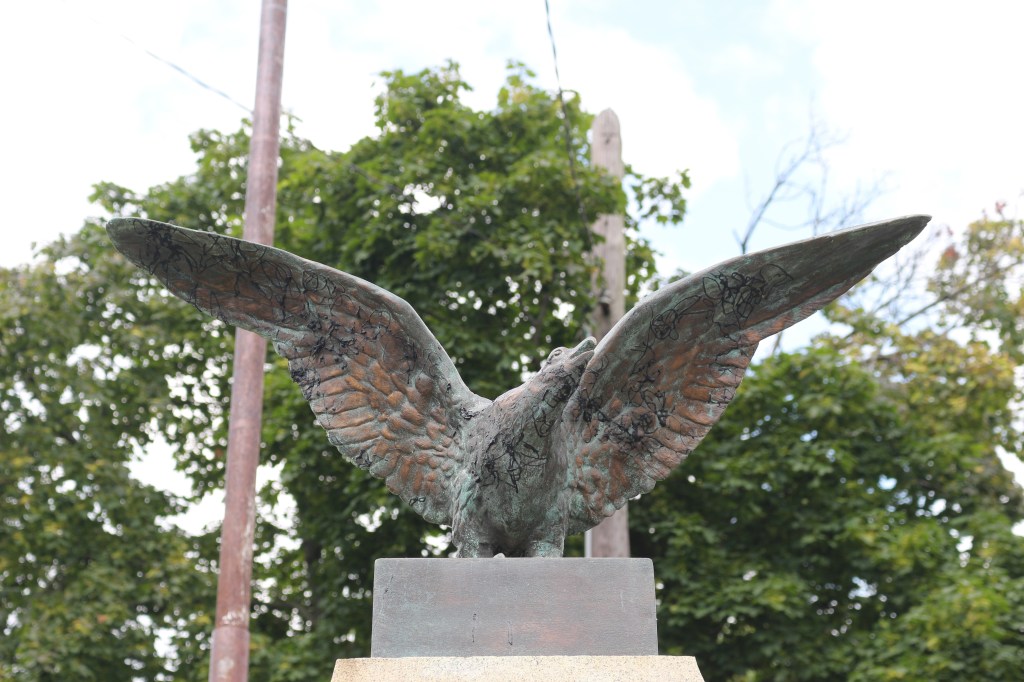
The Elks Rest in the Oakwood Cemetery in Syracuse, New York, has an Elks Rest marked by a bronze elk.  This particular statue was created by “ELI” who signed the hoof, dated 1904. 

The sculptor was Eli Harvey (September 23, 1860—February 10, 1957) an Ohio-born artist whose most famous work of art was, in fact, for the Benevolent Protective Order of Elks, who commissioned him to create a life-sized elk for use on their buildings and cemetery plots.

Eli Harvey’s sculptures can be found in art museums, historical societies, and zoos across the country.  Harvey’s elks can be found in many locations around the United States, including: Greenwood Cemetery in New Orleans; Evergreen Cemetery in Colorado Springs, Colorado; North Burial Ground, Providence, Rhode Island; Clinton County Historical Society in Wilmington, Ohio; Prince Street in Alexandria, Virginia; Riverside Cemetery in Waterbury, Connecticut; Elks Opera House in Prescott, Arizona; Lakewood Cemetery in Minneapolis Minnesota; Mohawk Trail in Florida, Massachusetts; B.P.O.E Lodge in Kirkwood, New York; Toledo Memorial Park in Sylvania, Ohio; Woodlawn National Cemetery in Elmira, New York; Elks National Home in Bedford, Virginia; Highlawn Cemetery in Terre Haute, Indiana; Greenlawn Cemetery in Newport News, Virginia; Kensico Cemetery in Valhalla, New York; and Roselawn Cemetery in Pueblo, Colorado.

Green-Wood Cemetery, New Orleans, Louisiana

Posted in Uncategorized | 2 Comments

A Son’s Tribute to His Pioneer Parents

REUBEN FLAGG
DIED NOV. 9, 1869
IN THE 71ST YEAR OF HIS AGE
WAS ONE OF THE FOUR FIRST FAMILIES
THAT SETTLED IN WILL CO.
A PIONEER IN THE ADVANCE GUARD OF THE
WESTERN EMIGRATION 1830
HAULED THE LUMBER TO BUILD THE FIRST
FRAME HOUSE ERECTED IN CHICAGO.
OUR MOTHER BETSEY K.
WIFE OF REUBEN FLAGG
DIED FEB. 20, 1876
IN THE 71ST YEAR OF HER AGE
MOTHER OF THE FIRST WHITE CHILD BORN IN WILL CO.
MARY JANE
DIED JULY 11, 1853 AGED 9. YRS. 10. MS 26. DS.
HENRY C.
DIED DEC. 17, 1854 AGED 15. YRS. 3. MS. 10. DS.
SAMATHA E.
DIED FEB. 25. 1872 AGED 41. YRS. 5. MS.
CHILDREN OF R. & B. FLAGG


According to the trade magazine publication, Monument Reporter, December, 1909, Volume 42, Issue No. 12, published by Nichols and Co., Chicago, Illinois, page 13, the Flagg monument was a “unique monument erected at the Plainfield, Cemetery, Plainfield, Ill. For George Flagg, in memory of his father and mother, Reuben A. Flagg and his wife. This job was cut out of one solid piece of Indiana buff Bedford stone. It is 5-0 x 4-0 x 7-2 to the top of the chimney and weighs 15,000 pounds. It required six horses to haul it from the depot to the cemetery. Mr. and Mrs. Flagg were one of the first four families in Will County and always lived in a log cabin of this style; and that is why this monument was especially designed for them by Arthur Wunderlich of the E. Wunderlich Granite Co., Joliet.”

Posted in Uncategorized | Leave a comment

The Iron Weeping Willow

One of my favorite graveyard motifs is the willow, one of the most ubiquitous symbols found in American cemeteries.

According to James Deetz and Edwin S. Dethlefsen, in their groundbreaking article, “Death’s Head, Cherub, Urn and Willow” the willow first made its appearance in cemeteries in the early 18th century.  The motif represented a break from the stark and cold reminders that death would bring that the Puritans carved into their gravestones—flying death’s heads, skulls and crossbones, and gravedigger’s equipment. In addition to the grim reminders of the inevitability of death Puritan gravestones often accompanied the haunting imagery with blunt words such as, “Here lies the body.” Nothing subtle there.

The willow, however, represented a more sentimental view of death.

The willow as a symbol is sentimental and hints at the human emotions felt during grief.  The willow motif represents what one might expect; sorrow and grief, it is after all a “weeping” willow. This symbol is found on many gravestones and can be found carved in a variety of styles. Not only does it appear on tombstones, but can also be found in the iron fences and gates surrounding plots–as does this willow shading two lambs in the Old City Cemetery in Sacramento, California.

Posted in Uncategorized | 2 Comments

Help–What kind of flower is this?

In the previous post, floriography was defined and highlighted as a way to understand the silent messages found on gravestones erected during the Victorian era. To understand the symbolism, however, one has to be able to identify the flower depicted on the stone.

For me, this flower is a mystery. Any ideas of what kind of flower this is?

Posted in Uncategorized | 6 Comments

Goddess of Flowers

JAMES COUSINS

DIED

JULY 4, 1901,

AGED 50 YEARS

The segmented top white marble gravestone of James Cousins in the Old City Cemetery in Sacramento, California, is festooned with flowers and foliage—lily of the valley, ferns, and ivy—each with meaning. 

 In Victorian times, flowers took on significance as a way to send coded messages; this was known as floriography from the Latin combining flora—“goddess of flowers”—and graphein—“writing.”

In 1884, Kate Greenaway, a popular author and illustrator published a book titled, the Language of Flowers.  According to her book, each flower had a meaning that was conveyed to the viewer or receiver of the flower or bouquet of flowers—for instance, the weeping willow represented mourning, the white lily represented purity, the Easter lily represented the Resurrection, and so on.  The book is a nearly complete listing of flowers along with their “secret” or symbolic meanings. 

Since the lily of the valley is one of Spring’s first bloomers, often pushing up through the snow it symbolizes renewal and resurrection.  Also, as legend tells us, when the Virgin Mary shed tears, her teardrops fell to the ground and sprung up into lilies of the valley. They have come to represent purity and innocence.  The fern represents humility and sincerity.  The ivy is commonly found in most cemeteries. Because of the ivy’s nature to twine up a surface and hang on tight, the plant symbolizes everlasting love and eternal friendship.

Posted in Uncategorized | 3 Comments

Art Deco

VIRGINIA

RANDOLPH

ELLETT

1857 – – 1939

FOREMOST IN LIEARNING AND IN FAITH AND AID

PRE-EMINENT; ALL-TIRELESS; NEVER FOND

BUT RESOULTE IN PROGRESS AND AFRAID

ONLY OF FINDING NO MORE WORK BEYOND

Nested under a canopy of trees in a gated plot surrounded by an iron fence in the famed Hollywood Cemetery is a gravestone dedicated to the pre-eminent educator, Virginia Randolph Ellett, in Richmond, Virginia.  Ellett was an early advocate for the education of girls and in 1890 established a small but well-known school.  By 1897, Ellett began accepting only girl students.  She became renown as an educator in Virginia and beyond.

Honoring Ellett is a plain square-topped white marble tablet embellished with a stylized trumpet angel.  Trumpet angels foretell of the impending apocalypse and that the last Judgment is at hand but also as “embodiments of the resurrection.” According to the article, “Embodying Immortality: Angels in America’s Rural Garden Cemeteries, 1850—1900”, pages 56 – 111, 2007 edition of Markers, XXIV, written by Elisabeth Roark, of the eight common categories of angels found in rural garden cemeteries only the trumpet angels are commonly found in cemeteries before the 1850s.

After the 1850s trumpet angels appear more frequently and often as full sculptures rather than bas-reliefs. The angels are often depicted looking toward the Heavens with an almost serene expression unlike the trumpet angels found in the Book of Revelation. The seven trumpet angels in Revelation “are a ferocious lot; each trumpet blow brings a disaster that destroys earthly life.”

This particular trumpet angel was carved by Rene Paul Chambellan (1893 – 1955) an American artist best known for his architectural sculptures.  His fluid designs were referred by several names—French Modern Style, Zig-Zag Moderne, as well as, Art Deco. 

His work can be found on many prominent buildings such as the Chicago Tribune Building, Sterling Memorial Library on the Yale campus, the Buffalo City Hall, and several works at Rockefeller Center in New York City, such as the Acts of Vaudeville under the marquee above the 1260 Avenue of the Americas entrance:

Atlas at the 630 Fifth Avenue, Main entrance, Chambellan collaborated with Lee Lawrie to create:

and the Fountainhead Figures of the Six Pools in the Channel Gardens.

Posted in Uncategorized | Leave a comment

Contrapposto

ANN AMERICA,

WIFEOF L. GAMBRILL,

AND DAUGHER OF

REV. L. PIERCE,

BORN DEC. 10TH 1815,

DIED DEC. 1ST 1859.

“THIS IS THE VICTORY THAT OVERCOM-

ETH THE WORLD EVEN OUR FAITH.”

The white marble monument in the Linwood Cemetery in Columbus, Georgia, of Ann America Gambrill is festooned with flowers decorating the rounded top.  The gravestone also has a deep inset with a bas-relief allegorical figure of Faith.  Faith holds a closed book, likely a Bible, in one hand and her other holds a Latin cross, the universal symbol of Christianity.

The neoclassical sculpture displays a Greek sculptural scheme referred to as contrapposto, which is an Italian word meaning counterpoise.  The figure is poised “such that the weight rests on one leg, freeing the other leg, which is bent at the knee.  With the weight shift, the hips, shoulders, and head tilt, suggesting relaxation.”  In early classical sculptures the statues were often nude figures but also draped as in this example.

Posted in Uncategorized | 2 Comments

Patriot Soldier Statesman

Archibald Bulloch’s tomb can be found in the Colonial Park Cemetery in Savannah, Georgia.  Though his name most likely does not ring a bell today, he was an historically significant figure in the State of Georgia’s history.

Brickwork covers his tomb.  Atop the stepped brick ledger sets a gray marble monument in three parts—plinth, base, and decorative urn.   

On each of the four-sides of the base is a carved Ouroboros Ophis.  The Ouroboros is an ancient symbol depicting a snake eating its tail. The word, Ouroboros, is Greek—oura meaning tail; vora meaning eating, and ophis meaning serpent or snake. In ancient Egypt, the Ouroboros represented the daily passage of the sun.  However, the symbol was adopted by Western culture and came to represent the cycle of endless creation and destruction; for living creatures, the cycle of life and death.  The snake eating its tail in cemetery symbolism represents the cycle of life—birth and death—and eternity.

Inside the Ouroboros on the front of the base is inscribed:

FIRST PRESIDENT

Of

GEORGIA

1776 – 1777

ARCHIBALD BULLOCK

Born in So. Carolina

1730

Died in Savh

1777

Below the base on the plinth is inscribed the following:

Patriot Soldier Statesman

Georgians! Let the memory

of Archibald Bulloch live

in your breasts, tell your

children of him and let them

tell another generation.

Next to Bulloch’s tomb is a marker placed by the Georgia Historical Commission that reads:

“This is no time to talk of moderation; in the present instance it ceases to be a virtue.”
Speech to Provincial Congress, June 5, 1776

Foremost among Georgia’s Revolutionary patriots stood Archibald Bulloch whose remains rest in this vault. An early and staunch advocate of American rights, Bulloch was among the patriots who issued the call in 1774 for the first province-wide meeting of the friends of Liberty in Georgia.

He served as President of the 1st and the 2nd Provincial Congress & was a delegate in 1775 to the Continental Congress where he won John Adams’ praise for his “abilities and fortitude.”

In April, 1776, Mr. Bulloch became the first President and Commander in Chief of Georgia, an office he ably filled until his untimely death during the latter part of February, 1777. His loss was a severe blow to the revolutionary cause in Georgia as his was the only leadership which united the Whig factions in the troubled young State.

Theodore Roosevelt was the great-great-grandson of the Georgia patriot.”

Posted in Uncategorized | Leave a comment

The Waving Girl, the Myth, Take Two

GEORGE W. MARTUS

MAY 31, 1861

JUNE 24, 1940

FLORENCE M. MARTUS

AUG. 7, 1868

FEB. 8. 1943

IN MEMORY OF THE WAVING GIRL AND HER BROTHER,

KEEPERS OF THE LIGHT HOUSE ON ELBA ISLAND. SAVH RIVER FOR 35 YRS.

Savannah, Georgia, like many historic cities has a Hop-on-Hop-off Trolley that takes you round the city with the tour guide regaling the tourists on the bus with many fascinating, spooky, and sometimes tragic stories.  Few of the stories told are as poignant as the story of the “Waving Girl.”  And here is where the myth comes in.

As the story goes, the young redhead, Florence Martus, fell in love with a good-looking sailor.  Unfortunately, he was soon to set sail shortly after they fell for each other.  But they pledged their love and promised that as soon as he returned, they would renew their love and begin their life together.  She promised to be faithful.  Patiently and hopefully, Florence waved her white apron greeting incoming ships and at night she waved a lantern hoping that her true love would be on board and see her.  For forty-four years she kept her vigil by the lighthouse, but her sailor never returned.  She never again saw the love of her youth and she died broken hearted.

But after further research, what I found out is that that fanciful tale is not, in fact, true.  It does sound terribly romantic, and you can imagine how a story like this got started as the story of the Waving Girl was told and re-told.  There is a lot of truth in the story.  Florence did live on Elba Island with her brother, George.  They took over the care of the lighthouse when their father died.  And Florence did wave at passing ships—from 1887 until 1931!  But, according to Savannah’s Monuments: The Untold Stories by Michael Freeman, published by Schiffer Publishing, Ltd., page 59, Florence gave an interview late in her life where she dispelled the myth that had grown up around her, “That’s a nice story.  But what got me started…I was young and it was sort of lonely on the island for a girl.  At first I would run out to wave at my friends passing, and I was so tickled when they blew the whistle back at me…”

Felix De Weldon, famous for his statue of the raising of the flag on Iwo Jima statue in Washington, D.C., was commissioned to create the bronze statue of Florence Martus. The statue was erected on the east end of River Street in Savannah not in remembrance of her lost love, but her devotion to greeting the passing ships for over four decades.

The cautionary tale here is: “Don’t believe everything you hear from a tour guide.”

Posted in Uncategorized | 2 Comments

The Waving Girl

GEORGE W. MARTUS

MAY 31, 1861

JUNE 24, 1940

FLORENCE M. MARTUS

AUG. 7, 1868

FEB. 8. 1943

IN MEMORY OF THE WAVING GIRL AND HER BROTHER,

KEEPERS OF THE LIGHT HOUSE ON ELBA ISLAND. SAVH RIVER FOR 35 YRS.

Savannah, Georgia, like many historic cities has a Hop-on—Hop-off Trolley that takes you round the city with the tour guide regaling the tourists on the bus with many fascinating, spooky, and sometimes tragic stories.  Few of the stories told are as poignant as the story of the “Waving Girl.”

As the story goes, the young redhead, Florence Martus, fell in love with a good-looking sailor.  Unfortunately, he was soon to set sail shortly after they fell for each other.  But they pledged their love and promised that as soon as he returned, they would renew their love and begin their life together.  She promised to be faithful.  Patiently and hopefully, Florence waved her white apron greeting incoming ships and at night she waved a lantern hoping that her true love would be on board and see her.  For fifty years she kept her vigil by the lighthouse, but her sailor never returned.  She never again saw the love of her youth and she died broken hearted.

A bronze statue of Florence Martus was created by Felix De Weldon and erected on the east end of River Street in Savannah in remembrance of her and her lost love.

Posted in Uncategorized | Leave a comment