Monument to An American Hero

IN BELOVED MEMORY OF

LT. COL. JOHN BAYARD SNOWEDEN II

BORN JAN. 19, 1906

KILLED IN ACTION NEAR MARBACHE, FRANCE

SEPT. 7, 1944

COMMANDING 318TH INF BN 3RD ARMY U.S.A.

BURIED LOT A ROW 6 GRAVE 145

AMERICAN MILITARY CEMETERY NO. 1

CHAMPIGNEUL, FRANCE

The monument in the Elmwood Cemetery in Memphis, Tennessee, was a cenotaph.  It was erected to commemorate the life and death of t. Col. John Bayard Snowden II, who was not originally buried under the tomb.  The word cenotaph originates from the Greek word kenotaphion.  Kenos means empty and taphos tranlsates to tomb–together they form “empty tomb.”

As the inscription details on tomb, Lieutenant Colonel John Bayard Snowden II was killed in action near, Marbache, France in September of 1944. After his death, he was buried in an American Military Cemetery in France, and then his body was returned to Elmwood Cemetery in his hometown of Memphis.

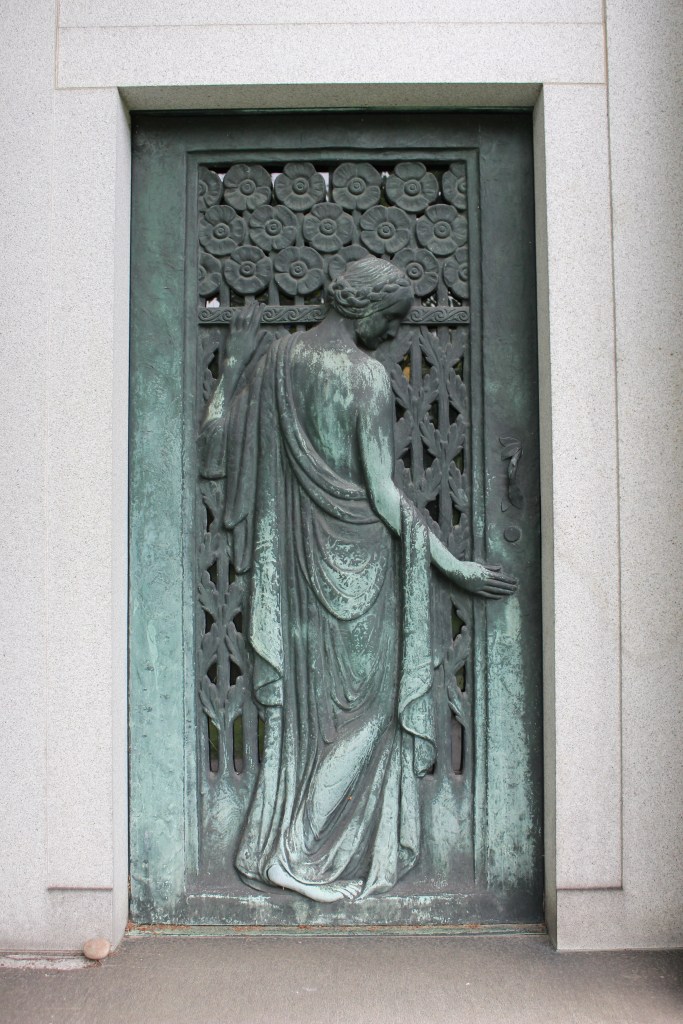
The life-size angel gracing the tomb was sculpted by Norfolk, Virginia-born artist, William Couper (September 20, 1853- June 22, 19420). The bronze angel holds a palm branch in one hand and torch pointed downward, representing death in the other.  Couper was a noted artist well-known for his neo-classic and realistic sculptures of military heroes, historical figures, and angels, including the recording angel he sculpted for his family’s monument in the Elmwood Cemetery, in Norfolk, Virginia. 

His sculptures can be found in town squares, museums, parks, and cemeteries, including the sculptures of sphinxes he carved for the Stanford Mausoleum on the grounds of Stanford University.

Posted in Uncategorized | Leave a comment

A Rusting Tribute

MOTHER

ARABELLA A.

BINNINGTON

Born October 27th 1847

Died January 5th 1918

Grave markers are made of many different materials—stone, zinc, wood, iron, bronze, and even steel as is this marker in the Rosehill Cemetery at Idaho Falls, Idaho. 

For the most part, markers are meant to be created to last, which is why so many are made of sturdy materials such as granite or bronze which holds up against the weather for generations. 

However, in some cases, the families had to use materials at hand, such as the pioneers who crossed the open prairie as they travelled Westward.  Many of those markers were fashioned quickly out of wood and painted with names and dates as the families continued their treks. 

While others used materials that are less expensive and less likely to endure harsh weather, such as this steel rounded-top marker.  Clearly the rust is taking a toll with the marker coming apart at the seams. It is only a matter of time before the corrosion damages the marker beyond repair and this tribute to a mother no longer serves its purpose.

Posted in Uncategorized | Leave a comment

Denver Pioneer

David Kline

1836 – 1911

Within the grounds of the Fairmount Cemetery in Denver, Colorado, is the Congregation Emanuel Cemetery. There lies the grave of David Kline, the first president of Denver’s B’nai B’rith, early pioneer of Denver, and the successful proprietor of a dry goods business. 

The center of his light gray granite headstone features a medallion with a bronze bas-relief portrait of Mr. Kline.  The sculpture was created by Julia Bracken Wendt (1868-1942), a student of the famed artist Lorado Taft with whom she studied at the Chicago Art Institute.

Posted in Uncategorized | 2 Comments

The Grim Reaper Stops the Soldier In His Tracks

Soldier

ADOLF SCHNIEDER

Born November 8th, 1884 – Died July 10th, 1916

He died

For the Fatherland

The dramatic gravestone of Adolf Schnieder, a German soldier who died in World War I, stands in a shaded recess in the Main Cemetery in Frankfurt, Germany.  The center column of the gravestone has a carved bas-relief sculpture and the inscription with the deceased soldier’s name, birth and death date.  The column is flanked on each side by side panels and broken columns with cherubs standing atop.  At the base of the center column is a helmet, rifle, and strap denoting the Adolf Schneider’s service.

The bas-relief sculpture depicts the cloaked and skeletal figure of the Grim Reaper, the personification of Death.  Some believe that the origin of the reaper is from the Greek myth of Charon, the ferryman.  Since ancient times, the imagery of the soul crossing a river was created to explain how the soul went from one realm to the other.  This vivid imagery has long been a part of the symbolism of death in iconography and word.

In Greek mythology, the River Styx wrapped its way around Hades (the Underworld) nine times.  To cross from this life to the next, the dead had to pay with a coin to be ferried from the realm of the living to the realm of the dead.  The toll was placed in the mouth of the deceased to pay Charon, the ferryman.  It was said that if the dead person did not have the coin, he was destined to wander the shores of the River Styx for a century.

Here, the Grim Reaper is holding an hourglass. There are several expressions in the American lexicon that refer to the hourglass and express how fleeting our time on this Earth is, how this temporal life is short. The grand old soap opera, Days of Our Lives, has as their catchphrase, “Like sands through the hourglass, so are the days of our lives.”  Life measured by the grains of sand slip through one side of the hourglass to the other in a flash.  The Grim Reaper is signifying that the soldier’s time is up. 

The Grim Reaper’s other hand is raised ominously stopping the equestrian soldier in his tracks.

Posted in Uncategorized | Leave a comment

The Poet

THE POET

HANS CHRISTIAN

ANDERSEN

2 April 1805

4 August 1875

The soul which God in his image created,

Is incorruptible, can not be lost.

Our life on earth is the seed of eternity,

Our body dies, but the soul can not die!

Hans Christian Andersen’s gravestone in the Assistens Cemetery in Copenhagen is plain and unostentatious especially given his worldwide fame and popularity.  Even though, Andersen wrote plays, novels, poems, and travelogues, he is best known for his 156 stories that have been translated into 145 languages and are the stuff all children grew up on. 

Fairy tales such as the “Ugly Duckling”, “The Emperor’s New Clothes”, “The Princess and the Pea”, and “Thumbelina” are iconic stories that have been read to children for generations.  The statue of the Little Mermaid, from his story of the same name has become an iconic symbol of Copenhagen and a must-visited stop for every tourist to the city.

Posted in Uncategorized | Leave a comment

 Slumber in the Dust

IN

memory of

SARAH CURTIS,

who departed this life

Aug. 1, 1840;

in the 68th year of her

age

Unveil thy bosom faithful tomb,

Take this new treasure to the thy trust;

And give these sacred relics room,

To seek slumber in the dust.

In the historic Mount Holly Cemetery at Little Rock, Arkansas, a stained square-top marble tablet is nestled into a tree growing around it. The gravestone marks the grave of Sarah Curtis.  The epitaph makes a simple and plaintive plea for her peaceful rest in the grave.

Posted in Uncategorized | Leave a comment

Heavenly Handshake

SWEETLY SLEEPING

Angel Wife

REST DEAR LOVED ONE.

MARY E.

WIFE OF

H. F. JONES

BORN

JULY 28. 1862.

DIED

NOV. 6. 1888.

Clasping hands as in a handshake was a popular Victorian motif and can be found in most American cemeteries in the latter 19th century. 

The symbol can take on many meanings and sometimes the cuffs on the wrists can give the viewer a clue and can indicate a particular meaning.  If for instance, one cuff has lace and one is a buttoned shirt cuff, it likely represents the matrimonial bond—that link between a married couple.  If the cuffs on both wrists are shirt cuffs, it can symbolize fraternal brotherhood—as members of the same organization or union. 

In the case above, where the hands descend through the clouds, which symbolize Heaven, it can represent a final farewell or eternal bond between the living and the dead. The handshake may also represent God reaching out for the deceased to bring them into his presence as a welcome to Heaven—the Heavenly handshake.

Posted in Uncategorized | Leave a comment

The Hand of God and a Broken Chain

N. G. LEWIS

DIED DEC. 21, 1869

AGED

69 Y. 10 M. 7D.

The rounded-top white marble gravestone of N. G. Lewis depicts the hand of God holding a broken chain. The broken link of chain represents a life that has ended. This symbolism dates back to medieval times when people believed that the soul could be held to the body by a golden chain. Once the chain was broken, the soul took flight and rose from the body leaving Earth and ascended to Heaven. Here there are three links in the chain which may also represent the Trinity—the Father, the Son, and the Holy Spirit.

Posted in Uncategorized | Leave a comment

The Hand of God Wielding a Hatchet

Memento Mori

In Memory of

Mrs. ABIGAIL GOBLE

who died in Oct.br 1742

Aged 62 Years

The Old Burying Ground at the Presbyterian Church at Morristown, New Jersey, is full of red slate gravestones, the most interesting of them by far is the gravestone of Abigail Goble, believed to be the oldest woman buried within the churchyard.  The image is dramatic.  In the right side of the top of the gravestone or the tympanum, out of the sculpted clouds of the Heavens, comes the hand of God wielding a hatchet. God’s axe has felled the Tree of Life!  The Tree is hacked down, life is over.  Over the top of the gravestone are the words “Memento Mori”.  This is a medieval reminder from the depths of the Black Death that swept through Europe to “remember death”.  Death was a constant and one must be prepared to die at any time.

Posted in Uncategorized | Leave a comment

The Hand of God Holding a Sheaf of Wheat

ALICE WARD JEFFS

Wife of

WILLIAM Y. JEFFS

BORN

Nov. 4 1832

Died

Sept, 4 1907

MOTHER

As the previous blogpost reported, for nearly a thousand years, artists depicted God as a hand reaching down from the clouds.  Such a representation can be found on Alice Ward Jeffs’s gothic-styled white marble gravestone in the Iona Cemetery in Ammon, Idaho.  On her marker, the hand coming down from swirling clouds is holding a sheaf of wheat and a sickle. 

Wheat’s origins are unknown but is the basis of basic food and a staple in many cultures. Because of wheat’s exalted position as a mainstay foodstuff, it is viewed as a gift from Heaven.  Wheat symbolizes immortality and resurrection.  But, like many symbols found on gravestones, they can have more than one meaning.  For instance, because wheat is the main ingredient of bread, the wheat can represent the Body of Christ in the Eucharist.  Wheat can also represent a long life, usually more than three score and ten, or seventy years, as is the case for Alice Ward Jeffs, who was a month shy of her 75th birthday.

The sickle is an ancient farm hand tool dating back thousands of years that was used to harvest cereal grains such as wheat.  The sickle was a farm implement to gather the wheat; used in funerary symbolism it represents a “harvesting of souls.”  The sickle can be shown alone or coupled with another object—such as a sheaf of wheat or with the Grim Reaper, himself! 

Posted in Uncategorized | Leave a comment