
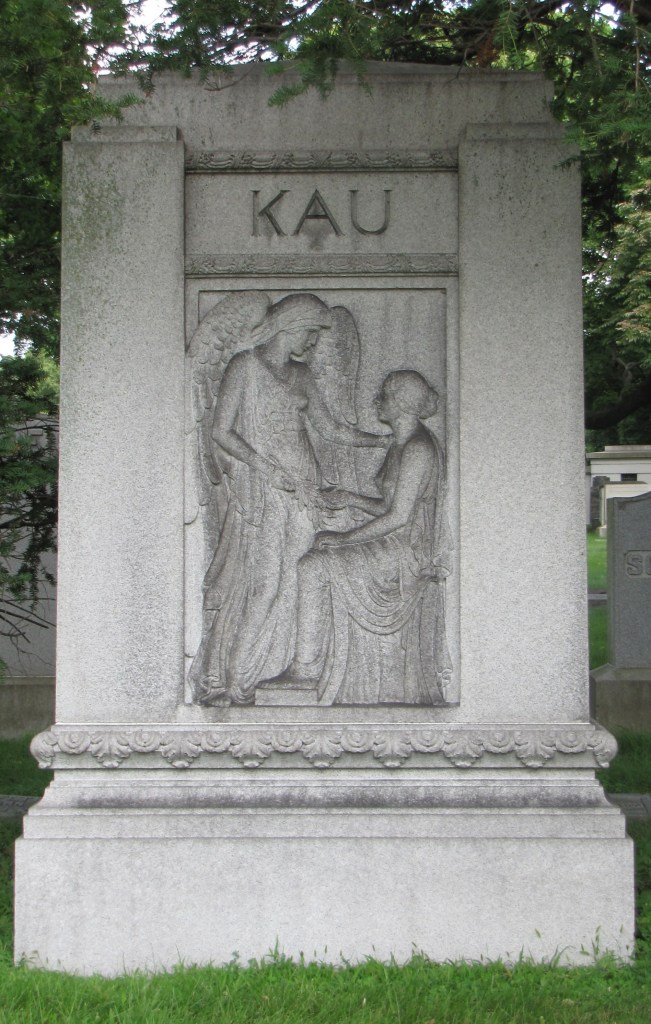
HENRY KAU
OCTOBER 18, 1863 – AUGUST 7, 1943
KATHERINA KAU
BORN OHIO, ILLINOIS
JUNE 15, 1867 – DECEMBER 6, 1933
Elisabeth L. Roark wrote an article about angels titled, “Embodying Immortality: Angels in America’s Rural Garden Cemeteries, 1850—1900”, pages 56 – 111, 2007 edition of Markers, XXIV, in which she wrote that in the second half of the 19th Century. there was an “invasion” of angels in rural garden cemeteries, which were for the most part Protestant graveyards. Roark explains in the article that Protestants accepted the concept of angels because they not only expressed a message of consolation but were also utilitarian—these angels performed tasks.
According the article, angels come onto the scene in rural garden cemeteries in a big way starting in 1850 and then throughout the rest of the century. Though angels come in many variations and forms, in her study of 14 rural cemeteries from each region of America, Roark found that the majority of angels fall into the following eight categories:
Soul-bearing Angels
Praying Angels
Angels who decorate and watch over the grave
Pointing angels
Recording angels
Trumpet angels
Michael the archangel
Child angels

In this example, in the Rose Hill Cemetery in Chicago, Illinois, the Kau monument depicts a classically dressed soul-bearing angel standing in front of a seated woman. The angel, a messenger of God, in a comforting moment touches the woman’s shoulder while offering her an olive sprig. This seems to be the moment just before the angel and the woman ascend to Heaven. Here the olive branch likely symbolizes that the soul of the soon-to-be departed woman will leave in peace with God. The olive sprig can also represent a desire for peace and harmony for the loved ones who are left behind.


 Gravely Speaking