

JOHN THEOBOLD WEYBRECHT
BORN IN ALSACE, FRANCE JANUARY 27TH 1829.
DIED AT ALLIANCE, OHIO JANUARY 31ST, 1895.
KNOW TO THIS COMMUNITY FOR FORTY YEARS
AS A USEFUL CITIZEN AND HONEST MAN
The towering granite Weybrecht monument in the Alliance City Cemetery in Alliance, Ohio, is imbued with symbolism starting at the very top. Often, urns are found on top of columns. The urn, of course, is a container used to hold the ashes or the cremated remains of the dead. In this case, the urn is draped. The drapery can represent a shroud symbolizing death and sorrow, or can be a motif that represents a veil that separates the Earthly and Heavenly realms. The urn was an almost ubiquitous 19th Century symbol found in nearly every American cemetery.
The irony is that very few people were cremated during the 19th Century when the draped urn motif was at the height of its popularity. For instance, during the eight years from 1876 until 1884, only 41 Americans were cremated. David Charles Sloane writes in his book, Is the Cemetery Dead? pages10-11, “in 1960, fewer than 5 percent of dead Americans were cremated. Most were buried or entombed in cemeteries after religious services. By 2015, a larger percentage of the dead were cremated (roughly 48 percent)…Projections suggest this trend will only escalate, perhaps to 70 percent cremated by 2030”.
Lower on the monument is a laurel wreath tied neatly with a ribbon. The laurel wreath dates back to Roman times when soldiers wore them as triumphal signs of glory. The laurel was also believed to wash away the soldier’s guilt from injuring or killing any of his opponents. In funerary art the laurel wreath is often seen as a symbol of victory over death.
But, the focal point of the monument, between the columns with the composite capitals is a cartouche with a bronze medallion containing the portrait of John Theobold Weybrecht and an inscription that details his birth, death, and virtue as a citizen and a man.
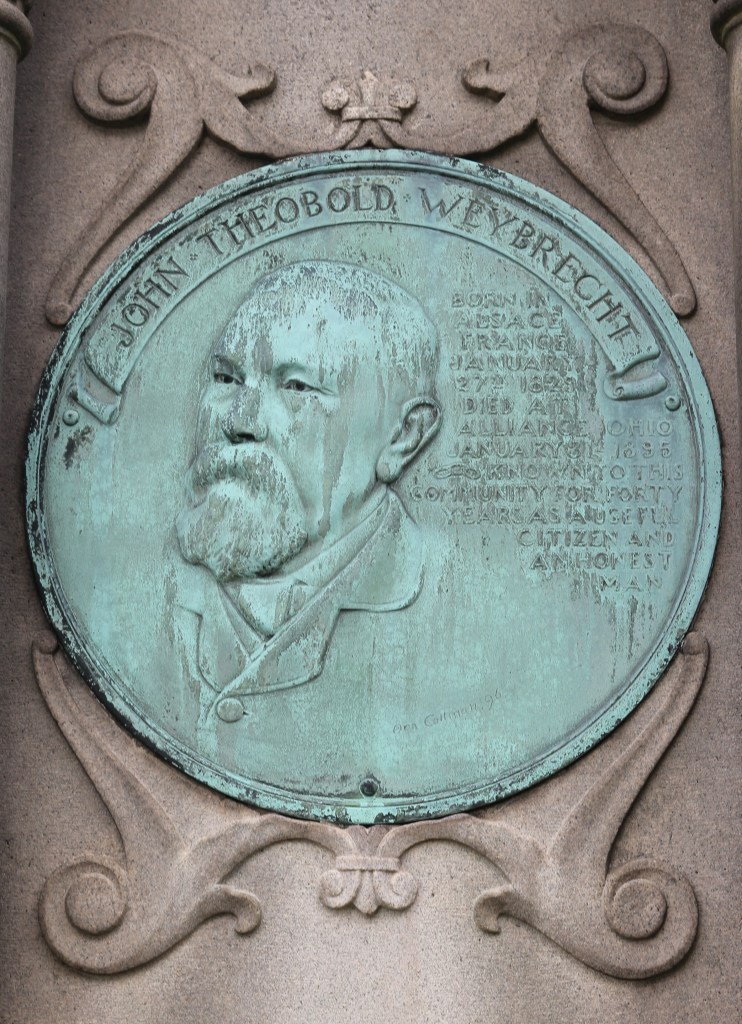
The bas-relief or low-relief of Weybrecht was sculpted by Ohio artist Ora Coltman (December 3, 1858 – July 2, 1940). Coltman was a painter, as well as a sculptor. The difficulty in creating a flattened sculpture of a face is giving it a three-dimensional look and feel and capturing the visual qualities of the man. Coltman’s talent is clear.


 Gravely Speaking