

James Breading Hogg
1813 – September 27, 1854
Before the horrific sinking of the Titanic, another maritime disaster made huge headlines. According to Images of America: Allegheny Cemetery by Lisa Speranza and Nancy Foley page 111, Arcadia Publishing 2016, Charleston, South Carolina, “James B. Hogg was lost on the infamous sinking of the Collins liner Arctic due to a collision with the steamer Vesta off the coast of Cape Race on September 27, 1854.” Cape Race is located at the southeastern tip of the Avalon Peninsula coast of Newfoundland, Canada.
Unfortunately, for the passengers on the Arctic, there were not enough lifeboats to accommodate all of those aboard the ship. When the two ships collided, confusion and panic took over and all sense of order was lost. Chaos ensued. Of the 250 passengers and 150 crew members, only “24 male passengers and 61 crew members survived. Every last woman and child was lost…Among the survivors was the captain of the ship, who was never called to account.” The captain did NOT go down with the ship.
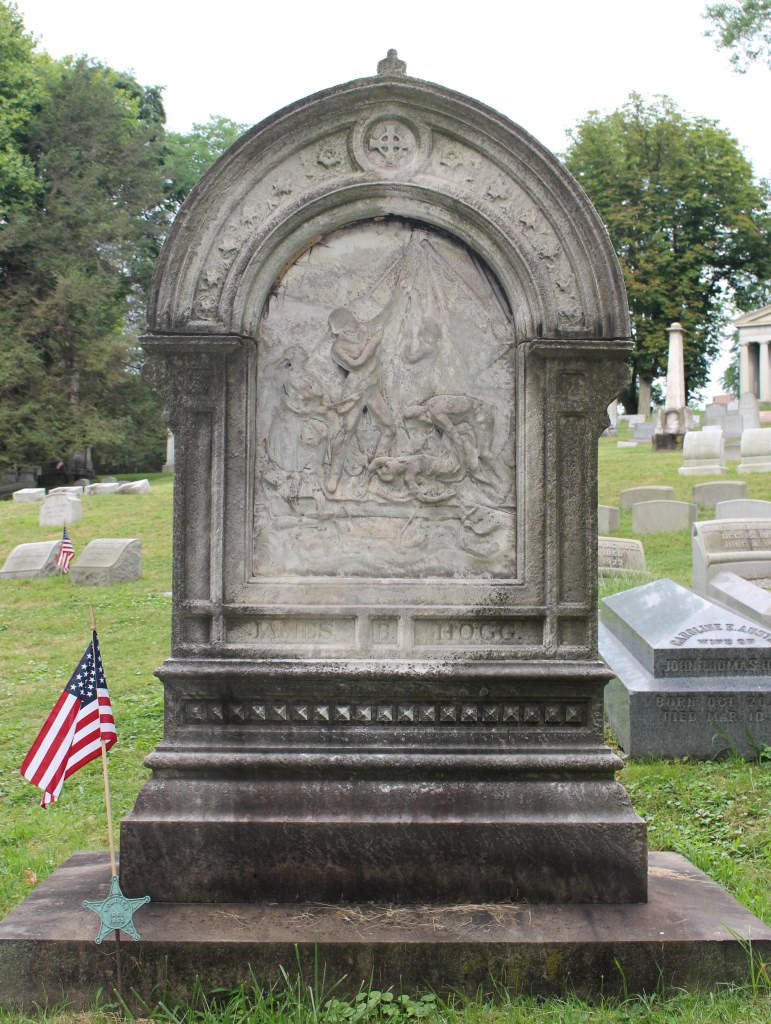
James Hogg, the son of George and Martha Hogg, drowned in the catastrophe. A marker was erected in the Allegheny Cemetery in Pittsburgh to commemorate his life, even though his body was never recovered. James Hogg’s marker is a cenotaph which originates from the Greek word kenotaphion. Kenos means empty and taphos translates to tomb–together they form “empty tomb.”
While the monument is badly eroded the sculpture still gives a glimpse into the confusion and drama that took place as the ship was taking on water. The Hogg’s commissioned Patrizio Piatti (1825—1888) to create the tombstone. Piatti was an Italian sculpture born in Lombardy, Italy, who immigrated to the United States in 1850, and plied his trade as a sculptor specializing in marble mantelpieces and cemetery monuments.


 Gravely Speaking