
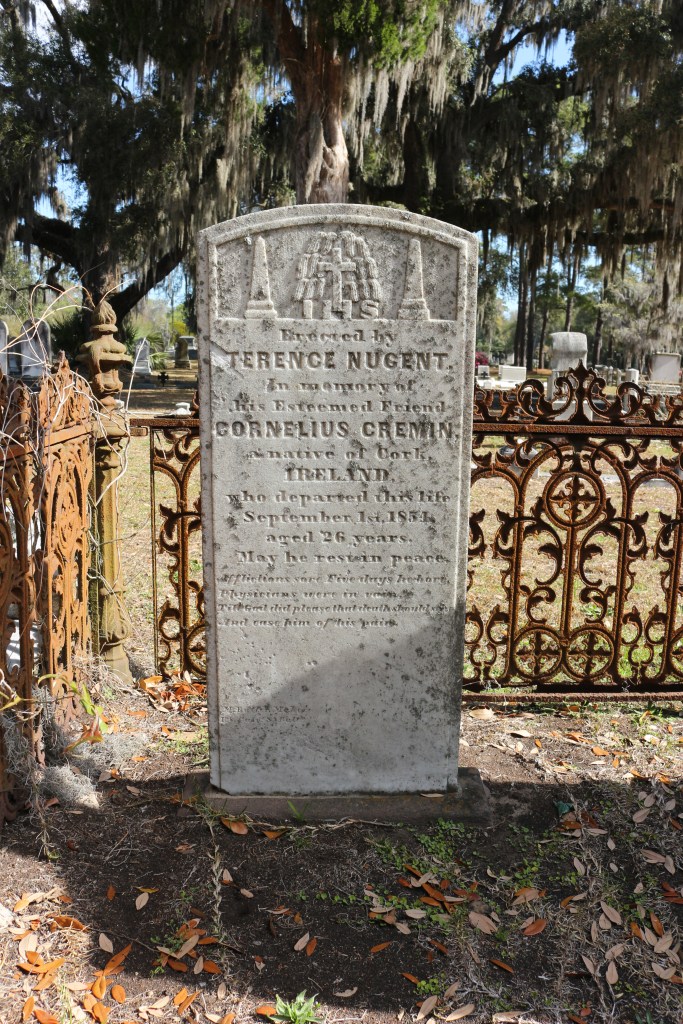
Erected by
TERENCE NUGENT
In Memory of
his Esteemed Friend
CORNELIUS CREMIN,
A native of Cork,
IRELAND,
Who departed this life
September 1st, 1854,
Aged 26 years,
May he rest in peace.
Afflictions sore he bore,
Physicians were in vain,
Till God did please that death should come [?]
And cease him of his pain
In the top third of the white marble segmented-top tablet in the Catholic Cemetery in Savannah, Georgia, is a Latin cross in the center of a weeping willow tree. The cross is nestled into the letter “H” and flanked by twin obelisks.
The initials “IHS” which have been used for centuries by Christians as a monogram, often referred to as a Christogram, for Jesus. The three letters are a Latinized version of the Greek letters ΙΗΣ (iota-eta-sigma), the first three letters of the name “Jesus” in Greek.
The obelisk is a stone shape that is ubiquitous in American cemeteries and part of the Egyptian Revival Period which was inspired by the French and then the British presence in Egypt in the late 18th and early 19th Centuries. The obelisk is said to represent a single ray of sunlight, petrified from sunlight into stone. It was thought that the Egyptian sun god Ra lived within the obelisks. These towering monuments were often placed flanking the entrance to temples. Here the obelisks are combined with the willow, which is a traditional symbol of morning and grief.

However, the Egyptian and Christian symbolism share an uncomfortable coexistence in this design. The obelisk is an easily recognized Egyptian symbol, yet, the tablet also displays the Latin cross. Because many Christians objected to Egyptian motifs and their non-Christian origins, designers softened the impact, by including Christian symbolism, as is the case here. Eventually the obelisk became a common site in American cemeteries large and small, urban and rural.


 Gravely Speaking
Savannah is one of my favorite cities! Thanks for this: the relief is nice and crisp, the inscription, too.