
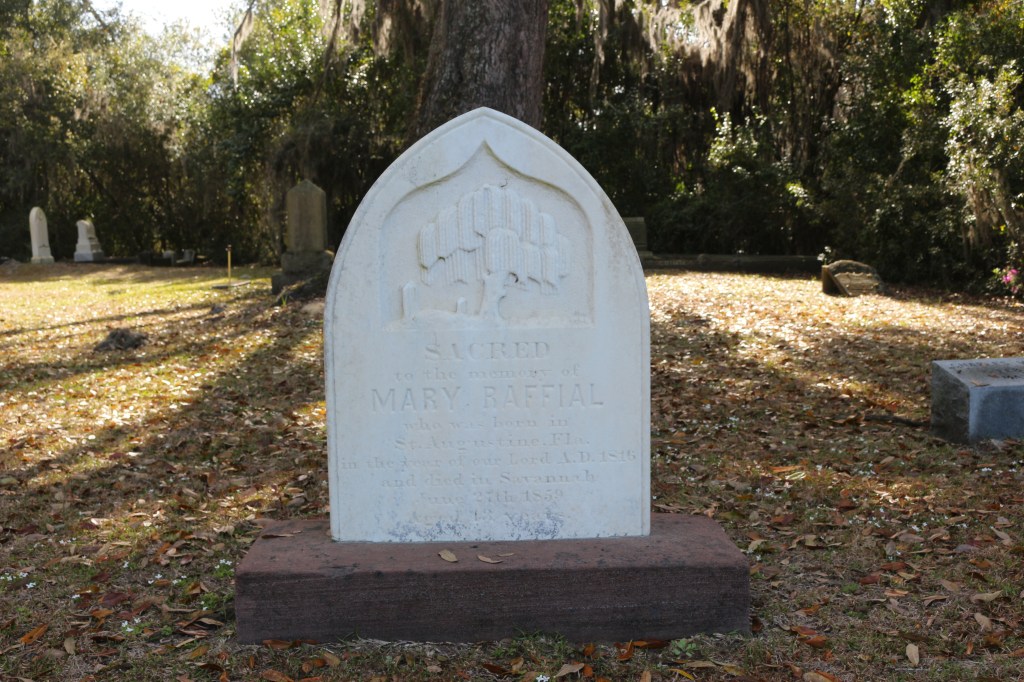
SACRED
To the memory of
MARY RAFFIAL
Who was born in
St. Augustine, Fla.
in the year of our Lord A.D. 1816
and died in Savannah
June 27th 1859
Aged 43 years
One of the most ubiquitous symbols found in American cemeteries is the weeping willow. According to James Deetz and Edwin S. Dethlefsen, in their groundbreaking article, “Death’s Head, Cherub, Urn and Willow” the willow first made its appearance in cemeteries in the early 18th century.
The motif represented a break from the stark and cold reminders that death would bring that the Puritans carved into their gravestones—flying death’s heads, skulls and crossbones, and gravedigger’s equipment. In addition to the grim reminders of the inevitability of death Puritan gravestones often accompanied the haunting imagery with blunt words such as, “Here lies the body.” Nothing subtle there.
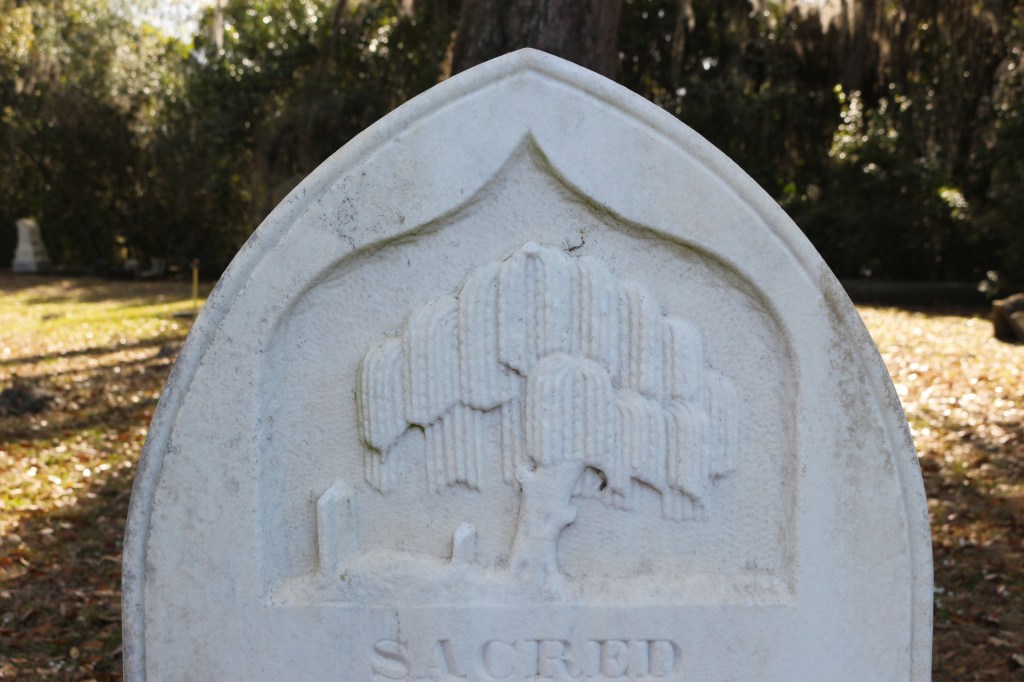
The willow, however, represented a more sentimental view of death. The willow as a symbol is sentimental and hints at the human emotions felt during grief. The willow motif represents what one might expect; sorrow and grief, it is after all a “weeping” willow. This symbol is found on many gravestones and can be found carved in a variety of styles. In this example, found in the Catholic Cemetery in Savannah, Georgia, the willow tree is shading the gravestone and footstone presumably of the deceased—the object of the grief.


 Gravely Speaking