
Gravely Speaking and Syngrammata have decided to dig deep into our photo collections in order to bring you pairs of images drawn from our many years combing through American cemeteries. Each pair will be linked by a theme which we are free to interpret. Suggestions of future themes to follow are welcome in the comments! This week’s theme is: the most impressive mausoleum.
Gravely Speaking writes:

The Belmont Mausoleum, in the Woodlawn Cemetery in the Bronx, is a near replica of the Chapel of Saint Hubert; the original is in Amboise, France, the final resting place of Leonardo da Vinci.
Alva Smith Vanderbilt Belmont (1853-1933) commissioned the architectural firm of Hunt and Hunt to build the tomb after the death of her second husband Oliver Hazard Perry Belmont (1858-1908) in 1908. The mausoleum was completed in 1913 and is a masterpiece of late-fifteenth-century French Gothic architecture.
The front façade displays two intricately carved sculptures. The lintel—or horizontal block above the door—features a sculpture depicting the legend of Saint Hubert from which the chapel is named. According to the legend, while hunting Hubert saw a stag with a crucifix between his anthers. After the vision, Hubert converted to Christianity. Because of his humane treatment of the animals he hunted, Saint Hubert became the patron saint of hunters. That was particularly fitting for a focal point for the Belmont Mausoleum because of the Belmont family’s association with horse racing—the Belmont Racetrack and the world-famous Belmont Stakes, the oldest prize in the Triple Crown.
The sculpture in the pointed arch above the door depicts a scene with King Charles VIII and his wife, Anne of Brittany, kneeling in deference to the Madonna and Child.
The chapel has many architectural features that were common to Gothic design: Gargoyles—The spouts that were designed to divert rainwater away from the building were often elaborately designed to look like grotesque animals and human forms known as gargoyles. These figures became popular in France during the Middle Ages, though they can be found in other countries during that time, as well. Hood molding—If you look above the scene of the stag, there is a three-sided molding, also known as a drip molding. Pinnacles—These ornamented structures are usually pointed and are found on the corners of the Saint Hubert Chapel. They are often found on the buttresses of Gothic buildings. Stepped buttresses—in the chapel, the stepped buttresses can be seen of the front of the building’s sides. These are a mass of masonry built against a wall to give the building additional support and strength. The buttresses on the chapel are stepped, meaning in this case, the buttress has a wider segment, then on top of that is a smaller one, and still one more smaller buttress on top of that. Topping the buttress is a gargoyle. Trefoil window—In the middle of the gable on the front of the chapel is a roundel, a small circular frame. Inside the roundel is a trefoil—three-lobed form—in this case, a window. Spire—the tall, oxidized copper structure tapering up from the roof is a steeple or a spire.
Syngrammata writes:
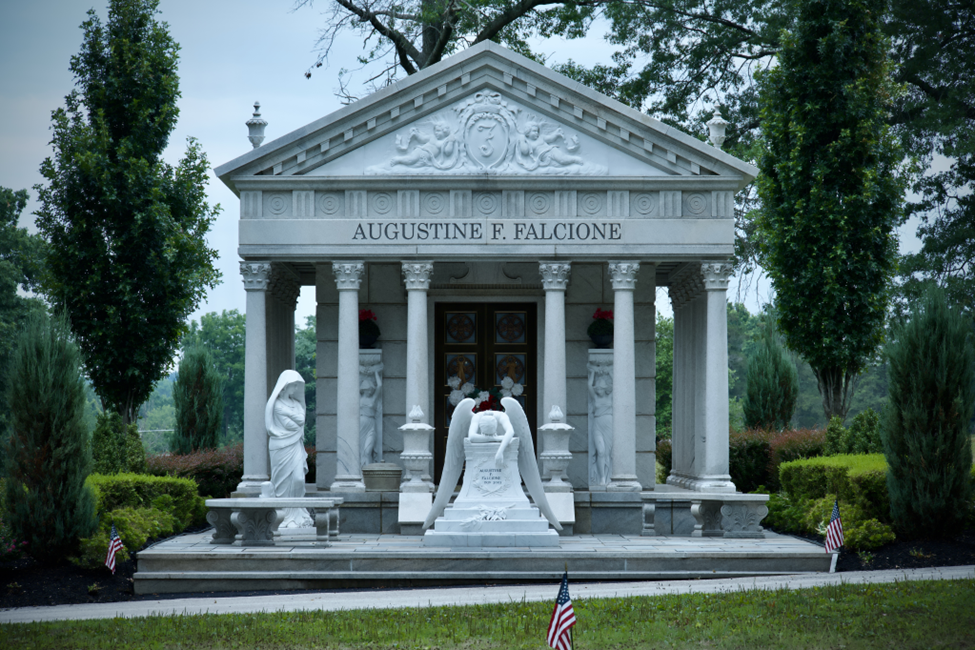
The Falcione mausoleum misappropriates Greek architecture in a dozen ways, but impresses nevertheless. One of the disappointments of my life is that the doors of the mausoleum are opaque, because I’m sure the interior is as stunning and lively as the exterior. Frankly, a preservation order should be slapped on this mausoleum: it’s that good.
I’m impressed by a rigorous commitment to symmetry which is even carried through the landscaping. The landscaper had real talent, playing effectively with the heights, shapes, colors, and brightness of the shrubs in order to create a dazzling frame for the structure. There must be a ‘perpetual care’ fund to keep everything so neatly trimmed.
A statue of the Madonna (?) on the left and a fine reproduction of William Wetmore Story’s 1894 Angel of Grief at center might be proxies for Falcione’s widow, who has humbly refused to place her name on the exterior of this complex so that it can be entirely about her beloved husband.


 Gravely Speaking