
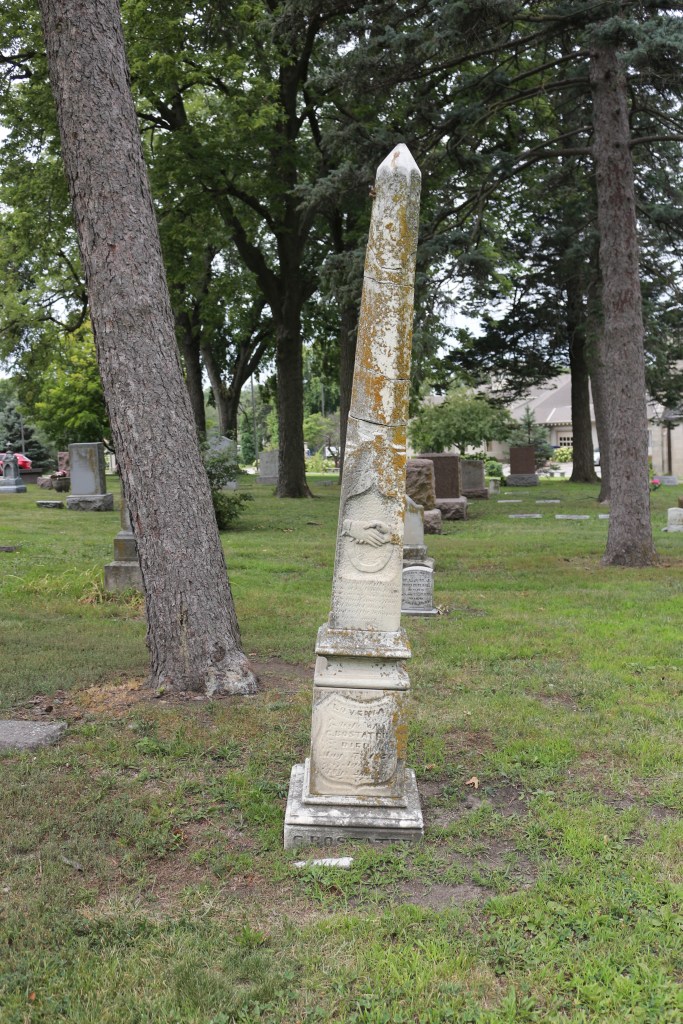
LOVINIA
wife of
G. BOSTATER
DIED
May 5, 1878 (?)
Aged
38Ys 2Ms & –Ds
Weep not for Her who
now at rest in her repose
and care no more annon
Her spirit smiles from
that bright shore
And softly whispers
weep no more.
The titled and eroded white marble gravestone of Lovinia Bostater in the Wyuka Cemetery in Lincoln, Nebraska, displays one of the most common Victorian motifs found in American cemeteries—clasping hands.
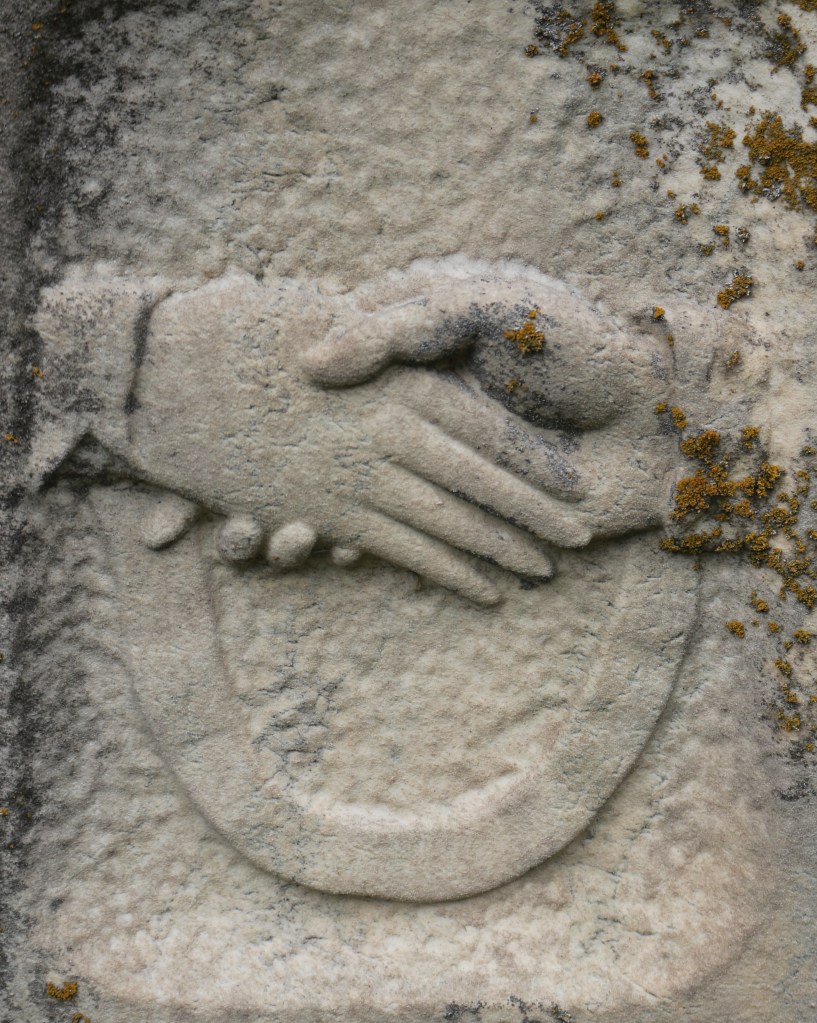
The symbol can take on many meanings and sometimes the cuffs on the wrists can give the viewer a clue and can indicate a particular meaning. If for instance, one cuff has lace and one is a buttoned shirt cuff, it likely represents the matrimonial bond—that link between a married couple. If the cuffs on both wrists are shirt cuffs, it can symbolize fraternal brotherhood—for members of the same organization or union—a brotherhood.
Some gravestones depict the hands descending through the clouds—the clouds symbolizing Heaven. This motif likely represents a final farewell or eternal bond between the living and the dead. The handshake may also represent God reaching down for the deceased to bring them into his presence as a welcome to Heaven—the Heavenly handshake.
In this case, the clasping hands most likely represent the marriage bond. In addition, to the symbolism of the clasping hands, there is a ribbon draped over each wrist. This may be a depiction of “handfasting”, an ancient Celtic ritual. In this ritual, the hands are tied together to symbolize the binding together of two lives, as in marriage.


 Gravely Speaking
Thanks for this: I can’t remember seeing the ribbon symbol for handfasting before: very interesting!
The stonecutter and the lichen make the poem very hard to read, but I plugged the first words into Google and got the poem _Consolation_ by Roswell Park. The carver (or whoever gave him his instructions for incising this stone) picked 4 of the 6 verses of the final stanza of the poem:
*Weep not for her, who now at rest
*Where care and pain no more annoy,
Has reach’d the haven of the blest,
And realized immortal joy.
*Her spirit smiles from that bright shore,
*And softly whispers ” Weep no more! ”
Once I know the words I can go back and say to myself, “oh, yah, now I see the letters on the stone!” But I’ll be honest and admit that while “annoy” must be carved into the stone, I see nothing more than “annou”.
What’s interesting is that by omitting verses 3 & 4 of _Consolation_ the carver omits, among other things, the verb “has reach’d” that follows “who.” You rightly saw this lack of a verb and estimated from the sloppy cutting of the ‘w’ of “now” that it must contain it: “now’s.” And you’re *right*, the end of the ‘w’ IS curly in a way that suggests an ‘s’.
Normally I despair over these marble inscriptions because weathering has rendered so many of them illegible, at least to my eyes.