
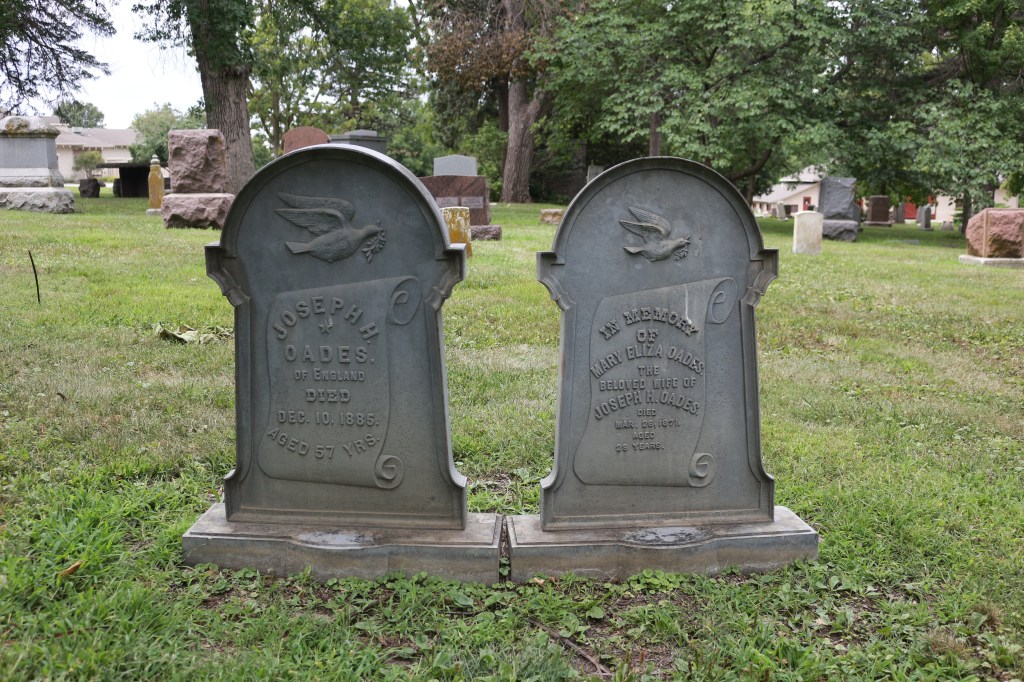
JOSEPH OADES
OF ENGLAND
DIED DEC. 10, 1885 AGED 57 YRS.
— —
IN MEMORY OF MARY ELIZA OADES
THE BELOVED WIFE OF JOSEPH OADES
DIED MAR. 26, 1871 AGED 29 YEARS
The Oades grave markers in the Wyuka Cemetery in Lincoln, Nebraska, were produced by the Western White Bronze Company of Des Moines, Iowa, a subsidiary of the Monumental Bronze Company of Bridgeport, Connecticut.
Though the company billed the markers as “white bronze” they were cast zinc. The zinc markers are often referred to as “Zincies” by cemetery aficionados. The markers are distinguishable by their bluish-gray tint. Many of the designs mimicked designs that were commonly found carved from stone. The Oades markers are designed to look like rounded-top tablets. The zinc markers were produced beginning in the 1870s until the company closed shop in 1912.
A scroll on the face of each of the markers contains the name and death dates of the Joseph and Mary Eliza Oades. The scroll represents both the life of the deceased, and the time spent on Earth.
Above the scroll is a dove. Several references in the Bible refer to the dove as a symbol of the Holy Spirit including Mark 1:10 the Bible says, “And Straightway coming up out of the water, he saw the heavens opened, and the Spirit like a dove descending upon him.” Again in John 1:32, the Bible reads, “And John bare record, saying, I saw the Spirit descending from heaven like a dove, and it abode upon him.” Along with the dove symbolizing the Holy Spirit, the dove is also closely associated with peace, often depicted with a olive in its beak. This, too, originated in the Bible. After the waters receded in the story of Noah, the dove appears. Genesis 8:11, “And the dove came in to him in the evening; and, lo, in her mouth was an olive leaf pluckt off; so Noah knew that the waters were abated from off the earth.” It was a sign of God’s forgiveness. Thus the dove symbolizes the Holy Spirit, peace, and purity.
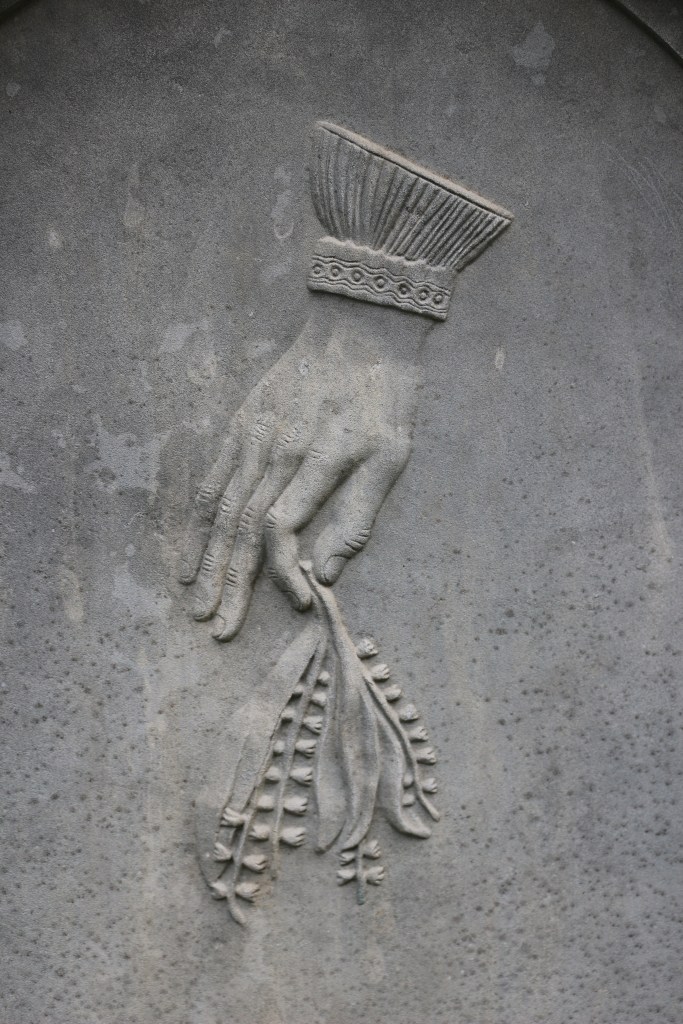
The back of the markers features a woman’s hand holding a lily of the valley sprig. The lily of the valley is much like other lilies in funerary art and viewed as a symbol of innocence and purity.
According to the booklet, Wyuka Cemetery: A driving & Walking Tour, page 70, written by Ed Zimmer, published in 2009 by the Wyuka Historical Foundation, “The Oades were born in England and immigrated to Lancaster County through Canada. Mary Eliza was only 29 years old when she died in 1871, just two years after the founding of Wyuka. Mr. Oades was suffering from “St. Vitus’s dance” a neurological disease that causes uncontrollable movements, when he took his own life at age 57 in 1885.”


 Gravely Speaking