
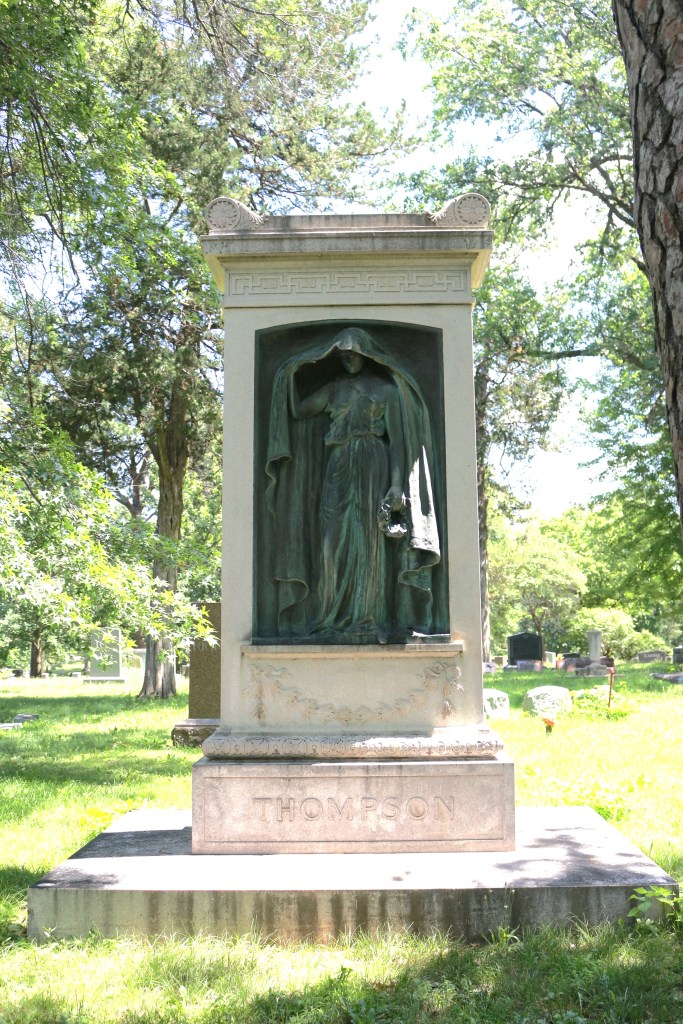
David E. Thompson
February 28, 1854
August 25, 1942
Jeanette M. Thompson
October 16, 1867
July 21, 1911
The Thompson monument in the Wyuka Cemetery in Lincoln, Nebraska, was commissioned by D. E. Thompson upon the death of his wife Jeanette Thompson. The Thompsons were a “power couple” in Lincoln in the 1890s and early 1900s. D. E. Thompson was a prominent businessman serving as superintendent of the Burlington Railroad west of the Missouri River and as the president of the local gas and insurance companies. Eventually his business acumen and connections led him into politics. According to Wyuka Cemetery: A Driving & Walking Tour by Ed Zimmer (2009), Thompson was appointed by President Theodore Roosevelt U. S. envoy to Brazil and later as ambassador to Mexico.

Thompson commissioned Fred L. Kimball, a noted Nebraska artist, to create the Thompson family monument. The sculpture was cast at the Jno Walters Foundry in New York. The monument is comprised of pink granite and has a life-size bronze relief sculpture in the center depicting a mourning figure lifting part of her garment over her head to form a veil. The veil represents the partition that exists between the Earthly realm and the Heavenly one–between life and death. In her other hand she is clutching a floral wreath. This is a common Victorian funerary symbol expressing the transitory nature of life. D. E. Thompson died in 1942 in Southern California. His remains were cremated and interred at the family plot.
The Thompson Monument is similar to a monument created for James Melvin who commissioned Daniel Chester French to design a memorial to his three fallen brothers. The monument is in the Sleepy Hollow Cemetery in Concord, Massachusetts. Daniel Chester French was arguably the most noted sculptor of his day, creating such monumental works as Minute Man at Concord, Massachusetts, the Marshall Field Memorial in Graceland Cemetery at Chicago, and his most famous work—the Seated Lincoln in the Lincoln Memorial at Washington, D.C.
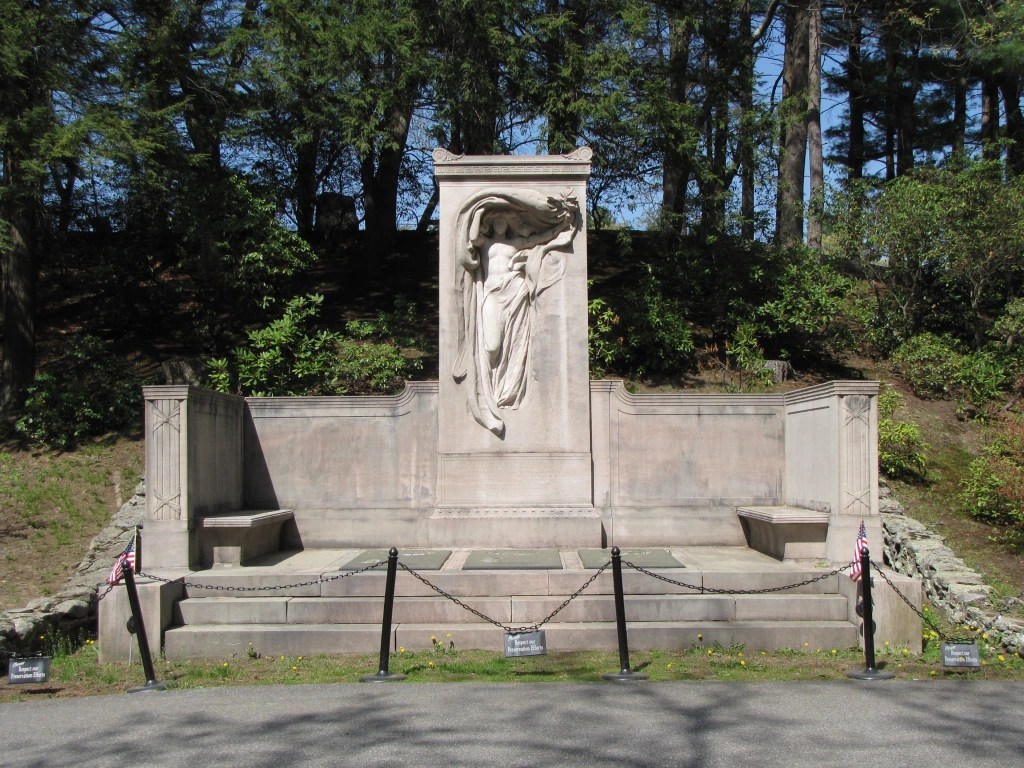
When James Melvin came back from the Civil War after serving in the 6th Massachusetts Infantry, he was not joined by his brothers, Asa, John, and Samuel. They had all served in the 1st Massachusetts Heavy Artillery unit which took heavy losses throughout the war. John was the first to perish—he, at a military hospital in Fort Albany, Virginia. Asa died on the battlefield during an assault on Petersburg, and Samuel, who had been captured, died at the infamous and reviled Andersonville prison.
French created the sculpture he titled, Mourning Victory, which features a woman as the allegorical figure of victory. Here again the mourning figure is lifting part of her garment over her head to form a veil. However, in French’s sculpture the mourning figure is holding a sprig of laurel in her other hand. The laurel wreath dates back to Roman times when soldiers wore them as triumphal signs of glory. The laurel was also believed to wash away the soldier’s guilt from injuring or killing any of his opponents. In funerary art the laurel wreath is often seen as a symbol of victory over death.
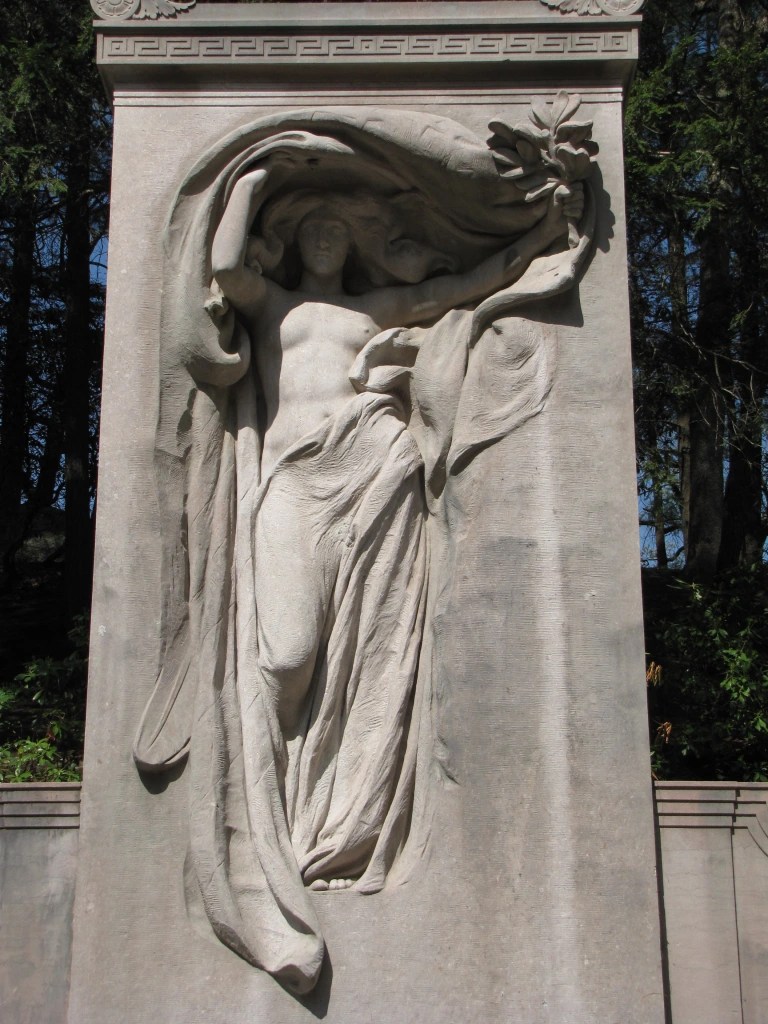
The Metropolitan Museum of Art in New York City, which has a replica of the statue in marble in their collection, describes the statue, “The massive figure of Mourning victory emerges from the block of stone projecting two moods: melancholy, in her downcast eyes and somber expression, and triumph, in the American flag and laurel she holds high. French captured the sense of calm after the storm of battle, which must have referred to the pride, after the sorrow of grieving, felt by the surviving brother.”
The similarities of the two monuments display common Victorian symbolism captured by each artist.


 Gravely Speaking
Thanks for this! It was waiting for me when I returned from a visit to Mt. Auburn this morning (business trip to Boston). There’s far too much in M.A. to do it justice in just a visit or two. When I was last in Omaha (2017, as I recall) my wife and I drove down to Nebraska City and we did the big cemeteries in Omaha but we didn’t have time for Lincoln. Next time I’ll do Wyuka for sure!
Did you go to the Wyuka Cemetery in Nebraska City and see the gravestone carved to look like a roll top desk? Also J. Morton sterling Morton’s tree-stump marker is there. It may be the tallest of that kind I’ve ever seen.
Yes, we went down to Nebraska City thanks to you, because I had read your essays on the monuments there.