
OLOF W. PALM
NOVEMBER 8, 1863
OCTOBER 28, 1939
CLARA LOUISA PALM
MARCH 29, 1861
SEPTEMBER 21, 1931
In 1928, the Georgia Marble Company of Tate, Georgia, produced a marketing piece in the form of a book titled, Memorials: To-Day for To-Morrow written by William Henry Deacy. The book was designed to showcase their memorial designs by highlighting them in the book with lush full-color watercolor illustrations of the various memorials. Along with the illustrations the book provided explanations of the symbolism found in the memorials. The book also coupled an architectural drawing of how the memorial is to be made.

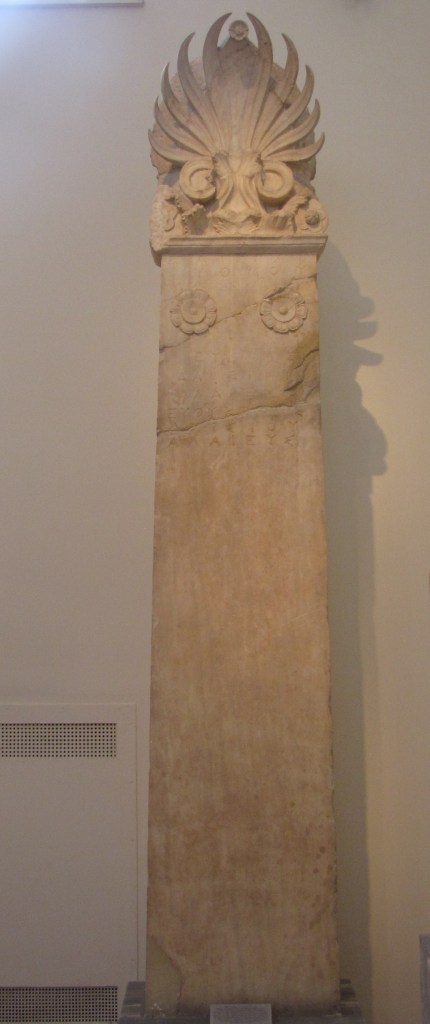
The stele, a stone or wooden slab generally taller than it is wide and designed as a funeral commemorative, dates back many centuries and is one of the oldest gravestone forms. Many examples of steles can be found in the National Archaeological Museum of Athens, Greece.
This example of a stele below was created for Daisios, son of Euthias on the east coast of Attica in Southern Greece. The stele dates to the middle of the 4th Century B.C. and has two rosettes on the shaft and is topped with an acroterion motif.
The example, however, found in the Wyuka Cemetery in Lincoln, Nebraska, marking the graves of Olof and Clara Palm varies. Though it has notable features of a traditional stele gravestone—the marker is taller than it is wide and the acroterion motif tops the marker—it is markedly different. Traditionally the face of the stone would be bare except for two rosettes. In this case, the Palms commissioned the Kimball Brothers to create the morning figure of a woman holding a rose, the symbol of romantic love. The figure was carved by noted Nebraska sculptor Fred L. Kimball.

The stele was an interesting choice for the Palms as the acroterion is a classical motif found in Roman and Greek architecture and has its origins in Egyptian art and architecture. The acroterion is a stylized palm leaf. Coincidence?


 Gravely Speaking
Pingback: 1928 memorial ideas to dress up the family plot so it can be fashionable too. Imagery from a promotional booklet put out by the Georgia Marble Company of Tate, Georgia entitled “Memorials: To-Day for To-Morrow.” It was written by William Henry
Thank you for the link to the Georgia Marble Company. I have written about a number of these gravestone types, i.e. the obelisk and the stele. I do not happen to be a funeral director. I am interested in gravestones from an artistic, architectural, and historical viewpoint. I have studied gravestones since 1977 and find that many people do not understand the symbolism found on gravestones and I started this blog as a way to explain some of it. Along the way, I have also written about many of the people buried in the graveyards and many of the carvers and sculptors who create the monuments.
Are you the lucky one who just bought a copy of the book on eBay? It looks beautiful! The Palm monument somehow escaped my attention when I was in Wyuka, alas. Thanks for this, bc the Palm monument is delightful.
I do not know which book on eBay you are referring to! Sorry you missed the Palm gravestone–it really is quite beautiful.
Oh! Sorry! I meant Deacy’s, referenced in your essay. You prompted me to look to see about a copy and I saw one had sold in June.
I wish I had purchased it–it would be a nice addition to my collection of cemetery books!
The watercolors in the Deacy book seem to me very beautiful.