
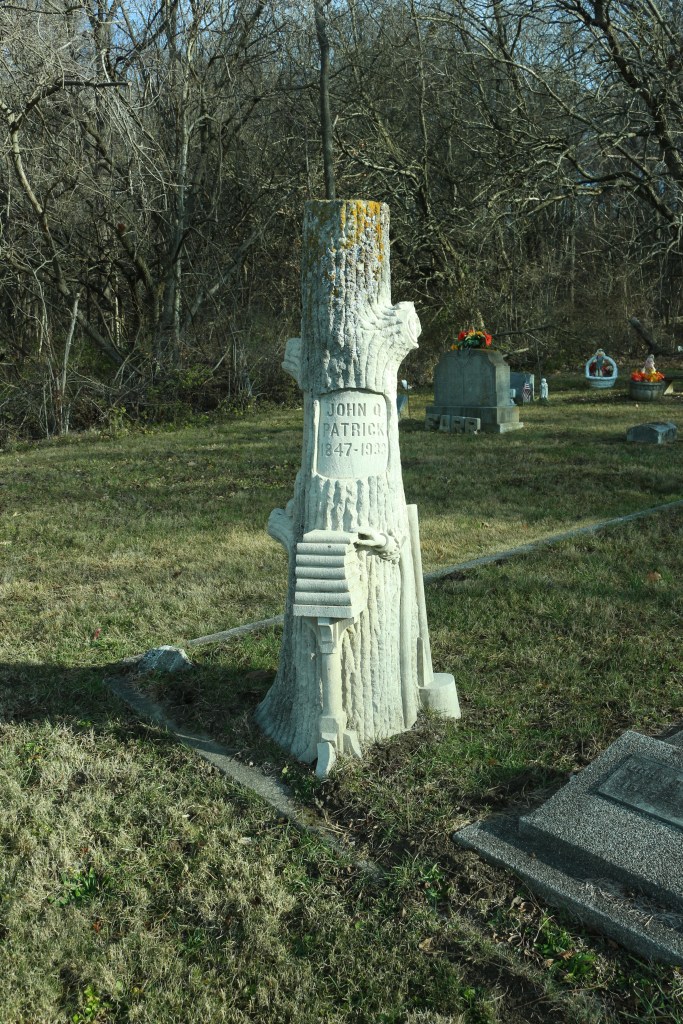
John Quincey Patrick
November 1847 – November 16, 1933
Highland Mary Franklin Patrick
May 15, 1856 – June 1, 1935
Tree stump tombstones were a part of the rustic movement of the mid-nineteenth century which was characterized by designs that were made to look like they were from the country. The gravestones were purposefully designed to look like trees that had been cut and left in the cemetery to mark a grave. Most of these tree-stump tombstones were carved from limestone, which is easier to carve.
The tree-stump tombstones were a funerary art contrivance mimicking the natural surroundings of the cemetery and were most popular for a twenty year-period from about 1885 until about 1905. The creativity of the carvers was boundless and often tailored to the interests of the deceased.
This tree stump tombstone in the Friendship Park Cemetery in Paragon, Indiana, created for the Patrick Family is a great example of the unique designs that the stone carvers used to display the individual tastes and interests of the persons they memorialized with their craft. This example depicts a stack of books resting atop a side table. From the tree reaches a hand reaching for the top book on the stack. As it turns out, a reading of Highland Mary Patrick’s obituary, indicates that Mrs. Patrick “was a well-read woman and took an intelligent delight in reading the best literature.” Her gravestone was a lasting tribute to her love of reading!

The tree-stump gravestones themselves were imbued with symbolism. The short tree stump usually marks the grave of a person who died young—a life that had been “cut” short. This tree-stump, however, is fairly tall—hardly a stump. The Patricks, John Quincey and Highland Mary, lived to be 86 and 79 respectively, both having lived long lives.


 Gravely Speaking
Love it!
Thank you for your comment. As a voracious reader and a book publisher myself, I found this gravestone to be one of my favorites!
So interesting! Thank you…
Bea Baird
Thank you for your comment. I find it interesting how a person’s interests are often displayed on their gravestone. This one was pretty obvious but confirmed by the obituary.
What a beautiful memorial to a well-read woman and what a lovely write up! I appreciate learning about the symbolism and art of cemeteries, something that’s always fascinated me. Thank you.
Thank you for your comment. A friend told me about this gravestone and I had to see it for myself.
Thank you for your comment. The limestone quarries in Indiana attracted some of the best stone carvers of their day. Their individual and unique designs can be found all over the state.
I can’t quite make out what the hand(s) are doing at the top. Is a female hand giving fruit to another hand? But in any event, thank you, as always for your work, and happy holiday!
I can’t tell what they are passing to each other either.
What is the carving above her name on the back of the stone?