
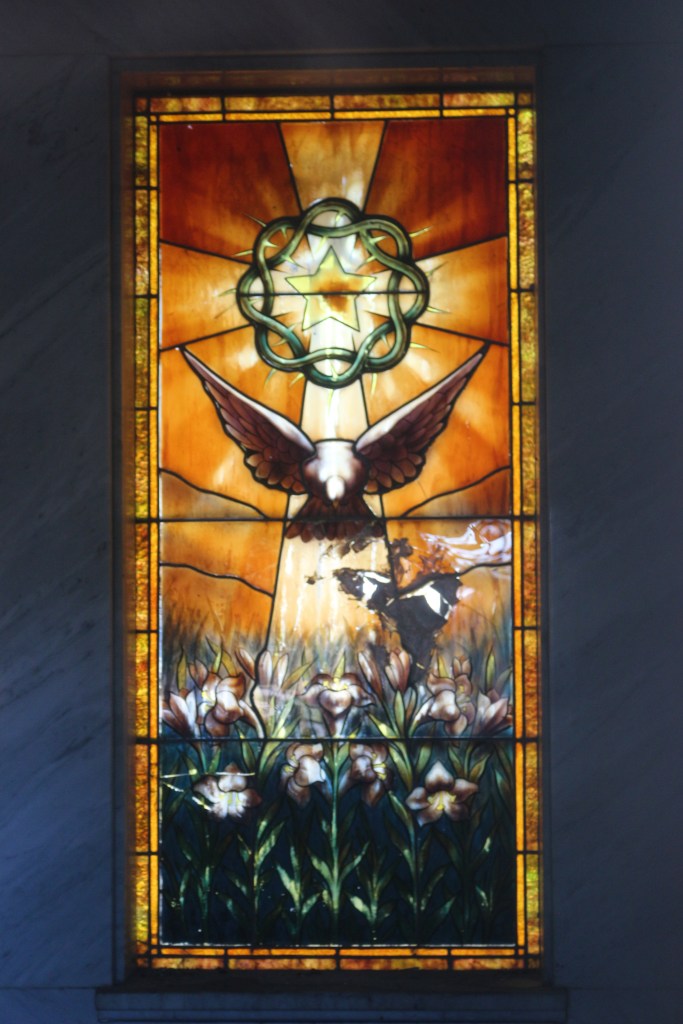
Often the inside of a mausoleum is the more impressive than the exterior with displaying sculptures and stained-glass windows that are not readily accessible to be viewed. Even though this window from a mausoleum in the Mount Holly, Little Rock, Arkansas, is broken, the brilliant colors and imagery convey what was likely the deep religious faith of the family entombed here.
The center of the top third of the window displays rays of amber light that form a cross—the universal symbol of Christianity. In the middle of that cross is a crown of thorns. The portrayal of crown of thorns as described in John, Chapter 19: Verse 1, where the Romans mock Christ: “Pilate therefore took Jesus, and scourged Him.” Verse 2, “And the soldiers platted a crown of thorns, and put it on his head, and they put on him a purple robe.” Verse 3, “And said, Hail, King of the Jews! and they smote Him with their hands.”
Inside the crown of thorns and in the center of the rays of light is a five-pointed star. Again, this imagery is about the Passion of Christ and His Suffering. The star likely represents the Five Holy Wounds of Christ–one wound in each hand, a wound in each foot, and one in his side where Jesus was pierced to check to make sure he was dead.
Just below is a dove. There are several references in the Bible that refer to the dove as a symbol of the Holy Spirit. Matthew 3:16 reads, “And Jesus, when he was baptized, went up straightway out of the water: and, lo, the heavens were opened unto him, and he saw the Spirit of God descending like a dove, and lighting upon him.” In Mark 1:10 the Bible says, “And Straightway coming up out of the water, he saw the heavens opened, and the Spirit like a dove descending upon him.” Again in John 1:32, the Bible reads, “And John bare record, saying, I saw the Spirit descending from heaven like a dove, and it abode upon him.”
Along with the dove symbolizing the Holy Spirit, the dove is also closely associated with peace, often depicted with a sprig of an olive in its beak. This, too, originated in the Bible. After the waters receded in the story of Noah, the dove appears. Genesis 8:11, “And the dove came in to him in the evening; and, lo, in her mouth was an olive leaf pluckt off; so Noah knew that the waters were abated from off the earth.” It was viewed as a sign of God’s forgiveness. The dove, with its white color, is also a symbol of purity and innocence and for that reason is often found the tombstones of children. Thus the dove symbolizes the Holy Spirit, peace, and purity.
At the base of the window is a display of Easter lilies. The lily, as a funerary symbol, has many meanings including purity, innocence, virginity, heavenly bliss, majestic beauty, and Christ’s resurrection. The Easter Lily has long been associated with the Christian religion, commonly referred to as “White-Robed Apostles of Christ.” Early Christians believed that lilies sprouted where Jesus Christ’s sweat and tears fell to the ground in the Garden of Gethsemane. Christians also believe that the trumpet-shaped blossoms announce the Resurrection of Jesus Christ.
As is often the case, symbols not only have a religious meaning but often share a secular one, as well. The color white has typically been a color associated with virtues of purity and innocence. So, just as the symbol of the white dove can be found on the grave of a child, so, too, can the white lily. The child being the epitome of purity and innocence. The white lily is also associated with virginity and marriage, in particular relationship to women. On one hand, the lily represents virginity and innocence, which is an appropriate symbol for a young unmarried woman. On the other hand, it is symbolic of majestic beauty and marriage, which makes it an appropriate symbol for all married women regardless of their age.


 Gravely Speaking