
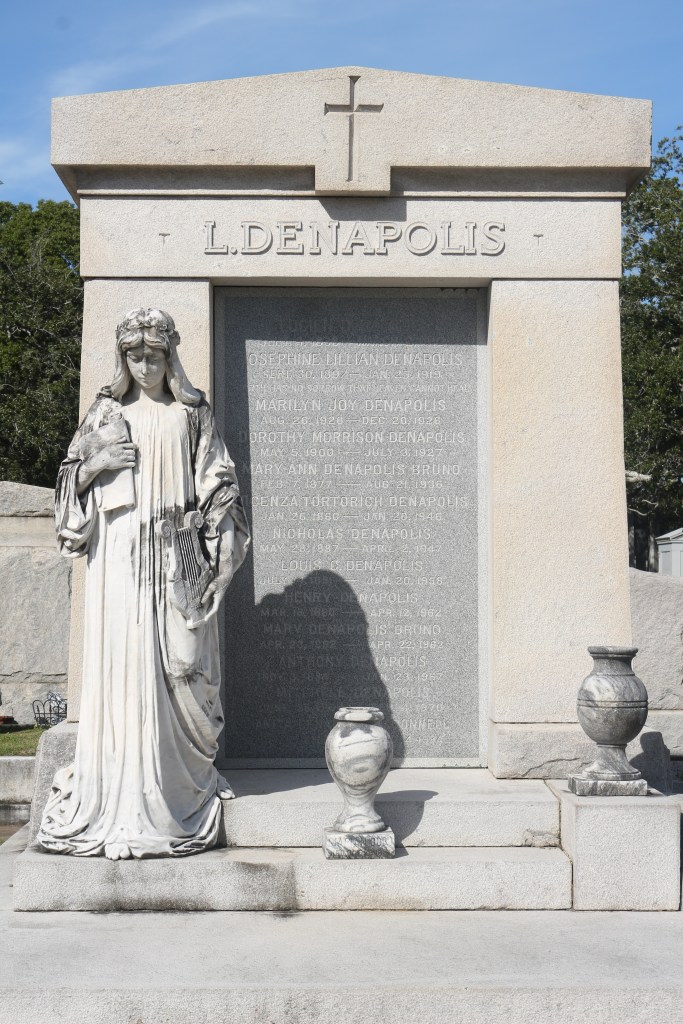
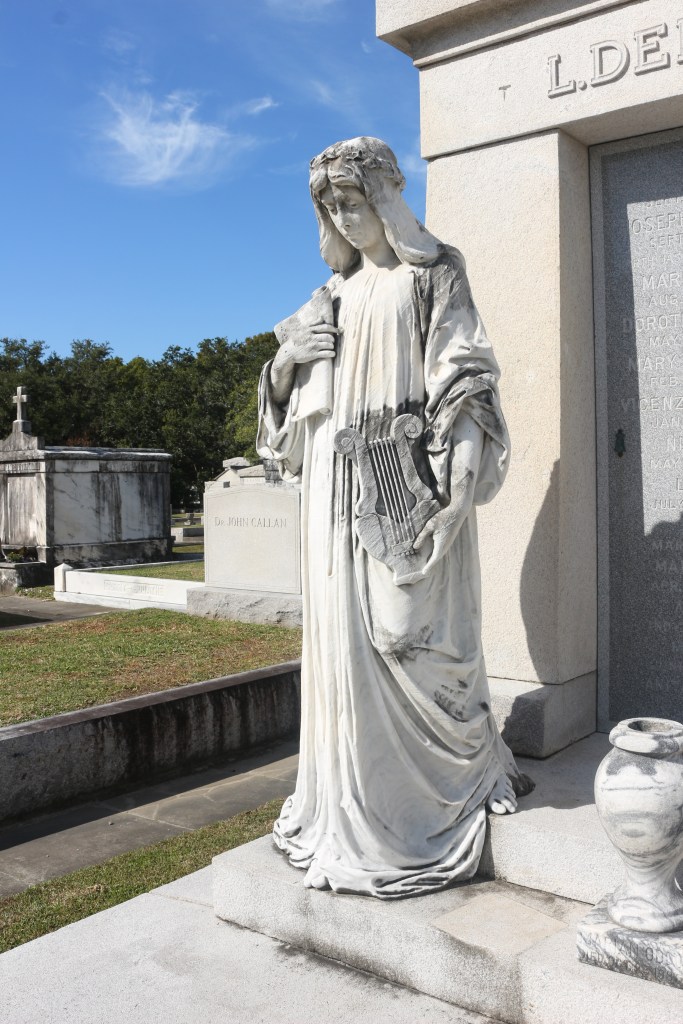
A white marble figure in classical robes stands in front of the Denapolis Family Tomb in the Metairie Cemetery in New Orleans, Louisiana. She is holding a scroll in one hand and a lyre in the other. Her head is slightly bowed as she walks down the step away from the door to the crypt. The figure’s lyre has five strings, though tradition has it that early lyres had four strings, some say indicating the four seasons.
In ancient mythology the lyre was seen as a symbol of Apollo, the Greek god of music and poetry. In Christian symbolism it can represent harmony and Heavenly accord and song in praise of the Lord. The lyre was seen as a source of divine music.
There is a Biblical reference to David, who was asked to play his lyre before the ailing King Saul. 1 Samuel 16:23: And whenever the evil spirit from God was upon Saul, David took the lyre and played it with his hand. So, Saul was refreshed and was well, and the evil spirit departed from him.
Sometimes the lyre is an indication that the deceased was Irish or a musician. The lyre is often depicted with a string broken representing the end of life. In funerary art, however, the lyre can also represent the end of life.


 Gravely Speaking